Abstracts of the 2024 Annual Meeting of the ALEH
More infoNo
Introduction and ObjectivesPrimary biliary cholangitis (PBC) is a chronic, progressive, autoimmune liver disease characterized by the destruction of the small bile ducts within the liver. Ursodeoxycholic acid (UDCA) is the first-line treatment for PBC, shown to improve liver biochemistry and delay disease progression. All biochemical criteria for response recommend a threshold of alkaline phosphatase (ALP) that is higher than the ULN, because those scores have shown a lower disease progression, liver related events and overall mortality. The impact of achieving normalization of ALP, compared to conventional biochemical scores is unknown, but it's relevance, particularly in countries without universal access to liver transplantation could be significant.
Patients / Materials and MethodsThis is a single center, retrospective, propensity score-matched cohort study, which included all patients with PBC and chronic liver disease, confirmed by liver biopsy that were followed by the hepatology clinic from January 1st, 2015 to March 1st 2024 under treatment with UDCA. All demographic, clinical and biochemical characteristics were obtained. A biochemical response was defined according to the Toronto criterion, with an ALP <1.67 x ULN after 2 years of UDCA therapy. Patients were subdivided into two groups, either by fulfilling these criteria or by achieving normalization of ALP <120 IU/L). The primary outcome was mortality due to a liver related event (LRE) a composite that included variceal hemorrhage (VH), spontaneous bacterial peritonitis (SBP), hepatic encephalopathy (HE), ascites, acute kidney injury (AKI), hepatorenal syndrome-AKI (HRS-AKI), and ACLF. the secondary outcomes were development of each independent variable of the definition of LRE.
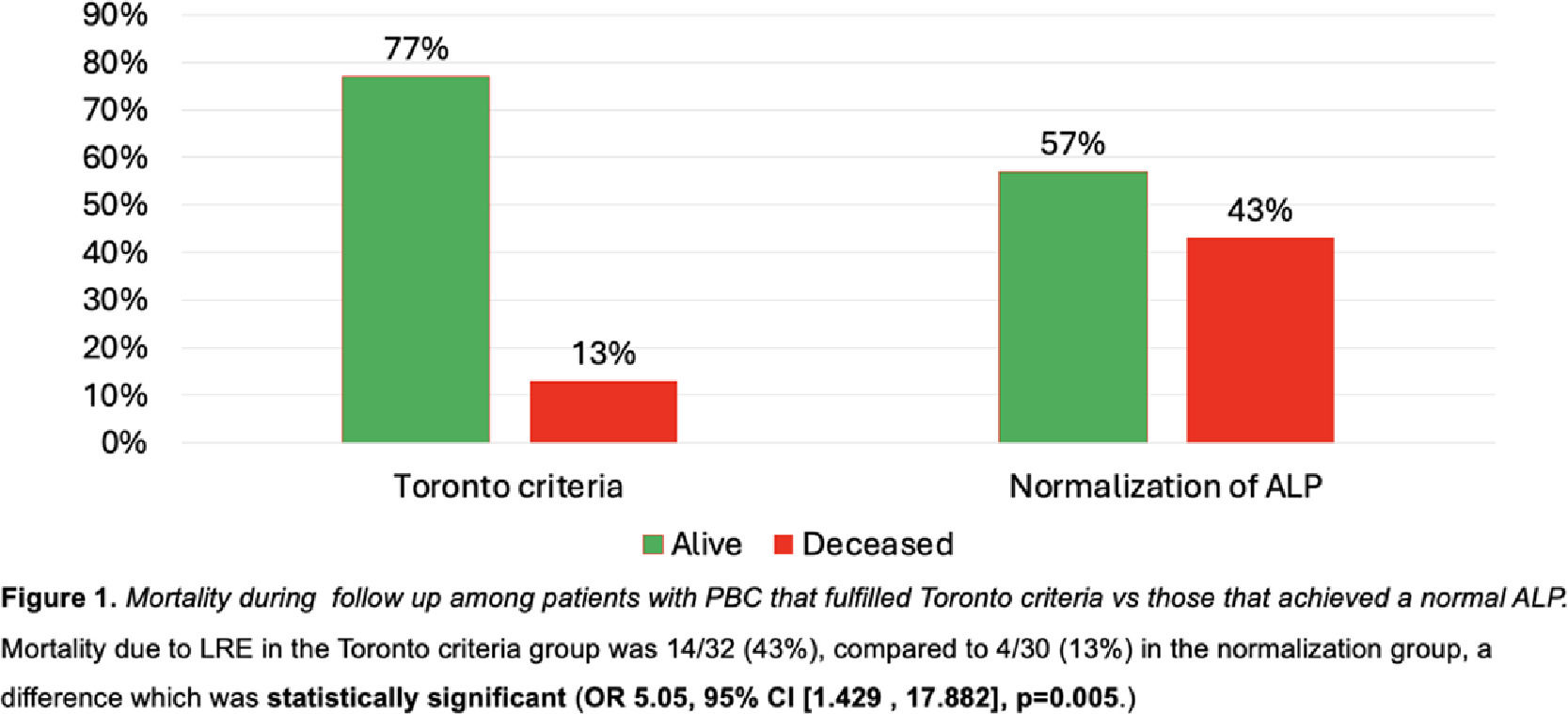
Results and DiscussionOut of a total pool of 132 patients, 32 fulfilled conventional Toronto criteria without achieving normalization of ALP, and 30 had a ALP level below 120 IU/L. The predominant gender was female in both groups (95% and 96%) with a median of 57 years for both groups. The prevalence of systemic autoimmune disease was similar between both groups, (55 and 57%, respectively). Mortality due to LRE in the Toronto criteria group was 14/32 (43%), compared to 4/30 (13%) in the normalization group, a difference which was statistically significant (OR 5.05, 95% CI [1.429, 17.882], p=0.005.). The development of HE (OR 5.47, 95% CI [1.075, 27.916], p=0.02) and VH (OR 4.71, 95% CI [1.165, 19.083], p=0.01), was greater in the Toronto criteria group, compared to the normalization group. These variables remained statistically significant after multivariate regression analysis (adjusted for age, gender and autoimmune systemic diseases).
No statistically significant differences were found for AKI, HRS-AKI, ACLF, ascites or SBP.
ConclusionsAmong patients with PBC that receive initial therapy with UDCA, a normalization of ALP after two years, compared to conventional biochemical response criteria (Toronto criteria), leads to lower liver related mortality and development of VH and EH. More prospective studies are needed.