Abstracts Asociación Mexicana de Hepatología (AMH) 2024
More infoLiver damage in preeclampsia is caused by antiangiogenic factors such as soluble tyrosine kinase, placental growth factor, and soluble endoglin. These induce endothelial injury and fibrin deposits in the hepatic microcirculation, thus modifying the physical characteristics of the liver parenchyma and its stiffness. This study aims to evaluate the correlation between the degree of liver stiffness and the severity of patients with preeclampsia.
Materials and PatientsAn observational, analytical, cross-sectional, and prospective study. Pregnant women from week 20 of gestation were included, and divided into 3 groups: normal pregnancy, pre-eclampsia, and pre-eclampsia with severity features; They were recruited from February 2023 to August 2023 in Mexico´s City General Hospital, Obstetrics department. Transient elastography was performed on all of them. Pregnant women with chronic systemic arterial hypertension and pre-existing liver diseases were excluded. Descriptive statistics measures of central tendency were performed, and univariate analysis was carried out considering kilopascals (kPa) as a dependent univariable and the group (without preeclampsia, preeclampsia, and preeclampsia with severity criteria) as fixed factors and BMI as a covariate.
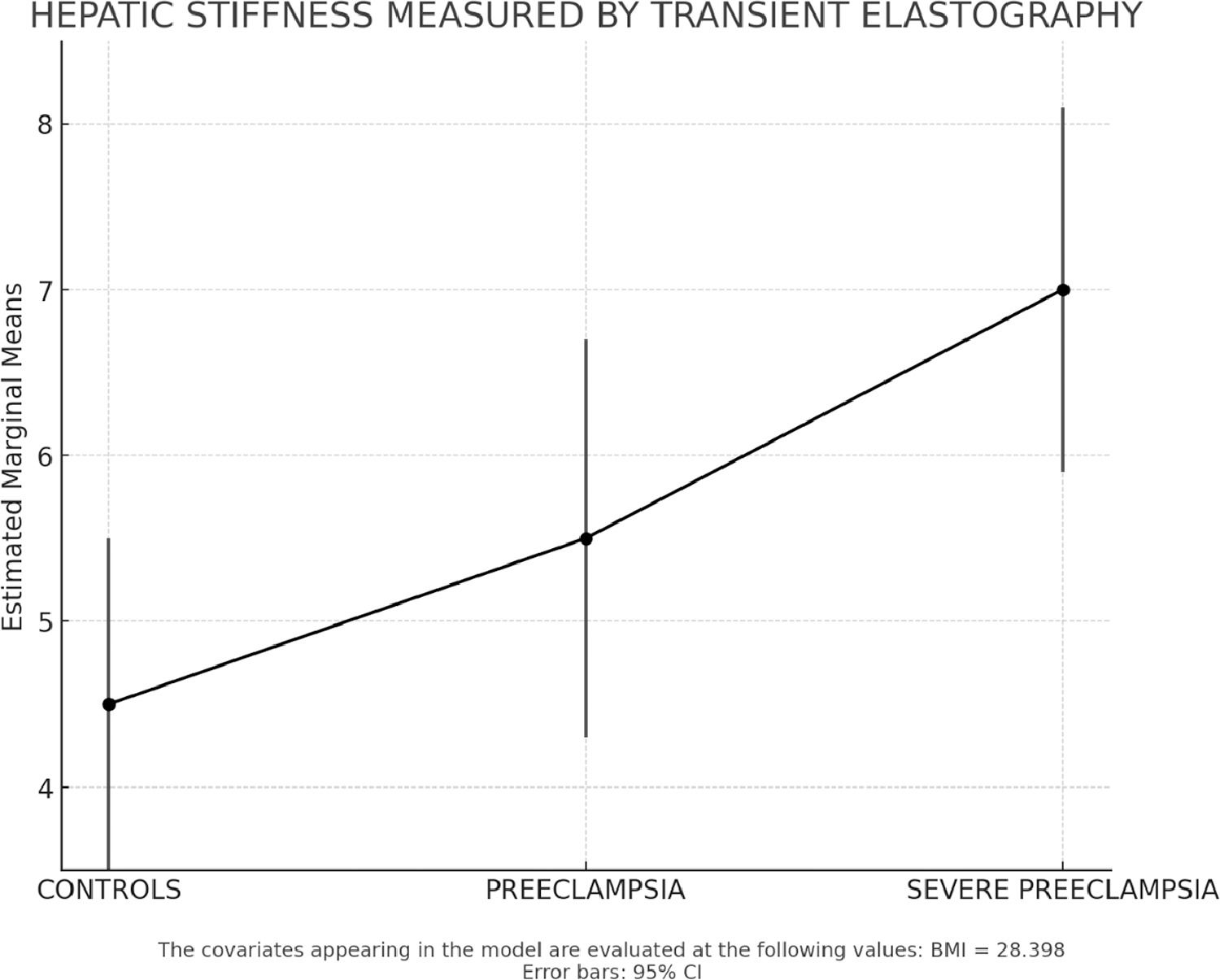
Results34 patients were included, 9 in the control group, 12 in the preeclampsia group and 13 in the preeclampsia with severity features group. The mean gestational age was 32 ± 5.8 weeks. The mean age was 27.26 ± 7.73 years. The mean BMI was 28.88 ± 4.83. The mean kPa in the control group was 4.35 ± 0.98, in the preeclampsia without severity features group 5.05 ± 0.87, and in the preeclampsia with severity features group 6.67 ± 1.84. The mean control group CAP was 202.82 ± 21.26 db/m2, in the preeclampsia without severity features group was 227.81 ± 47.81 db/m2, and in the preeclampsia with severity features group was 215.28 ± 37.41 db/m2. Univariate contrasts were significant for preeclampsia with severity criteria features versus preeclampsia F (2 of 23) = 7.679, p = 0.011. Preeclampsia with severity features versus control F (2 of 22) = 11.134, p = 0.003
ConclusionsLiver stiffness significantly increases in patients with preeclampsia and preeclampsia with severity features measured by transient elastography. This increase is due to intrahepatic fibrin deposition, but not by fibrosis (collagen) itself. Transient elastography could be useful as a predictor of severity in patients with preeclampsia.
Ethical statement: Study approved by the research ethics committee of the General Hospital of Mexico registration key DI/23/310-E/03/37.
Declaration of interests: None.
Funding: This research did not receive any specific grant from funding agencies in the public, commercial, or not-for-profit sectors.