

metricas
Spanish Journal of Psychiatry and Mental Health Clinical management recommendations for adults with attention-deficit/hyperactiv...
Journal Information
Visits
2132
Original
Full text access
Available online 29 January 2026

Clinical management recommendations for adults with attention-deficit/hyperactivity disorder

Visits
2132
Josep Antoni Ramos-Quirogaa,b,c,d,
Corresponding author
antoni.ramos@vallhebron.cat

Corresponding author.
, Elena Benítez Cerezoe,1, María del Juncal Sevillaf,1, José Martínez-Ragag,1, Javier Quinteroh,i,1
a Department of Mental Health, Hospital Universitari Vall d’Hebron, Barcelona, Catalonia, Spain
b Psychiatry, Mental Health and Addictions Research Group, Vall d’Hebron Research Institute (VHIR), Barcelona, Catalonia, Spain
c Biomedical Network Research Centre on Mental Health (CIBERSAM), Barcelona, Catalonia, Spain
d Department of Psychiatry and Forensic Medicine, Universitat Autònoma de Barcelona, Barcelona, Catalonia, Spain
e Private Practice, Elche, Alicante, Spain
f Clínica DRAJUNCAL®, Spain
g Department of Psychiatry, Hospital Universitario Dr. Peset and University of Valencia, Valencia, Spain
h Department of Psychiatry, University Hospital Infanta Leonor, Madrid, Spain
i Department of Legal Medicine, Psychiatry and Pathology, Universidad Complutense de Madrid, Spain
Ver más
This item has received
Article information
Abstract
Full Text
Bibliography
Download PDF
Statistics
Figures (1)
fig0005
Tables (2)
Table 1. Statements approved by the expert panel (those approved in the second round are shown in bold).
Tables
Table 2. Recommendations not reaching consensus among the expert panel.
Tables
Additional material (1)
Abstract
Introduction

Attention-deficit/hyperactivity disorder (ADHD) is a common, complex, multifactorial neurodevelopmental disorder. In this study, conducted by experts in the management of ADHD in adults, a set of recommendations have been developed based on a review of the available evidence, with the aim of improving the clinical care of these patients.

Materials and methods

This study was conducted in full compliance with the consensus methodology developed by the RAND Corporation/University of California Los Angeles (RAND/UCLA). The 29 proposed statements were evaluated using a 2-round iterative Delphi process. Of the 18 invited panellists, 15 completed both rounds (83.3% response rate).

Results

After 2 rounds of voting, the expert panel reached consensus, either in agreement or disagreement, on 93.1% of the statements (a total of 27 of the 29 proposed). These included proposals on important topics in the management of ADHD in adults, such as barriers to detection and diagnosis, unmet treatment needs, treatment objectives, the treat-to-target approach, and response and remission criteria.

Conclusions

This study has sought to reinforce the importance of a structured and multidisciplinary approach in the management of ADHD in adulthood, focused on the patient and their needs. The recommendations presented here aim not only to mitigate the adverse outcomes associated with untreated ADHD, but also to facilitate a substantial improvement in the quality of life of individuals living with this disorder.

Keywords:
Attention deficit hyperactivity disorder
Adult
Delphi technique
Consensus
Clinical management
Multidisciplinary approach
Full Text
Introduction

Attention-deficit/hyperactivity disorder (ADHD) is a common, complex, multifactorial neurodevelopmental disorder.1 Clinically, it presents with considerable heterogeneity due to the broad range of symptoms that may lead to its diagnosis, further complicated by the high comorbidity associated with diagnosis, treatment and progression.2 Although the global prevalence of ADHD in adults is around 3%,3,4 only 0.2%–0.4% of the adult population in Spain are prescribed pharmacological treatment with drugs specifically targeting ADHD.3

Recent findings indicate that ADHD adversely affects the adult patient's social, academic, work and family life, including their quality of life (QoL).5 If untreated, this disorder is associated with lifelong adverse effects on psychosocial functioning, including lower educational attainment, antisocial behaviour and/or legal problems, difficulties in relationships, lower socioeconomic status,6 and employment issues. Moreover, these individuals have a higher risk of road traffic and other accidents,7 a greater likelihood of physical health problems and psychiatric comorbidities, increased risk of suicide (especially in cases of comorbidity with other mental health disorders and substance use disorders) and premature death (especially from external causes),8 and low self-esteem.9 Similarly, up to 40% of the prison population10 and 17%–22% of patients on psychiatric therapy for other conditions exhibit ADHD.11 Effective treatment of this disorder may help prevent these adverse outcomes.12

Poor awareness of the serious clinical repercussions associated with ADHD or inadequate clinical training in both primary care (PC) and the specialized setting mean that this condition often goes unrecognized.13 Former studies on the pharmacological treatment of ADHD in adults clearly indicate that it is undertreated in our setting,3 while it is common for people diagnosed with ADHD to perceive discrimination in health care services during assessment. These attitudes are the result of the stigma surrounding the diagnosis of ADHD.14

A number of barriers to the management of ADHD have been identified, including late diagnosis or misdiagnosis, limited access to available care, systemic inequalities in marginalized communities, and a lack of education among the medical community about the persistent nature of ADHD into adulthood.15,16 Some questions regarding the prescription of treatments by health care professionals have also been raised.17 Furthermore, other issues, including those related to response and remission criteria, treatment objectives and the treat-to-target approach generate controversy among professionals involved in managing this disorder.

In this study, conducted by experts on the management of ADHD in adults from the Spanish Society of Psychiatry and Mental Health Working Group on Lifelong Neurodevelopmental Disorders, a set of recommendations has been developed based on a review of the available evidence, with the aim of improving the clinical care of adults with ADHD.

Materials and methods

We conducted this study following the consensus methodology developed by the RAND Corporation/University of California Los Angeles (RAND/UCLA).18 The Recommendation Development Group (RDG) included five clinical psychiatrists with extensive experience in the diagnosis and treatment of adults with ADHD. The first meeting, held in January 2024, defined the underlying concepts of the proposed consensus., so an initial set of five conceptual areas was proposed based on clinical relevance and gaps observed in daily practice. A non-systematic but structured literature search was then performed in the PubMed databases, using primary search terms such as “ADHD in adults”, “treatment”, “comorbidity”, “transition”, or “remission criteria”. Articles on adults (≥18 years) with ADHD were reviewed, prioritizing articles, studies, clinical trials, observational studies, reviews, and systematic reviews. Preclinical studies were not considered. Current clinical practice guidelines were also taken into consideration.19–21 The search was limited to literature in English or Spanish published in the last 5 years (search completed on April 8th, 2024). The RDG could add studies they considered relevant and subsequently performed a critical reading of the publications to identify current gaps in clinical guidance and use it to support the development of the statements. The group then formulated the 29 statements relating to the previously defined concepts, which were validated through several rounds of revisions and submitted to a vote by the panellists. Panellists were selected by the RDG based on a minimum of 10 years of clinical experience in the diagnosis and treatment of adult ADHD; several also had relevant peer-reviewed publications.

The 29 proposed statements were evaluated using a 2-round iterative Delphi process according to a 9-point Likert scale (1: strongly disagree; 9: strongly agree) using an online questionnaire that ensured anonymity and confidentiality. The RAND/UCLA methodology was used for analysis of the consensus in Delphi panels.18 Each questionnaire item was classified according to the level of agreement and the median score of the panel as “appropriate” (median in the 7–9 range), “uncertain” (median in the 4–6 range or any median in disagreement) or “inappropriate” (median in the 1–3 range). Agreement was reached if at least one-third of the sample responded within the same score range as the median. Disagreement was considered to occur if the median score was at either of the two extremes and more than one-third of the sample responded at the opposite extreme range, or if the median was in the central range and at least one-third of the sample responded in 1 of the other 2 ranges. If the assessment of the statement did not meet any of the previous criteria, it was considered neutral. Of the 18 panellists invited, 15 completed both rounds (83.3% response rate) (a detailed description of professional activity can be found in the supplementary data). In both Delphi rounds, panellists were invited to provide optional free-text comments, which were reviewed by the RDG to refine the discussion, and in the second round, they were free to maintain or modify their scores based on the group's feedback and measures of central tendency.

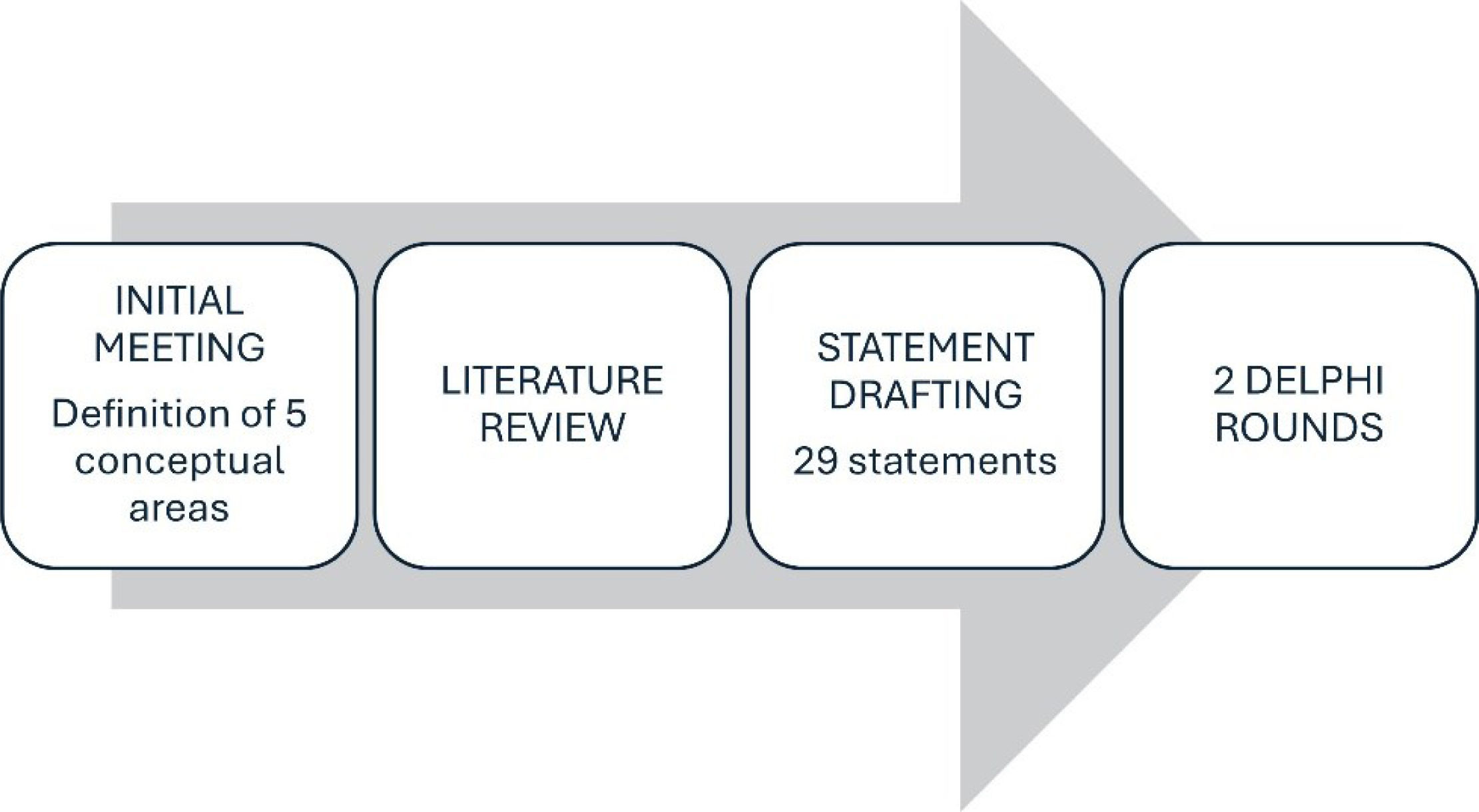
An overview of the consensus methodology, including the initial meeting, literature review, and subsequent steps, is shown in Fig. 1.

Fig. 1.

Methodological flow of the consensus development process.

Results

After the two rounds of voting, the expert panel reached consensus, either in agreement or disagreement, on 93.1% of the statements (a total of 27 of the 29 proposed). The rationale for each point raised and the results obtained are explained below and summarized in the respective tables.

Barriers to detection and diagnosis

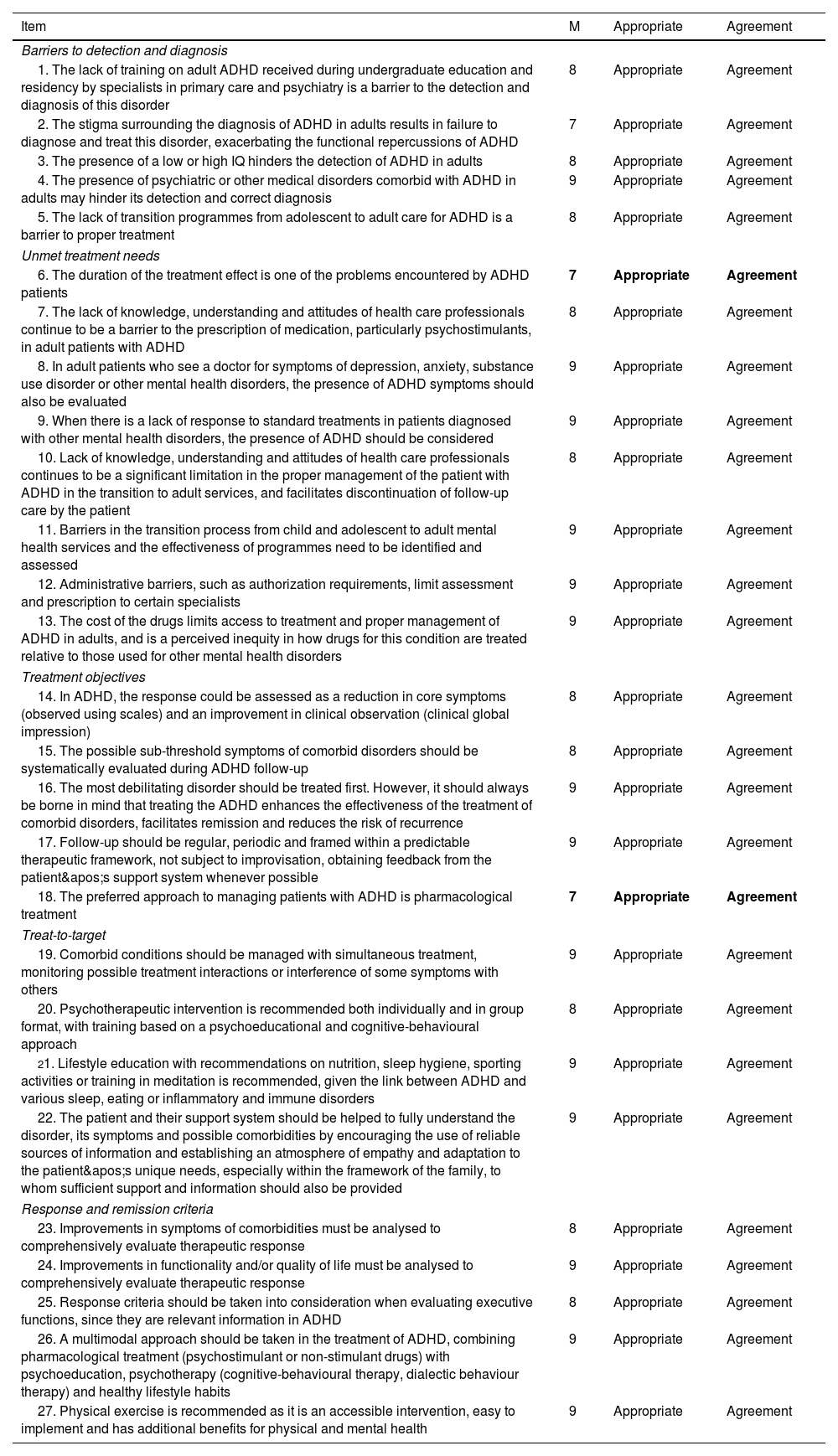
The main barriers to the detection and diagnosis of ADHD in adults include inadequate education for professionals during their academic training; the stigma associated with diagnosis; difficulty in identifying the disorder in people with extreme IQs; the presence of psychiatric or medical comorbidities; and the absence of programmes that ensure a smooth transition of treatment from adolescence to adulthood (recommendations 1–5, Table 1).

Table 1.

Statements approved by the expert panel (those approved in the second round are shown in bold).

Item  Appropriate  Agreement 
Barriers to detection and diagnosis
1. The lack of training on adult ADHD received during undergraduate education and residency by specialists in primary care and psychiatry is a barrier to the detection and diagnosis of this disorder  Appropriate  Agreement 
2. The stigma surrounding the diagnosis of ADHD in adults results in failure to diagnose and treat this disorder, exacerbating the functional repercussions of ADHD  Appropriate  Agreement 
3. The presence of a low or high IQ hinders the detection of ADHD in adults  Appropriate  Agreement 
4. The presence of psychiatric or other medical disorders comorbid with ADHD in adults may hinder its detection and correct diagnosis  Appropriate  Agreement 
5. The lack of transition programmes from adolescent to adult care for ADHD is a barrier to proper treatment  Appropriate  Agreement 
Unmet treatment needs
6. The duration of the treatment effect is one of the problems encountered by ADHD patients  7  Appropriate  Agreement 
7. The lack of knowledge, understanding and attitudes of health care professionals continue to be a barrier to the prescription of medication, particularly psychostimulants, in adult patients with ADHD  Appropriate  Agreement 
8. In adult patients who see a doctor for symptoms of depression, anxiety, substance use disorder or other mental health disorders, the presence of ADHD symptoms should also be evaluated  Appropriate  Agreement 
9. When there is a lack of response to standard treatments in patients diagnosed with other mental health disorders, the presence of ADHD should be considered  Appropriate  Agreement 
10. Lack of knowledge, understanding and attitudes of health care professionals continues to be a significant limitation in the proper management of the patient with ADHD in the transition to adult services, and facilitates discontinuation of follow-up care by the patient  Appropriate  Agreement 
11. Barriers in the transition process from child and adolescent to adult mental health services and the effectiveness of programmes need to be identified and assessed  Appropriate  Agreement 
12. Administrative barriers, such as authorization requirements, limit assessment and prescription to certain specialists  Appropriate  Agreement 
13. The cost of the drugs limits access to treatment and proper management of ADHD in adults, and is a perceived inequity in how drugs for this condition are treated relative to those used for other mental health disorders  Appropriate  Agreement 
Treatment objectives
14. In ADHD, the response could be assessed as a reduction in core symptoms (observed using scales) and an improvement in clinical observation (clinical global impression)  Appropriate  Agreement 
15. The possible sub-threshold symptoms of comorbid disorders should be systematically evaluated during ADHD follow-up  Appropriate  Agreement 
16. The most debilitating disorder should be treated first. However, it should always be borne in mind that treating the ADHD enhances the effectiveness of the treatment of comorbid disorders, facilitates remission and reduces the risk of recurrence  Appropriate  Agreement 
17. Follow-up should be regular, periodic and framed within a predictable therapeutic framework, not subject to improvisation, obtaining feedback from the patient's support system whenever possible  Appropriate  Agreement 
18. The preferred approach to managing patients with ADHD is pharmacological treatment  7  Appropriate  Agreement 
Treat-to-target
19. Comorbid conditions should be managed with simultaneous treatment, monitoring possible treatment interactions or interference of some symptoms with others  Appropriate  Agreement 
20. Psychotherapeutic intervention is recommended both individually and in group format, with training based on a psychoeducational and cognitive-behavioural approach  Appropriate  Agreement 
21. Lifestyle education with recommendations on nutrition, sleep hygiene, sporting activities or training in meditation is recommended, given the link between ADHD and various sleep, eating or inflammatory and immune disorders  Appropriate  Agreement 
22. The patient and their support system should be helped to fully understand the disorder, its symptoms and possible comorbidities by encouraging the use of reliable sources of information and establishing an atmosphere of empathy and adaptation to the patient's unique needs, especially within the framework of the family, to whom sufficient support and information should also be provided  Appropriate  Agreement 
Response and remission criteria
23. Improvements in symptoms of comorbidities must be analysed to comprehensively evaluate therapeutic response  Appropriate  Agreement 
24. Improvements in functionality and/or quality of life must be analysed to comprehensively evaluate therapeutic response  Appropriate  Agreement 
25. Response criteria should be taken into consideration when evaluating executive functions, since they are relevant information in ADHD  Appropriate  Agreement 
26. A multimodal approach should be taken in the treatment of ADHD, combining pharmacological treatment (psychostimulant or non-stimulant drugs) with psychoeducation, psychotherapy (cognitive-behavioural therapy, dialectic behaviour therapy) and healthy lifestyle habits  Appropriate  Agreement 
27. Physical exercise is recommended as it is an accessible intervention, easy to implement and has additional benefits for physical and mental health  Appropriate  Agreement 

M, median; ADHD, attention-deficit/hyperactivity disorder.

Unmet treatment needs

The main barriers identified in the treatment of ADHD in adults include problems related to the duration of the treatment effect; lack of knowledge and restrictive attitudes of health care professionals, especially towards psychostimulants; and administrative and economic barriers that hinder access to treatment. ADHD symptoms should also be evaluated in adults with comorbid conditions, especially if they fail to respond to standard treatments. The lack of effective transition programmes from child to adult mental health services contributes to the discontinuation of follow-up care. The need to assess the response to treatment using symptom scales and global clinical improvement was also recommended (recommendations 6–14, Table 1).

Treatment objectives

Treatment of ADHD should include systematic evaluation of sub-threshold symptoms of comorbidities during follow-up. The most debilitating disorder should be treated first, keeping in mind that treating the ADHD effectively improves the treatment of comorbidities, facilitates their remission, and reduces the risk of recurrence. Furthermore, follow-up should be regular, planned, and based on a structured therapeutic framework, incorporating, when possible, feedback from the patient's support system. Finally, pharmacological intervention is the preferred ADHD treatment option in adults (recommendations 15–18, Table 1).

Treat-to-target

The treat-to-target approach in the management of ADHD involves, among other factors, the control of comorbid conditions with simultaneous therapies, taking into consideration possible interactions between drugs and symptoms. It includes individual and group psychotherapeutic interventions based on psychoeducational and cognitive-behavioural approaches, and, given the relationship of ADHD with sleep, eating, and inflammatory disorders, education on healthy lifestyle habits. It is also important to reassure and inform the patient and their support system, encouraging them to seek reliable information, establish empathy and adapt to the patient's needs (recommendations 19–22, Table 1).

Response and remission criteria

Response and remission criteria in the treatment of ADHD should include improvement in comorbid symptoms, functionality and QoL, as well as an assessment of executive functions, given their key role in this disorder. A multimodal approach combining medication, psychoeducation, psychotherapy, healthy lifestyle habits and physical exercise is recommended. Physical exercise is particularly recommended for its accessibility and additional benefits for mental and physical health (recommendations 23–27, Table 1).

Discussion

This study details a series of recommendations on the management of ADHD in adults. They have been validated by a panel of professional experts in the treatment of this disorder involved in SEPSM Working Group on Lifelong Neurodevelopmental Disorders.

Among the statements on the barriers to detection and diagnosis, we identified lack of adequate training for professionals and the stigma surrounding ADHD and its repercussions, issues that have also been identified in similar studies.22 A delay in diagnosis adversely affects the lives of people with ADHD, as it has been associated with a significant increase in mortality.23

Another important issue highlighted as a barrier is the existence of comorbid disorders associated with ADHD, whose prevention and treatment should be considered a primary objective.24 ADHD manifests early in life and is a risk factor for the onset of a wide variety of mental health disorders (major depressive disorder, anxiety disorders, substance use disorders, bipolar disorder, and borderline personality disorder).10,25,26 Numerous studies have shown that early and optimal treatment of ADHD during childhood and adolescence reduces the likelihood of developing comorbid conditions later in life and improves its long-term prognosis.24,27,28 Moreover, despite fewer long-term studies in adults, there is also evidence that treating ADHD reduces the risk of developing comorbidities.29 It is essential to keep in mind that treating ADHD enhances the effectiveness of treatment for comorbid disorders, facilitates their remission, and reduces the likelihood of their recurrence.30 Although instruments for the detection and diagnosis of ADHD in adults and appropriate treatments are available, more research is needed in this age group.31

Regarding unmet needs in the treatment of ADHD, we found difficulties derived from the duration of the treatments. Attitudes toward ADHD diagnosis and treatment, particularly in relation to the use of psychostimulant drugs, vary significantly among specialists and clinics.32 In addition, the lack of planning for patient transition from adolescence to adulthood was identified as a source of limitations, as already observed in other studies.32 This transition is a critical period marked by increased vulnerability to psychiatric comorbidities and treatment discontinuation.28,33,34 The treatment of ADHD must be tailored according to various considerations: clinical (symptom intensity, de novo vs chronic, type and progression of comorbidities, etc.), therapeutic (treatment response, tolerability, etc.), and psychosocial (social support, etc.) factors, and even factors related to the care/health care setting.35

Moreover, there are inequalities in access to ADHD medication. Unlike other mental health disorders, not all drugs indicated for the treatment of ADHD receive the same subsidies or funding, which significantly increases costs for patients36 and implies a situation of unequal access for some treatments and disorders. This is compounded by certain restrictions, such as the need for authorization for use or the limited prescriptive authority of some specialists. These barriers make it difficult for many patients to receive adequate treatment and constitute one of the unmet needs in the management of ADHD in adults.36 In this context, the implementation of some recommendations – particularly those related to pharmacological treatment and access to psychotherapeutic care – may pose additional challenges due to current economic and structural limitations within the health care system.

Panellists discussed the treat-to-target strategy, which in medicine is a therapeutic approach that involves establishing specific clinical objectives for the treatment of a disease and adjusting therapy to systematically achieve these objectives.37 This is achieved by defining clear, specific, and measurable goals; planning continuous and regular follow-up; adjusting treatment according to clinical response; and actively involving the patient.37 The highlights of the recommendations associated with this strategy include psychotherapeutic interventions and, as already mentioned, the treatment of comorbidities. Although psychosocial treatments have not consistently demonstrated significant efficacy in terms of reducing symptoms, they do produce changes in behavioural terms that reduce functional impairment and improve QoL and overall well-being.9,38

The importance of patient education on lifestyle habits was highlighted. For example, while studies on physical exercise in adults with ADHD may be scarce and reveal significant methodological limitations,38,39 they do appear to show that cardiovascular physical activity can improve cognitive functions that are altered in ADHD (processing speed, attention, inhibition, etc.).39

Furthermore, this study examined response and remission criteria, reiterating the importance of assessing existing comorbidities in the ADHD patient. The response to treatment should be measured not only in terms of reduction in symptom intensity, but also in improvement in the patient's executive dysfunction and functional capacity.9 Symptomatic remission, defined as a very low symptom score (e.g., total ADHD-RS-IV score of ≤18), is an achievable goal for many adults with ADHD. Of note, while criteria based on rating scale scores are commonly used in the literature, clinical criteria should be defined to evaluate treatment response (sufficient improvement) and remission (functional recovery).40 The findings suggest that while many individuals experience substantial improvement, they may not achieve full remission. This underscores the need for a more comprehensive definition of successful treatment that goes beyond simple symptom reduction. Another factor that should be examined in the evolution of ADHD is executive function, as suggested by Adler et al., who reported that improvement in executive function during treatment is associated with a lower relapse rate and better long-term outcomes for patients with ADHD.40 Similarly, it has been observed that the impact of ADHD in adults is significantly associated with alterations in emotional regulation and some executive functions, such as planning, which can affect patient QoL.41

Table 2 lists the statements that did not reach consensus among the panellists. One of these was the recommendation that screening instruments be used to help improve the detection of ADHD in adults. Regarding this statement, Loskutova et al. reported that a 2-step screening tool showed promising results for the detection of this disorder.42 Controversial aspects and areas of clinical uncertainty in the current approach to ADHD were deliberately considered during the drafting of the recommendations, particularly in areas where evidence remains limited. This is reflected in the statements that did not reach consensus, which highlight ongoing debates in the field and the need for further expert discussion and research.

Table 2.

Recommendations not reaching consensus among the expert panel.

Item  Appropriate  Agreement 
1. The use of screening instruments is recommended to help improve the detection of ADHD in adults  Appropriate  Neutral 
2. The use of self-reports is recommended, as they have proven their usefulness and reliability  Uncertain  Disagree 

M, median; ADHD, attention-deficit/hyperactivity disorder.

Another statement that did not reach the appropriate level of agreement recommended the use of self-reporting, as this method has proven to be useful and reliable. In this respect, Biederman et al. analyzed the use of ADHD symptom self-reports in adults to monitor the response to stimulant treatment. They found a strong correlation between clinical evaluations and self-reports, supporting the use of these tools in clinical practice.43 Free-text comments indicated that the lack of consensus on screening instruments stemmed from divergent views on their role: while some panellists regarded structured tools (e.g., DIVA) as useful to systematize assessment, especially for less-experienced clinicians, others stated that adult ADHD diagnosis should primarily rely on a comprehensive, clinician-led interview, considering screening instruments optional rather than essential. Regarding self-reports, comments reflected a preference for clinician-guided interviews and collateral history in routine practice, with self-reports perceived as having limited practical utility. No specific concerns about psychometric reliability were raised. This heterogeneity in clinical practice helps explain the absence of consensus despite supportive evidence cited in the literature.

This study has several limitations. One of these is that recommendations have only been made on the most relevant aspects of clinical management, while other approaches, such as psychosocial interventions, have not been considered, since this would have required the inclusion of other professionals involved in these areas. Another limitation is the low number of panellists who participated in the study, and that geographical distribution and other demographics were not collected, which may influence consensus outcomes. Nevertheless, their high level of expertise in the management of ADHD is worth noting as an element that strengthens the value of the approved statements. The absence of patient participation, due to the clinical focus of the panel, is also acknowledged as a limitation.

In this study, consensus was reached on a set of recommendations related to key aspects of ADHD management in adults, including barriers to detection and diagnosis, unmet treatment needs, response and remission criteria, treatment objectives and the treat-to-target approach, all of which have shown a high degree of agreement among all the professionals who took part as panel members. The recommendations that were not validated underline the need for further research and greater dissemination of the findings, with the aim of improving clinical outcomes in patients and mitigating the adverse outcomes associated with this neurodevelopmental disorder.

Conclusions

This study provides a comprehensive set of recommendations to improve the clinical management of ADHD in adults, addressing key barriers in its diagnosis, treatment and follow-up. The use of rigorous, evidence-based Delphi methodology highlighted critical aspects such as the need for specific training for professionals, reduction of the stigma associated with the disorder and the implementation of a multimodal approach that integrates pharmacological, psychotherapeutic treatments and lifestyle changes.

Furthermore, the treat-to-target approach is established as a promising strategy to personalize care and optimize clinical outcomes, emphasizing the role of continuous monitoring and collaboration with the patient and their support system. The proposed response and remission criteria not only focus on symptom reduction, but also on improvements in functionality and QoL, underlining the importance of a comprehensive approach to treatment.

Nevertheless, significant challenges remain, such as a lack of consensus in certain areas, administrative and economic barriers limiting access to treatment, and the shortage of effective programmes for the transition between child, youth and adult care. These limitations underscore the need to encourage more research, expand the training of professionals and develop public policies to ensure equitable access to care.

In conclusion, this study has attempted to reinforce the importance of a structured and multidisciplinary approach in the management of ADHD in adulthood, centred on the patient and their needs. The recommendations presented here not only seek to mitigate the adverse outcomes associated with untreated ADHD, but also to facilitate a substantial improvement in the QoL of individuals living with this disorder.

Funding

Financial support for this study was provided by Takeda Pharmaceutical Company Limited. However, the sponsor was not involved in the implementation of the Delphi panels, analysis or interpretation of the data, or the writing of the manuscript. Medical writing was funded by Takeda Pharmaceutical Company Limited.

Conflict of interest

The members of the RDG received consulting fees from Takeda during the development of the project. J.A.R.Q. has worked as a consultant for Biogen, Idorsia, Casen-Recordati, Janssen-Cilag, Novartis, Takeda, Bial, Sincrolab, Neuraxpharm, Novartis, BMS, Medice, Rubió, Uriach, Technofarma and Raffo for the past 3 years. He has also received travel expenses for participating in psychiatric meetings from Idorsia, Janssen-Cilag, Rubió, Takeda, Bial, and Medice. The Department of Psychiatry which his heads have received unrestricted educational and research support in the last 3 years from the following companies: Exeltis, Idorsia, Janssen-Cilag, Neuraxpharm, Oryzon, Roche, Probitas and Rubió.

Acknowledgements

The authors wish to thank the panellists: Pablo Cervera Boada, Javier Correas Lauffer, Christian Fadeuilhe, Marc Ferrer, Lorena Francés Soriano, Giovanna Legazpe García, Mercedes Loro, Alicia Loureiro González, Raquel Martínez de Velasco Soriano, Benjamín Piñeiro, Alberto Real Dasi, Alberto Rodríguez, and Maria López Cerveró for their valuable opinion.

Support for medical writing was provided under the direction of the authors by Antoni Torres-Collado, PhD, and Laura Hidalgo, PhD, of Medical Statistics Consulting (MSC), Valencia, Spain, and in accordance with the guidelines of Good Publication Practices (GPP 2022).

Appendix B
Supplementary data

The following are the supplementary data to this article:

Icono mmc1.doc

References
[1]
J.T. Nigg, B.J. Casey.
An integrative theory of attention-deficit/hyperactivity disorder based on the cognitive and affective neurosciences.
Dev Psychopathol, 17 (2005), pp. 785-806
[2]
T.G. Costa Dias, S.P. Iyer, S.D. Carpenter, et al.
Characterizing heterogeneity in children with and without ADHD based on reward system connectivity.
Dev Cogn Neurosci, 11 (2015), pp. 155-174
[3]
J.A. Ramos-Quiroga, V. Richarte, I. Soto, M. Targhetta, J. Ward, N. Perulero.
The prevalence and treatment of ADHD in Spain: a retrospective cohort analysis.
J Atten Disord, 27 (2023), pp. 273-282
[4]
E. Aragonès, J.L. Piñol, J.A. Ramos-Quiroga, G. López-Cortacans, A. Caballero, R. Bosch.
Prevalencia del déficit de atención e hiperactividad en personas adultas según el registro de las historias clínicas informatizadas de atención primaria.
Rev Esp Salud Públ, 84 (2010), pp. 417-422
[5]
J. Quintero, I. Morales, R. Vera, P. Zuluaga, A. Fernandez.
The impact of adult ADHD in the quality of life profile.
J Atten Disord, 23 (2019), pp. 1007-1016
[6]
F. De Crescenzo, S. Cortese, N. Adamo, L. Janiri.
Pharmacological and non-pharmacological treatment of adults with ADHD: a meta-review.
Evid Based Ment Health, 20 (2017), pp. 4-11
[7]
A. Roy, A.A. Garner, J.N. Epstein, et al.
Effects of childhood and adult persistent attention-deficit/hyperactivity disorder on risk of motor vehicle crashes: results from the multimodal treatment study of children with attention-deficit/hyperactivity disorder.
J Am Acad Child Adolesc Psychiatry, 59 (2020), pp. 952-963
[8]
L. Li, N. Zhu, L. Zhang, et al.
ADHD pharmacotherapy and mortality in individuals with ADHD.
JAMA, 331 (2024), pp. 850-860
[9]
J.R. Ramsay.
Assessment and monitoring of treatment response in adult ADHD patients: current perspectives.
Neuropsychiatr Dis Treat, 13 (2017), pp. 221-232
[10]
Y. Ginsberg, T. Hirvikoski, N. Lindefors.
Attention deficit hyperactivity disorder (ADHD) among longer-term prison inmates is a prevalent, persistent and disabling disorder.
BMC Psychiatry, 10 (2010), pp. 112
[11]
P. Rao, M. Place.
Prevalence of ADHD in four general adult outpatient clinics in North East England.
Prog Neurol Psychiatry, 15 (2011), pp. 7-10
[12]
L. Li, Z. Chang, J. Sun, et al.
Association between pharmacological treatment of attention-deficit/hyperactivity disorder and long-term unemployment among working-age individuals in Sweden.
JAMA Netw Open, 5 (2022),
[13]
J.H. Newcorn, M. Weiss, M.A. Stein.
The complexity of ADHD: diagnosis and treatment of the adult patient with comorbidities.
CNS Spectr, 12 (2007), pp. 1-14
[14]
A.K. Mueller, A.B. Fuermaier, J. Koerts, L. Tucha.
Stigma in attention deficit hyperactivity disorder.
Atten Defic Hyperact Disord, 4 (2012), pp. 101-114
[15]
Y. Shi, L.R. Hunter Guevara, et al.
Racial disparities in diagnosis of attention-deficit/hyperactivity disorder in a US national birth cohort.
JAMA Netw Open, 4 (2021),
[16]
D.W. Goodman, C.B. Surman, P.B. Scherer, G.D. Salinas, J.J. Brown.
Assessment of physician practices in adult attention-deficit/hyperactivity disorder.
Prim Care Companion CNS Disord, 14 (2012),
[17]
N. Way, J. Mikl, M. Cataldo, et al.
Drivers and barriers to tolerable and effective treatment for ADHD: the importance of treatment perseverance and duration of effect.
J Atten Disord, 28 (2024), pp. 310-320
[18]
K. Fitch, R. Europe, S.J. Bernstein, et al.
The Rand/UCLA Appropriateness Method User's Manual: Rand.
(2001),
[19]
J.J.S. Kooij, D. Bijlenga, L. Salerno, et al.
Updated European Consensus Statement on diagnosis and treatment of adult ADHD.
Eur Psychiatry, 56 (2019), pp. 14-34
[20]
Ministerio de Sanidad. Guía de Práctica Clínica sobre las Intervenciones Terapéuticas en el Trastorno por Déficit de Atención con Hiperactividad (TDAH) 2018. Available from: https://portal.guiasalud.es/wp-content/uploads/2018/12/GPC_574_TDAH_IACS_compl.pdf.
[21]
NICE.
Attention Deficit Hyperactivity Disorder: Diagnosis and Management. NICE Guideline.
(2018),
[22]
J.J.S. Kooij, D. Bijlenga, L. Salerno, et al.
Updated European Consensus Statement on diagnosis and treatment of adult ADHD.
Eur Psychiatry, 56 (2019), pp. 14-34
[23]
S. Dalsgaard, S.D. Østergaard, J.F. Leckman, P.B. Mortensen, M.G. Pedersen.
Mortality in children, adolescents, and adults with attention deficit hyperactivity disorder: a nationwide cohort study.
Lancet, 385 (2015), pp. 2190-2196
[24]
M.A. Katzman, T.S. Bilkey, P.R. Chokka, A. Fallu, L.J. Klassen, A.D.H.D. Adult.
and comorbid disorders: clinical implications of a dimensional approach.
BMC Psychiatry, 17 (2017), pp. 302
[25]
D. Das, N. Cherbuin, P. Butterworth, K.J. Anstey, S. Easteal.
A population-based study of attention deficit/hyperactivity disorder symptoms and associated impairment in middle-aged adults.
[26]
T. Spencer, J. Biederman, T. Wilens, et al.
A large, double-blind, randomized clinical trial of methylphenidate in the treatment of adults with attention-deficit/hyperactivity disorder.
Biol Psychiatry, 57 (2005), pp. 456-463
[27]
A. Halmoy, O.B. Fasmer, C. Gillberg, J. Haavik.
Occupational outcome in adult ADHD: impact of symptom profile, comorbid psychiatric problems, and treatment: a cross-sectional study of 414 clinically diagnosed adult ADHD patients.
J Atten Disord, 13 (2009), pp. 175-187
[28]
T.E. Wilens, S.V. Faraone, J. Biederman, S. Gunawardene.
Does stimulant therapy of attention-deficit/hyperactivity disorder beget later substance abuse? A meta-analytic review of the literature.
Pediatrics, 111 (2003), pp. 179-185
[29]
J. Biederman, M.C. Monuteaux, T. Spencer, T.E. Wilens, S.V. Faraone.
Do stimulants protect against psychiatric disorders in youth with ADHD? A 10-year follow-up study.
Pediatrics, 124 (2009), pp. 71-78
[30]
C.A. Hartman, H. Larsson, M. Vos, et al.
Anxiety, mood, and substance use disorders in adult men and women with and without attention-deficit/hyperactivity disorder: a substantive and methodological overview.
Neurosci Biobehav Rev, 151 (2023),
[31]
S.J. Kooij, S. Bejerot, A. Blackwell, et al.
European consensus statement on diagnosis and treatment of adult ADHD: the European Network Adult ADHD.
BMC Psychiatry, 10 (2010), pp. 67
[32]
B. French, K. Sayal, D. Daley.
Barriers and facilitators to understanding of ADHD in primary care: a mixed-method systematic review.
Eur Child Adolesc Psychiatry, 28 (2019), pp. 1037-1064
[33]
J. Quintero, A. Rodriguez-Quiroga, M.A. Alvarez-Mon, F. Mora, A.L. Rostain.
Addressing the treatment and service needs of young adults with attention deficit hyperactivity disorder.
Child Adolesc Psychiatr Clin N Am, 31 (2022), pp. 531-551
[34]
J. Martinez-Raga, M. Lopez-Cervero.
Transition of adolescents with attention deficit/hyperactivity disorder. Implications for treatment of adults.
Medicina (B Aires), 79 (2019), pp. 72-76
[35]
G.W. Mattingly, J. Wilson, L. Ugarte, P. Glaser.
Individualization of attention-deficit/hyperactivity disorder treatment: pharmacotherapy considerations by age and co-occurring conditions.
CNS Spectr, 26 (2021), pp. 202-221
[36]
S.C. Blake, M. Song, L. Gaydos, J.R. Cummings.
Prior authorization policies and preferred drug lists in medicaid plans: stakeholder perspectives on the implications for youth with ADHD.
Adm Policy Ment Health, 46 (2019), pp. 580-595
[37]
D.H. Solomon, A. Bitton, J.N. Katz, H. Radner, E.M. Brown, L. Fraenkel.
Review: treat to target in rheumatoid arthritis: fact, fiction, or hypothesis?.
Arthritis Rheumatol, 66 (2014), pp. 775-782
[38]
S.V. Faraone, T. Banaschewski, D. Coghill, et al.
The World Federation of ADHD International Consensus Statement: 208 evidence-based conclusions about the disorder.
Neurosci Biobehav Rev, 128 (2021), pp. 789-818
[39]
A.E. Den Heijer, Y. Groen, L. Tucha, et al.
Sweat it out? The effects of physical exercise on cognition and behavior in children and adults with ADHD: a systematic literature review.
J Neural Transm (Vienna), 124 (2017), pp. 3-26
[40]
L.A. Adler, B. Robertson, J. Chen, E. Sarkis.
Post hoc responder and remission analyses from two studies of SHP465 mixed amphetamine salts extended-release among adults with attention-deficit/hyperactivity disorder.
J Child Adolesc Psychopharmacol, 30 (2020), pp. 427-438
[41]
S. Weibel, O. Menard, A. Ionita, et al.
Practical considerations for the evaluation and management of attention deficit hyperactivity disorder (ADHD) in adults.
Encephale, 46 (2020), pp. 30-40
[42]
N.Y. Loskutova, E. Callen, R.G. Pinckney, E.W. Staton, W.D. Pace.
Feasibility, implementation and outcomes of tablet-based two-step screening for adult ADHD in primary care practice.
J Atten Disord, 25 (2021), pp. 794-802
[43]
J. Biederman, M. Fitzgerald, T.J. Spencer, et al.
Informativeness of self-reports of ADHD symptoms in monitoring response to stimulant treatment in clinically referred adults with ADHD.
J Atten Disord, 24 (2020), pp. 420-424

These authors have contributed equally to this work.

Article options
Tools
Supplemental materials