

metricas

Spanish Journal of Legal Medicine

Suggestions
Spanish Journal of Legal Medicine The evolution of Spanish Journal of Legal Medicine
Journal Information
Vol. 51. Issue 4.
(October - December 2025)
Cite
Cite
Share
Download PDF
More article options
Vol. 51. Issue 4.
(October - December 2025)
Editorial article
Full text access

The evolution of Spanish Journal of Legal Medicine

La evolución de Revista Española de Medicina Legal
Visits
1091
Carles Martin-Fumadó
Corresponding author
carles.martin@comb.cat

Corresponding author.
, Amadeo Pujol-Robinat, Eneko Barbería-Marcalain, Esperanza L. Gómez-Durán, Alexandre Xifró-Collsamata, Josep Arimany-Manso
Equipo Editorial, Revista Española de Medicina Legal, Madrid, Spain
This item has received
Article information
Full Text
Bibliography
Download PDF
Statistics
Figures (1)
f0005
Full Text

More than half a century has passed since the Spanish Journal of Legal Medicine (REML) was established, and 17 years have passed since its second and current phase began in 2008, after a hiatus of around 9 years. In its current phase, the REML remains true to the spirit and raison d'être of its early days: to serve as a platform for the National Association of Forensic Doctors (ANMF).1

However, over the last 50 years, legal and forensic medicine in Spain has undergone a profound transformation, marked by scientific advances, legislative changes, and institutional modernisation,2 which has included renovating our Institutes of Legal Medicine and Forensic Sciences, and creating the Forensic Medical Council.3 We have witnessed the professionalisation and specialisation of our practice and teaching and learning methods,4 and the resurgence of the legal and forensic medicine specialty through the MIR residency system.5,6 We have not escaped demographic changes within the medical community itself and have undergone significant alterations and transformations in recent decades.7

The technological modernisation that has taken place, with the incorporation of techniques from molecular biology, advanced toxicology, forensic genetics, imaging tests such as conventional radiology and computed tomography,8 applied in multiple situations such as virtual autopsies,9 as well as the digitisation of records and databases, among others, has led to an unprecedented change in the practice of our profession. In addition, social changes reflected in legislative modifications and the restructuring of medical-forensic institutions have enabled a more modern, scientific, technical, and multidisciplinary approach to forensic work. This in turn has resulted in greater social impact.

However, while the field of legal and forensic medicine has evolved significantly over the last 50 years, so too has scientific publishing. In short, it has transitioned from a closed, paper-based system with limited international reach, to an open, digital, global model subject to intense competition. For this reason, modifications have been announced periodically in the recent phase of the REML to adapt to the new standards.10

Some editorial articles11 have accompanied these modifications and analysed the REML's bibliometric data,12 sharing hopes, work, effort, joys, and some disappointments with authors, reviewers, and readers. We are therefore convinced of the enormous, necessary, and recognised role 13 that the REML has played in Spain in terms of academic development and professional training, as well as being a driving force for national scientific productivity in the field of legal and forensic medicine, specifically for members of the ANMF.

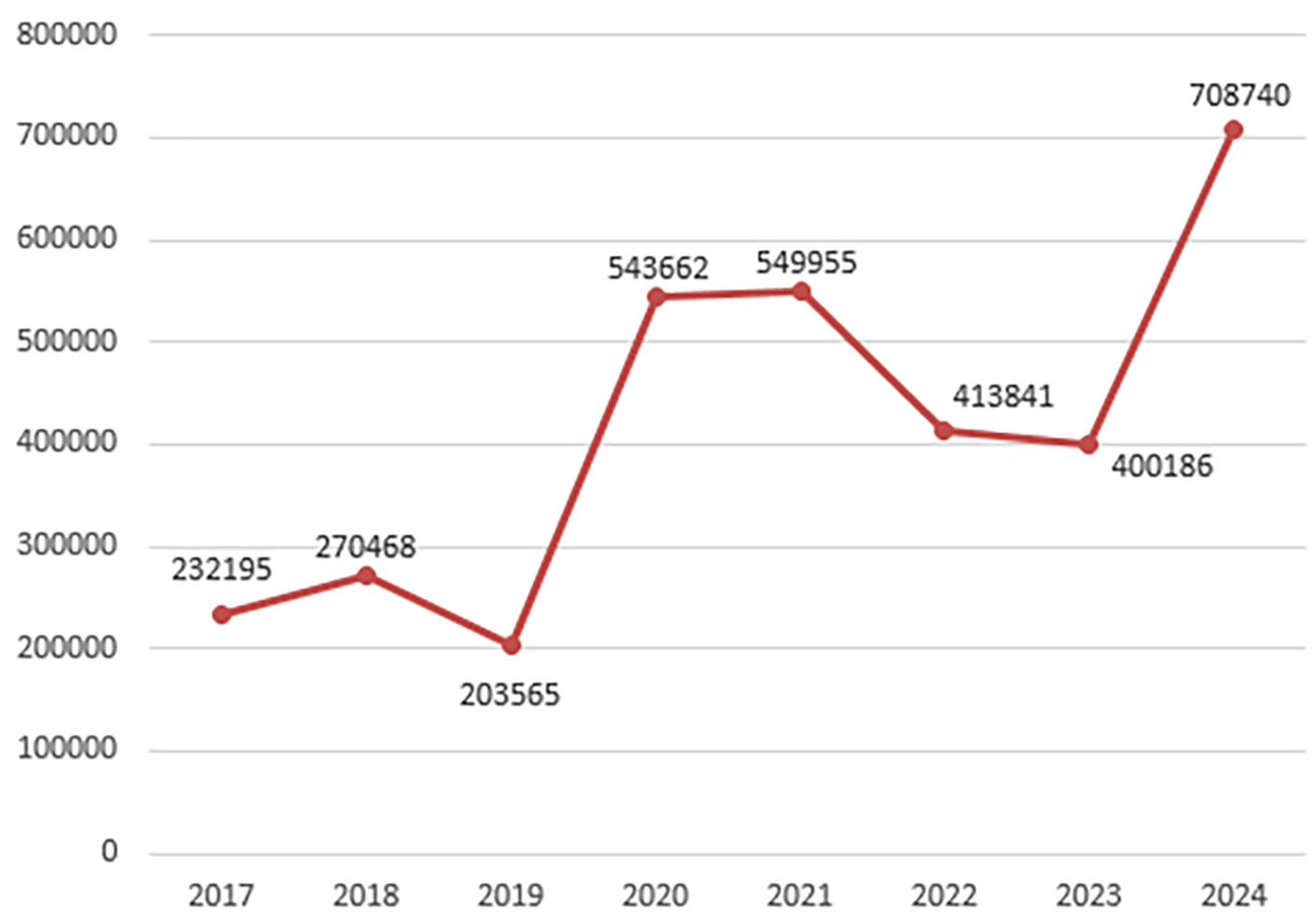
Even a brief analysis of the evolution of our bibliometric data indicates that REML is still growing.12 Having become a well-established and modern publication, it is now the leading Spanish-language scientific journal in the field of forensic science, as demonstrated by its Scopus indexing and the 2024 data, which show that REML has reached a historic milestone of 708,740 visits (Fig. 1).

Figure 1.

Evolution of visits to the Spanish Journal of Legal Medicine between 2017 and 2024 (Source: Elsevier).

In order to maintain the current situation for as long as possible, the Editorial Committee of REML recognises that the ideal evolution of our journal must entail bolstering its scientific relevance, social impact, and editorial sustainability. Consequently, our future actions must be aligned with this objective. A suitable course of action would incorporate key points such as scientific and ethical quality, internationalisation, openness and visibility, thematic innovation, dissemination, and editorial sustainability.

Regarding the scientific and ethical quality of REML, we believe that we publish rigorously and transparently, respecting universal ethical principles. The Editorial Committee has sought to publish original, current, and relevant works, focusing on methodological rigour, clarity, and precision in writing. All articles undergo peer review (we are eternally grateful to our altruistic reviewers for their work14), and references are kept up to date and relevant. Articles are applicable to forensic practice. Unsurprisingly, our article acceptance rate was 50% in 2024.

In terms of thematic innovation, several new trends are currently emerging in scientific journals on legal and forensic medicine. These reflect technological advances and changes in scientific communication. Notable examples include the use of artificial intelligence and big data, forensic omics (genomics, proteomics, and metabolomics), ethics, bioethics and human rights, mental health and forensic medicine, and digital applications in forensic teaching. We have already started to explore these new themes and look forward to receiving more articles on these subjects. These articles should take an interdisciplinary approach and aim to establish standards and good practices within the community. They should also propose protocols that allow for the harmonised, high-quality production of expert reports. Other necessary aspects, such as the internationalisation of the REML and the dissemination and visibility of published works, have been extensively addressed recently.12 The REML strives to maintain an effective social media presence. In this regard, we recognise that future altmetrics, a method of measuring the impact of publications at the document level through new semantic web media (blogs, Facebook, X, etc.), can help to define certain aspects of our project.12

REML seeks to be a dynamic journal that is constantly updated and adapted to current standards, combining scientific rigour, technological innovation, an open approach to the world, and social responsibility. In short, our goal is to remain the leading Spanish-language publication in the field of forensic science. REML's current success, as demonstrated by the 2024 data, is thanks to its readers, authors, editorial team, and reviewers. Without their selfless participation, REML would not be possible. To maintain our position at the forefront of the field, we invite our readers to participate actively by submitting original, high-quality work, proposing topics of interest or special issues, collaborating by reviewing articles, supporting the visibility of REML by citing articles from the journal in other communications, sharing articles on academic networks, or recommending the journal to their institutions or research circles, and collaborating on publications with colleagues from other countries. Together, we will continue to update REML, ensuring it remains a shared success for the entire Spanish legal and forensic medicine community.

References
[1]
C. Ortega.
Celebrando el 50 aniversario de Revista Española de Medicina Legal.
Rev Esp Med Legal, 50 (2024), pp. 135-137
[2]
M. Grijalba, E. Barbería, J.M. Montero, R. Bañón, M. Pastor, R.A. Marcos, et al.
Organización de la medicina legal y forense en España.
Rev Esp Med Legal, 50 (2024), pp. 155-163
[3]
R.M. Bañón-González.
Consejo médico forense: una oportunidad.
Rev Esp Med Legal, 41 (2015), pp. 1-2
[4]
B. Perea-Pérez, F. Pera-Bajo, E. Dorado-Fernández, A. Santiago-Saez.
La enseñanza de la medicina legal y forense en España.
Rev Esp Med Legal, 50 (2024), pp. 149-154
[5]
J. Arimany-Manso, M. Grijalba-Mazo, E. Garrido-Lestache, B. Perea-Pérez, I. Galtés, S. Baena-Pinilla, et al.
La especialidad de medicina legal y forense en España: la consolidación por el sistema de residencia.
Rev Esp Med Legal, 46 (2020), pp. 159-161
[6]
M. Grijalba-Mazo, J. Arimany-Manso.
El inicio de la residencia de la especialidad de medicina legal y forense en España.
Rev Esp Med Legal, 48 (2022), pp. 89-91
[7]
M. Grijalba, E. Barbería.
Perfil demográfico del cuerpo de médicos forenses en España.
Rev Esp Med Legal, 45 (2019), pp. 89-91
[8]
G.D. Albano, G.L. Re, S. Salerno, M.B. Triskari, M. Fornasari, G. Micci, et al.
The role of forensic imaging in the allegations of torture in asylum seekers.
[9]
T.I. Joseph, K.L. Girish, P. Sathyan, M.S. Kiran, S. Vidya.
Virtopsy: an integration of forensic science and imageology.
J Forensic Dent Sci, 9 (2017), pp. 111-114
[10]
E. Barbería, C. Martin-Fumadó, A. Xifró, E.L. Gómez-Durán, J. Arimany-Manso, A. Pujol-Robinat.
Revista Española de Medicina Legal solo en formato online.
Rev Esp Med Legal, 49 (2023), pp. 79-81
[11]
C. Martin-Fumadó, E. Barbería-Marcalain, E.L. Gómez-Durán, A. Xifró-Collsamata, J. Arimany-Manso, A. Pujol-Robinat.
La consolidación de Revista Española de Medicina Legal (2008-2018).
Rev Esp Med Legal, 44 (2018), pp. 141-143
[12]
E. Barbería, A. Xifró, C. Martin-Fumadó, C. Rudilla-Soler.
Revista Española de Medicina Legal: análisis bibliométrico en Scopus del periodo 2008–2024.
Rev Esp Med Legal, 50 (2024), pp. 141-148
[13]
L. González-Wilhelm, M. Duce.
Forensic and legal medicine in Chile: cinderella without a prince.
Medwave, 24 (2024),
[14]
Revista Española de Medicina Legal.
Agradecimientos Revista Española de Medicina Legal 2024.
Rev Esp Med Legal, 51 (2025),

Please cite this article as: Martin-Fumadó C, Pujol-Robinat A, Barbería-Marcalain E, Gómez-Durán EL, Xifró-Collsamata A, Arimany-Manso J. The evolution of Spanish Journal of Legal Medicine. Revista Española de Medicina Legal. 2025. https://doi.org/10.1016/j.remle.2025.500491.

Copyright © 2025. Asociación Nacional de Médicos Forenses
asdasdasd
Article options
Tools
