

Attacks involving corrosive chemical agents represent an extreme form of violence, frequently linked to gender-based violence, resulting in irreversible physical injuries, psychosocial harm, and functional loss. In Colombia, the phenomenon has been underestimated due to imprecise classifications. This study aims to characterize the victims, alleged perpetrators, and contextual factors related to non-fatal injuries caused by corrosive chemical agents between 2018 and 2021.
Materials and methodsThis is a retrospective observational study. A total of 800 cases recorded by the Colombian National Institute of Legal Medicine and Forensic Sciences (INML) were reviewed. After applying inclusion criteria based on the Natalia Ponce de León Law, 105 cases were classified as corrosive chemical injuries. Descriptive statistics were applied, followed by logistic regression to identify associated risk factors.
ResultsIn total, 72.4% of the victims were women, and 71.8% of perpetrators were men. 77% of the attacks occurred in the context of interpersonal violence, and 48.6% of the victims had a low level of education. Both female sex (OR = 2.73; p < 0.001) and single marital status (OR = 1.78; p = 0.041) showed independent and significant associations with the likelihood of experiencing such an attack. Most cases occurred in urban settings and public spaces.
ConclusionsCorrosive chemical injuries in Colombia reflect a gender-based violence pattern, with close male aggressors and structurally vulnerable victims. There is an urgent need to improve forensic data accuracy, enhance comprehensive victim care, and implement public policies aimed at prevention, legal protection, and access to justice, especially in rural and socioeconomically disadvantaged areas.
Los ataques con agentes químicos corrosivos representan una forma extrema de violencia, frecuentemente asociada con la violencia basada en género, que causa lesiones físicas irreversibles, afectación psicosocial y pérdida funcional. En Colombia, este fenómeno ha sido subestimado por clasificaciones imprecisas. El objetivo de este estudio es caracterizar a las víctimas, presuntos agresores y factores contextuales relacionados con lesiones no fatales por agentes químicos corrosivos entre 2018 y 2021.
Materiales y métodosEstudio observacional retrospectivo. Se revisaron 800 casos registrados por el Instituto Nacional de Medicina Legal y Ciencias Forenses (INML). Tras aplicar criterios de inclusión basados en la Ley Natalia Ponce de León, se identificaron 105 casos. Se realizaron estadísticas descriptivas y una regresión logística para identificar factores de riesgo.
ResultadosEl 72,4% de las víctimas eran mujeres y el 71,8% de los agresores, hombres. El 77% de los ataques ocurrieron en contextos de violencia interpersonal. El 48,6% de las víctimas tenía bajo nivel educativo. Ser mujer (OR = 2,73; p < 0,001) y estar soltera (OR = 1,78; p = 0,041) aumentaron cada una la probabilidad de sufrir un ataque. La mayoría de los casos ocurrieron en zonas urbanas y espacios públicos.
ConclusionesLas lesiones por agentes químicos corrosivos en Colombia reflejan un patrón de violencia basada en género, con agresores cercanos y víctimas vulnerables. Se requiere mejorar el registro forense, fortalecer la atención integral e implementar políticas públicas de prevención, protección legal y acceso a la justicia en zonas rurales y poblaciones en desventaja.

Corrosive chemical attacks represent an extreme manifestation of violence on a global scale. These acts are complex, deliberate and brutal, carried out with the explicit intention to assault, injure, disfigure, or torture the victim, often going beyond the intent to kill.1,2 Furthermore, they constitute a form of gender-based violence that follows a systematic pattern rooted in patriarchal societies, where jealousy, marital conflict, power imbalances, romantic or sexual rejection, and persistent intimate partner violence are common triggers.2–5
Corrosive chemical injuries are highly destructive and result in irreversible deforming and disabling consequences at both tissue and organ levels. The severity of damage depends largely on the duration of exposure and the concentration of the chemical agent, whether acid or alkali.6,7 Although there is no official global registry, studies from Southeast Asia and the United Kingdom report that 65% to 78% of attacks target the face and neck; in Colombia, this figure rises to 95%, reflecting a clear esthetic intent to deform and undermine the victim's personal identity.2,5,8–10 In addition to their severe physical consequences, these injuries often lead to profound psychosocial, economic, and occupational impacts, related to social rejection and isolation, physical disability, and partial or total loss of sensory and motor functions suffered by the victims.3,11,12
According to data from Acid Survivors Trust International (ASTI), the United Kingdom had the highest number of recorded acid attacks in the world in 2018, with 501 cases, most of which were associated with gang-related violence.13,14 India ranked second with 228 officially reported cases in 2018 and 176 in 2021; however, estimates from the National Crime Records Bureau suggest that the actual number may be closer to 1000 cases annually.15 This discrepancy is likely due to low reporting rates, poor investigation by authorities, and inconsistencies in case registration.16–18
Colombia ranks third globally and is the only Latin American country among the most affected, with approximately 100 cases recorded in 2018, surpassing countries like Bangladesh, Pakistan, and Uganda. In fact, between 2010 and 2014, Colombia had more acid attacks per capita than any other country in the world.13,19,20 In response to this alarming situation, the Colombian government enacted several legal reforms, most notably Law 1639 of 2013, which introduced the Emergency Medical Care Protocol for Victims of Chemical Agent Attacks to ensure timely and comprehensive medical attention.21,22 Later, in 2016, the Natalia Ponce de León Law was passed, which strengthened criminal penalties for perpetrators, promoted comprehensive forensic medical follow-up, and banned the possession and distribution of corrosive chemical substances.23
The Natalia Ponce de León Law introduced a new perspective on chemical agent injuries in Colombia by defining any corrosive substance as one with a high destructive potential to human tissue.23 This redefinition led to a reevaluation of the classification system previously used by the National Institute of Legal Medicine (INML), which until 2016 had documented chemical injuries without distinguishing between degrees of harm or types of chemical agents involved.24 However, this legal framework still has important limitations: it contributes to the overestimation of the total number of corrosive chemical injury cases and hinders the effective application of the law by including cases that do not meet the established legal criteria.
Given the limitations observed up to 2022 regarding the classification and management of corrosive chemical injuries, the main objective of this study is to characterize the population of victims, alleged aggressors, incidents, and forensic conclusions related to non-fatal corrosive chemical injuries assessed by the Colombian INML between 2018 and 2021.
Materials and methodsThis is a retrospective observational study, in which administrative reports of cases evaluated in Colombia between 2018 and 2021 were analyzed. These cases were classified by forensic experts affiliated with the INML as involving a “chemical agent” as the traumatic mechanism.
The administrative reports were requested from the Subdirectorate of Forensic Services of the INML through memorandum 269–2024 and under the approval of ethics committee number (B.FM.1.002-CE-022-24). A total of 800 cases were obtained in which the traumatic mechanism of the injury was listed as “chemical agent.” The data were coded to protect sensitive information related to the identification of the individuals involved. Subsequently, 259 cases were excluded due to misclassification, as the causative agent of the injury (such as stones, fists, hot water, among others) did not match the characteristics of the mechanism of interest in this study.
The remaining 541 cases were reviewed, and it was determined that information regarding the harmful agent was insufficient or missing in most of them. Therefore, authorization was requested from the National Reference Group Against Violence to access the complete forensic reports, with justification based on the objectives of this study.
In accordance with the provisions of the Natalia Ponce de León Law and based on the information obtained from the narrative of events, injury descriptions, and clinical history, 105 cases were identified as involving corrosive chemical agent injuries, which are the focus of this study. The excluded cases were distributed into a new subclassification.
Based on the above, the sample for this study consists of 105 cases of corrosive chemical agent injuries, in which the harmful object and the topographic diagnosis made during the forensic evaluation are characterized. Each case also includes key variables related to the victim: sex, age, educational level, sexual orientation, gender identity, context of the events, setting, aggressor identification, aggressor's sex, and whether the victim cohabitated with the aggressor.
Additionally, the data were processed using the R Studio software version 4.3.1 and descriptive statistics were used for analysis, including absolute and relative frequencies and graphical representations. A logistic regression model was subsequently applied to identify characteristics that increase the likelihood of suffering injuries caused by corrosive chemical agents.
ResultsThe examined sample consists of 105 cases corresponding to attacks with corrosive chemical agents, extracted from the database of the National Institute of Legal Medicine and Forensic Sciences. According to Colombian legislation, these agents are characterized by causing tissue destruction, as defined by the Natalia Ponce de León Law.23 The following is a description of the variables associated with the context of each case, for subsequent analysis.
Regarding the sex of the victims, 76 (72.38%) were female and the remaining 29 (27.62%) were male. As for sexual orientation, 88 victims (83.81%) were classified as heterosexual, including 65 women and 23 men. In the remaining cases (n = 17), this variable was not recorded. On the other hand, gender identity was not reported in most of the forensic records and therefore could not be analyzed.
Concerning the stage of life at the time of evaluation of the victim, two stages predominated: youth (18–28 years) and adulthood (29–59 years), with 26 cases (25.24%) and 56 cases (54.37%), respectively. Other life stages showed lower cases: early childhood (0 to 5 years) with 2 cases, childhood (6 to 11 years) with 1 case, adolescence (12 to 17 years) with 6 cases, and older adulthood (over 60 years) with 12 cases. Additionally, there were 2 missing records.
Regarding education level, most victims had completed only primary or lower secondary education, totaling 51 cases (48.57%). Other victims reported having completed upper secondary education (19 cases; 18.10%) or higher education (23 cases; 21.90%).
As for the characteristics of the aggressor, in 103 of the 105 cases analyzed, information was available about the aggressor's sex. Males were the perpetrators in 74 cases (71.84%). Regarding the social relationship between victim and aggressor, in 29 cases (27.88%), the victim reported being assaulted by someone they knew. In 19 cases, the aggressor was a stranger. In 15 cases (14.29%), the aggressors were identified as current or former intimate partners. Table 1 presents the sociodemographic details of victims and aggressors.
Relationship with the alleged aggressor.
| Relationship | Female VictimsNumber (%) | Male VictimsNumber (%) | TotalNumber (%) |
|---|---|---|---|
| Acquaintance | 26 (34.21%) | 3 (10.34%) | 29 (27.62%) |
| Partner or Ex-partner | 13 (17.11%) | 2 (6.90%) | 15 (14.29%) |
| Stranger | 11 (14.47%) | 8 (27.59%) | 19 (18.10%) |
| Family Member | 6 (7.89%) | 0 (0.0%) | 6 (5.71%) |
| Friend | 3 (3.95%) | 2 (6.90%) | 5 (4.76%) |
| Common Crime | 1 (1.32%) | 4 (13.79%) | 5 (4.76%) |
| Armed Forces, Police, or Intelligence Services | 0 (0.0%) | 2 (6.90%) | 2 (1.90%) |
| Organized Crime Member | 0 (0.0%) | 1 (3.45%) | 1 (0.95%) |
| Other | 2 (2.63%) | 1 (3.45%) | 3 (2.86%) |
| Not Applicable | 1 (1.32%) | 0 (0.0%) | 1 (0.95%) |
| No Information | 13 (17.11%) | 6 (20.69%) | 19 (18.10%) |
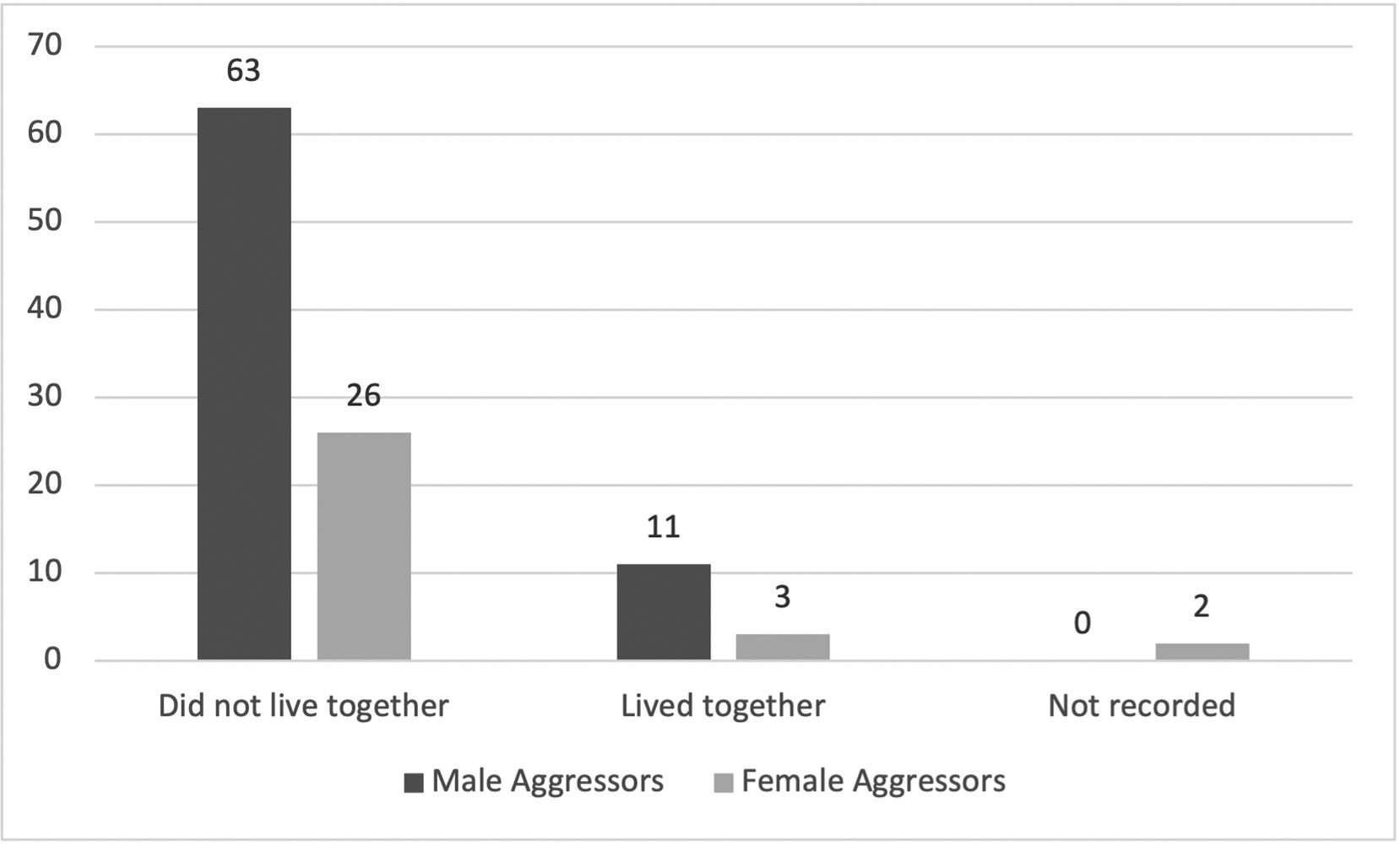
In terms of cohabitation, it was found that in 89 of the 105 cases (84.7%), the aggressors did not live with the victim at the time of the incident. Among these, 63 (70%) were men. In contrast, among the 14 cases (13.3%) in which the victim and the aggressor did cohabit, 78% of the aggressors were male (Fig. 1).
Regarding the incidence of the events, the year 2018 had the highest number of reported non-fatal corrosive chemical injuries in Colombia. In 2019, 29 cases were reported; in 2020, the number dropped to 19 cases; and in 2021, it rose again to 25 cases. The cities with the highest number of reported cases were large urban centers, including Bogotá D.C. (25 cases), Medellín (11 cases), Cali (7 cases), and Cúcuta (4 cases). Fig. 2 shows a heat map with the detailed distribution of cases by department.
Concerning the context in which the incidents occurred, the majority were classified as interpersonal violence, with 81 cases (77%). This was followed by cases within the context of family violence (21 cases; 20%), distributed as follows: intimate partner violence (15 cases), violence against children and adolescents (3 cases), and, to a lesser extent, one case (2.38%) involving violence against an older adult and one case associated with a suspected sexual offense (Fig. 3). Due to the relevance of each category, in the Colombian context, intrafamilial violence has been studied epidemiologically as separate from the subset of interpersonal violence. For the purposes of this study, interpersonal violence is defined according to the INML's Forensics report as “Intentional aggression aimed at causing injury or harm to the victim's body, perpetrated by a third party without any familial or blood relationship with the victim”.15
Regarding the location of the events, public streets in urban areas accounted for 52 cases (49.5%). Homes were the second most frequent setting for these incidents, accounting for 28.5% of cases. Among these, 96.7% were women (n = 29) and 3.3% were men (n = 1). Less frequently, the events occurred on national roads (4.76%), in crowded places (10.47%), detention centers (3.8%), private vehicles, lodging facilities, or were recorded without location information (0.95%).
The variable with the most missing data was related to the identification of the substances involved. In only 13 of the 105 analyzed cases was the substance reported by the healthcare professional during initial medical attention. The recorded substances were: sodium hypochlorite (7 cases), paint thinner (2 cases), and one case each of muriatic acid, nitric acid, alcohol, and gasoline. After the forensic reports were reviewed by the research team, it was found that victims commonly referred to substances using terms such as “muriatic acid,” “ammonia,” “facade cleaning acid,” “engine liquid,” or simply “acid.” The absence of precise information about the substances involved represents a limitation for the analysis of this variable.
Logistic regressionA logistic regression model was conducted to identify the characteristics that increase the likelihood of sustaining injuries caused by corrosive chemical agents, as opposed to injuries caused by toxic or irritant chemical agents. The sociodemographic characteristics of the victims considered in the analysis are presented in Table 2.
Logistic regression model of corrosive substance injuries.
| Variable | B | SE | p | OR | 95% CI |
|---|---|---|---|---|---|
| Sex.Female | 1.00 | 0.24 | 0.00 | 2.73 | 1.70–4.38 |
| Age.(12 to 17) | −0.40 | 1.19 | 0.74 | 0.67 | 0.07–6.96 |
| Age.(18 to 28) | 0.06 | 1.15 | 0.96 | 1.06 | 0.11–10.07 |
| Age.(29 to 59) | 0.41 | 1.14 | 0.72 | 1.51 | 0.16–14.12 |
| Age.(60 and over) | 0.87 | 1.18 | 0.46 | 2.38 | 0.23–24.27 |
| MaritalStatus.Married | −0.15 | 0.40 | 0.71 | 0.86 | 0.39–1.90 |
| MaritalStatus.Separated/Divorced | 0.74 | 0.45 | 0.10 | 2.10 | 0.87–5.09 |
| MaritalStatus.Single | 0.58 | 0.28 | 0.04 | 1.78 | 1.02–3.11 |
| MaritalStatus.Widowed | 0.12 | 0.77 | 0.88 | 1.12 | 0.25–5.05 |
| Education.Lower Secondary | 0.42 | 0.54 | 0.44 | 1.53 | 0.53–4.41 |
| Education.Postgraduate | −12.27 | 490.55 | 0.98 | 0.00 | 0.00 |
| Education.Primary | 0.86 | 0.53 | 0.10 | 2.37 | 0.83–6.75 |
| Education.Upper Secondary | 0.66 | 0.55 | 0.23 | 1.93 | 0.66–5.67 |
| Education.No Schooling | 1.89 | 1.05 | 0.07 | 6.63 | 0.84–52.18 |
| Education.Technical | 0.60 | 0.54 | 0.27 | 1.82 | 0.63–5.22 |
| Education.University | 1.82 | 1.03 | 0.08 | 6.16 | 0.82–46.23 |
B = Logistic regression coefficient; SE = Standard error of the coefficient; p = Statistical significance (p-value); OR = Odds ratio, indicating the strength of association between the independent variable and the occurrence of the event; 95% CI = 95% confidence interval for the OR, reflecting the precision of the estimate.
In the logistic regression model, being a woman was significantly associated with a higher likelihood of experiencing the event under study (OR = 2.73; 95% CI: 1.70–4.38; p < 0.001). A significant association was also found for single individuals, who showed a higher probability compared to those who were not (OR = 1.78; 95% CI: 1.02–3.11; p = 0.041). Although other variables, such as having no formal education (OR = 6.63; 95% CI: 0.84–52.18; p = 0.072) or having a university education (OR = 6.16; 95% CI: 0.82–46.23; p = 0.077), showed high odds ratios, they did not reach statistical significance. The postgraduate category, meanwhile, yielded an unstable estimate (OR ≈ 0), suggesting estimation issues likely due to the low number of cases in this group. Overall, the findings highlight that sex and marital status are relevant factors in the occurrence of corrosive substance injuries.
The findings of this study reinforce the understanding of injuries caused by corrosive chemical agents as an extreme manifestation of gender-based violence.4,11,25 This is evidenced by the predominance of women as victims and the identification of men as perpetrators in 71.8% of cases, who are often close to and/or live with the victim. This relational proximity supports the notion that attacks with corrosive chemical agents are a premeditated form of aggression, associated with a strong symbolic burden rooted in relationships marked by a desire for control and social isolation of the victim.1,26,27 This phenomenon is not exclusive to the Colombian context: in countries such as India, Cambodia, the United Kingdom, and Italy, the pattern of female victims, male perpetrators, and domestic settings is similarly replicated.5,10,12,17,25,28
The home, the second most frequent setting where these events occurred, emerges as a place of risk for women, who were the main victims in this context (27.62%). This phenomenon breaks with the traditional notion of the home as a protective space for human beings and affects the victim's sense of identity and safety within their environment.29 On the other hand, the high proportion of victims with low educational levels (48.57%), as seen in other forms of violence, may be correlated with Colombia's structural vulnerability.20,27,29,30 Low educational attainment limits access to information about rights, support networks, protection mechanisms, and job opportunities, and has been associated with teenage pregnancy and early marriage. These factors may increase economic and social dependence on aggressors and perpetuate cycles of violence that precede the occurrence of this type of attack.
The concentration of cases of injuries caused by corrosive chemical agents in Colombia's major cities, while it may suggest a higher incidence in urban centers, could also reflect an underrepresentation of assaults occurring in rural areas. This is due to barriers in access to healthcare and justice that are characteristic of the Colombian territory, such as limited institutional presence, transportation difficulties, and a lack of specialized services.24,30 This territorial gap also perpetuates impunity and places victims at further risk by denying them access to adequate protection mechanisms and primary care services.26
A noteworthy finding relates to Colombia's position in the global statistics reported by ASTI.13 Currently, Colombia ranks third worldwide in the incidence of acid attacks. However, the characterization carried out in our study would imply a change in this ranking. As described in the methodology, out of 800 cases classified as “chemical agent” injuries, only 105 met the criteria established after recategorization; therefore, Colombia would no longer hold this position in the global ranking.
We acknowledge the limitations of this study, one of which is the sample size, which was reduced after the initial screening of cases. Only 105 cases met the specific inclusion criteria. In addition, the missing data regarding the type of substance used and the detailed context of the events limit the possibility of conducting a more in-depth analysis of the elements that underlie and constitute this type of aggression.
Year-to-year variations in the number of cases may be influenced by factors such as awareness campaigns, changes in legal regulations, or barriers to reporting during periods such as the COVID-19 pandemic, which may explain the decrease observed in 2020. These interpretations highlight the need for more in-depth studies that address not only the quantification of cases but also their structural and contextual determinants.
The distribution of recorded cases by city suggests that forensic medical evaluations in cases of attacks with corrosive substances are concentrated in the country's major urban centers, possibly due to easier access to health and justice services, which may facilitate the reporting and documentation of these cases. In this context, further studies are needed to identify the underlying causes of these phenomena.
A relevant limitation in the context of corrosive agent attacks is the lack of information on the affected body areas. According to multiple studies, the anatomical location of the injuries is often intentionally directed toward the face and visible areas of the body, with the aim of disfiguring and harming the victim's personal identity.1,3–5,9,10,13 The absence of detailed records in this regard represents a weakness for analyzing physical and functional sequelae, as well as the associated psychosocial damage, thereby limiting a comprehensive understanding of the phenomenon as a form of gender-based violence.4
Lastly, the lack of data from rural areas also constitutes a limitation, both in terms of understanding the actual number of cases occurring there and in terms of gaining insight into the dynamics of corrosive chemical attacks in these regions. This gap hinders the development of public and health policies that could improve access to victim care mechanisms.
ConclusionsInjuries caused by corrosive chemical agents in Colombia are not isolated incidents but profound manifestations of structural inequality and gender-based violence. This study identified a systematic pattern of assaults occurring in close contexts between victim and aggressor, most frequently affecting women in vulnerable situations. Although national figures have been widely disseminated, our findings reveal previous overestimations due to imprecise classifications that must be corrected to ensure effective responses.
Based on this characterization, it is urgent to improve the quality and accuracy of forensic records, facilitate access to comprehensive care for victims, and design prevention strategies adapted to social and territorial contexts. Public policies must go beyond punishment and focus on changing the conditions that perpetuate these aggressions. This study provides a solid foundation for future research aimed at deepening the understanding and prevention of this extreme form of violence, while also contributing to making the victims more visible and dignified.
FundingThis research did not receive any specific grants from public sector agencies, commercial entities, or non-profit organizations.
Conflict of interestThe authors have no conflict of interest to declare.
Please cite this article as: Romero-Chacón DM, Chavez-Rodríguez LM, León-Ariza SA, Pulido-Díaz D. Non-fatal injuries caused by corrosive chemical agents in Colombia between 2018 and 2021: Characterization of victims, perpetrators, and contextual factors. Revista Española de Medicina Legal. 2025. https://doi.org/10.1016/j.remle.2025.500479.


