





By allowing intensive monitoring of acute postoperative pain (APP), mHealth could be clinically useful in contexts with a high prevalence of moderate to severe APP.
ObjectiveThe primary objective was to evaluate the feasibility and acceptability of an app for monitoring DAP. The secondary objectives were to describe DAP during the first week of the postoperative period, to analyse factors associated with it and to assess adherence and satisfaction with analgesic treatment.
Materials and methodsObservational and prospective study in patients undergoing surgery under major ambulatory surgery (MAS) regimen who reported the intensity of DAP for 7 days with an app. We determined the proportions that agreed to use it and who made trajectories of DAP ≥5 days, the pattern of use of the app and the results. Risk factors associated with DAP were analyzed. Satisfaction with DAP control and adherence to the analgesic regimen were assessed through surveys.
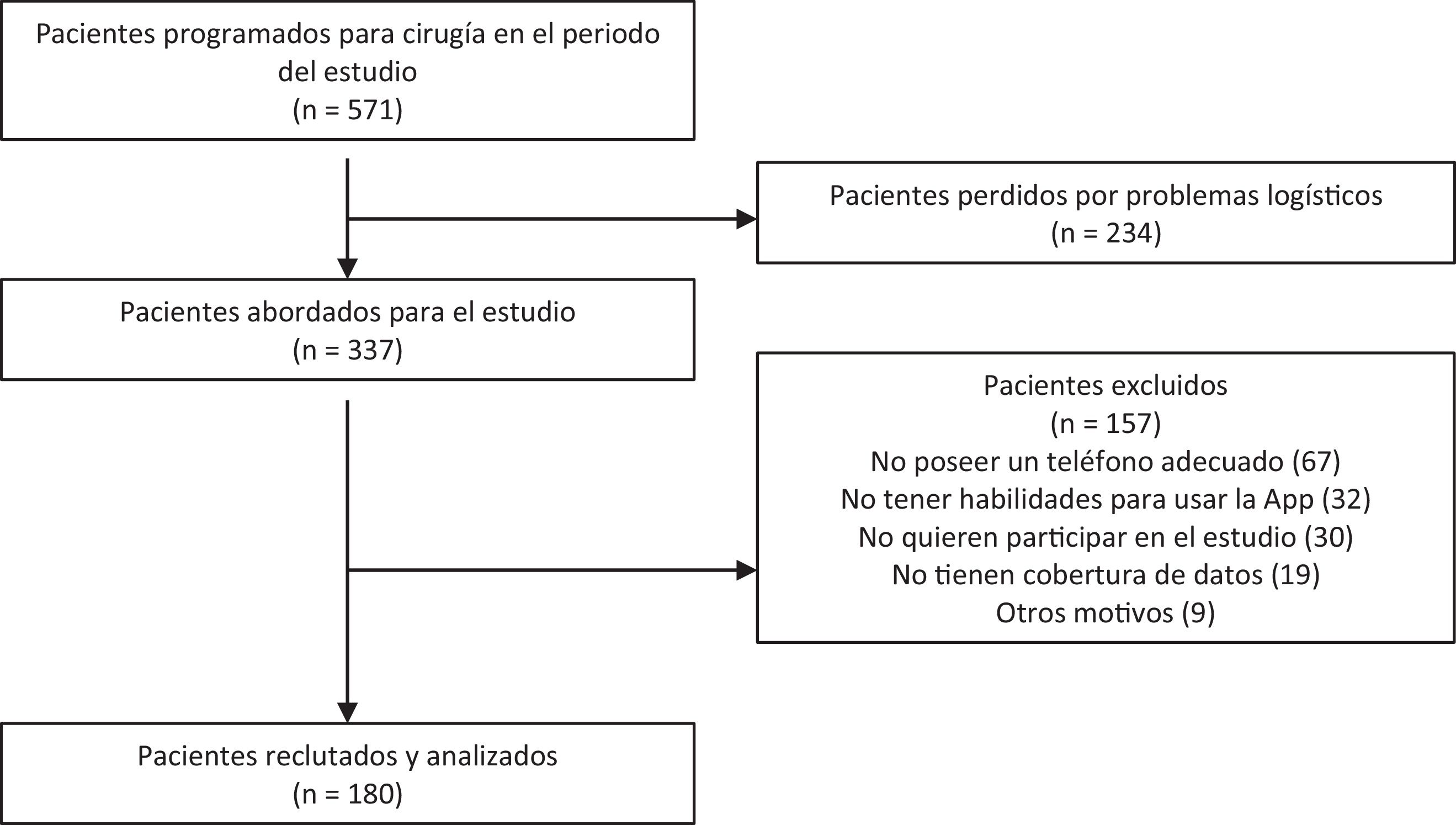
Results53.4% of patients measured their DAP with the app. The main reason for exclusion was technological limitations (75.1%). An uninterrupted DAP trajectory of ≥5 days was traced in 74.4% of patients and a high prevalence of moderate to severe DAP was observed, as well as a high proportion of patients who adhered little or not at all and were little or not at all satisfied with the analgesic results obtained.
ConclusionsMonitoring DAP with the app used was feasible and accepted by patients. It provided clinically useful information by allowing DAP trajectories to be traced and detecting high proportions of patients with moderate to severe DAP, dissatisfied with the analgesic results obtained and non-compliant with analgesic guidelines.
Al permitir monitorizar de forma intensiva el dolor agudo postoperatorio (DAP), la mHealth podría ser de utilidad clínica en contextos de alta prevalencia de DAP moderado a severo.
ObjetivosEl principal fue evaluar la viabilidad y aceptabilidad de una app para el seguimiento del DAP. Los secundarios fueron describir el DAP durante la primera semana del postoperatorio, analizar factores asociados al mismo y la adherencia y satisfacción con el tratamiento analgésico.
Materiales y métodosEstudio observacional y prospectivo, en pacientes sometidos a cirugías en régimen de CMA que reportaron la intensidad del DAP durante 7 días con una app. Determinamos las proporciones que aceptaron utilizarla y que confeccionaron trayectorias de DAP ≥5 días, el patrón de utilización de la app y los resultados. Se analizaron factores de riesgo asociados a DAP. Se valoró mediante encuestas la satisfacción con el control del DAP y la adherencia a la pauta analgésica.
ResultadosEl 53.4 % de los pacientes midió su DAP con la app. El principal motivo de exclusión fue por limitaciones tecnológicas (75.1 %). Se trazó trayectoria de DAP ininterrumpida de ≥5 días en el 74.4 % de los pacientes y se observó prevalencia elevada de DAP moderado a severo y elevada proporción de pacientes que adhirieron poco o nada y poco o nada satisfechos con los resultados analgésicos obtenidos.
ConclusionesEl seguimiento del DAP con la app utilizada fue viable y aceptado por los pacientes. Brindó información clínicamente útil al permitir trazar trayectorias de DAP y detectar proporciones elevadas de pacientes con DAP moderado a severo, insatisfechos con los resultados analgésicos obtenidos e incumplidores con las pautas analgésicas.

