


We define a journal club as a group of people who meet to critically read and discuss scientific articles. In medicine, journal clubs are a very important part of training during residency programs. In 2013, the Spanish Society of Medical Radiology’s (SERAM) journal club was established with the aim of promoting the acquisition of non-interpretative skills and training in scientific journalism during residency. After nearly 10 years, more than 137 reviewers at 54 hospitals have formed part of the SERAM’s journal club. In this time period, the number of reviewers, publications, and visits to our website have increased progressively. The SERAM’s journal club currently employs a structured workflow that is organized into quarterly groups and supported by a peer-review system. In the future, the SERAM’s journal club aims to internationalize its content beyond the Spanish-speaking community, increase its presence in social networks, and incorporate audiovisual content.
Llamamos club bibliográfico (CB) a un grupo de personas que se reúnen para realizar una lectura y un debate crítico de artículos científicos. En medicina, los CB son una parte muy importante del currículo formativo durante la residencia. En 2013 se funda el CB de la Sociedad Española de Radiología Médica (SERAM), con el objetivo de fomentar la adquisición de habilidades no interpretativas y la formación en editorialismo durante el periodo de residencia. Tras casi diez años de trayectoria, han formado parte del CB SERAM más de 137 revisores de 54 hospitales diferentes. En este tiempo, el número de revisores, publicaciones y visitas a nuestro sitio web han aumentado progresivamente. Actualmente, el CB SERAM funciona a través de un flujo de trabajo estructurado, organizado por grupos trimestrales y sustentado por un sistema de revisión por pares. Entre los objetivos de futuro del CB SERAM figuran internacionalizar su contenido más allá de la comunidad hispanohablante, aumentar su presencia en redes sociales (RR.SS) e incorporar contenido audiovisual.
A journal club (JC) is a group of people who meet regularly to critically review articles from the academic literature.1 These types of clubs have special representation in the medical field, where they are proven to be a versatile learning tool.2 In addition, an important aspect of the JC is its informal nature, which allows the creation of a social link between the different members of the club.3
The first use of the term is attributed to James Paget, an English surgeon and pathologist, who in his memoirs and letters from the period between 1835 and 1854 recorded that a group of medical students met in a room above a bakery near St. Bartholomew Hospital in London to read scientific journals.4 However, the first official JC is considered to be the one created by William Osler in Montreal in 1875, with a clear objective: to facilitate access to scientific literature, justified under the premise that the prices of an individual subscription were prohibitive.5 One of Osler’s pupils, Harvey Cushing, moved this type of model to the Johns Hopkins Hospital in Baltimore in 1889.6 Progressively, JCs have been incorporated into different faculties and hospitals, reaching 80% of them, according to some series.7
There are studies that show that participation in a JC leads to an increase in the reading habit and the critical nature of reading,8–10 also providing knowledge about evidence-based medicine.11 In addition, these skills introduce and promote research among residents.12,13 All these qualities are of special relevance in the training curriculum in medicine, which is why belonging to a JC could facilitate their development, being an important tool during the residency period.14–16
It is important that JCs work in a structured way and with a minimum quality criteria.17,18 Due to the technological revolution and immediate access to information, the presence of JCs is currently relevant, since it facilitates the screening of articles of interest to the medical community and, especially, to residents.19,20
The objective of this paper is to describe the history of the JC of the Sociedad Española de Radiología Médica [Spanish Society of Medical Radiology] (SERAM JC) since its creation and after almost 10 years of experience, as well as its organisation chart and work methodology. In addition, it intends to show its growth over time and its future prospects. With this we hope that this is a work that serves as an inspiration and model for existing or future JCs.
History and evolutionThe SERAM JC was born in March 2013 under the auspices of the communication and training commissions of the SERAM. It is presented as a JC created by radiodiagnostic residents, with no restrictions regarding nationality or language. Among its objectives are the acquisition of non-interpretive skills and training in editorialism through reading and critical review of current radiological articles.21 In addition, it helps residents gain knowledge related to statistical aspects and evidence-based medicine. Within editorialism, it introduces residents to the editorial process and peer review, while also promoting teamwork, constructive criticism and collaborative and communication skills.22
To belong to the SERAM JC, interested residents must make an application through its website. Coordinator positions are offered on a voluntary basis and are generally reserved for veteran members. The SERAM JC is mainly aimed at radiodiagnostic residents, although the participation of senior diagnostic imaging and nuclear medicine technicians (TSIDMN) is also allowed.
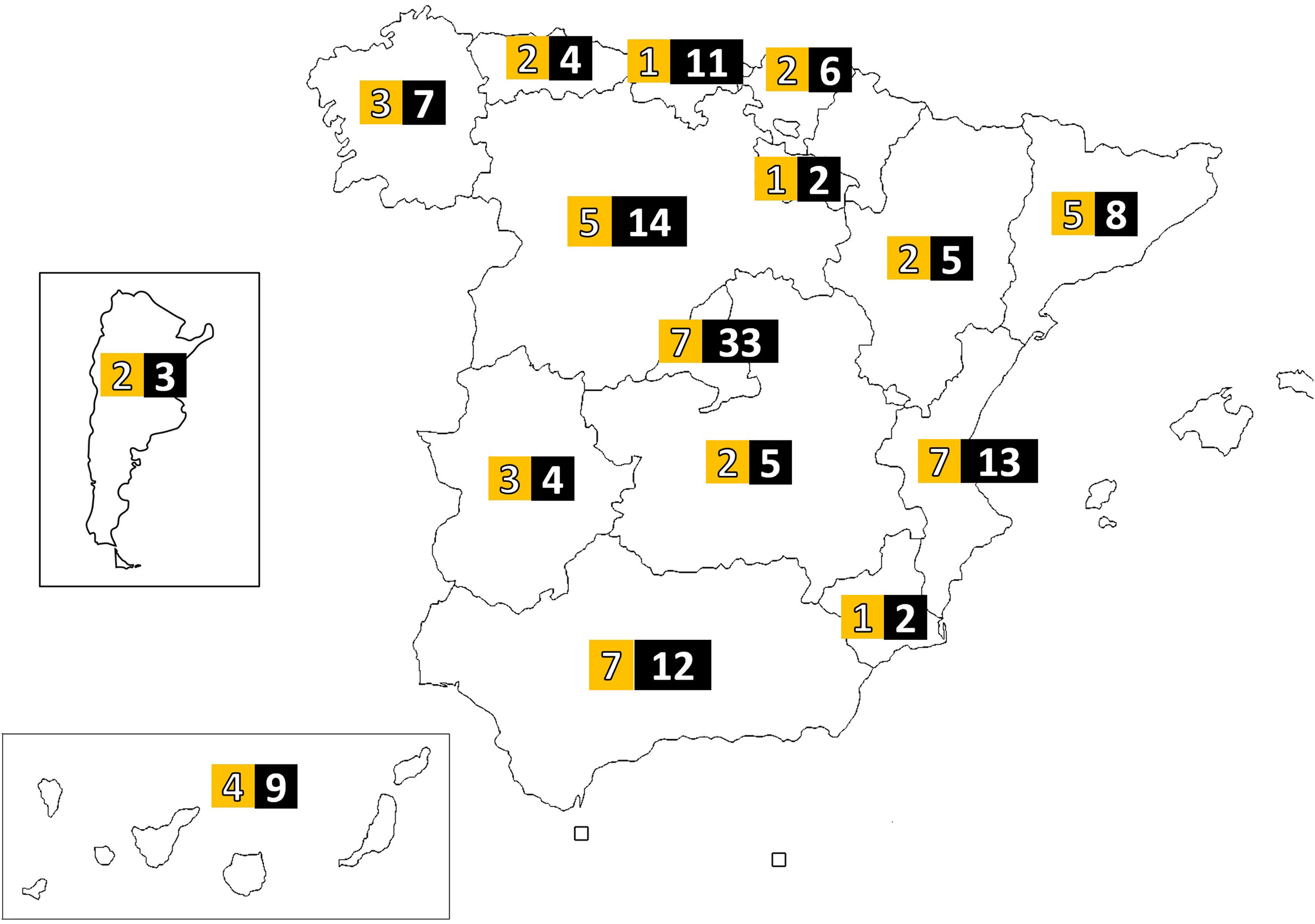
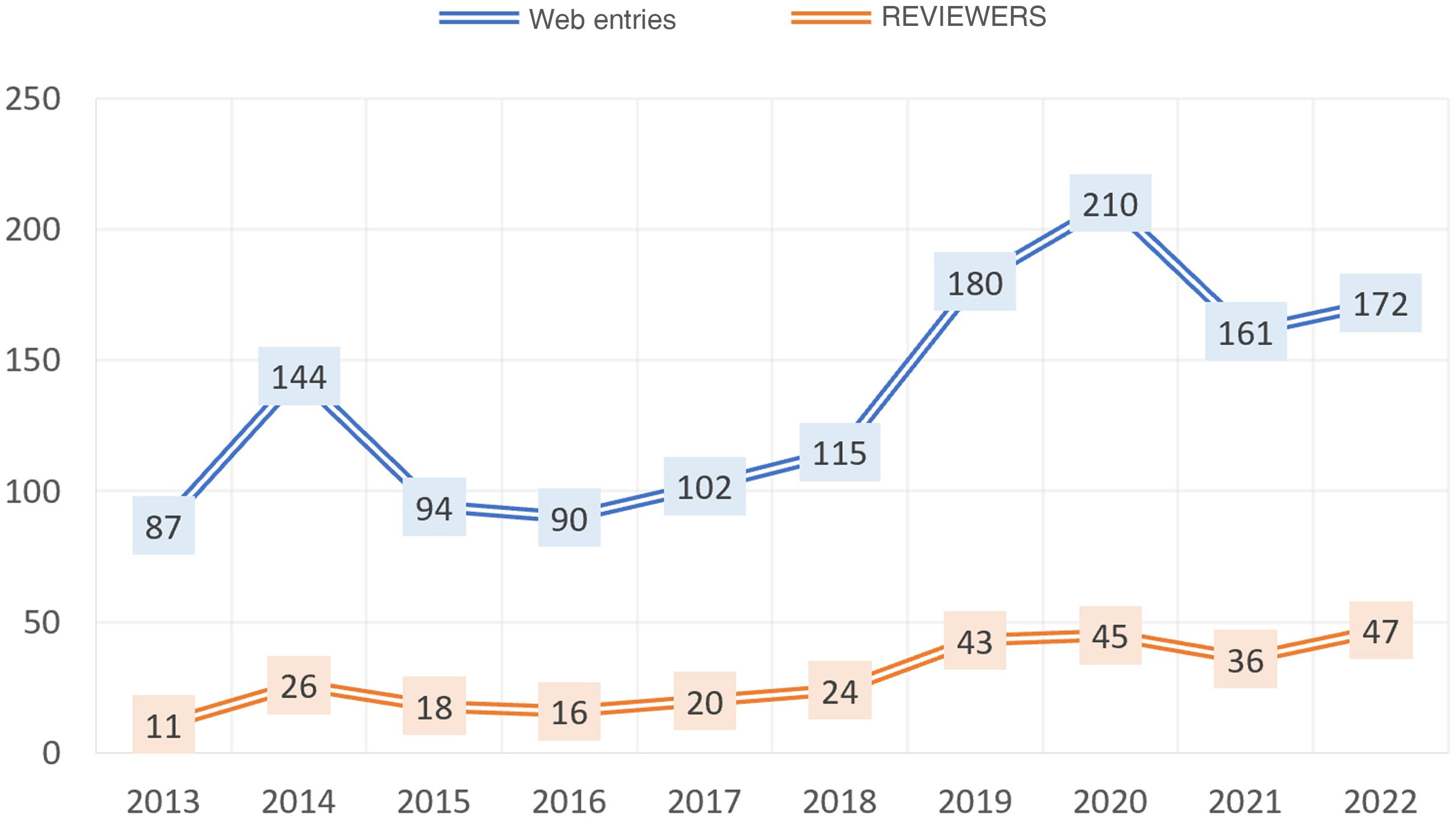
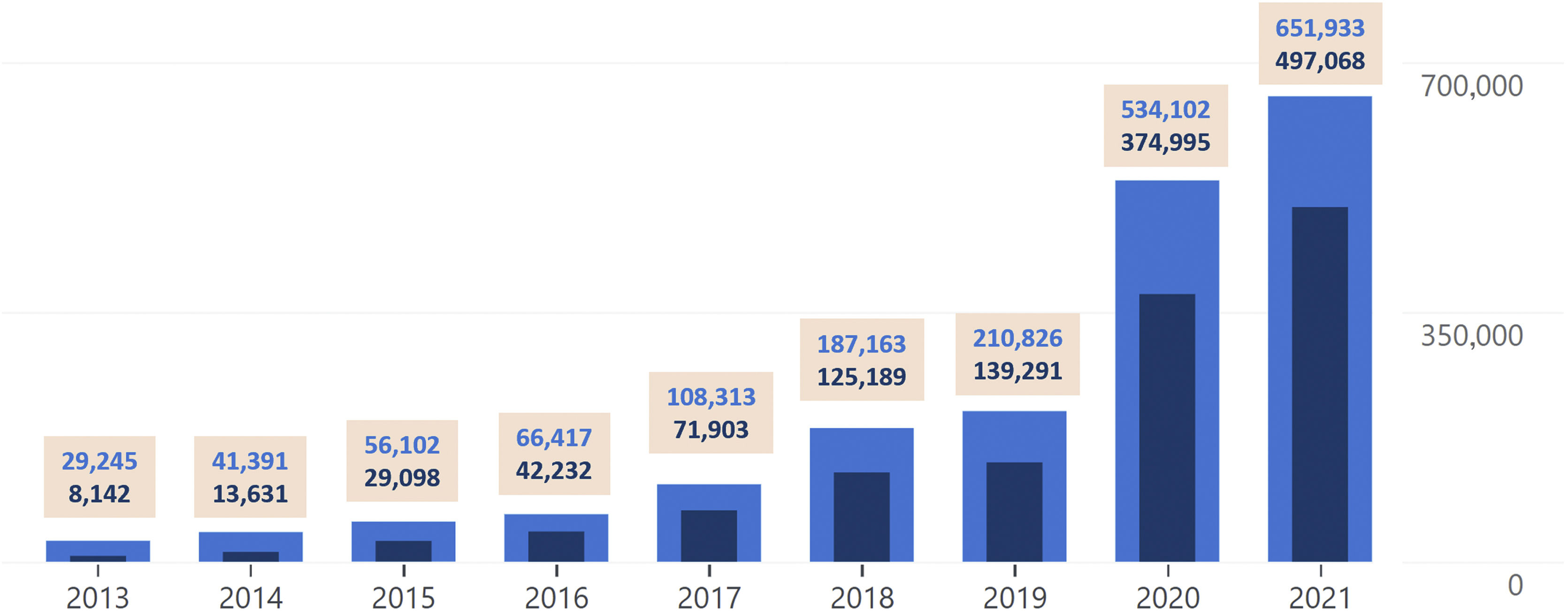
Up to the date of this work, approximately 137 reviewers from 54 different hospitals have participated in the SERAM JC (Fig. 1). In its first year, the SERAM JC had 11 members, with this figure being doubled in 2014. A growth of the SERAM JC between 2018 and 2019 is worth noting, when it went from 24 to 43 reviewers and incorporated up to four TSIDMN into its staff for the first time. At present, the SERAM JC is made up of 47 reviewers (Fig. 2). Due to the increase in the number of participants in the SERAM JC, since mid-2015 there have been "review groups", which will be explained later.

History of members of the SERAM JC and their distribution by Autonomous Communities (AC). The number in the yellow box refers to the number of hospitals by Autonomous Community that have contributed members to the SERAM JC. The number inside the black box refers to the historical number of members by AC. To the left of the image within a box, a smaller map of Argentina, since the SERAM JC has also had three reviewing members from two different hospitals in that country.

The SERAM JC exhibits its content openly and free of charge, exclusively online, being made up of articles grouped in monthly journals. The configuration of the issues of the SERAM JC journal has evolved over the years. In June 2013, the SERAM JC included its first lead article dedicated to introducing the contents of each issue.23 Since January 2014, the journal has had an International Standard Serial Number (ISSN).24,25 The ISSN is an identification code for periodicals and continuing resources, whether printed on paper or in digital format.24 On the other hand, the number of journals in the review catalogue has increased to 26. The number of articles per journal issue has increased, initially being six articles and currently ranging between 10 and 13 articles per issue.
Since its inception, the SERAM JC has used the WordPress® online blogging platform to present its content. This is due to its simple, intuitive and easy-to-use format. Each month, the different review articles are published on the website individually, offering at the same time the issue of the journal in “.pdf” format. This working method has been maintained without interruption for these 10 years. When analysing online publications since the creation of the SERAM JC, there is a parallel increase in the number of reviewers and the number of publications, reaching its maximum in the years that include the period of the COVID-19 pandemic (Fig. 2).
In order to give visibility to the SERAM JC, promote its content and maintain contact with residents and medical specialists, a Gmail account (cbseram@gmail.com) and profiles on Twitter (@cbSERAM), Facebook and LinkedIn were created in parallel to the development of the journal.
Since its creation, the SERAM JC has participated in different national and international conferences. An example of this is its presence in different national21,26 and European22,27 radiology congresses. In 2022, during the 36τη SERAM National Congress, the SERAM JC had a specific thematic block on the critical reading of articles.28
The repercussion in the interest in editorialism on the part of the members of the SERAM JC can be seen reflected through the granting of the Dr. Calatayud Editorialism Scholarships of SERAM. These scholarships began to be offered in 2014 and, since their creation, 47% have gone to active or former members of the SERAM JC.29 The habit of reviewing and editing is maintained for some members, beyond the period of residence, by participating in different scientific journals.30,31
Organisation and contentsThere is scant scientific evidence regarding how to manage a JC.32 However, it has been described that, to avoid the loss of public interest and excessive dedication on the part of the reviewers, a monthly periodicity of the contents is preferred.33
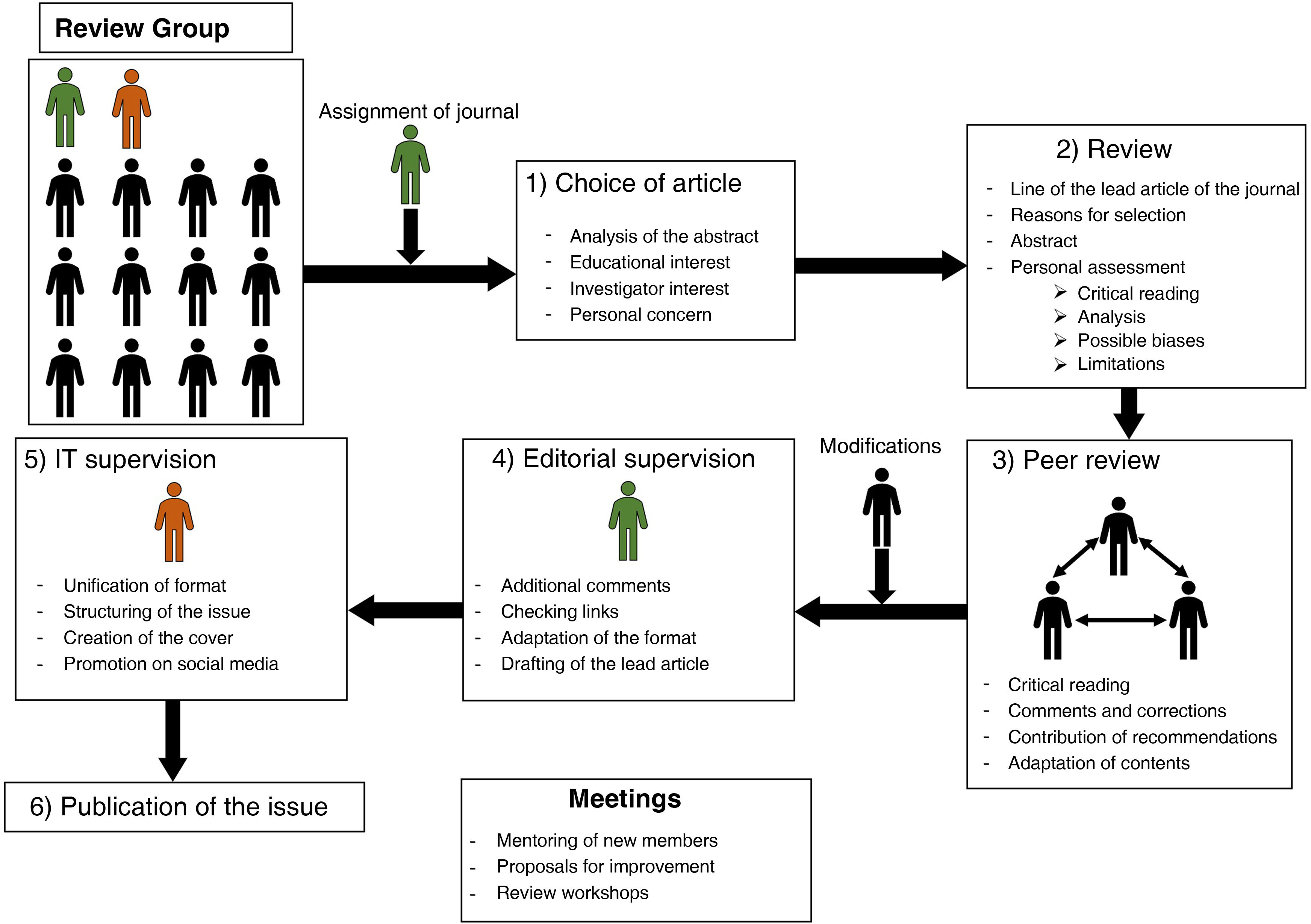
The SERAM JC is currently structured into three 'review groups' of about 12–13 reviewers each. This distribution means that each reviewer participates in at least four issues a year, assuming an even workload. In addition, each group has an editorial coordinator who acts as leader and an IT and social media coordinator (Fig. 3). All members conduct a review, including coordinators. If a reviewer wishes, as has already happened on several occasions, they can participate with a maximum periodicity of up to one review per month.

Workflow within the SERAM JC. The SERAM JC is made up of three review groups, which review every three months. The diagram serves as an example of the operation of one of them. Within each group there is an editorial coordinator (green) and an IT coordinator (brown). After the period of assigning the journal and carrying out the review, the peer review begins.
The catalogue of journals that are the subject of review is generally drawn up with those with the greatest impact within the sphere of radiodiagnosis, seeking to represent the different radiological subspecialties. Most of the journals are present in the SERAM virtual library. The SERAM JC also has in its review repository the journals of the Radiological Society of North America (RSNA): Radiographics, Radiology and Radiology: Artificial Intelligence, to which there is free access during the residence period. Since March 2021, the SERAM JC has included reviews of the journal Radiología. The increase in the number of reviewers and editorial coordination meetings are the factors that determine the incorporation of new journals to the catalogue, given that an increase in the number and variety of scientific journals is preferred over carrying out numerous reviews of a small group of them.
Configuration of an issueThe preparation of an issue begins on the 15th of each month. The editorial coordinator issues a document through the Google Groups® and WhatsApp® platforms with the relevant instructions. There is evidence that reflects that the mandatory assignment of articles does not favour motivation during the review,34 therefore, only one journal is assigned to each reviewer, leaving the article to be of their choice.
Preparation of the reviewThe reviews are carried out between the first and sixth days of each month. Using the Google Drive® platform and access to shared folders, members can modify files. It is required that the review be carried out in “.doc” format to standardise the content and facilitate its editing. In parallel, the original article on which the review is based must be included.
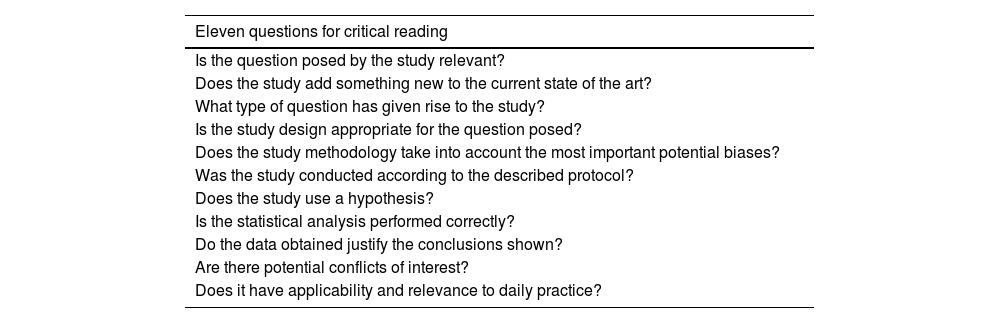
The preparation of the review is the most important step in the editorial process. It develops a large part of the non-interpretive skills and requires the effort of the reviewer to carry out a critical reading of the selected article.35,36 On the other hand, more experienced reviewers should be willing to provide mentoring to newer members. It is recommended that reviewers consult the guidelines of the Consolidated Standards of Reporting Trials (CONSORT)37 before analysing each article. Training courses in editorialism are also promoted, such as SERAM's “Introduction to Publications Course”. The key questions that the reviewer must answer are shown in Table 1.
Summary of questions for a reading of a scientific article.
| Eleven questions for critical reading |
|---|
| Is the question posed by the study relevant? |
| Does the study add something new to the current state of the art? |
| What type of question has given rise to the study? |
| Is the study design appropriate for the question posed? |
| Does the study methodology take into account the most important potential biases? |
| Was the study conducted according to the described protocol? |
| Does the study use a hypothesis? |
| Is the statistical analysis performed correctly? |
| Do the data obtained justify the conclusions shown? |
| Are there potential conflicts of interest? |
| Does it have applicability and relevance to daily practice? |
Modified from the original by Young et al.51
The editorial and IT coordination make a review template available to the reviewers. This template provides a homogeneous format to the article. Every review article must consist of some fixed items that must be completed in each of the works:
Review identifiers- -
Review status: serves as editable text to explain at what point of the process the work is in (pending review, ready to publish, etc.).
- -
Title of the review.
- -
Original article and digital object identifier (DOI): must be referenced in Vancouver format together with the corresponding DOI.
- -
Society: most scientific journals are linked to societies. In this case, reference should be made to the society to which the journal belongs with a link to its website and social media.
- -
Key words.Abbreviations: these should be the abbreviations used in the review, arranged in alphabetical order.
From the SERAM JC it is recommended not to be limited solely to the article that is the subject of the review. Therefore, the reviewer must present the issue of the journal and make a brief comment on those articles that he or she considers interesting.
Reasons for selectionThe selection of an article from a scientific journal must have a justification by the reviewer. In it, the reviewer must present the state of the art regarding the article that is the subject of the review and his or her personal reasons for selecting it. These reasons may include a personal or educational interest.38 With this section, the goal is to create a conceptual framework in which it is worth critically reviewing that article and why this review may be relevant to readers.
AbstractMakes a summary of the article by emphasising its key points. It is preferable to avoid long summaries trying not to exceed more than a page or page and a half (the average number of words for reviews is around 1000–1200).
Personal assessmentIt is a section with free format. It is advisable to mention similar studies to contextualise the article. This critical evaluation must carefully assess the strengths and limitations of the article.38 In this section, the steps of the CONSORT guidelines must be applied and the questions in Table 1 must be answered.
Classifiers of the articleTo facilitate the indexing of the reviews, this section has different labels that help to classify it: section, radiological technique, type of article, year of residence recommended for reading…
Reviewer identifiersIn it, the reviewers must sign each review and include their affiliation, contact email address and, optionally, their identifier in social media.
Peer reviewThe “peer review” period by the review groups takes place between the 7th and 10th of each month. These are made up of four subgroups of about three or four people each. In the different pairings there must be experienced and new reviewers to promote constructive communication. The preparation of the peer review groups is the responsibility of the editorial coordinator.
The peer review process has multiple objectives. By applying the same questions as the reviewer himself or herself, the focus he or she has made on the article is analysed. The ultimate goal is to improve the quality of published papers,39 giving special importance to the grammatical correction of inadvertent errors and reformulating different phrases to facilitate their reading and understanding. Review group members use the Google Docs’ “comment” tool to establish a dialogue in real time and increase the fluency of corrections. Once each member of the review subgroup has made all the corrections and comments on the work of their assigned peers, each reviewer must make the suggested corrections to their article, either incorporating them or debating their usefulness.
Supervision and preparation of the lead articleOn the 11th and 12th of each month, the editorial coordinator supervises the corrections made. This redundancy is intended to imitate the “Swiss cheese” model to prevent errors from spreading in the different sections.40 In this phase, new corrections are proposed and the last adjustments of the review are made. In parallel, an editorial will be written that will be the letter of introduction for that issue. The lead article is usually accompanied by a famous quote chosen by the author and generally summarises some recent milestone in the scientific field and introduces the different reviews of the issue. This lead article is reviewed by another of the editorial coordinators.
IT coordination: layout of the issue and publicationThe IT coordinator is in charge of the layout of the issue in ".pdf" format, using a template system. He or she also designs the cover of the issue, which is generally an attractive radiological image duly referenced from one of the articles subject to review that are open access or under the Creative Commons© license. In addition, he or she individually schedules the automatic publication of all reviews on the WordPress website. The final date of publication of the issue is the 15th of each month. The SERAM JC does not take into account any specific time slot to publish the reviews, although it is true that there is literature that reflects that each web platform and social network have a peak time.41
Statistics and repercussionWordPressThe WordPress platform has provided access to a detailed analysis of the visits to the SERAM JC website since its creation. In the first two years (2013 and 2014), the SERAM JC website received an average of 180–200 daily visits, with a total of 3500−4000 monthly visits. Since then, the number of visits has grown progressively with a notable peak in April 2020. This growth was probably due to the publication of the “COVID-19 Special Issue”,42 in which factors such as the lockdown that took place in Spain during the period of the state of alarm and the large number of articles on the subject at a time of scientific maelstrom surely had an influence.43 At the time of this article, the SERAM JC has received more than two million visits since its creation, currently averaging around 1700−1900 daily visits with around 55,000 monthly visits (Fig. 4). Statistics regarding the number of downloads of our. pdf issues are much more variable, which could be attributed to the convenience and immediacy of viewing an individual review in WordPress versus downloading the entire file.

In the breakdown of visits by country, Spain is the one that contributes the most (more than 750,000 visits), followed by Mexico (>390,000), Argentina (>290,000), Peru (>170,000) and Colombia (>160,000). Below 100,000 visits we currently find countries such as Ecuador, the US, Venezuela and Bolivia, among others. This fact can suggest a niche for the growth of the SERAM JC, for example, through twinning with other Spanish-speaking JCs.
Social mediaThe use of social media is imperative for the dissemination of information today.44 The SERAM JC has a presence on Twitter (@cbSERAM), Facebook and LinkedIn. Twitter is the social network with the largest number of followers. Articles and notifications of the publication of new issues are shared on these networks, looking to maintain an informal format and the promotion of other radiological platforms aimed at residents is encouraged, such as that of SERAM residents (@residentesSERAM).
Coordination and discussion forumsAt the root of the JCs is also the will to share space and passion with professional colleagues who show a common interest in order to create professional and personal ties.45 Due to the distribution and operation of the SERAM JC, mostly virtual, this facet is more complex to acquire. Therefore, the SERAM JC organises open virtual meetings (for all the members of the SERAM JC) or limited to the coordination. At all meetings, minutes must be kept of the points discussed and agreements reached. The main points of discussion tend to be: improvement of the quality of the reviews, new perspectives and content, points of improvement and possible fronts for expansion.
Future outlookThe format of the SERAM JC has remained virtually unchanged since its inception; despite its progression in terms of the number of visits, reviewers and publications, it is imperative to periodically update and review the contents. Online workshops on how to carry out a critical reading have recently been incorporated into the SERAM JC, in which all members participate by contributing different doubts or ideas. This aspect encourages teamwork and allows for discussion among reviewers.
One of the main fronts of the SERAM JC is to strengthen its presence in social media with attractive content for all types of medical specialists. Since maintaining efficient social networks takes a lot of time, the use of online managers has been considered,44 with a specific position for it within the IT Coordination.
Another limiting factor is the production of content exclusively in Spanish. Radiology and international literature are predominantly in English. That is why a long-term objective would consist of managing to translate part of the contents into English. However, it is a process that would require additional time in the preparation of the issues and members with a command of the English language.
Finally, due to the way in which online content is consumed today (preferably video and in real time46), many journals have switched to presenting abstracts or reviews in video format.47 One example of this in Spain is the work of the Radiology Service of the Hospital Morales Meseguer [Morales Meseguer Hospital] on Twitter (@serammeA6SALUD) through the hashtag #Radiologiaparaestudiantes. Therefore, one of the possibilities proposed by the SERAM JC consists of creating audiovisual content for some of its reviews or special issues.
The SERAM JC intends to offer a first approach to training in editorialism. Editorial training is not exclusive to the members of a scientific journal. Both authors and readers can apply editorialism knowledge to assess the quality and applicability of a scientific paper.31,48 These non-interpretive skills that can be contributed from the JC could be part of the training programme of the radiodiagnostic specialty during the residence period.49,50
ConclusionsSince its foundation, the SERAM JC has promoted the acquisition of knowledge related to evidence-based medicine, non-interpretive skills, and training in editorialism through reading and critical review of current radiological articles. During these past 10 years, the SERAM JC has grown progressively in the number of reviewers, publications and visits to its website, practically maintaining the same format since its origin. This format consists of the reviewer selecting an article, following a scheme similar to that of a scientific journal. The skills developed in the JC could form part of the training curriculum in medicine, introducing its members to the editorial process and promoting this aspect beyond the period of specialised training.
Author contributionsDarío Herrán de la Gala: review of the literature, writing and structuring of the article.
Cristina Biosca Calabuig: review of the history of the SERAM JC.
Juan Miranda Bautista: statistical analysis of the SERAM JC.
FundingThe authors declare that they have not received external funding.
Conflicts of interestDarío Herrán de la Gala: editorial coordinator of the SERAM JC. Cristina Biosca Calabuig: former IT and editorial coordinator of the SERAM JC. Juan Miranda Bautista: former editorial coordinator of the SERAM JC.

