


Physicians find it difficult to take on the role of the patient and they show unusual behaviors when ill. One of these behaviors is presenteeism, which is working while sick. The objective of this research is to analyze the factors that contribute to the phenomenon of presenteeism in Spanish physicians.
Material and methodsMixed methodology study: one national survey through the General Council of Medical Associations website (quantitative part), 22 semistructured interviews with sick residents and practicing physicians, and three focus groups involving professionals from the occupational health services (qualitative). A bivariate analysis using parametric and non-parametric tests. The significance level was p<0.05 (95% confidence interval). Qualitative analysis using the comparative-constant method until saturation of information.
ResultsPresenteeism is reported by 89.4% of doctors who responded to the survey, and it is more common among women. Contributing factors include fear of overburdening colleagues (the main reason and more common among women 58.14% vs 48.35%), self-perception of doing one's duty (the second reason and more common among men, 44.63% vs 33.14%) and economic impact and difficulty in accepting the role of a sick person. This behavior has an impact on patient safety, and is part of the hidden curriculum that also affects the training of medical professionals.
ConclusionsPresenteeism is a widespread and accepted practice among medical professionals. Although normalized, and even appreciated as a way to avoid overburdening colleagues, presenteeism has important implications for clinical ethics and patient safety.
A los médicos les cuesta asumir el papel de pacientes y muestran comportamientos anómalos cuando están enfermos. Uno de estos comportamientos es el presentismo, que consiste en trabajar mientras estás enfermo. El objetivo de esta investigación es analizar los factores que contribuyen al fenómeno del presentismo en los médicos españoles.
Material y métodosEstudio de metodología mixta: una encuesta nacional a través de la página web del Consejo General de Colegios de Médicos (parte cuantitativa), 22 entrevistas semiestructuradas a residentes enfermos y médicos en ejercicio, y tres grupos focales en los que participaron profesionales de los servicios de salud laboral (cualitativa). Se realizó un análisis bivariante mediante pruebas paramétricas y no paramétricas. El nivel de significación fue p<0,05 (intervalo de confianza del 95%). Análisis cualitativo mediante el método comparativo/constante hasta la saturación de la información.
ResultadosEl presentismo es referido por el 89,4% de los médicos que respondieron a la encuesta. Y es más frecuente en las mujeres. Entre los factores que contribuyen a ello se encuentran el miedo a sobrecargar a los colegas (principal motivo y más frecuente en las mujeres, el 58,1 frente al 48,4%), la autopercepción de cumplir con el deber (segundo motivo y más frecuente en los varones, el 44,6 frente al 33,1%), el impacto económico y la dificultad para aceptar el papel de enfermo. Este comportamiento repercute en la seguridad del paciente, y forma parte del currículo oculto que también afecta a la formación de los profesionales médicos.
ConclusionesEl presentismo es una práctica extendida y aceptada entre los profesionales de la medicina. Aunque normalizado, e incluso apreciado como una forma de evitar sobrecargar a los colegas, el presentismo tiene importantes implicaciones para la ética clínica y la seguridad del paciente.
When physicians are sick, they have to deal with an inner conflict. They have been trained to treat patients, but not to think of themselves as patients. Common behaviors of sick doctors range from denial to self-treatment, and common consequences include late diagnoses, lack of proper follow-up, and noncompliance with treatment. In short, they do not handle their sickness in the same way as any other patient.1
Presenteeism consists of working while sick.2 According to the literature, it is a common phenomenon among physicians and one that occurs more often in this profession than in others of similar responsibility and socioeconomic level.3 A large number of individual, cultural, occupational, and institutional/organizational factors are proposed as causes.4
Presenteeism can lead to lower productivity and higher economic costs,5 in addition to increased risks for patients,6 including clinical errors, transmission of infections,7,8 and risks to the physicians’ own health, among others. Many physicians are aware of these risks, but they continue to work in a situation for which they themselves would recommend others to take sick leave.9 Some studies have found gender differences in presenteeism rates (higher for women) and in the reasons given for this practice. Concerns about overburdening colleagues are more frequent among female doctors, while patient responsibility and economic reasons are more common among male doctors.10
The very few studies published regarding physicians in training also report high presenteeism rates,11 which increases as training progresses and are highest among practising physicians.12
The aim of this study was to analyze the factors that contribute to the phenomenon of presenteeism in Spanish physicians and throughout their careers by means of a qualitative and quantitative methodology.
Material and methodsThis research uses a mixed methodology with a quantitative section based on a national survey, and a qualitative section in which the researchers have done 22 semi-structured interviews with sick physicians and 3 focus groups.
An online self-report questionnaire was designed and validated13 to obtain information about behaviors and attitudes toward their own illness. The questionnaire was available on The Spanish Medical Colleges Organization website (http://www.cgcom.es/) from June 2017 to June 2018. The link of the survey was publicized on the websites of the medical associations in the 51 provinces of the country to ease access to all registered doctors in Spain. Given Spain's population of 270,000 registered doctors, the determined sample size was 3662. Inclusion criteria encompassed doctors at any stage of their careers, spanning from trainee physicians (MIR, “médico interno residente”) to retired practitioners, with no other specified exclusion criteria.
A descriptive analysis of socio-demographic variables was made, presenting qualitative variables in percentage and continuous variables with median and standard deviation. A bivariate analysis by sex was performed for all the questionnaire variables using Pearson Chi Square test and Mann–Whitney–Wilcoxon test. The significance level was set at p<0.05 (95% confidence interval). All analysis were performed using statistical software (IBM SPSS for Windows, v.22.0).
A total of 22 semistructured interviews were conducted, 12 with practising physicians and 10 with MIR. Nonprobability, purposive sampling was performed, with the selection of physicians at different career stages who were or had been suffering from an illness that was serious enough as to affect their work or training activity. A number of different variables were taken into account, such as sex, type of illness (severe/chronic, physical/mental), specialty (medical/surgical), and workplace (hospital/primary care practice). Each interviewee was given a code number consisting of two parts: first digits referring to career stage (10 practising doctors, 20 training doctors and 30 retired doctors). The second part of the code refers to the order of the different interviews performed (for example: 20-007 means the seven interview of training doctors).
In addition, 3 focus groups were conducted in the qualitative part. In the first focus group (FG1), the participants were members of medical colleges. In the second one (FG2), doctors who care for other sick doctors explained their experiences. The third one (FG3) was held with occupational health specialists of different teaching hospitals. The period of this qualitative section was from May 2015 to June 2017.
Each interview was conducted by a researcher and an observer who took notes. A previously designed script was used covering factors related to the process of dealing with sickness and its impact on their career, learning, and relations with medical associations, as shown in Table 1.
Script of semistructured interviews.
| What can you tell us about the process by which physicians deal with their own illness? | |
|---|---|
| Description of the process of dealing with own illness | • Differences with nonphysician healthcare professionals:• Diagnosis: Timing, treatment pathway, treatment received…• Treatment: Care received, place of treatment (hospital vs clinic), differences found…• Feelings: Anxiety, dependence, denial. Manner: interest, harshness. Tolerance of symptoms. Concern for confidentiality.• Information received: Type of information, amount, physician and patient's attitude, search for additional information…• Attitude of physicians providing treatment: Nervousness, indifference, therapeutic distance, inconvenience, guarantee follow-up or left to the judgment of the sick physician?• Information and knowledge of the sick physician: Advantage or disadvantage• Decision-making: how this is done, by whom, and what influences the decision-maker• Family doctor |
| Impact of sickness on work | • Sick leave: when, who recommends it• Changes in medical practice• Quality of patient care |
| Relationship with colleagues, superiors, and medical associations | • Support received• Measures taken• Possible measures |
| Experience as a physician treating other physicians | • Care pathway• Differences with other patients• Differences between specialists and primary care physicians, primary care vs hospital setting• Differences between active physicians, retired physicians, and physicians in training• Resistance and peculiarities• Sentiments experienced: uneasiness• Identifying a physician as such when presenting as a patient |
The interviews had a duration of approximately one hour, and the focus group had a duration of two hours. All fieldwork was recorded in the form of audio files, and verbatim transcripts were subsequently made.
Statistical analysisThe qualitative analysis of the contents was performed with support from MAXQDA v12 software with categorization and coding of transcript passages by pairs, using discourse analysis grounded theory.14 Initially, based on the bibliography, a “presenteeism” coding category was created that included codes related to the reasoning given for this: “overloading colleagues” and “keeping up level of income.” Moreover, there were two codes that referred to “comparison to other healthcare professionals,” “impact on quality of healthcare service provision,” and “impact on training” (only included in the analysis of physicians in training). After the first analysis rounds, categories that emerged spontaneously and were not included in the literature were included: “early fitness-for-duty certification,” “use as an escape route,” and “corporatism/concealment among colleagues.” This paper uses verbatims as part of its findings and each verbatim is accompanied by the interviewee code and the line number of the interview transcript (for example, 11-001: 72 – 72).
Ethical considerationsThis study is part of the National-wide Project PI18/00968 Enfermar es humano: cuando el paciente es el médico (Getting Sick is Human: When the Doctor is the Patient), which analyzes, quantifies, and describes the process by which physicians deal with their own sickness at different career stages. All the data compiled was treated confidentially, and after providing participants with the appropriate information regarding the project, their informed consent was obtained. This project was also approved by the Clinical Research Ethics Committee of Aragón (PII6/0236).
ResultsA total of 4308 doctors participated in the survey: 2450 women (56.87% of the sample) and 1858 men (43.13%). In the group of practicing physicians, 2057 women (59.37%) and 1408 men (40.63%) participated. In the MIR group, 263 women (73.06%) and 97 men (26.94%) participated. Finally, in the group of retired doctors, 353 men (73.08%) and 130 women (26.92%) participated.
The mean age in the group of active physicians was 46.84±9.69 years in women and 52.93±9.24 in men. Most MIRs (87.8%) were aged between 24 and 34, making them the youngest group in the medical profession (Table 2).
Average age of sample by gender.
| Career stage | Gender | N (%) | Average age | S.D. | p* value |
|---|---|---|---|---|---|
| Total sample | Men | 1858 (43.13) | 54.78 | 11.87 | p<0.005 |
| Women | 2450 (56.87) | 45.95 | 11.76 | ||
| Total | 4306 | 49.76 | 12.59 | ||
| Practising physicians | Men | 1407 (40.63) | 52.93 | 9.24 | p<0.005 |
| Women | 2056 (59.37) | 46.84 | 9.69 | ||
| Total | 3463 | 49.31 | 9.97 | ||
| MIR | Men | 97 (26.94) | 31.67 | 9.91 | p<0.005 |
| Women | 263 (73.06) | 28.90 | 5.95 | ||
| Total | 360 | 29.65 | 7.32 | ||
| Retired doctors | Men | 353 (73.08) | 68.48 | 5.09 | p<0.005 |
| Women | 130 (26.92) | 66.43 | 5.58 | ||
| Total | 483 | 67.93 | 5.30 | ||
N: number; %: percentage; S.D.: standard deviation; MIR: “médico interno residente” or physicians in training.
The survey results show that 9 out of 10 doctors who responded to the survey said they had gone to work while sick, and presenteeism is more common among women (90.29% vs. 88.16%, p<0.05). In the group of practising doctors, 92.95% of women and 89.06% of men go to work when they are sick. And 56.1% admit that they do so often or always. Almost all retired doctors also had a history of presenteeism during their working life (93.08% of women and 89.80% of men). In the MIR group, 68.3% have gone to work when they were ill. And 32% say do it often or always. There was no difference in the prevalence of presenteeism between women and men at the MIR stage (Table 3).
How often have you gone to work with a health problem for which you would have taken a patient off work? By gender and career stage.
| Total sample | Practising physicians | MIR | |||||||
|---|---|---|---|---|---|---|---|---|---|
| Men | Women | Total | Men | Women | Total | Men | Women | Total | |
| Never, rarely | 22011.84% | 2389.71% | 45810.63% | 15410.94% | 1457.05% | 2998.63% | 3030.93% | 8431.94% | 11431.67% |
| Sometimes, often, always | 163888.16% | 221290.29% | 385089.37% | 125489.06% | 191292.95% | 316691.37% | 6769.07% | 17968.06% | 24668.33% |
| Total | 1858 | 2450 | 4308 | 1408 | 2057 | 3465 | 97 | 263 | 360 |
| p value* | 0.025 | 0.000 | 0.855 | ||||||
Presenteeism was considered to be present if the answer to the question was sometimes, often or always.
438 retired doctors also responded to the survey. Presenteeism was an usual practice, 92.95% of women and 89.06% of men.
There are two main reasons for presenteeism in the group of practising doctors: not to overburden colleagues (58.14% women vs. 48.35% men) and responsibility to patients (44.63% men vs. 33.14% women). There were significant differences (p<0.05) in the causes of presenteeism between men and women in this group. The reasons are the same in the MIR group. However, no significant differences were found between women and men in training doctors’ group (Table 4).
The main reason (choose only one) why you came to work when you were ill. Distributed by gender and career stage.
| Total sample | Practising physicians | MIR | |||||||
|---|---|---|---|---|---|---|---|---|---|
| Men | Women | Total | Men | Women | Total | Men | Women | Total | |
| Preservation of revenue | 825.01% | 813.66% | 1634.23% | 695.50% | 713.71% | 1404.42% | 45.97% | 84.47% | 124.88% |
| Do not overburden your co-workers (colleagues) | 79248.35% | 128658.14% | 207853.97% | 61448.96% | 112658.89% | 174054.96% | 4770.15% | 11363.13% | 16065.04% |
| Fear of job loss | 332.01% | 1125.06% | 1453.77% | 302.39% | 995.18% | 1294.07% | 00% | 116.15% | 114.47% |
| Responsibility to patients | 73144.63% | 73333.14% | 146438.03% | 54143.14% | 61632.22% | 115736.54% | 1623.88% | 4726.26% | 6325.61% |
| Total | 1638 | 2212 | 3850 | 1254 | 1912 | 3166 | 67 | 179 | 246 |
| p-Value* | <0.05 | <0.05 | 0.186 | ||||||
438 retired doctors also responded to the survey. The main reason for presenteeism in this group was the responsability to patients, 57.85% of women and 54.89% of men. The second one was do not overburden colleagues, 38.84% of women and 41.32% of men. There were no significant differences observed between women and men with regard to the causes of presenteeism (p 0.766).
The analysis of the interviews and focus group produced important categories that explain why physicians usually report for work when they are unwell, which are described later.
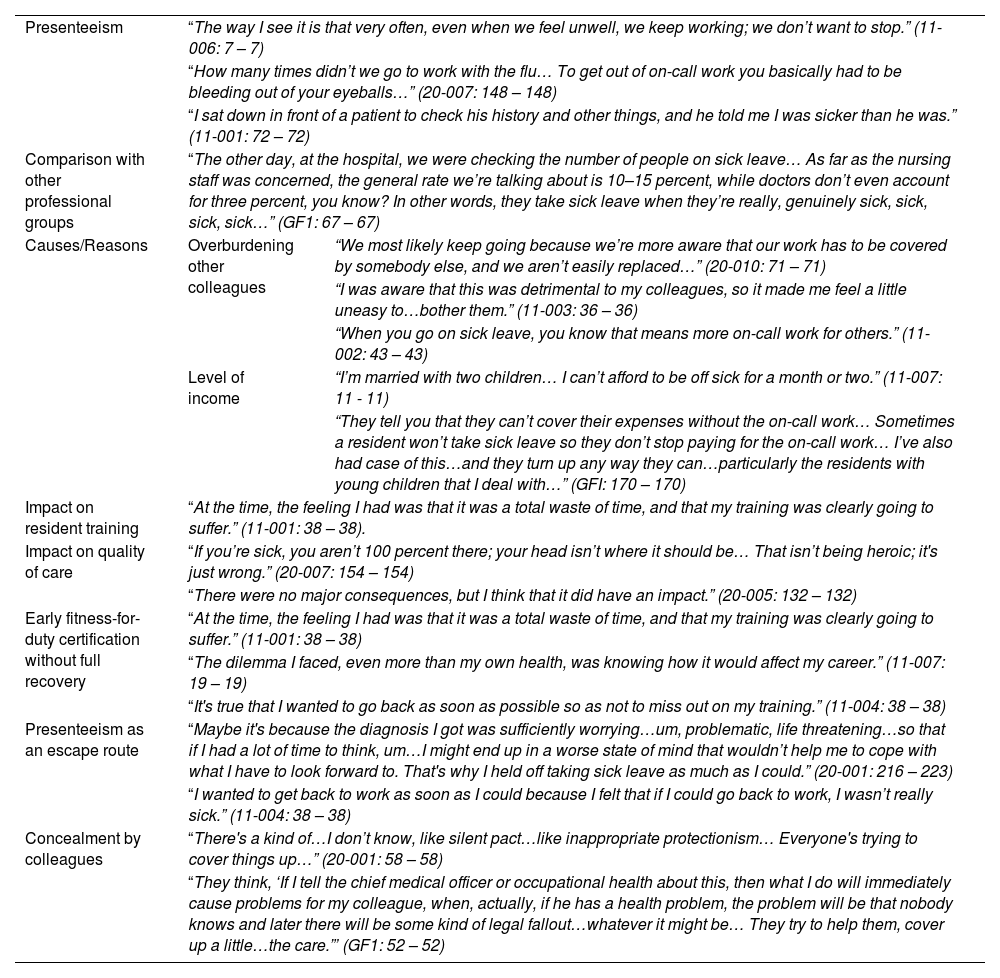
Perception and frequency of presenteeismPresenteeism is shown to be a habitual attitude in all of the studied career stages (Table 5; verbatim codes 20-007: 148 – 148 and 11-001: 72 – 72).
Other passages coded in the categories related to presenteeism.
| Presenteeism | “The way I see it is that very often, even when we feel unwell, we keep working; we don’t want to stop.” (11-006: 7 – 7) | |
| “How many times didn’t we go to work with the flu… To get out of on-call work you basically had to be bleeding out of your eyeballs…” (20-007: 148 – 148) | ||
| “I sat down in front of a patient to check his history and other things, and he told me I was sicker than he was.” (11-001: 72 – 72) | ||
| Comparison with other professional groups | “The other day, at the hospital, we were checking the number of people on sick leave… As far as the nursing staff was concerned, the general rate we’re talking about is 10–15 percent, while doctors don’t even account for three percent, you know? In other words, they take sick leave when they’re really, genuinely sick, sick, sick, sick…” (GF1: 67 – 67) | |
| Causes/Reasons | Overburdening other colleagues | “We most likely keep going because we’re more aware that our work has to be covered by somebody else, and we aren’t easily replaced…” (20-010: 71 – 71) |
| “I was aware that this was detrimental to my colleagues, so it made me feel a little uneasy to…bother them.” (11-003: 36 – 36) | ||
| “When you go on sick leave, you know that means more on-call work for others.” (11-002: 43 – 43) | ||
| Level of income | “I’m married with two children… I can’t afford to be off sick for a month or two.” (11-007: 11 - 11) | |
| “They tell you that they can’t cover their expenses without the on-call work… Sometimes a resident won’t take sick leave so they don’t stop paying for the on-call work… I’ve also had case of this…and they turn up any way they can…particularly the residents with young children that I deal with…” (GFI: 170 – 170) | ||
| Impact on resident training | “At the time, the feeling I had was that it was a total waste of time, and that my training was clearly going to suffer.” (11-001: 38 – 38). | |
| Impact on quality of care | “If you’re sick, you aren’t 100 percent there; your head isn’t where it should be… That isn’t being heroic; it's just wrong.” (20-007: 154 – 154) | |
| “There were no major consequences, but I think that it did have an impact.” (20-005: 132 – 132) | ||
| Early fitness-for-duty certification without full recovery | “At the time, the feeling I had was that it was a total waste of time, and that my training was clearly going to suffer.” (11-001: 38 – 38) | |
| “The dilemma I faced, even more than my own health, was knowing how it would affect my career.” (11-007: 19 – 19) | ||
| “It's true that I wanted to go back as soon as possible so as not to miss out on my training.” (11-004: 38 – 38) | ||
| Presenteeism as an escape route | “Maybe it's because the diagnosis I got was sufficiently worrying…um, problematic, life threatening…so that if I had a lot of time to think, um…I might end up in a worse state of mind that wouldn’t help me to cope with what I have to look forward to. That's why I held off taking sick leave as much as I could.” (20-001: 216 – 223) | |
| “I wanted to get back to work as soon as I could because I felt that if I could go back to work, I wasn’t really sick.” (11-004: 38 – 38) | ||
| Concealment by colleagues | “There's a kind of…I don’t know, like silent pact…like inappropriate protectionism… Everyone's trying to cover things up…” (20-001: 58 – 58) | |
| “They think, ‘If I tell the chief medical officer or occupational health about this, then what I do will immediately cause problems for my colleague, when, actually, if he has a health problem, the problem will be that nobody knows and later there will be some kind of legal fallout…whatever it might be… They try to help them, cover up a little…the care.”’ (GF1: 52 – 52) | ||
When compared to other healthcare professions, working while unwell is more common in physicians, as shown by the focal group of occupational health physicians when speaking about their daily experience (Table 5; verbatim code GF1: 67 – 67).
Causal factors that contribute to presenteeismIn the study the most commonly given reasons for physicians going to work while unwell shows that a major justification is the fear of overburdening colleagues with work (Table 5; verbatim code 11-003: 36 – 36).
Presenteeism is also encouraged by the difficulty in finding individuals to cover the workload of the sick physician, particularly consultations and on-call work. This situation involves another physician having to perform the work of two in the same hours. This was without doubt the most common reason for presenteeism given by the physicians interviewed (Table 5; verbatim code 20-010: 71 – 71).
Another of the prominent reasons given in the study is related to loss of income, an issue that also concerns physicians. The impact on income is more pronounced among medical residents, given that their monthly income is largely dependent on the on-call work performed (Table 5; verbatim code 11-007: 11 – 11). Occupational health physicians also agree with the concern felt by physicians in training about keeping up their level of income (Table 5; verbatim code GF1: 170 – 170).
There are also less evident causal factors for presenteeism, notably its use as an “escape route” for sick physicians. Continuing to work allows them to remain occupied, which is a psychological defense mechanism to reduce anxiety in the case of serious illness (Table 5; verbatim code 20-001: 216 – 223).
Presenteeist behavior may also be a reflection of difficulty in accepting sickness (Table 5; verbatim code 11-004: 38 – 38).
Impact of presenteeism on careConcern for the impact on the care provided to patients caused by presenteeism is a category that appeared in interviews with active physicians, but not with physicians in training (Table 5; verbatim code 20-007: 154 – 154).
On the other hand, medical residents underscored in their interviews their concern for the impact of sickness on their training process. They expressed fear that they would not achieve the necessary knowledge and experience, and the impact it would have on their final assessment from residency program directors. At times, this concern for their training program can lead to unsuitable decisions being made with regard to caring for their own health, such as returning to work earlier than indicated by their condition (Table 5; verbatim code 11-001: 38 – 38).
Finally, presenteeism affects teamwork and creates dysfunction. The analysis points to the trend for colleagues of physicians who work when unwell to conceal their sickness and, consequently, take on and/or supervise part of their work. This supposed “protection” given to the sick physician within a unit or service to prevent problems with patients and a possible impact on care and of a legal nature is a very common situation (Table 5; verbatim code 20-001: 58 – 58). Table 5 shows other passages related to the results described above.
DiscussionThe current study provides insights into presenteeism among Spanish doctors, but it is essential to acknowledge potential biases in both methods and participant responses. The reliance on a self-report questionnaire, hosted on a specific website, introduces selection bias, as physicians who choose to respond may differ in attitudes and behaviors from those who abstain. Social desirability bias is also a concern, as participants might be inclined to offer responses they perceive as socially acceptable, particularly in the survey section, leading to potential underreporting due to ethical concerns and fear of professional consequences. Moreover, participants responding to questions about past behaviors may introduce recall bias. Cultural factors may influence the perception and prevalence of presenteeism too.
Despite employing snowball sampling for interviews and focus groups, nonprobability and purposive sampling introduce potential biases, impacting the representation of participants. The qualitative analysis, particularly grounded theory, may be susceptible to confirmation bias, as researchers with preconceived notions may unconsciously focus on data confirming their beliefs.
Furthermore, the study spans a significant period from May 2015 to June 2018, and societal attitudes and behaviors may have evolved. The data collected earlier may not fully capture the current state of physician attitudes toward presenteeism, especially given the significant impact of the COVID-19 pandemic and telemedicine, as recent publications have highlighted.15 The pandemic has intensified the phenomena, underscoring the relevance of the topic to the health and wellbeing of healthcare professionals as integral contributors to human factors influencing the quality and safety of healthcare provision. However, the sample's representativeness, encompassing all Spanish provinces, along with its size, may aid in mitigating these biases.
Presenteeism is a normalized attitude among the studied physicians (almost 90% of prevalence). Earlier studies on the subject also show high rates of presenteeism, such as that by Rosvold et al.,16 in which 80% of interviewees had worked while unwell during the previous year. Uallachain17 found that 65% of physicians did not consider taking sick leave while they were unwell. As would be expected given their age, the MIR group has a lower rate of presenteeism due to their lower incidence and prevalence of pathologies and less working time.
In his article, Johns18 analyzed how presenteeism is more common in cultures and jobs more prone to loyalty and concern for vulnerable clients (patients, children, older people). However, the same authors also explain that the same professions are precisely those most likely to suffer from understaffing. This is a confounder when it comes to explaining why physicians report for work when unwell.
Occupational health physicians pointed out in their interviews that presenteeism is more common among physicians that in other healthcare professions, such as nursing. This difference may be due to the greater difficulty in finding replacement physicians and their lower availability. On the other hand, presenteeism among physicians may be encourages by the strong professional and sentimental identification with patients, colleagues, and institutions that is characteristic of the profession.19
With regard to gender, the results of this research are consistent with those of some studies which have found higher rates of presenteeism among women than men.10,20 However, it is important to note that the differences in prevalence and reasons for presenteeism among female doctors compared to male doctors were not found in the group of doctors in training.
There were also differences between men and women in the reasons for their presenteeism. While women justify their presenteeism in terms of “not overburdening their colleagues”, men are more likely than women to justify their presenteeism in terms of “patient responsibility” and “money”.20 These differences are probably the effects of gender stereotypes and of different responsibilities within families. While the interviews and focus groups did not produce reflections on gender differences with regard to presenteeism, both the literature and preliminary analysis of the quantitative stages of the project to which this study belongs show a need for further development of this hypothesis.
As we have seen, the causes of presenteeism include conscious attitudes, such as solidarity toward colleagues with regard to the additional workload resulting from absence, commitment to patients and the institution, the impact of the loss of training, and issues related to income and work contracts, among others. However, other unexpected issues emerged related to the high level of self-demand and the use of work as a defense against the feeling of vulnerability produced by sickness (difficulty in accepting that one is unwell).
With regard to physicians in training, who are very concerned about their career path, presenteeism may operate as a learned behavior or reinforced during their college years by observing professors and other faculty, and for the rewards associated with effort and sacrifice at medical school, even at the cost of neglecting their own health. In other words, there is a hidden curriculum that transmits these values to the detriment of self-care and personal wellbeing.21
Working when unwell can cause attention problems, leading to errors in patient care and, consequently, affecting patient safety. The interviews clearly show how errors are perceived and poor-quality care is provided to patients by physicians who work when unwell. Improving awareness of the need for physicians to be in good physical conditions when treating patients should be one of the priorities of healthcare providers.22
Considering its ethical importance, we must point out the tendency by part of the profession to minimize the impact of sickness and even conceal it, a reflection of the perception that sickness is a circumstance that diminishes the credibility and prestige of the physician. This “conspiracy of silence,” which is more common that would be expected, particularly in situations of mental illness, enhances the stigma23 of sickness and keeps physicians from speaking about their health problems or those of their colleagues.24 This causes dysfunction in medical teams that keep a sick physician working and increases the uneasiness of the professionals involved. For this reason, there is an ethical duty in certain countries to report cases of colleagues who practice in conditions that are less than ideal, and this duty may even become a legal obligation.25
To conclude, presenteeism is part of the culture of the medical profession. A habitual attitude during training stages, it is approved and accepted by medical professionals, and even considered normal by patients. Overburdening colleagues and lost income are the most common causes, although others, such as the use of work as a defense mechanism for denying illness are also prominent. Behaviors of false protectionism by others in the medical team delay the sick physicians from dealing with their illness and may contribute to lowing patient safety standards.
The ethics and patient safety-related issues raised by this subject make it necessary to implement interventions to train physicians to recognize their vulnerability and care for their own health from the earliest stages of their career.
Authors’ contributions (use CRediT terms)Conceptualization: María Pilar Astier Peña, Bárbara Marco Gómez. Data curation: Oscar Urbano Gonzalo, Alba Gállego Royo, María Pilar Astier Peña. Formal analysis: Bárbara Marco Gómez, Candela Pérez Álvarez, Alba Gállego Royo, María Pilar Astier Peña. Funding acquisition: María Pilar Astier Peña. Investigation: Oscar Urbano Gonzalo, Bárbara Marco Gómez, Candela Pérez Álvarez, Alba Gállego Royo, Inés Sebastian Sánchez, María Pilar Astier Peña. Methodology: Oscar Urbano Gonzalo, Bárbara Marco Gómez, Candela Pérez Álvarez, Alba Gállego Royo, María Pilar Astier Peña. Software: Alba Gállego Royo. Validation: Bárbara Marco Gómez, Candela Pérez Álvarez, Alba Gállego Royo, María Pilar Astier Peña. Visualization: Oscar Urbano Gonzalo, Bárbara Marco Gómez, Inés Sebastián Sánchez. Writing – original draft: Oscar Urbano Gonzalo, Bárbara Marco Gómez, Alba Gállego Royo. Writing – review & editing: Oscar Urbano Gonzalo, Bárbara Marco Gómez, Alba Gállego Royo, Ines Sebastián Sánchez, María Pilar Astier Peña.
FundingThis work was supported by the National Institute of Health Carlos III (ISCIII), “PI18/00968”, co-funded by the European Union Project also funded by the Government of Aragon, through the research group Feminisation and Ethics of Health Professions (FEPS) H36_23D. Institute of Health Research of Aragón (IIS Aragón).
Conflicts of interestNone declared.
Monica Lalanda and Yo, Doctor for their assistance with the visual aspects of this project.
The first and second authors are considered by all participants in this study to have had an equal workload and responsibility.



