


metricas
covid
Gastroenterología y Hepatología (English Edition) Sudden dysphagia: A diagnostic challenge
Journal Information
Vol. 46. Issue 3.
Pages 201-202 (March 2023)
Vol. 46. Issue 3.
Pages 201-202 (March 2023)
Image of the month
Full text access
Sudden dysphagia: A diagnostic challenge
Disfagia súbita: un reto diagnóstico
Visits
382
Sara Martínez Delgado
Corresponding author
saram_corella@hotmail.com

Corresponding author.
, Alejandro Minguez, Marco Bustamante, Pablo Ladrón Abia, Pedro López Muñoz, Vicente Pons Beltrán
Hospital Universitari i Politècnic La Fe, Valencia, Spain
This item has received
Article information
Full Text
Bibliography
Download PDF
Statistics
Figures (3)
Show moreShow less
Full Text

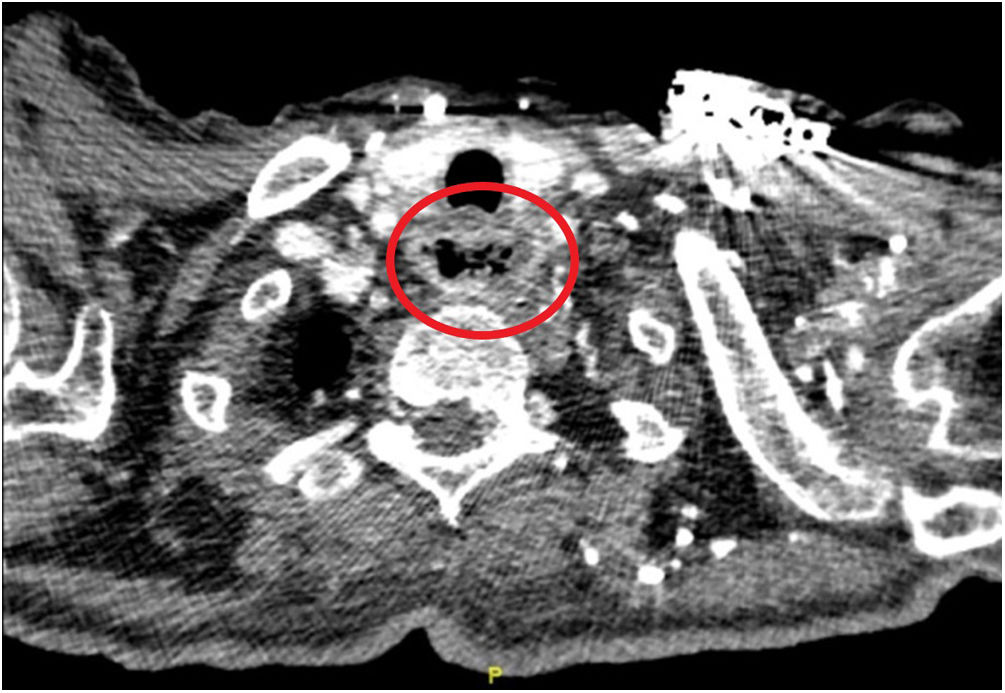
A 77-year-old man on anticoagulation with apixaban for atrial fibrillation and advanced frontal dementia attended the Accident and Emergency Department due to vomiting blood and dysphagia. The initial endoscopy was inconclusive due to a mass with clots, which prevented the examination of the oesophageal lumen. A computed tomography scan showed a para-oesophageal collection and thickening and narrowing of the oesophageal lumen, suggesting neoplasia (Fig. 1). A second endoscopy was requested, in which a blister was found embedded in the upper oesophageal sphincter (Fig. 2). It was extracted with foreign body forceps using a variceal ligation cap. After extraction, two deep contralateral ulcers were identified in the cervical oesophagus, the probable origin of a peri-oesophageal abscess (Fig. 3).

Figure 1.

Periesophageal abscess in cervical oesophagus.

Figure 2.

Blister occluding oesophageal lumen.

Figure 3.

Bilateral deep ulcers after blister removal.

A more detailed history revealed that the patient had started treatment with oral calcium days before.

The differential diagnosis of the origin of a peri-oesophageal abscess should include the ingestion of foreign bodies, especially in older adult patients with an impaired cognitive level.1,2 Although not in our case, computed tomography is usually diagnostic.3,4

If an overtube is not available, the use of the ligation cap for removal can be helpful to protect the oesophageal mucosa.


References
[1]
I. Tzur, M. Shteinshnaider, I. Alon, D. Almoznino-Sarafian, N. Cohen, O. Gorelik.
Esophageal impaction caused by a blister-wrapped tablet: case report and review of the literature.
Eur Geriatr Med., 7 (2016), pp. 190-193
[2]
S.M. Laeeq, A.A. Rai, A.A. Tasneem, N.H. Luck, Z. Majid.
Pill in the blister pack: a rare cause of dysphagia in an elderly adult.
Pan Afr Med J., 22 (2015), pp. 176
[3]
L.W. Yip, F.S. Goh, R.S. Sim.
“I’ve got a UFO stuck in my throat!”—an interesting case of foreign body impaction in the oesophagus.
Singapore Med J., 39 (1998), pp. 121-123
[4]
B. Coulier, R. Rubay, S. Van den Broeck, A.R. Azar, P. Maldague, P. Mailleux, et al.
Perforation of the gastrointestinal tract caused by inadvertent ingestion of blister pill packs: report of two cases diagnosed by MDCT with emphasis on maximal intensity and volume rendering reformations.
Abdom Imaging., 39 (2014), pp. 685-693
Copyright © 2022. Elsevier España, S.L.U.. All rights reserved
Download PDF
Article options
Tools