



metricas
Gastroenterología y Hepatología (English Edition) Pancreatic PEComa, a not so uncommon neoplasm? Systematic review and therapeutic...
Journal Information
Visits
300
Vol. 47. Issue 1.
Pages 93-100 (January 2024)
Review
Full text access

Pancreatic PEComa, a not so uncommon neoplasm? Systematic review and therapeutic update

PEComa pancreático ¿una neoplasia no tan infrecuente? Revisión sistemática y actualización clínico-terapéutica
Visits
300
Manuel Nogueira Sixtoa,
Corresponding author
manunogueirasixto@gmail.com

Corresponding author.
, Roberto Carracedo Iglesiasa, Sergio Estévez Fernándeza, Carlos Rodríguez Pereirab, Raquel Sánchez Santosa
a Servicio de Cirugía General y del Aparato Digestivo, Complejo Hospitalario Universitario de Vigo, Vigo, Galicia, Spain
b Servicio de Anatomía Patológica, Complejo Hospitalario Universitario de Vigo, Vigo, Galicia, Spain
This item has received
Article information
Abstract
Full Text
Bibliography
Download PDF
Statistics
Figures (2)
fig0005
fig0010
Tables (2)
Table 1. Radiological features of pancreatic PEComas.
Tables
Table 2. Malignancy criteria, Folpe et al.
Tables
Show moreShow less
Additional material (1)
Abstract

Pancreatic PEComas are extremely rare neoplasms with malignant potential, which mostly affect middle-aged women and are characterized by presenting melanocytic and myogenic markers in immunohistochemical analysis. There are no symptoms or pathognomonic imaging tests, so the diagnosis is established with the analysis of the surgical specimen or the FNA obtained with preoperative endoscopic ultrasound. The mean treatment consists on radical excision, adapting the intervention to the location of the tumor. To date, 34 cases have been described; however, more than 80% of them have been reported in the last decade, which suggests that it is a more frequent pathology than expected. A new case of pancreatic PEComa is reported and a systematic review of the literature is carried out according to the PRISMA guidelines with the aim of divulge this pathology, deepening its knowledge and updating its management.

Keywords:
PEComa
Perivascular epithelioid cell tumour
Pancreas
Neoplasm
Surgery
Resumen

Los PEComas pancreáticos son neoplasias con potencial maligno extremadamente raras, que afectan mayoritariamente a mujeres de mediana edad y que se caracterizan por presentar marcadores melanocíticos y miogénicos en el análisis inmunohistoquímico. No existen síntomas ni pruebas de imagen patognomónicas. El diagnóstico se establece con el análisis de la pieza quirúrgica o de la PAAF obtenida con ecoendoscopia preoperatoria. El tratamiento más habitual consiste en la exéresis radical, adecuando la intervención a la localización del tumor. Hasta la fecha se han descrito 34 casos, no obstante, más del 80% de los mismos han sido reportados en la última década, lo que sugiere que es una patología más frecuente de lo esperado. Se reporta un nuevo caso de PEComa pancreático y se realiza una revisión sistemática de la literatura de acuerdo con las guías PRISMA con el objetivo de difundir su existencia, profundizar en su conocimiento y actualizar su manejo.


Palabras clave:
PEComa
Perivascular epithelioid cell tumour
Páncreas
Neoplasia
Cirugía
Full Text
Introduction

Pancreatic perivascular epithelioid cell tumours (PEComas) are extremely rare tumours. A total of 34 cases have been described to date. The WHO defined it in 2016 as a mesenchymal tumour composed of perivascular epithelioid cells (PEC). They are characterised by a focal association with the vessel wall and simultaneous expression of melanocytic and myogenic markers. PEComas can affect a wide variety of organs and their morphology can vary, making their diagnosis challenging.1 PECs were first described in 1943 by Apitz et al.2 but it was not until 1992 that Bonetti et al. first used the term perivascular epithelioid cells according to their immunoreactivity and pathological characteristics. Tumours derived from these cells were termed PEComas.3 Subsequently, angiomyolipomas (AML), clear cell sugar tumours of the lung (CCST), lymphangioleiomyomatosis (LAM) and other atypical visceral neoplasms that may involve intra-abdominal organs, bone and soft tissues were included in the PEComa family. Currently, with the exception of AML, CCST and LAM, all other PEComas are referred to as non-specific PEComas (PEComas-NOS).4

Methods

Use of own clinical case and systematic review of available literature according to PRISMA guidelines. The search was performed in PubMed, Embase and Web of Science using the combination of the following MeSH terms: (“perivascular epithelioid cell tumour” or “PEComa”) AND (“pancreatic” OR “pancreas”). All existing publications in English, Spanish or French concerning patients with diagnosed pancreatic PEComa were included regardless of the type of publication.

The review and selection of articles of interest was carried out by two independent researchers. A first selection was made from the total number of articles based on title, authors, keywords and abstract. The pre-selected articles were then read through to identify the final articles of interest. Duplicate articles were excluded. The following variables were collected from these articles: age, sex, clinical presentation, tumour location and size, FNA, diagnostic tests, pathological features, treatment, duration of follow-up and relapse or metastasis.

Results

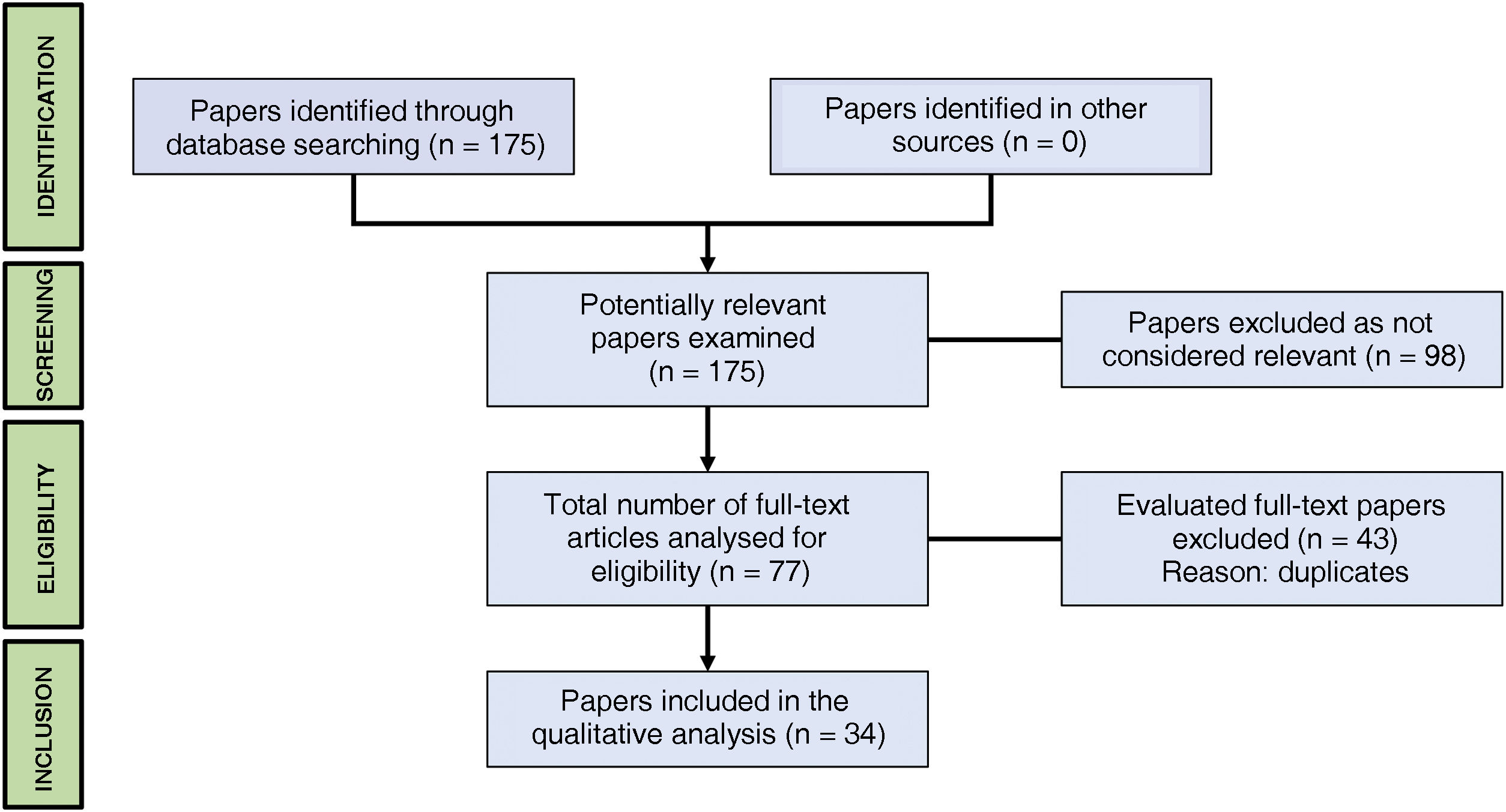
The search was conducted in July 2022. A total of 175 potentially relevant articles were found. Of these, only 77 were selected for full reading on the basis of interest. After eliminating duplicates, a total of 34 articles were included in the qualitative analysis (Fig. 1). The articles selected for this paper were images of the month,2 abstracts,1 letters to the editor,3 original articles,2 case reports,24 case series1 and systematic reviews.1

Figure 1.

Flow chart of bibliographic search according to PRISMA guidelines.

Case report

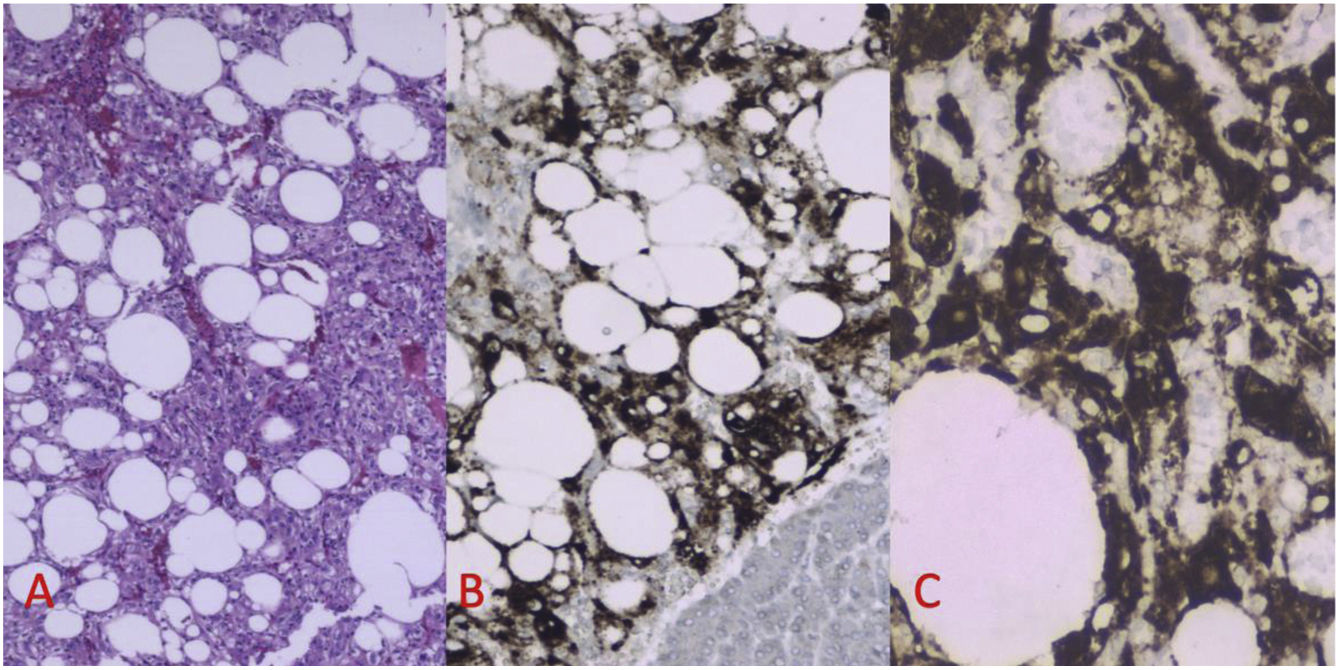
A 68-year-old man was admitted to the hospital for abdominal pain in the left hypochondrium of six months' duration. An abdominal CT scan showed a 7.8-cm pancreatic mass located in the head of the pancreas which, after completing the studies, was radiologically characterised as a T3N0M0 neuroendocrine tumour. No preoperative endoscopic ultrasound was performed. Following a multidisciplinary committee, a pylorus-preserving cephalic pancreaticoduodenectomy was indicated. The postoperative period was without incident and the patient was discharged on day eight after the procedure. Pathological analysis identified a neoplastic lesion of smaller size than estimated by radiological evidence (5.5cm maximum diameter) with epithelioid cells without areas of necrosis or haemorrhage and with mitoses <1/50 HPF with positivity for HMB-45, Melan-A, ∞-SMA, S-100 and focally for CD68 (Fig. 2). In contrast, it was negative for desmin, endocrine markers and cytokeratins. It was classified as a pancreatic PEComa of uncertain malignant potential given the size of more than 5cm in maximum diameter. The surgical margins and all lymph node levels were free of tumour. After 18 months of follow-up with thoracoabdominal CT every six months, the patient remains disease free and asymptomatic.

Figure 2.

Pathological and immunohistochemical analysis. A) Pathology (H&E, 4×): epithelioid cells, highly vascularised, with a large lattice of adipose tissue. B) Immunohistochemistry: positive for HMB-45, in contrast to adjacent pancreatic parenchyma. C) Immunohistochemistry: cytoplasmic positivity for MELAN-A.

Epidemiology

PEComas affect intra-abdominal organs with some frequency, but pancreatic involvement is uncommon.1 To date, 35 cases have been reported in Spain, 29 of which (82.5%) have been reported in the last 11 years. The table in Appendix B Annex 1 summarises the demographic and clinical characteristics of these cases.

It typically affects females (4:1 ratio) in their 30s and 40s. The mean age at diagnosis is 48.4 years (median 49). Mutations in the TSC1 or TSC2 genes have been detected in two of the 35 cases described (5.7%).

The mean pre-surgical size was 38.8mm (range 6–115mm), while the mean post-surgical size was 41.3mm (range 1.2–140mm). Of the 35 cases, 15 were located in the pancreatic head (42.8%), 10 in the body (28.6%) and six in the tail (17.1%). In three of the 35 cases (8.6%) the tumour involved two pancreatic areas.

Aetiopathogenesis

It has not been possible to determine the origin of these neoplasms. There are no non-pathological cells homologous to PECs in normal tissue.5 Four possible origins of PECs have been proposed: undifferentiated neural crest cells, telocytes, mesenchymal stem cells and pericytes and myoblasts. In all cases, the authors have relied on the immunohistochemical similarities and the ultrastructure of PECs and these cells.6–10

Moreover, genetic typing has been carried out to try to determine whether there are mutations that induce the appearance of PEComas. Two genetic theories have been proposed:

  • 1.

    TSC1 and TSC2: tuberous sclerosis (TS) with associated mutations in TSC1 (9q34; 27%) and TSC2 (16p.13.3; 73%) leading to overactivation of the Rheb/mTOR/p70S6K pathway.2,4 Kenereson et al. have described an increase in p70S6K in renal and hepatic angiomyolipomas, which translates into mutations in TSC1 and TSC2. Mutations in these genes were detected in two of the 35 cases described but no increase in p70S6K was detected.4,11–13

  • 2.

    Microphthalmia-associated transcription factor (MiTF): PEComas share histomorphological features with tumours overexpressing the MiTF gene. This overexpression induces an increase in TFE3 that could be observed in hepatic and pulmonary PEComas, but could not be confirmed in any of the described cases of pancreatic PEComas.4

Clinical presentation

These tumours are characterised by their non-specific presentation. In eight of the 35 cases (22.9%), patients were asymptomatic and the diagnosis was incidental. As presented in the table included in Appendix B Annex 1, the most common symptom was abdominal pain or discomfort (18 out of 35 cases; 51.4%), while the second most frequent symptom was abdominal mass or tumour (five out of 35; 14.3%). Jaundice, flu-like syndrome or melaenas were also reported. There is no pathognomonic symptom, sign or combination of symptoms.

Diagnosis

A high diagnostic suspicion is necessary. The diagnostic mainstays are CT, MRI, ultrasound and endoscopic ultrasound (EUS) with FNA. However, only histopathological and immunohistochemical analysis of the FNA or surgical specimen will provide a definitive diagnosis.16,17

Imaging

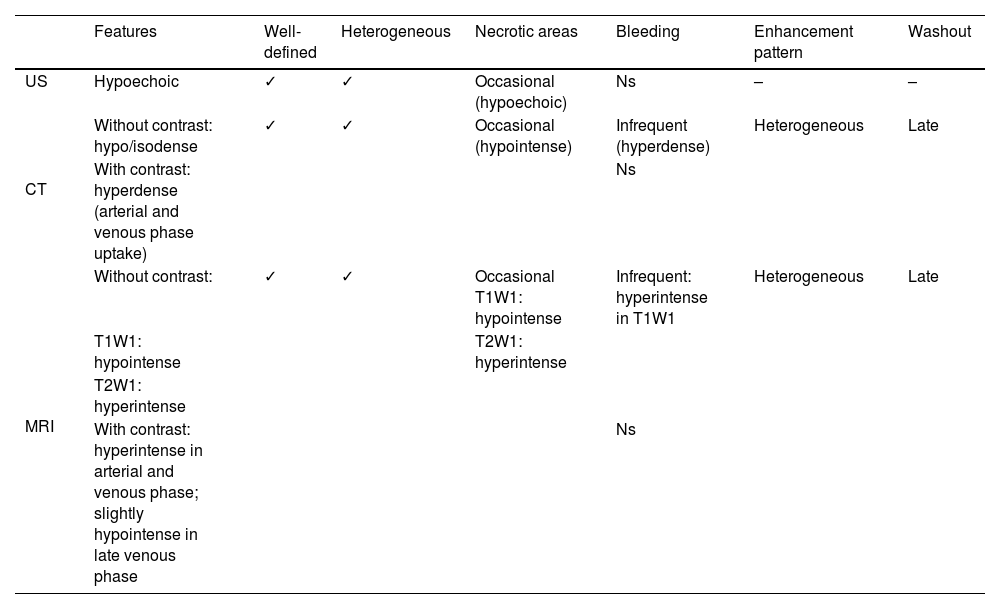
Pancreatic PEComa cannot be diagnosed by imaging.14 However, in all described cases of this neoplasm, some radiological features (on ultrasound, CT and MRI) were collected and are detailed in Table 1.

Table 1.

Radiological features of pancreatic PEComas.

  Features  Well-defined  Heterogeneous  Necrotic areas  Bleeding  Enhancement pattern  Washout 
US  Hypoechoic      Occasional (hypoechoic)  Ns  –  – 
CTWithout contrast: hypo/isodense      Occasional (hypointense)  Infrequent (hyperdense)  Heterogeneous  Late 
With contrast: hyperdense (arterial and venous phase uptake)        Ns     
MRIWithout contrast:      Occasional T1W1: hypointense  Infrequent: hyperintense in T1W1  Heterogeneous  Late 
T1W1: hypointense      T2W1: hyperintense       
T2W1: hyperintense             
With contrast: hyperintense in arterial and venous phase; slightly hypointense in late venous phase        Ns     

Source: references 14,15 and 18–22.

18F-Fluorodeoxyglucose [18F-FDG] PET-CT is known to be useful in the diagnosis and follow-up of non-pancreatic PEComas. In addition, this test has proven useful in laboratory studies in the characterisation of PEComas as benign or malignant as they have different avidity for 18F-FDG. Despite the above, its use has not yet been described in any case of pancreatic PEComa.14,23,24

Fine needle aspiration (FNA) biopsy

EUS-guided FNA (EUS-FNA) is the only preoperative test that can definitively diagnose PEComa.26 Theoretically, this technique allows sufficient tumour material to be obtained for immunohistochemical analysis. EUS-FNA was performed in 19 of 35 cases (54.3%) and was diagnostic in 13 of them, giving a diagnostic yield of 63.2%. In most cases in which no diagnosis was established, it was because the cellular material obtained was insufficient for immunohistochemical analysis. This may be due to the high inter-cohesion and inter-vascularisation of the cells of the PEComas.

Morphological and immunohistochemical characteristics of PEComas

Macroscopically, they are tumours that are well-defined by a thin fibrous capsule. Inside, they are composed of solid greyish-white areas and cystic areas that may contain blood.27

Microscopically, regardless of their location, they are biphasic tumours composed of epithelioid and spindle cells in close association with vessel walls. Of the 22 cases that studied glycogen granules, they were detected in 14 (63.6%). Necrosis is unusual and mitoses are rare.27–30 Pancreatic PEComas are characterised by epithelioid cells with clear-eosinophilic cytoplasm with oval nuclei and prominent nucleoli. The cases described include five cases subclassified as AML, five cases of CCST and one case of LAM.

Immunohistochemically, they express melanocytic and myogenic markers simultaneously. This immunohistochemical pattern is diagnostic. Some 97.4% were positive for HMB-45, 82.8% for α-SMA, 80% for Melan-A, 33.3% for S-100 and 26.7% for desmin. The rest of the immunohistochemical characteristics collected are shown in the table included in Appendix B Annex 2.

Malignancy criteria

To determine the nature of the tumour, Folpe et al. have established criteria for malignancy. They are described in Table 2.35

Table 2.

Malignancy criteria, Folpe et al.

Tumour characteristics  Points 
Size >5cm 
Infiltrative growth pattern 
High nuclear grade or hypercellularity 
Necrosis 
Vascular invasion 
Mitotic activity >1/50 high-power fields (HPF) 

0: benign; 1: uncertain malignant potential; 2: malignant.

Differential diagnosis

Neoplasms or lesions that share radiological and/or pathological features with PEComas are solid pseudopapillary tumour (SPT) of the pancreas, clear cell pancreatic endocrine tumour, metastases from other neoplasms (especially clear cell renal neoplasm and melanoma due to some similarities in pathological anatomy), pancreatic GIST and clear cell sarcoma of soft tissue. In all cases the differential factor will be immunohistochemistry, so it is essential to apply it to the FNA sample or surgical specimen to establish a diagnosis.24,29,36–38

Treatment

Given the small number of cases described, it is difficult to establish the best treatment. Moreover, in 22 of the 35 cases (62.9%), the diagnosis was reached after immunohistochemical analysis of the surgical specimen, at which point it is no longer possible to opt for other types of treatment. Neoadjuvant therapy was not administered in any case. Therapeutic options are as follows:

Surgery: this was opted for in 29 out of 32 cases (90.7%). Complete excision with free surgical margins is the goal and should be tailored to the location of the tumour.4,12,26,28–33,39–52 Enucleation, minor surgery or total pancreatic excision was opted for in three cases.34,43,53 In three of the cases described, the therapeutic management followed was not specified.54,55

“Watch and wait”: Zizzo et al. describe the only known case to date in which conservative management with regular clinical and radiological follow-up was opted for. This decision was based on the clinical characteristics of the patient (multi-pathological and elderly) with a pancreatic PEComa without malignancy criteria; after 20 months of follow-up the lesion remained stable in the imaging tests and showed no changes in the FNA performed.56

Adjuvant chemotherapy: Zhang et al. describe the use of adjuvant chemotherapy in a patient with malignant pancreatic PEComa and known liver metastases at diagnosis. An ifosfamide, epirubicin and Endostar regimen was followed.50

Chemoembolisation: Nagata et al. describe the use of chemoembolisation with lipiodol-pharmorubicin for the treatment of a liver metastasis detected 27 months after surgery. Twelve months after chemoembolisation and 39 months after surgery, the patient is still alive.32

Immunotherapy: Gondran et al. described the first pancreatic PEComa treated in monotherapy with sirolimus (mTor inhibitor). Based on the work of Kenerson et al. and Wagner et al. and the relationship described between some forms of PEComa and mutations in TSC1 and TSC2, sirolimus was administered to a young patient (17 years old) in order to avoid the morbidity and mortality associated with surgical treatment.11,23,57,58 Partial remission and stabilisation of the disease was achieved with good tolerance to treatment, and after 30 months of follow-up the patient is still alive and has not developed distant disease.57

Follow-up

Follow-up is described in all cases regardless of the therapeutic option chosen by the authors. All authors opted for regular clinical-radiological surveillance. The mean follow-up described is 23.1 months (range 3–144) with a median of 14 months. No deaths have been reported. In the group of patients who were treated surgically, there were no cases of locoregional recurrence, although there were two cases of liver metastases after surgery at 27 and six months. In the first case, chemoembolisation of the liver lesion was opted for; after 20 months of follow-up, the patient is still alive. In the second, the authors do not specify the management. In both cases the tumours were initially characterised as malignant according to Folpe’s malignancy criteria.32,46

According to Zizzo et al., endoscopic ultrasound with FNA should be associated with routine imaging tests in cases where a “watch and wait” approach is opted for. The aim is to detect radiological or pathological changes that lead to characterisation of the lesion as malignant. This would entail a change in therapeutic attitude.

Discussion

This is a rare pathology. Twenty-nine of the 35 cases described (82.9%) were diagnosed in the last 11 years; probably related to the development of pathology and the widespread use of immunohistochemistry for characterising tumours and neoplasms that are difficult to classify. This leads us to believe that pancreatic PEComas may be more common than expected. These neoplasms manifest with non-specific clinical and radiological features. The most common clinical presentation is abdominal pain, followed by abdominal mass, while there is no pathognomonic radiological finding. For this reason, in a large percentage of cases the diagnosis is incidental or is not established until a pathological and immunohistochemical analysis of the surgical specimen is carried out.

Although imaging tests are useful, only the pathological and immunohistochemical analysis of a histological sample obtained by endoscopic ultrasound and FNA or of the surgical specimen can provide a definitive diagnosis. In the available literature, PET/CT has not yet been used for the diagnosis and/or follow-up of any case of pancreatic PEComa, but it has been used in PEComas located in other organs. There are robust studies indicating that malignant PEComas have moderate/high avidity for 18F-FDG, while benign PEComas have low avidity. For this reason, it could be useful in the diagnosis of lesions not detected in the other tests, in the follow-up and in the characterisation of the lesion as benign or malignant.14,15,25 Folpe et al. have described the only known criteria for malignancy so far. This classification divides tumours into malignant, tumours of uncertain malignant potential or benign tumours according to the histological and radiological features of PEComas.35 Whether uptake on 18F-FDG PET-CT is useful in the classification of these tumours warrants further study.

The treatment of choice remains surgery with the aim of achieving complete excision of the tumour. Despite complete excision, two cases of the onset of distant disease at six and 27 months, respectively, have been reported.32,46 In addition, a case of malignant pancreatic PEComa treated with sirolimus monotherapy has been reported with partial remission and subsequent stabilisation of the lesion after more than 30 months of follow-up.57 The authors of this article consider it prudent to use it in monotherapy in patients in whom it is preferable to avoid the morbidity and mortality associated with surgery, i.e. patients at the end of life or with high associated comorbidity.

The authors of this article consider that “watch and wait” management should only be considered as a therapeutic option in those cases in which the pancreatic PEComa is classified as benign and does not invade or compress other organs or structures and the patient falls into one of the following two groups: 1) an elderly and/or frail patient with major comorbidities, low functional reserve and high anaesthetic/surgical risk; 2) patient refusal of surgical management. If, during follow-up, the status of the lesion changes from benign to malignant or of uncertain malignant potential, or if the patient develops any type of symptomatology, we believe that the case should be re-evaluated and the appropriate surgical intervention proposed for each case.

With regard to adjuvant therapies, we believe that they should be used in cases where metastatic disease is detected at diagnosis or is detected during follow-up. The epirubicin, ifosfamide and Endostar regimen or chemoembolisation with lipiodol-pharmorubicin are described and valid options.32,50,57 However, taking into account the good response documented with the use of sirolimus and the described alterations of the mTOR pathway, an mTOR inhibitor is probably the best adjuvant treatment available. However, more cases need to be documented and the alterations in the Rheb/mTOR/p70S6K pathway need to be further investigated to determine which of the three options is most beneficial.

Conclusion

Pancreatic PEComas are generally benign and their prognosis is relatively good. An analysis of disease-free survival after surgery reveals that most patients are alive and disease-free at 24 months follow-up. However, those classified as malignant can lead to death within 12 months of diagnosis.

Pancreatic PEComa is a tumour with capacity for malignancy that can decrease life expectancy. The best available diagnostic test is EUA-guided FNA. Correct diagnosis, treatment and follow-up can cure and/or control disease progression. These patients generally benefit from radical surgical resection, which may be complemented by adjuvant chemotherapy/immunotherapy in cases where malignancy or local recurrence or distant disease develops postoperatively. However, the risks of surgical resection must be assessed on a case-by-case basis, as in patients where the surgical risk is very high or unacceptable or the patient refuses the procedure, conservative “watch and wait” management or chemotherapy with mTOR inhibitors (sirolimus) could be considered. More cases need to be documented in order to establish the optimal management of these tumours. We therefore consider it necessary to raise awareness of its existence and the best known management to date.

Ethical considerations

This article is a systematic review and therefore ethics committee approval was not required. All clinical data of the case provided have been duly anonymised and consent has been sought from the patient for use in this article.

Funding

This article received no specific funding from public, private or non-profit organisations.

Conflicts of interest

The authors declare that they have no conflicts of interest.

Appendix A
Supplementary data

The following is Supplementary data to this article:

Icono mmc1.doc

References
[1]
G. Martignoni, M. Pea, D. Reghellin, G. Zamboni, F. Bonetti.
PEComas: the past, the present and the future.
Virchows Arch, 452 (2008), pp. 119-132
[2]
M. Zizzo, L. Ugoletti, D. Tumiati, C. Castro Ruiz, S. Bonacini, M. Panebianco, et al.
Primary pancreatic perivascular epithelioid cell tumor (PEComa): a surgical enigma. A systematic review of the literature.
[3]
F. Bonetti, M. Pea, G. Martignoni, G. Zamboni, M.J. Gaffey, S.E. Mills, et al.
PEC and sugar.
Am J Surg Pathol, 16 (1992), pp. 307-308
[4]
C. Geng, Z. Cao, B. Bacacao, Z. Cao.
Perivascular epithelioid cell tumor of the pancreas: case report and literature review.
Int J Clin Exp Pathol, 14 (2021), pp. 653-661
[5]
J.L. Hornick, C.D.M. Fletcher.
PEComa: what do we know so far?.
Histopathology, 48 (2006), pp. 75-82
[6]
A. Fernandez-Flores.
Evidence on the neural crest origin of PEComas.
Rom J Morphol Embryol, 52 (2011), pp. 7-13
[7]
C. Ardeleanu, G. Bussolati.
Telocytes are the common cell of origin of both PEComas and GISTs: an evidence-supported hypothesis.
J Cell Mol Med, 15 (2011), pp. 2569-2574
[8]
R. Liu, W. Jia, H. Zou, X. Wang, Y. Ren, J. Zhao, et al.
Expression of CD44 and CD29 by PEComa cells suggests their possible origin of mesenchymal stem cells.
Int J Clin Exp Pathol, 8 (2015), pp. 13023-13033
[9]
M. Barnard, G. Lajoie.
Angiomyolipoma: immunohistochemical and ultrastructural study of 14 cases.
Ultrastruct Pathol, 25 (2001), pp. 21-29
[10]
Chad H Stone, Min W Lee, Mahul B Amin, Hadi Yaziji, Allen M Gown, Jae Y Ro, et al. Renal angiomyolipoma: further immunophenotypic characterization of an expanding morphologic spectrum — PubMed. [Accessed 18 June 2022]. Available from: https://pubmed.ncbi.nlm.nih.gov/11371226/.
[11]
H. Kenerson, A.L. Folpe, T.K. Takayama, R.S. Yeung.
Activation of the mTOR pathway in sporadic angiomyolipomas and other perivascular epithelioid cell neoplasms.
Hum Pathol, 38 (2007), pp. 1361-1371
[12]
C.P. Hartley, D.J. Kwiatkowski, L. Hamieh, J.A. Lefferts, K.D. Smith, M. Lisovsky.
Pancreatic PEComa is a novel member of the family of tuberous sclerosis complex-associated tumors: case report and review of the literature.
Virchows Arch, 469 (2016), pp. 707-710
[13]
A. Sinha, K. Tufail, A.S. Johal, H.S. Khara.
Late recurrence of metastatic pancreatic angiomyolipoma in tuberous sclerosis following bilateral nephrectomy and transplant.
ACG Case Rep J, 7 (2020), pp. e00408
[14]
C.H. Phillips, A.R. Keraliya, A.B. Shinagare, N.H. Ramaiya, S.H. Tirumani.
Update on the imaging of malignant perivascular epithelioid cell tumors (PEComas).
Abdom Radiol (NY), 41 (2016), pp. 368-376
[15]
Y. Tan, H. Zhang, E.H. Xiao.
Perivascular epithelioid cell tumour: dynamic CT, MRI and clinicopathological characteristics — analysis of 32 cases and review of the literature.
Clin Radiol, 68 (2013), pp. 555-561
[16]
K. Thway, C. Fisher.
PEComa: morphology and genetics of a complex tumor family.
Ann Diagn Pathol, 19 (2015), pp. 359-368
[17]
A.L. Folpe, D.J. Kwiatkowski.
Perivascular epithelioid cell neoplasms: pathology and pathogenesis.
[18]
M.A. Manning, A. Srivastava, E.E. Paal, C.F. Gould, K.J. Mortele.
Nonepithelial neoplasms of the pancreas: radiologic-pathologic correlation, Part 1—benign tumors.
Radiographics, 36 (2016), pp. 123-141
[19]
M.E. O’Malley, T.P. Chawla, L.P. Lavelle, S. Cleary, S. Fischer.
Primary perivascular epithelioid cell tumors of the liver: CT/MRI findings and clinical outcomes.
Abdom Radiol, 42 (2017), pp. 1705-1712
[20]
X. Han, M.Y. Sun, J.H. Liu, X.Y. Zhang, M.Y. Wang, R. Fan, et al.
Computed tomography imaging features of hepatic perivascular epithelioid cell tumor: a case report and literature review.
Medicine (United States), 96 (2017),
[21]
P. Nie, J. Wu, H. Wang, R. Zhou, L. Sun, J. Chen, et al.
Primary hepatic perivascular epithelioid cell tumors: Imaging findings with histopathological correlation.
Cancer Imaging, 19 (2019),
[22]
J. Hu, W. Liu, S. Xie, M. Li, K. Wang, W. Li.
Abdominal perivascular epithelioid cell tumor (PEComa) without visible fat: a clinicopathologic and radiological analysis of 16 cases.
Radiol Medica, 126 (2021), pp. 189-199
[23]
L. Sun, X. Sun, Y. Li, L. Xing.
The role of18F-FDG PET/CT imaging in patient with malignant PEComa treated with mTORinhibitor.
Onco Targets Ther, 8 (2015), pp. 1967-1970
[24]
A. Ciarallo, W. Makis, M. Hickeson, V. Derbekyan.
Malignant perivascular epithelioid cell tumor (PEComa) of the uterus.
Clin Nucl Med, 36 (2011), pp. e16-e19
[25]
J. Zhao, H. Teng, R. Zhao, W. Ding, K. Yu, L. Zhu, et al.
Malignant perivascular epithelioid cell tumor of the lung synchronous with a primary adenocarcinoma: one case report and review of the literature.
BMC Cancer, 19 (2019),
[26]
J.D. Ulrich, K. Specht, A.M. Schlitter, G.O. Ceyhan, M. Quante, R.M. Schmid, et al.
A rare case of perivascular epithelioid cell tumor (PEComa) of the pancreas diagnosed by endoscopic ultrasound.
Endosc Int Open, 8 (2020), pp. E25-E28
[27]
H.B. Armah, A.V. Parwani.
Perivascular epithelioid cell tumor.
Arch Pathol Lab Med, 133 (2009), pp. 648-654
[28]
R. Zemet, H. Mazeh, T. Neuman, H.R. Freund, A. Eid.
Asymptomatic pancreatic perivascular epithelial cell tumor (PEComa) in a male patient: report and literature review.
J Pancreas, 12 (2011), pp. 55-58
[29]
H. Jiang, N. Ta, X.Y. Huang, M.H. Zhang, J.J. Xu, K.L. Zheng, et al.
Pancreatic perivascular epithelioid cell tumor: a case report with clinicopathological features and a literature review.
World J Gastroenterol, 22 (2016), pp. 3693-3700
[30]
Y. Mizuuchi, K. Nishihara, A. Hayashi, S. Tamiya, S. Toyoshima, Y. Oda, et al.
Perivascular epithelial cell tumor (PEComa) of the pancreas: a case report and review of previous literatures.
Surg Case Rep, 2 (2016), pp. 1-7
[31]
G. Heywood, T.C. Smyrk, J.H. Donohue.
Primary angiomyolipoma of the pancreas.
[32]
S. Nagata, M. Yuki, M. Tomoeda, C. Kubo, H. Yoshizawa, M. Kitamura, et al.
Perivascular epithelioid cell neoplasm (PEComa) originating from the pancreas and metastasizing to the liver.
Pancreas, 40 (2011), pp. 1155-1157
[33]
J.Y. Kim, J.S. Song, H. Park, J.H. Byun, K.B. Song, K.P. Kim, et al.
Primary mesenchymal tumors of the pancreas: single-center experience over 16 years.
Pancreas, 43 (2014), pp. 959-968
[34]
M. Singh, V. Saroha, R. Wadhwa, N. Khurana, A.K. Kakkar.
Solitary lymphangioleiomyoma of pancreas mimicking pancreatic pseudocyst — a case report.
J Gastrointest Cancer, 43 (2012), pp. 336-339
[35]
A.L. Folpe, T. Mentzel, H.A. Lehr, C. Fisher, B.L. Balzer, S.W. Weiss.
Perivascular epithelioid cell neoplasms of soft tissue and gynecologic origin: a clinicopathologic study of 26 cases and review of the literature.
Am J Clin Pathol, 29 (2005), pp. 1558-1575
[36]
Z. Chen, S. Han, J. Wu, M. Xiong, Y. Huang, J. Chen, et al.
A systematic review: perivascular epithelioid cell tumor of gastrointestinal tract.
Medicine (United States), 95 (2016),
[37]
S.C. Abraham, D.S. Klimstra, R.E. Wilentz, C.J. Yeo, K. Conlon, M. Brennan, et al.
Solid-pseudopapillary tumors of the pancreas are genetically distinct from pancreatic ductal adenocarcinomas and almost always harbor β-catenin mutations.
Am J Pathol, 160 (2002), pp. 1361-1369
[38]
R. Singh, O. Basturk, D.S. Klimstra, G. Zamboni, R. Chetty, S. Hussain, et al.
Lipid-rich variant of pancreatic endocrine neoplasms.
Am J Surg Pathol, 30 (2006), pp. 194-200
[39]
G. Zamboni, M. Pea, G. Martignoni, C. Zancanaro, G. Faccioli, E. Gilioli, et al.
Clear cell “sugar” tumor of the pancreas: a novel member of the family of lesions characterized by the presence of perivascular epithelioid cells.
Am J Surg Pathol, 20 (1996), pp. 722-730
[40]
O. Ramuz, B. Lelong, M. Giovannini, J.R. Delpero, P. Rochaix, L. Xerri, et al.
“Sugar” tumor of the pancreas: a rare entity that is diagnosable on preoperative fine-needle biopsies.
Virchows Arch, 446 (2005), pp. 55-559
[41]
K. Hirabayashi, N. Nakamura, H. Kajiwara, S. Hori, Y. Kawaguchi, T. Yamashita, et al.
Perivascular epithelioid cell tumor (PEComa) of the pancreas: Immunoelectron microscopy and review of the literature.
Pathol Int, 59 (2009), pp. 650-655
[42]
J.C. Baez, J.M. Landry, J.R. Saltzman, X. Qian, M.J. Zinner, K.J. Mortelé.
Pancreatic PEComa (sugar tumor): MDCT and EUS features.
J Pancreas, 10 (2009), pp. 679-682
[43]
G. Finzi, D. Micello, G. Wizemann, F. Sessa, C. Capella.
Pancreatic PEComa: a case report with ultrastructural localization of HMB-45 within melanosomes.
Ultrastruct Pathol, 36 (2012), pp. 124-129
[44]
M. Al-Haddad, H.M. Cramer, T. Muram, X. Wang, H.A. Pitt.
Perivascular epithelioid cell tumor: an unusual pancreatic mass diagnosed by EUS-FNA.
Gastrointest Endosc, 78 (2013), pp. 165-167
[45]
K. Okuwaki, M. Kida, H. Masutani, H. Yamauchi, H. Katagiri, T. Mikami, et al.
A resected perivascular epithelioid cell tumor (PEComa) of the pancreas diagnosed using endoscopic ultrasound-guided fine-needle aspiration.
Intern Med, 52 (2013), pp. 2061-2066
[46]
N. Mourra, T. Lazure, C. Colas, L. Arrive, A. De Gramont.
Perivascular epithelioid cell tumor: the first malignant case report in the pancreas.
Appl Immunohistochem Mol Morphol, 21 (2013), pp. 1-4
[47]
C. Petrides, K. Neofytou, A.Z. Khan.
Pancreatic perivascular epithelioid cell tumour presenting with upper gastrointestinal bleeding.
Case Rep Oncol Med, 2015 (2015), pp. 1-4
[48]
J. Wei, X. Liu, Y. Fu, W. Gao, K. Jiang, Z. Zhang, et al.
Primary perivascular epithelioid cell tumor of the pancreas: a case report.
Pancreatology, 16 (2016), pp. S30
[49]
K. Collins, T. Buckley, K. Anderson, M. Karasik, S. Ligato.
Perivascular epithelioid cell tumor (PEComa) of pancreas diagnosed preoperatively by endoscopic ultrasound-guided fine-needle aspiration: a case report and review of literature.
Diagn Cytopathol, 45 (2017), pp. 59-65
[50]
S. Zhang, F. Chen, X. Huang, Q. Jiang, Y. Zhao, Y. Chen, et al.
Perivascular epithelial cell tumor (PEComa) of the pancreas.
Medicine (United States), 96 (2017),
[51]
K. Uno, S. Shimizu, K. Hayashi, T. Yamada, A. Kusakabe, H. Kanie, et al.
Perivascular epithelial cell tumor of the pancreas diagnosed preoperatively by endoscopic ultrasound-guided fine-needle aspiration.
Intern Med, 58 (2019), pp. 2515-2521
[52]
A. Colón Rodríguez, J. Calleja Kempin, E. Quirós Higueras, E. Ramón Botella, J. Castillo.
Pancreatic perivascular epithelial cell tumour (PECOma). Case report and literature review.
Gastroenterol Hepatol, 43 (2020), pp. 257-259
[53]
M. Périgny, O. Larochelle, P. Hammel, A. Sauvanet, S. Dokmak, J. Belghiti, et al.
Tumeur des cellules épithélioïdes périvasculaires (PECome) du pancréas.
Ann Pathol, 28 (2008), pp. 138-142
[54]
P. Tummala, S. Rao, B. Agarwal.
Differential diagnosis of focal non-cystic pancreatic lesions with and without proximal dilation of pancreatic duct noted on CT scan.
Clin Transl Gastroenterol, 4 (2013), pp. e42
[55]
V. Sangiorgio, L. Daniele, T. Gallo, R. Rocca, C. Fava, P. Campisi, et al.
Ultrasound-guided fine needle aspiration cytology in the diagnosis of hepatic and pancreatic perivascular epithelioid cell tumors: a case series.
Diagn Cytopathol, 47 (2019), pp. 315-319
[56]
M. Zizzo, C.C. Ruiz, L. Ugoletti, S. Bonacini, A. Giunta, R. Valli, et al.
Primary pancreatic pecoma: is surgery always the best choice?.
JOP, 18 (2017), pp. 92-94
[57]
H. Gondran, E. Thebaud, A. Moreau, M. Le Rhun, Y. Touchefeu, N. Regenet, et al.
First pancreatic perivascular epithelioid cell tumor (PEComa) treated by mTOR inhibitor.
Pancreatology, 19 (2019), pp. 566-568
[58]
A.J. Wagner, I. Malinowska-Kolodziej, J.A. Morgan, W. Qin, C.D.M. Fletcher, N. Vena, et al.
Clinical activity of mTOR inhibition with sirolimus in malignant perivascular epithelioid cell tumors: targeting the pathogenic activation of mTORC1 in tumors.
J Clin Oncol, 28 (2010), pp. 835-840
Copyright © 2023. Elsevier España, S.L.U.. All rights reserved