







To describe the usefulness of cellular indices in the diagnosis of ulcerative colitis (UC).
MethodsDiagnostic study of patients under 15 years of age undergoing colonoscopy±esophagogastroduodenoscopy for suspected inflammatory bowel disease between 2015 and 2022 in a pediatric hospital. Patients with normal biopsy and anatomopathological diagnosis of UC were included. Using the area under the ROC curve, the values of platelet–lymphocyte ratio (PLR), neutrophil–lymphocyte ratio (NLR) and monocyte–lymphocyte ratio (MLR), calculated by dividing the number of platelets, neutrophils, and monocytes by the number of lymphocytes, respectively, were compared to establish the sensitivity, specificity, predictive values and odds ratio of each parameter in the diagnosis of UC.
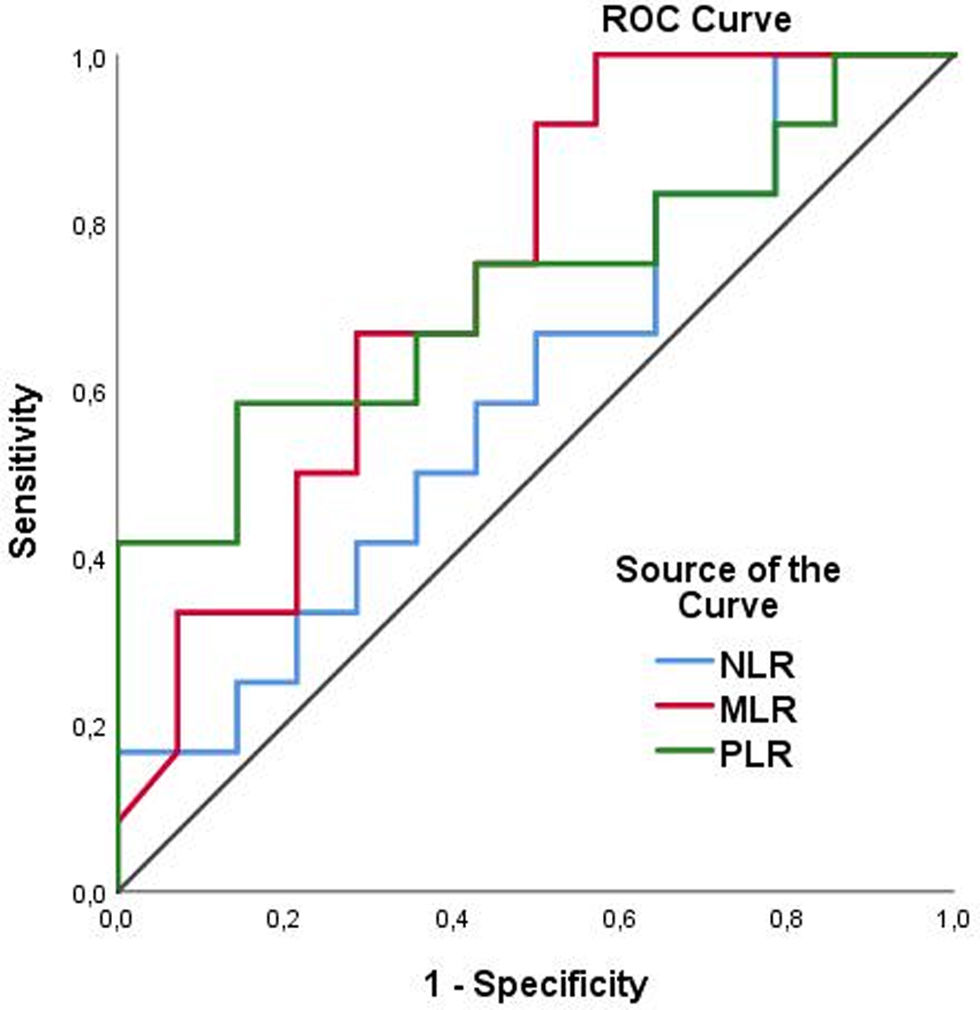
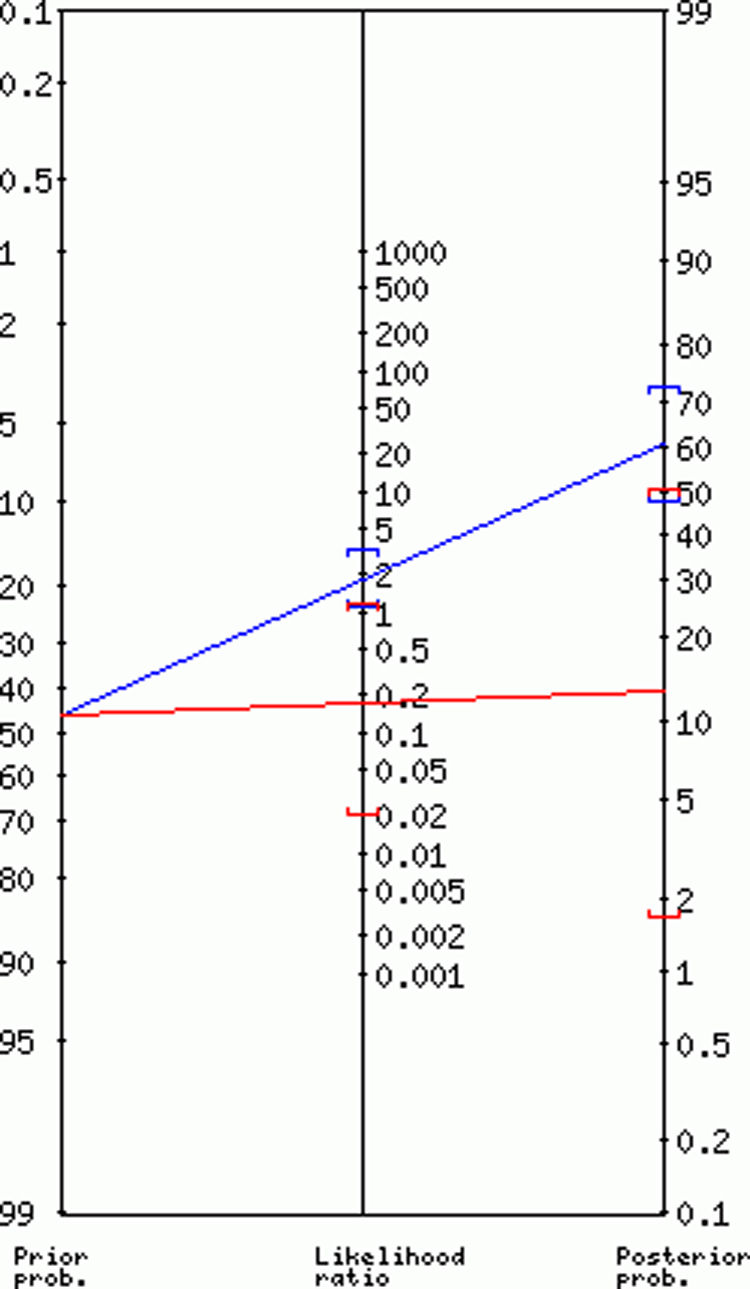
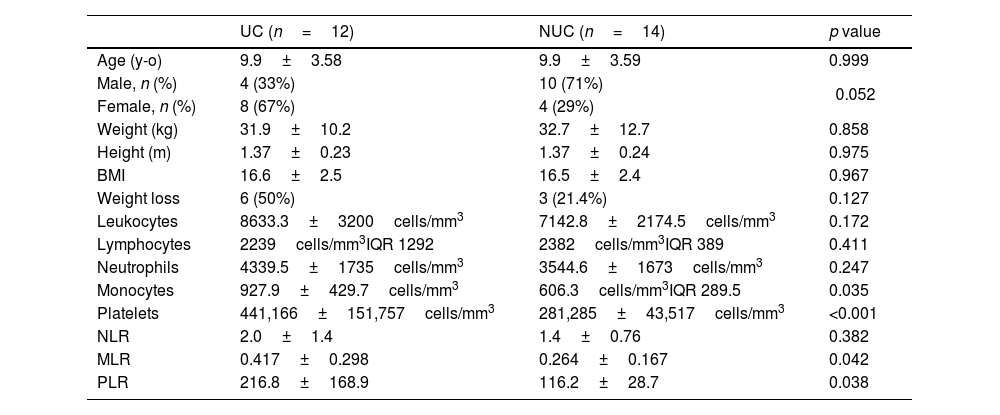
ResultsTwenty-six patients were included: 14 with normal biopsy and 12 with UC. PLR and MLR values were significantly higher in patients with UC (p<0.05). The sensitivity, specificity, and negative predictive value of PLR, NLR and MLR for diagnosing UC were 58%, 83% and 91%; 85%, 35% and 50%; 70%, 71% and 87%, respectively. The biomarker with the highest diagnostic performance was MLR with a cutoff point of 0.235, area under the curve of 0.735 and odds ratio of 11 (95% CI 1.1–109.6; p=0.041).
ConclusionsMLR has a high sensitivity, negative predictive value, and odds ratio in the pre-endoscopic diagnosis of ulcerative colitis. These findings, although exploratory, suggest that MLR could be useful in clinical practice in the initial diagnostic workup of UC, and perhaps in the future in the prioritization of endoscopic studies according to MLR values.
Describir la utilidad de los índices celulares en el diagnóstico de la colitis ulcerosa (CU).
MétodosEstudio diagnóstico en pacientes <15 años tratados mediante colonoscopia±esofagogastroduodenoscopia por sospecha de enfermedad inflamatoria intestinal entre 2015-2022 en un hospital pediátrico. Se incluyó a pacientes con biopsia normal y diagnóstico anatomopatológico de CU, comparándose los valores del índice plaqueta-linfocito (IPL), índice neutrófilo-linfocito (INL) e índice monocito-linfocito (IML), calculados del cociente entre el número de plaquetas, neutrófilos y monocitos y el número de linfocitos, respectivamente, utilizando el área bajo la curva ROC para establecer la sensibilidad, especificidad, valores predictivos y odds ratio de cada parámetro en el diagnóstico de CU.
ResultadosSe incluyó a 26 pacientes: 14 con biopsia normal y 12 con CU. Los valores de IPL e IML fueron significativamente mayores en pacientes con CU (p <0,05). La sensibilidad, la especificidad y el valor predictivo negativo del IPL, INL e IML para el diagnóstico de CU fueron del 58, el 83 y el 91%, el 85, el 35 y el 50, y el 70, el 71 y 87%, respectivamente. El biomarcador con mejor rendimiento diagnóstico fue el IML, con un punto de corte de 0,235, área bajo la curva de 0,735 y odds ratio de 11 (IC del 95% 1,1-109,6; p=0,041).
ConclusionesEl IML presenta alta sensibilidad, valor predictivo negativo y odds ratio en el diagnóstico preendoscópico de CU. Estos hallazgos, aunque exploratorios, sugieren que el IML podría ser útil en la práctica clínica en la evaluación diagnóstica inicial de la CU y, en el futuro, en la priorización de estudios endoscópicos según los valores de IML.


