




metricas
Gastroenterología y Hepatología (English Edition) Evaluation of tolerance to mercaptopurine in patients with inflammatory bowel di...
Journal Information
Vol. 47. Issue 5.
Pages 433-552 (May 2024)
Cite
Cite
Share
Download PDF
More article options
Visits
430
Vol. 47. Issue 5.
Pages 433-552 (May 2024)
Original article
Full text access

Evaluation of tolerance to mercaptopurine in patients with inflammatory bowel disease and gastrointestinal intolerance to azathioprine

Evaluación de la tolerancia a la mercaptopurina en los pacientes con enfermedad inflamatoria intestinal e intolerancia gastrointestinal a la azatioprina
Visits
430
Guillermo Bastidaa,
Corresponding author
guille.bastida@gmail.com

Corresponding author.
, Diego Alvarez-Sotomayorb, Mariam Aguasa, Marisa Iborraa, Javier Del Hoyoa, Sergio Béjar-Serranoa, Alejandro Garrido-Marína, Elena Valero-Pérezc, Pilar Nosa
a Medicina Digestiva, Sección de Gastroenterología, Hospital Universitari i Politècnic La Fe, Avenida Fernando Abril Martorell 106, 46020 Valencia, Spain
b Medicina Digestiva, Hospital Verge de la Cinta, Carrer de les Esplanetes, 44-58, 43500 Tortosa, Tarragona, Spain
c Medicina Interna, Sección de Digestivo, Hospital Universitario de La Ribera, Km 1, Ctra. Corbera, 46600 Alzira, Valencia, Spain
This item has received
Article information
Abstract
Full Text
Bibliography
Download PDF
Statistics
Figures (2)
fig0005
fig0010
Tables (4)
Table 1. Demographic characteristics of patients included in the study.
Tables
Table 2. Clinical characteristics of patients included in the study.
Tables
Table 3. Univariate analysis of variables associated with GI intolerance to AZA.
Tables
Table 4. Independent risk factors for gastrointestinal intolerance to azathioprine.
Tables
Abstract
Background

Thiopurines such as azathioprine (AZA) and mercaptopurine (MP) are commonly utilized to treat inflammatory bowel disease (IBD). Their use is frequently restricted due to gastrointestinal intolerance (GI). Previous retrospective studies have reported that AZA-intolerant patients may benefit from a switch to MP; yet the effectiveness of this strategy has not been prospectively evaluated.

Aims

To assess GI tolerance to MP in patients who are intolerant to AZA, and to identify clinical predictors of GI intolerance to AZA or MP.

Methods

A prospective, observational, single-cohort study was performed in 92 thiopurine-naïve IBD patients. They were started on a 50mg dose of AZA and escalated to 2.5mg/kg per day by week 2. Those with GI intolerance were rechallenged with a 50% dose of AZA, after which another dose escalation attempt was made. If symptoms persisted, they were switched to MP.

Results

Thirty (32.6%) of the recruited patients suffered from GI intolerance to AZA. Of these, 15 did not present recurrence of symptoms after rechallenge with lower doses. Of 15 intolerant patients, 14 were switched to MP. Within the MP cohort, 8 patients (57%) were also intolerant to MP, 5 (36%) had no symptoms, and 1 (7%) was lost to follow-up. Female gender was the only independent predictor of GI intolerance to AZA.

Conclusions

Up to half of the AZA-intolerant patients tolerated a 50% dose rechallenge that was successfully escalated. A switch to MP was tolerated in over a third of cases whom rechallenge failed. Our strategy (challenge–rechallenge–switch) achieved an overall GI tolerance to thiopurines in most of the patients.

Keywords:
Inflammatory bowel disease
Thiopurines
Azathioprine
Mercaptopurine
Intolerance
Adverse events
Resumen
Antecedentes

Las tiopurinas como la azatioprina (AZA) y la mercaptopurina (MP) se utilizan comúnmente para tratar la enfermedad inflamatoria intestinal (EII). Su uso está frecuentemente restringido debido a la intolerancia gastrointestinal. Estudios retrospectivos anteriores han informado que los pacientes intolerantes a la AZA pueden beneficiarse de un cambio a MP; sin embargo, la eficacia de esta estrategia no ha sido evaluada prospectivamente.

Objetivos

Evaluar la tolerancia gastrointestinal a MP en pacientes que son intolerantes a AZA e identificar predictores clínicos de intolerancia gastrointestinal a AZA o MP.

Métodos

Se realizó un estudio prospectivo, observacional y de cohorte única en 92 pacientes con EII que nunca habían recibido tiopurinas. Comenzaron con una dosis de 50mg de AZA y se aumentó a 2,5mg/kg por día en la semana 2. En aquellos con intolerancia gastrointestinal se administró una dosis del 50% de AZA que se fue incrementando en función de la tolerancia. Si los síntomas persistían, se cambiaba a MP.

Resultados

Treinta (32,6%) de los pacientes reclutados presentaron intolerancia gastrointestinal a la AZA. De estos, 15 no presentaron recurrencia de los síntomas después de la nueva exposición. De los 15 pacientes que no toleraron una dosis más baja, 14 recibieron MP. De los que recibieron MP, 8 pacientes (57%) también eran intolerantes a MP, 5 (36%) no tenían síntomas y uno (7%) se perdió durante el seguimiento. El género femenino fue el único predictor independiente de intolerancia gastrointestinal a la AZA.

Conclusiones

Hasta la mitad de los pacientes intolerantes a la AZA toleran una nueva exposición al 50% de la dosis. Se toleró un cambio a MP en más de un tercio de los casos en los que la reexposición fracasó. Nuestra estrategia logró la tolerancia gastrointestinal a tiopurinas en la mayoría de los pacientes.


Palabras clave:
Enfermedad inflamatoria intestinal
Tiopurinas
Azatioprina
Mercaptopurina
Intolerancia
Eventos adversos
Full Text
Introduction

Thiopurine-derived immunomodulatory drugs [i.e., azathioprine (AZA), mercaptopurine (MP) and thioguanine (TG)] are an effective and safe treatment option in the management of patients with inflammatory bowel disease (IBD). They are typically used for the maintenance of steroid-free remission in patients with both Crohn's disease (CD) and ulcerative colitis (UC) and are recommended as the first line immunosuppressive therapy by major guidelines.1–4 Also, thiopurines have been shown to enhance the treatment effectiveness of anti-tumor necrosis factor (anti-TNF) agents, helping overcome the loss of clinical benefits experienced by almost half of the patients in anti-TNF monotherapy within the first year.5,6

Thiopurines are the most frequently used immunosuppressive drugs in IBD, but unfortunately their widespread use is often limited by the development of adverse reactions and drug intolerance which leads to treatment discontinuation in up to a third of patients.7,8 Some of the most characteristic side effects that appear in patients treated with AZA include potentially life-threatening conditions such as liver toxicity, myelosuppression and acute pancreatitis; nevertheless, the onset of gastrointestinal (GI) symptoms – typically in the form of nausea, vomiting and abdominal pain – remains the main cause of treatment discontinuation.7 Activity levels of thiopurine S-methyltransferase (TPMT), one of the enzymes in charge of thiopurine metabolism, can help predict incidence of adverse effects. Low levels of TPMT activity in patients who receive standard doses of AZA or MP are then associated with severe side effects. However, its influence on GI tolerance remains uncertain.

For historic reasons, the first clinical trials that assessed the efficacy of thiopurines were conducted with AZA, AZA has become the thiopurine of choice for most gastroenterologists in Europe, whereas MP is almost exclusively used in patients who are intolerant to AZA. The main exception to this is in patients who develop idiosyncratic reactions such as pancreatitis, in whom rechallenge with thiopurines is not recommended as there is virtually a 100% chance of recurrence.7 The rationale for switching to MP in AZA-intolerant patients is based on evidence derived from case series, retrospective studies, and a recent meta-analysis reporting a 50–87% success rate with this strategy.9–14 Despite their retrospective design, many of these works include only a small number of patients, thus making it hard to ascertain whether the effectiveness of switching to MP varies according to the nature of the adverse event that motivated AZA interruption. Importantly, to our knowledge, there are still no prospective studies to support this strategy in patients with GI intolerance to AZA, and yet, it continues to be a common routine in clinical practice.

Based on this observation, we performed a prospective, single cohort study in a tertiary referral center aiming to assess the tolerance to MP solely in patients who required discontinuation of AZA due to GI intolerance.

Materials and methodsStudy design and population

The study was designed as a prospective, single-cohort observational study and was conducted at La Fe University Hospital, one of Spain's largest tertiary referral centers for patients with IBD. All patients with confirmed IBD (CD and UC) who granted their informed consent and fulfilled the following criteria were enrolled into the study: (a) indication to initiate therapy with purine analogs according to ECCO guidelines3,4; (b) age>18 years; (c) time since IBD diagnosis>3 months; (d) absence of a prior history of thiopurine use, and (e) normal thiopurine methyl-transferase (TPMT) activity (>5units/mL RBC).

The diagnosis of IBD was established according to standard diagnostic criteria based on clinical, histological and endoscopic findings.15 Demographic data and disease characteristics (location, behavior, and time since onset) were recorded during the enrolment visit, alongside information regarding concomitant and past treatments. Specific laboratory parameters (liver panel, complete blood cell count, and TPMT activity) were obtained from all patients prior to treatment initiation.

The patients recruited started 50mg of AZA once daily according to local protocols based on our previous experience8 and were scheduled for visits on weeks 2, 4, 8, and every 3 months thereafter for 1 full year as recommended by practice guidelines.7 At every visit, the patient underwent blood tests and was checked for presence of GI symptoms and other adverse events. At week 2, if no adverse event were present, AZA dosage was escalated to 2.5mg/kg per day and maintained only in the absence of symptoms. If, on the other hand, patients developed GI symptoms at any time-point during the course of the study (assessed during the follow-up visits), they were rechallenged with a 50% dose of AZA and escalated to 2.5mg/kg per day over 4 weeks. Those with digestive intolerance despite rechallenge, were given a 1-week thiopurine holiday and subsequently commenced on 0.75mg/kg daily of MP which was escalated to 1.5mg/kg at week 4. Patients with signs of severe bone marrow suppression or pancreatitis, or other severe adverse reactions were instructed to discontinue medication. Other dose-dependent side effects, such as liver toxicity, were managed by reducing the dose.

Definition of study outcomes

The primary outcome of interest was to determine the proportion of IBD patients with GI intolerance to AZA who could be successfully switched to MP without recurrence of symptoms. Gastrointestinal intolerance was defined as new onset of any or a combination of nausea, vomiting and abdominal pain, not due to other evident specific causes. The decision to discontinue medication was made by the treating physician based on the severity of the reported symptoms, past history and lab results. If symptoms failed to improve after treatment withdrawal, other potential causes were investigated.

As secondary objectives, we sought to (a) identify clinical predictors of GI intolerance to AZA; (b) identify clinical predictors of tolerance to MP; and (c) assess the value of performing a rechallenge with AZA.

Analysis of TPMT activity

Blood samples were collected in heparinized vacuum tubes using standardized procedures. The samples were stored at 4°C and then centrifuged at 800g for 15min, after which plasma and buffy coats were discarded. Next, RBC lysate was obtained by mixing with cold water and then centrifuged at 13,000×g for 10min to obtain the supernatant used for enzyme assays. Measurement of TPMT activity was performed using a radiochemical method based on the conversion of 6-mercaptopurine to 6-methylmercaptopurine. Details on the complete procedure can be found elsewhere.16

Statistical analysis

Continuous data are reported as median and range or mean±standard deviation. Assumptions of normality and homodescacity were assessed using Kolmogorov–Smirnov and Levene's tests, followed by an independent t-test to check for differences in means. Categorical data are expressed as counts (%) and range and they were compared using Fisher's exact test. In order to identify independent predictors of GI intolerance, variables associated with poor tolerance by univariate analysis and other clinically relevant covariates were incorporated into a stepwise logistic-regression model in which GI intolerance was the dependent outcome. For all implemented tests, a two-sided P-value inferior to 0.05 was deemed to indicate statistical significance.

Ethics

All patients provided their informed consent to participate in the study, which was approved by the Research Ethics Committee of La Fe University Hospital.

ResultsStudy patients

A total of 92 consecutive and unselected IBD patients (68 CD and 24 UC) were enrolled in the study. Patients’ mean age was 37 (range 18–70) years and gender was equitably distributed (52% male vs 48% female). Basal characteristics and demographics of the cohort are listed in Table 1.

Table 1.

Demographic characteristics of patients included in the study.

  UC  CD  Total 
Gender: n (%)
Female  13 (14)  31 (34)  44 (48) 
Male  11 (12)  37 (40)  48 (52) 
Age: years (range)  38 (16–67)  35 (16–70)  37 (16–70) 
Smoking status: n (%)
Current smoker  4 (16.7)  33 (48.5)  37 (40) 
Ex-smoker  4 (16.7)  12 (17.6)  16 (17) 
Non-smoker  16 (66.7)  23 (33.8)  39 (43) 

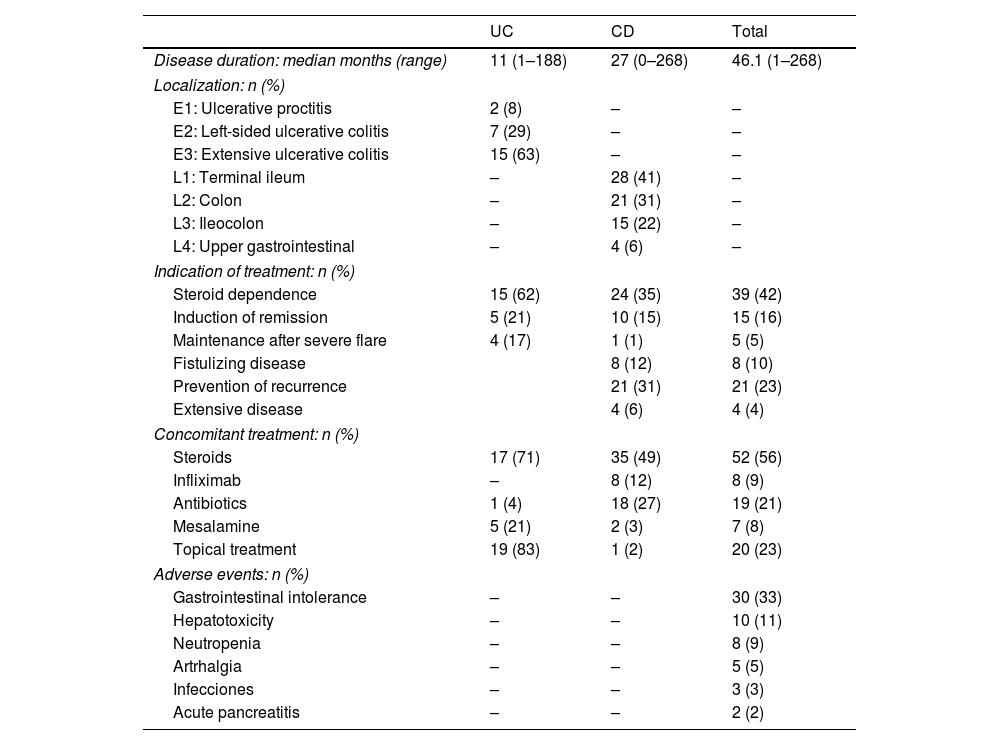
Patients with CD had a median disease duration of 27 months, and 41% of them had a terminal ileum localization. In the case of the patients affected by UC, the median disease duration was 11 months and the majority of them (63%) had an extensive UC according to Montreal classification. Regarding TPMT activity levels, global mean TPMT levels were 19.7 (SD 4.63; range 6.6–35.7). The most frequent indication for AZA treatment was steroid dependence (42%) followed by prevention of disease recurrence (23%) (Table 2).

Table 2.

Clinical characteristics of patients included in the study.

  UC  CD  Total 
Disease duration: median months (range)  11 (1–188)  27 (0–268)  46.1 (1–268) 
Localization: n (%)
E1: Ulcerative proctitis  2 (8)  –  – 
E2: Left-sided ulcerative colitis  7 (29)  –  – 
E3: Extensive ulcerative colitis  15 (63)  –  – 
L1: Terminal ileum  –  28 (41)  – 
L2: Colon  –  21 (31)  – 
L3: Ileocolon  –  15 (22)  – 
L4: Upper gastrointestinal  –  4 (6)  – 
Indication of treatment: n (%)
Steroid dependence  15 (62)  24 (35)  39 (42) 
Induction of remission  5 (21)  10 (15)  15 (16) 
Maintenance after severe flare  4 (17)  1 (1)  5 (5) 
Fistulizing disease    8 (12)  8 (10) 
Prevention of recurrence    21 (31)  21 (23) 
Extensive disease    4 (6)  4 (4) 
Concomitant treatment: n (%)
Steroids  17 (71)  35 (49)  52 (56) 
Infliximab  –  8 (12)  8 (9) 
Antibiotics  1 (4)  18 (27)  19 (21) 
Mesalamine  5 (21)  2 (3)  7 (8) 
Topical treatment  19 (83)  1 (2)  20 (23) 
Adverse events: n (%)
Gastrointestinal intolerance  –  –  30 (33) 
Hepatotoxicity  –  –  10 (11) 
Neutropenia  –  –  8 (9) 
Artrhalgia  –  –  5 (5) 
Infecciones  –  –  3 (3) 
Acute pancreatitis  –  –  2 (2) 
Gastrointestinal tolerance to AZA and MP

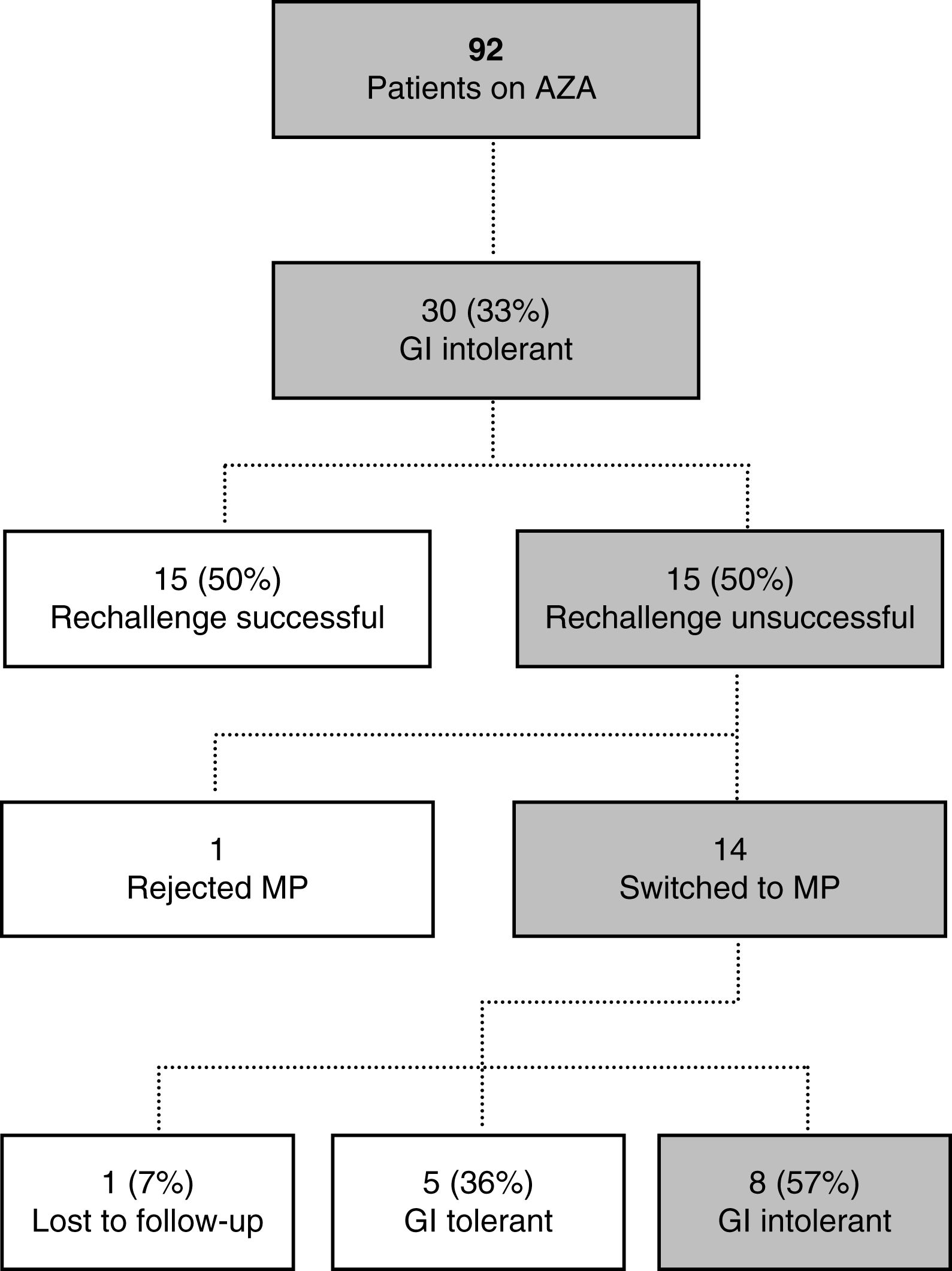
A patient flow diagram is provided in Fig. 1. Fifty-eight patients (63%) experienced at least one adverse event, of which GI intolerance was the most common, affecting 30 patients (33%) after a mean of 2.1 [0.36–12] months on AZA. Fifteen of these patients (50%) did not present recurrence of symptoms after rechallenge, however, 2 patients had to stop treatment at a later stage due to altered liver function tests. Other side effects are listed in Table 2 and included liver toxicity (11%), neutropenia (10%), arthralgia (5%), infectious complications (3%), and acute pancreatitis (2%).

Figure 1.

Patient flow diagram.

Fifteen subjects required discontinuation of AZA due to digestive intolerance and were subsequently offered a trial with MP; one patient declined and the remaining 14 accepted. Within this last subset of patients, 5 (36%) remained free of GI symptoms at 1-year follow up, 8 (57%) were taken off medication due to symptom recurrence, and 1 (7%) was lost to follow-up. The appearance of toxicity in those patients who did not tolerate 6MP was an early event, occurring in the first 1–2 weeks immediately after its introduction.

Predictive factors for GI intolerance

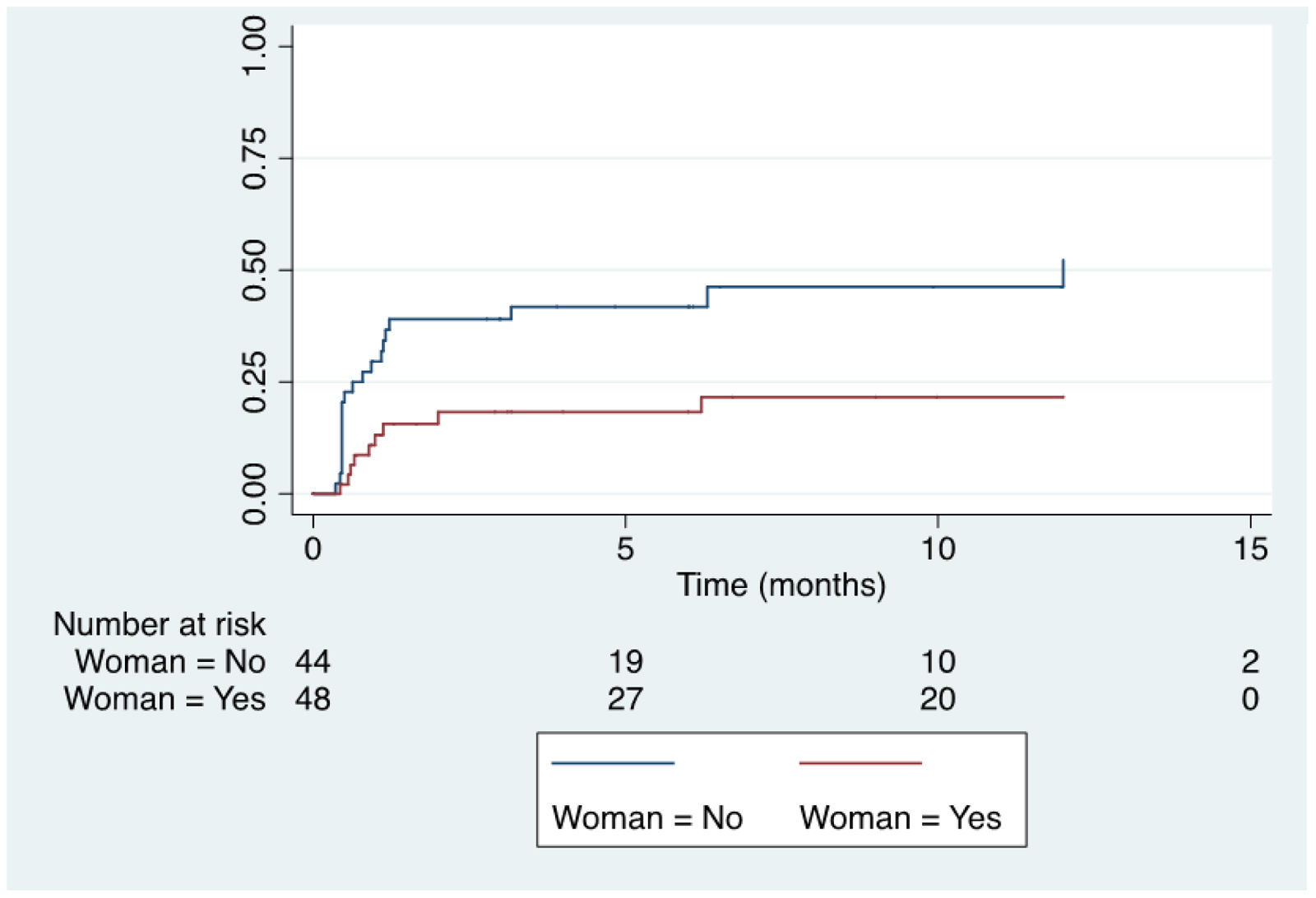
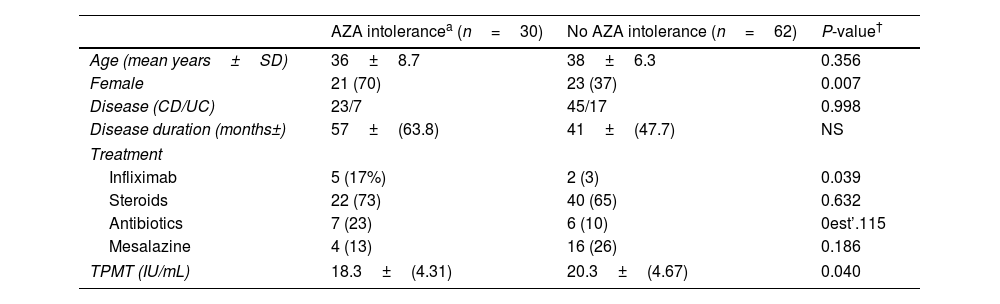
As shown in Table 3, variables that were significantly associated with presence of GI intolerance to AZA in univariate analysis were: female gender (odds ratio [OR], 2.8; 95% confidence interval [CI], 1.3–6.2; P=0.007), concomitant therapy with infliximab (OR, 5.8; 95% CI, 1.1–32; P=0.039), and low TPMT activity (18.3units/mL in AZA-intolerant vs 20.3units/mL in AZA-tolerant patients; P=0.040). Of these, only female gender retained statistical significance in multivariate analysis (OR, 3.7; 95% CI, 1.4–10; P=0.011) (Table 4). The cumulative incidence of GI intolerance according to patient gender can be seen in Fig. 2. Both univariate and multivariate analyses yielded no significant associations between clinical variables and tolerance to MP.

Table 3.

Univariate analysis of variables associated with GI intolerance to AZA.

  AZA intolerancea (n=30)  No AZA intolerance (n=62)  P-value 
Age (mean years±SD)  36±8.7  38±6.3  0.356 
Female  21 (70)  23 (37)  0.007 
Disease (CD/UC)  23/7  45/17  0.998 
Disease duration (months±)  57±(63.8)  41±(47.7)  NS 
Treatment
Infliximab  5 (17%)  2 (3)  0.039 
Steroids  22 (73)  40 (65)  0.632 
Antibiotics  7 (23)  6 (10)  0est’.115 
Mesalazine  4 (13)  16 (26)  0.186 
TPMT (IU/mL)  18.3±(4.31)  20.3±(4.67)  0.040 

Data are presented as mean±SD and absolute number (%).

a

Defined as new onset of nausea, vomiting, diarrhea, abdominal pain, dyspepsia, heartburn, or appetite loss, not due to other specific causes.

For continuous data, differences in means were calculated using Student's t-test. Categorical data were analyzed using Fisher's exact test.

Table 4.

Independent risk factors for gastrointestinal intolerance to azathioprine.

Variable  Odds ratio  95% CI  P value 
Gender
Male  Ref  –  – 
Female  3.7  1.4–10  0.01 
Concomitant treatment with infliximab
Yes  Ref  –  – 
No  4.8  0.7–31.3  0.09 
TPMT (UI/mL)  0.9  0.8–1.4  0.19 
Figure 2.

Cumulative incidence of GI intolerance according to gender.

Discussion

To our knowledge, this is the first systematic, prospective study to assess the clinical effectiveness of a challenge–rechallenge–switch approach with thiopurines in order to improve their GI tolerance in IBD patients. More than a third of the patients that presented GI intolerance to AZA were successfully switched to MP with no recurrence of the symptoms. Overall, we found that this strategy allowed over 87% of the IBD patients studied to continue the treatment with thiopurines. Importantly, we also pointed out female gender as an independent predictor of GI toxicity to AZA.

Thiopurines offer several advantages in the treatment of IBD, but their widespread use is hampered by a high incidence of adverse events leading to treatment discontinuation in up to a third of the patients.7,8 Notably, a recent study has shown the benefits of long-term thiopurine treatment in patients with UC. Those patients with tolerance to thiopurines had a decreased risk of colectomy, reduced progression in disease extend and hospital admission within 10 years of therapy when compared with patients discontinuing therapy within the first year due to adverse drug reactions.17 Thus, in order to achieve better clinical outcomes in IBD, it seems increasingly important to find therapeutic strategies that improve patient tolerance to thiopurines. Up to date, several approaches have been employed in an effort to reduce the toxicity to AZA and MP, namely: split-dose administration, dose reduction, combining low dose thiopurine with allopurinol, and switching to another thiopurine. Performing a switch to MP is probably the single-most commonly used approach, and yet, prospective data on its efficacy are still scarce.

Over the past two decades, the treatment of IBD has evolved significantly. The introduction of biological therapies supposed a big change in the treatment paradigm, improving the clinical management of the disease. Initially, anti-TNF agents were used after immunosuppressive failed. However, new evidence showed that addition of an immunosuppressive to anti-TNF therapy improves treatment efficacy and protects against loss of clinical response.5,6,18 Specifically, the combination treatment of AZA and infliximab early in the disease course has proven to be more effective than the sequential therapy or monotherapy.5,6 Therefore, thiopurines together with anti-TNF agents constitute a superior strategy in the treatment of IBD.

It has been suggested in the past that the success of performing a switch to MP may depend on the mechanism responsible for intolerance to AZA, and that this strategy should only be employed if the adverse event is dose-dependent (e.g., GI intolerance), but not in subjects who develop immune-mediated idiosyncratic reactions (e.g., pancreatitis).19,20 The rationale for this is that idiosyncratic reactions to AZA are drug-class-specific and that, consequently, they are likely to reappear with other thiopurines. Following this line of reasoning, most authors suggest that performing a gradual dose escalation or a switch to MP makes more sense in patients with dose-dependent adverse events, and yet the evidence is still somewhat inconsistent. A study by Hindorf et al., for instance, reports superior tolerance to MP among patients with AZA-induced arthralgia/myalgia – both typical examples of idiosyncratic reactions – compared to those with GI intolerance.21 In this same paper, the authors also report 7 cases of AZA-induced pancreatitis which only reappeared in 2 patients (28%) after switching to MP. These observations constituted the rationale for performing a rechallenge with low-dose AZA followed by gradual dose escalation in our own cohort of AZA-intolerant patients.

An important finding of our study was that 36% of the patients with confirmed digestive intolerance to AZA were able to switch to MP without recurrence of symptoms. This figure is somewhat lower than expected based on the available literature, where digestive tolerance to MP ranges from 47% to 73%.8,13,14 The prospective design of our study allowed us to predefine the starting dosage of AZA and apply a standardized rechallenge strategy which successfully rescued 50% of patients who were initially deemed AZA-intolerant. This suggests that rates of GI tolerance to MP published in earlier retrospective studies may actually include patients who are not definitively AZA-intolerant, and thus, that a second trial with AZA before switching to MP may help to identify such patients. In fact, if we add patients who tolerated a rechallenge with AZA to those who tolerated switching to MP in our study, we end up with 67% of patients who tolerated thiopurines among those originally classified as AZA-intolerant, a figure more consistent with the ones reported in the above mentioned studies.10,21

In our multivariate analysis, female gender was found to be associated with GI intolerance to AZA, but no TMPT activity or concomitant medications. Several studies have established the link between intermediate to low TPMT activity and increased risk for myelotoxicity22–27; however, its influence on GI tolerance and other adverse events remains unclear. While some studies found no association between TPMT polymorphism and the development of GI side effects,28 others found that GI intolerance was more common in TPMT heterozygotes than wild-type individuals.29 Our results seem to support former study, as neither AZA nor MP were influenced by mean TPMT activity. This notwithstanding, our study did not include patients with TPMT activity below 5units/mL RBC and hence, any inferences derived from these results may not be applicable to such patients. With regard to gender, our results showed a clear predominance of females among patients with GI intolerance to AZA, a pattern that was not seen in patients treated with MP. It should be borne in mind, however, that these results cannot rule out an existing association as this study is not adequately powered to detect differences within the MP subgroup. Variations in the activity of enzymes involved in thiopurine metabolism between males and females have been described in previous papers,30,31 but the effect of these differences on tolerance to thiopurines remains uncertain. Our findings are mostly consistent with those of a large retrospective study of 3931 IBD patients conducted by Chaparro et al., who reported an increased risk of nausea among females treated with thiopurines [mostly AZA (HR, 1.4; 95% CI, 1.1–1.8)].8 This was also observed in a later study.32

This study has multiple strengths, including its standardized prospective nature and the evaluation of multiple variables associated with GI intolerance to thiopurines. However, it has also some limitations. One could argue that the length of follow-up may have been insufficient to detect subjects who developed delayed intolerance to thiopurines and that, therefore, we could be overestimating GI tolerance to thiopurines. This argument is supported by a meta-analysis that reported a trend toward increasing side-effects with increasing cumulative dose of AZA and MP.1 While this point appears compelling, most reactions to AZA appear to occur early after starting treatment and previous reports suggest that patients who are maintained on AZA for longer than 6 months only rarely have to stop the drug due to side-effects.33,34 Another potential limitation may have been caused by non-random patient selection. Though we do acknowledge the possibility that a certain level of selection bias may have occurred, this was anticipated during study design and special care was taken to recruit all eligible patients consecutively, irrespective of pretreatment characteristics.

Despite these limitations, our prospective study has successfully described a therapeutic approach that optimizes thiopurine tolerance in IBD patients. A rechallenge strategy with low-dose AZA followed by a progressive dose escalation was effective in half of the AZA-intolerant patients. Additionally, over a third of patients in whom rechallenge has failed tolerated a switch to MP. Overall, 87% of the patients were able to be maintained on thiopurine therapy. We also identify female gender as a variable independently associated with GI toxicity to AZA.

Authors’ contribution

GB was involved in study concept and design; acquisition of data; analysis and interpretation of data; writing of the manuscript; critical revision of the manuscript. MR was involved in acquisition of data and writing of the manuscript; PN was involved in study design and writing of the manuscript.

Funding

Dr. Bastida received a heath research grant of the Instituto de Investigación Sanitaria La Fe de Valencia (IIS La Fe).

Conflict of interest

The authors declare that they have no conflict of interest.

Acknowledgements

The authors thank Vanessa Marfil at Medical Statistics Consulting for medical writing services.

References
[1]
D.C. Pearson.
Azathioprine and 6-mercaptopurine in Crohn disease: a meta-analysis.
[2]
A. Timmer, J.W.D. McDonald, J.K. MacDonald.
Azathioprine and 6-mercaptopurine for maintenance of remission in ulcerative colitis.
[3]
F. Gomollón, A. Dignass, V. Annese, H. Tilg, G. Van Assche, J.O. Lindsay, et al.
3rd European evidence-based consensus on the diagnosis and management of Crohn's disease 2016: Part 1: Diagnosis and medical management.
J Crohn's Colitis., 11 (2017), pp. 3-25
[4]
M. Harbord, R. Eliakim, D. Bettenworth, K. Karmiris, K. Katsanos, U. Kopylov, et al.
Third European evidence-based consensus on diagnosis and management of ulcerative colitis. Part 2: Current management.
J Crohn's Colitis., 11 (2017), pp. 769-784
[5]
J.F. Colombel, W.J. Sandborn, W. Reinisch, G.J. Mantzaris, A. Kornbluth, D. Rachmilewitz, et al.
Infliximab, azathioprine, or combination therapy for Crohn's disease.
N Engl J Med., 362 (2010), pp. 1383-1395
[6]
A.J. Yarur, D.T. Rubin.
Therapeutic drug monitoring of anti-tumor necrosis factor agents in patients with inflammatory bowel diseases.
Inflamm Bowel Dis, 21 (2015), pp. 1709-1718
[7]
F. Bermejo, M. Aguas, M. Chaparro, E. Domènech, A. Echarri, E. García-Planella, et al.
Recommendations of the Spanish Working Group on Crohn's Disease and Ulcerative Colitis (GETECCU) on the use of thiopurines in inflammatory bowel disease.
Gastroenterol Hepatol., 41 (2018), pp. 205-221
[8]
M. Chaparro, I. Ordás, E. Cabré, V. Garcia-Sanchez, G. Bastida, M. Peñalva, et al.
Safety of thiopurine therapy in inflammatory bowel disease: long-term follow-up study of 3931 patients.
Inflamm Bowel Dis., 19 (2013), pp. 1404-1410
[9]
G. Bastida Paz, P. Nos Mateu, M. Aguas Peris, B. Beltrán Niclós, M. Rodríguez Soler, J. Ponce García.
Optimization of immunomodulatory treatment with azathioprine or 6-mercaptopurine in inflammatory bowel disease.
Gastroenerol Hepatol., 30 (2007), pp. 511-516
[10]
C.W. Lees, A.K. Maan, B. Hansoti, J. Satsangi, I.D.R. Arnott.
Tolerability and safety of mercaptopurine in azathioprine-intolerant patients with inflammatory bowel disease.
Aliment Pharmacol Therap, 27 (2007), pp. 220-227
[11]
J.R. Boulton-Jones, K. Pritchard, A.A. Mahmoud.
The use of 6-mercaptopurine in patients with inflammatory bowel disease after failure of azathioprine therapy.
Aliment Pharmacol Therap, 14 (2000), pp. 1561-1565
[12]
D.G. Bowen, W.S. Selby.
Use of 6-mercaptopurine in patients with inflammatory bowel disease previously intolerant of azathioprine.
Digest Dis Sci, 45 (2000), pp. 1810-1813
[13]
E. Domènech, P. Nos, M. Papo, A. López-San Román, E. Garcia-Planella, M.A. Gassull.
6-Mercaptopurine in patients with inflammatory bowel disease and previous digestive intolerance of azathioprine.
Scand J Gastroenterol., 40 (2005), pp. 52-55
[14]
N.A. Kennedy, E. Rhatigan, I.D. Arnott, C.L. Noble, A.G. Shand, J. Satsangi, et al.
A trial of mercaptopurine is a safe strategy in patients with inflammatory bowel disease intolerant to azathioprine: an observational study, systematic review and meta-analysis.
Aliment Pharmacol Therap., 38 (2013), pp. 1255-1266
[15]
J.E. Lennard-Jones, S. Shivananda.
Clinical uniformity of inflammatory bowel disease a presentation and during the first year of disease in the north and south of Europe. EC-IBD Study Group.
Eur J Gastroenterol Hepatol, 9 (1997), pp. 353-359
[16]
C. Menor, J.A. Fueyo, O. Escribano, C. Cara, M.D. Fernández-Moreno, I.D. Román, et al.
Determination of thiopurine methyltransferase activity in human erythrocytes by high-performance liquid chromatography: comparison with the radiochemical method.
Therap Drug Monit., 23 (2001), pp. 536-541
[17]
C. Eriksson, S. Rundquist, Y. Cao, S. Montgomery, J. Halfvarson.
Impact of thiopurines on the natural history and surgical outcome of ulcerative colitis: a cohort study.
[18]
P.S. Dulai, C.A. Siegel, J.F. Colombel, W.J. Sandborn, L. Peyrin-Biroulet.
Systematic review: monotherapy with antitumour necrosis factor alpha agents versus combination therapy with an immunosuppressive for IBD.
[19]
F. Bermejo, A. Lopez-Sanroman, C. Taxonera, J.P. Gisbert, J.L. Pérez-Calle, I. Vera, L. Menchén, et al.
Acute pancreatitis in inflammatory bowel disease, with special reference to azathioprine-induced pancreatitis.
Aliment Pharmacol Therap., 28 (2008), pp. 623-628
[20]
C.J. Haber, S.J. Meltzer, D.H. Present, B.I. Korelitz.
Nature and course of pancreatitis caused by 6-mercaptopurine in the treatment of inflammatory bowel disease.
Gastroenterology, 91 (1986), pp. 982-986
[21]
U. Hindorf, M. Johansson, A. Eriksson, E. Kvifors, S.H.C. Almer.
Mercaptopurine treatment should be considered in azathioprine intolerant patients with inflammatory bowel disease.
Aliment Pharmacol Therap, 29 (2009), pp. 654-661
[22]
J.P. Gisbert, P. Niño, L. Rodrigo, C. Cara, L.G. Guijarro.
Thiopurine methyltransferase (TPMT) activity and adverse effects of azathioprine in inflammatory bowel disease: long-term follow-up study of 394 patients.
Am J Gastroenterol, 101 (2006), pp. 2769-2776
[23]
W.E. Evans, Y.Y. Hon, L. Bomgaars, S. Coutre, M. Holdsworth, R. Janco, et al.
Preponderance of thiopurine S-methyltransferase deficiency and heterozygosity among patients intolerant to mercaptopurine or azathioprine.
J Clin Oncol., 19 (2001), pp. 2293-2301
[24]
W.E. Evans, M. Horner, Y.Q. Chu, D. Kalwinsky, W.M. Roberts.
Altered mercaptopurine metabolism, toxic effects, and dosage requirement in a thiopurine methyltransferase-deficient child with acute lymphocytic leukemia.
J Pediatrics, 119 (1991), pp. 985-989
[25]
E. Schütz, J. Gummert, F. Mohr, M. Oellerich.
Azathioprine-induced myelosuppression in thiopurine methyltransferase deficient heart transplant recipient.
[26]
M.V. Relling, M.L. Hancock, G.K. Rivera, et al.
Mercaptopurine therapy intolerance and heterozygosity at the thiopurine S-methyltransferase gene locus.
JNCI., 91 (1999), pp. 2001-2008
[27]
A.J. Black.
Thiopurine methyltransferase genotype predicts therapy-limiting severe toxicity from azathioprine.
[28]
M. Schwab, E. Schäffeler, C. Marx, C. Fischer, T. Lang, C. Behrens, et al.
Azathioprine therapy and adverse drug reactions in patients with inflammatory bowel disease: impact of thiopurine S-methyltransferase polymorphism.
Pharmacogenetics., 12 (2002), pp. 429-436
[29]
A. Ansari, M. Arenas, S.M. Greenfield, D. Morris, J. Lindsay, K. Gilshenan, et al.
Prospective evaluation of the pharmacogenetics of azathioprine in the treatment of inflammatory bowel disease.
Aliment Pharmacol Therap., 28 (2008), pp. 973-983
[30]
B. Klemetsdal, B. Straume, E. Wist, J. Aarbakke.
Identification of factors regulating thiopurine methyltransferase activity in a Norwegian population.
Eur J Clin Pharmacol, 44 (1993), pp. 147-152
[31]
M.V. Relling, J.-S. Lin, G.D. Ayers, W.E. Evans.
Racial and gender differences in N-acetyltransferase, xanthine oxidase, and CYP1A2* activities.
Clin Pharmacol Therap, 52 (1992), pp. 643-658
[32]
G. Clemente Actis, R. Pellicano, F. Rosina.
6-Mercaptopurine for azathioprine intolerant inflammatory bowel disease: literature search and reappraisal of own data.
Inflamm Allergy-Drug Targets, 14 (2016), pp. 133-137
[33]
J.S. Bajaj, K. Saeian, R.R. Varma, J. Franco, J.F. Knox, J. Podoll, et al.
Increased rates of early adverse reaction to azathioprine in patients with Crohn's disease compared to autoimmune hepatitis: a tertiary referral center experience.
Am J Gastroenterol., 100 (2005), pp. 1121-1125
[34]
Y. Bouhnik, M. Lémann, J.Y. Mary, G. Scemama, R. Taï, C. Matuchansky, et al.
Long-term follow-up of patients with Crohn's disease treated with azathioprine or 6-mercaptopurine.
Lancet., 347 (1996), pp. 215-219
asdasdasd
Article options
Tools