






In ulcerative colitis (UC), STRIDE-II consensus has established the long-term goal of achieving endoscopic remission (ER), which helps reduce inflammatory burden, prevent permanent intestinal damage, and improve patient’s quality of life. However, achieving histological remission (HR) is also associated with a lower risk of experiencing outbreaks of inflammatory activity, the need for corticosteroids, hospitalizations, and the development of colorectal cancer.
ObjectiveEvaluate the role of ER and HR in the development of inflammatory activity flares in patients who have achieved these long-term goals and are being followed in the Inflammatory Bowel Disease (IBD) Program.
Materials and methodsA retrospective study was conducted on patients with UC treated in the IBD Program at the Universidad de los Andes, between January 2021 and April 2023. Patients with ER (Mayo Endoscopic Index [MEI] 0) or endoscopic response (MEI 1), with at least one year of follow-up, were included. HR was defined using the Nancy (<2), Geboes (<2), and Robarts (<3) indices. Inflammatory activity was assessed by a Partial Mayo Index (PMI) ≥2 and fecal calprotectin >250μg/g.
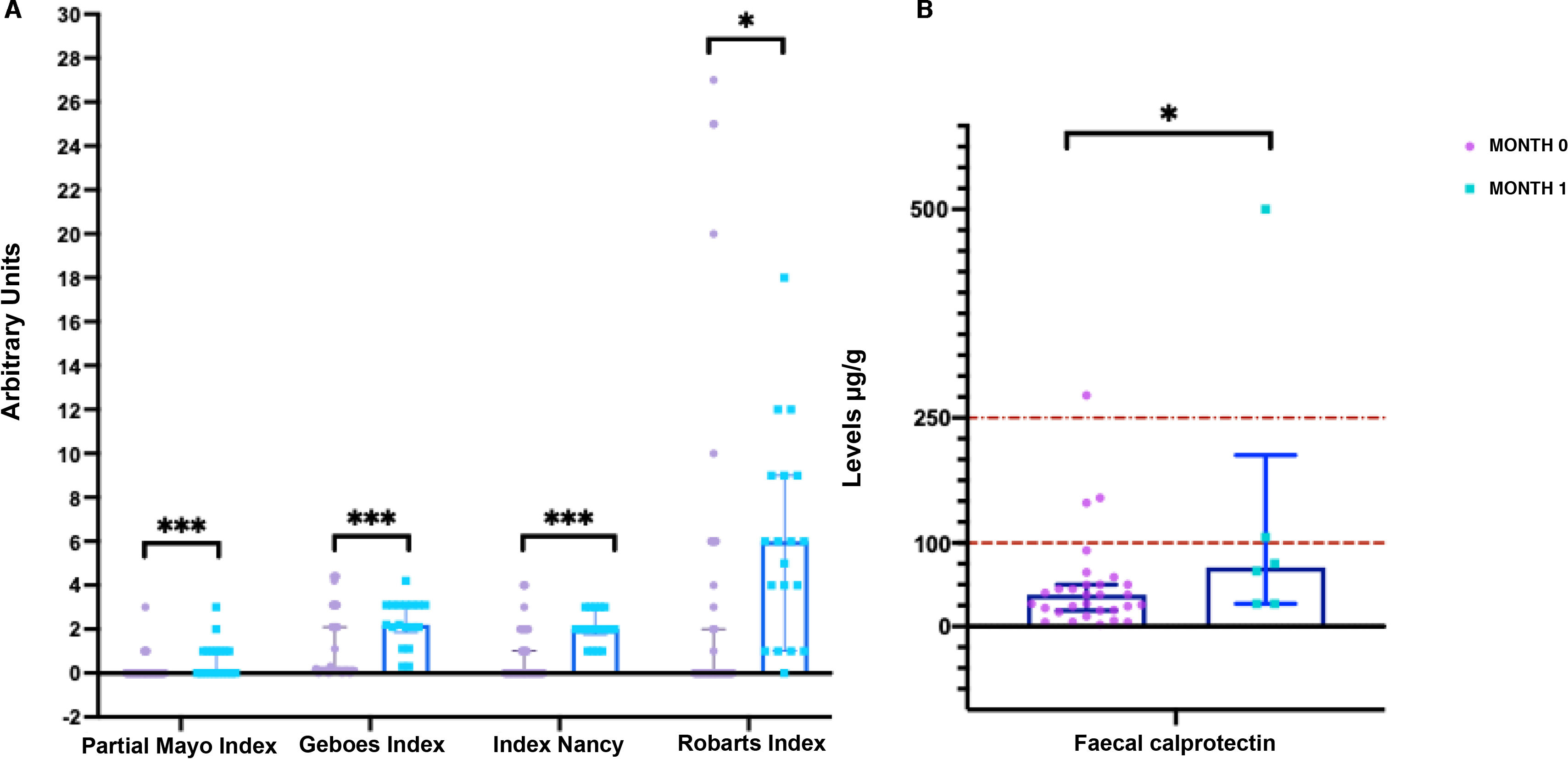
ResultsA total of 84 patients were included, 57.1% were women, with a median age of 37 years (IQR 31–45). During follow-up, 71 patients continued in the study, and 24 (31%) experienced inflammatory flares. In the MEI 0 group, the percentage of flares at 12 and 44 months was 15% and 53%, respectively, compared to 43% and 67% in the MEI 1 group (p=0.0302). PMI and fecal calprotectin levels were significantly lower in MEI 0 than in MEI 1 (p<0.001 and p<0.05, respectively). Although the Nancy, Geboes, and Robarts indices showed significant differences between MEI 0 and MEI 1, none were associated with a lower risk of flares in the MEI 0 group. No cases of colorectal neoplasia or need for surgery were reported during follow-up.
ConclusionIn this cohort, ER is a significant predictor of the development of inflammatory flares in patients with UC, while HR did not show a clear impact in this regard. Further studies are needed to clarify the role of HR as a therapeutic target in UC.
En colitis ulcerosa (CU), el consenso STRIDE-II ha establecido como objetivo a largo plazo alcanzar la remisión endoscópica (RE), lo que ayuda a reducir la carga inflamatoria, el daño intestinal permanente y mejorar la calidad de vida de los pacientes. Sin embargo, alcanzar la remisión histológica (RH) también se asocia con un menor riesgo de experimentar brotes de actividad inflamatoria, la necesidad de utilizar corticoides, hospitalizaciones y el desarrollo de cáncer colorrectal.
ObjetivoEvaluar el papel de la RE y RH en el desarrollo de brotes de actividad inflamatoria en pacientes que han alcanzado estos objetivos a largo plazo y que se encuentran en seguimiento en el Programa de Enfermedad Inflamatoria intestinal (EII).
Material y metodosSe realizó un estudio retrospectivo en pacientes con CU atendidos en el Programa de EII de la Clínica Universidad de los Andes entre enero de 2021 y abril de 2023. Se incluyeron pacientes con RE (Índice de Mayo Endoscópico [IME] 0) o respuesta endoscópica (IME 1), con al menos un año de seguimiento. La RH se definió mediante los índices de Nancy (<2), Geboes (<2) y Robarts (<3). La actividad inflamatoria se evaluó por un Índice de Mayo parcial (IMp) ≥2 y calprotectina fecal >250μg/g.
ResultadosDe 84 pacientes incluidos, el 57,1% eran mujeres, con una mediana de edad de 37 años (RIQ 31-45). Durante el seguimiento, 71 pacientes continuaron en el estudio, y 24 (31%) experimentaron brotes inflamatorios. En el grupo IME 0, el porcentaje de brotes a los 12 y 44 meses fue del 15% y 53%, respectivamente, frente al 43% y 67% en el grupo IME 1 (p=0,0302). IMp y calprotectina fecal presentaron valores significativamente menores en IME 0 que en IME 1 (p<0,001 y p<0,05, respectivamente). Aunque los índices de Nancy, Geboes y Robarts mostraron diferencias significativas entre IME 0 e IME 1, ninguno se asoció con un menor riesgo de brotes en el grupo IME 0. No se reportaron casos de neoplasia colorrectal ni necesidad de cirugía durante el seguimiento.
ConclusiónEsta cohorte, la RE es un predictor significativo del desarrollo de brotes inflamatorios en pacientes con CU, mientras que la RH no mostró un impacto claro en este aspecto. Se necesitan estudios adicionales para clarificar el rol de la RH como objetivo terapéutico en la CU.

