



To describe the role of Executive Nurse Leaders (ENLs) in the response to the COVID-19 pandemic in Spain.
MethodA qualitative descriptive study with an ethnographic approach and direct qualitative content analysis was designed. Twenty-five semi-structured interviews were conducted with ENLs who held senior management positions in one of the two management areas: autonomous health policy and healthcare organisation. The study includes the following executive roles: Chief Nurse Executive in autonomous government policy, Chief Executive Officer, Chief Nurse Officer, and Assistant Chief Nurse Officer in healthcare organisations. The sample includes most autonomous communities in Spain.
ResultsFour themes and seven subthemes were identified. Theme 1. Health crisis: Negative outlook on the situation despite the new opportunities made possible by the pandemic. Theme 2. Action areas: The ENLs were involved in areas of management: autonomous policy, healthcare organisation and shared areas. Theme 3. Accompanying patients: Widespread criticism of visitation bans and the nurses’ response to the restrictions. Theme 4. Communication: Characteristics’ communication description, information management and communication strategies towards staff or the public.
ConclusionsThe results demonstrate the vital role that ENLs played in managing the response to the pandemic. In the context studied, the interviewees’ scope and degree of participation differed in each autonomous community. Understanding the role of ENLs helps respond to major healthcare challenges, raises their leadership visibility and facilitates social and institutional recognition. Advocating for the involvement of ENLs at the executive levels studied will help to improve the country’s preparedness for future health crises.
Describir el rol de los/as Directivos/as de Enfermería de Nivel Ejecutivo (DENE) en la respuesta a la pandemia de COVID-19 en España.
MétodoEstudio descriptivo cualitativo con enfoque etnográfico y análisis directo de contenido cualitativo. Se realizaron veinticinco entrevistas semiestructuradas a DENE que ocuparon un alto cargo en una de las áreas de gestión establecidas: política autonómica sanitaria u organización sanitaria. Se incluyen: Cargo directivo de enfermería en el gobierno autonómico, Dirección gerencia, Dirección y Subdirección de enfermería en instituciones sanitarias. La muestra incluye la mayoría de las comunidades autónomas españolas.
ResultadosSe identificaron cuatro temas y siete subtemas. Tema 1. Crisis sanitaria: Perspectiva negativa de la situación y en contraposición las nuevas oportunidades que posibilitó la pandemia. Tema 2. Ámbitos de actuación: Áreas de gestión donde participaron los/as DENE de ámbito político autonómico, ámbito organizativo asistencial y las áreas compartidas. Tema 3. Acompañamiento a los pacientes: crítica generalizada a la prohibición de visitas y la respuesta enfermera a la restricción. Tema 4. Comunicación: Características de la comunicación, gestión de la información y las estrategias comunicativas hacia el personal o la población.
ConclusionesLos resultados demuestran el papel crucial que los/as DENE desempeñaron en la gestión de la respuesta a la pandemia. En el contexto estudiado, el ámbito y grado de participación de los/as entrevistados/as difiere en función de la comunidad autónoma. Conocer el rol de los/as DENE ayuda a dar respuesta a los grandes retos asistenciales, visibiliza su liderazgo y posibilita su reconocimiento social e institucional. Fomentar la participación de los/as DENE en los niveles ejecutivos estudiados mejorará la preparación del país ante futuras crisis sanitarias.

Research exists on the role of nurse leaders in managing the COVID-19 pandemic internationally. In Spain, there are no previous studies on this role, which are set in multicentre health institutions.
What does this paper add?This study qualitatively analyses the role of executive nurse leaders in managing the health crisis provoked by COVID-19 in Spain in two management areas: autonomous health policy and healthcare organisation.
The United Nations (UN) and the World Health Organisation (WHO) recommend promoting research on disaster risk reduction and post-event analysis with a focus on ‘build back better’, thereby improving the country’s future preparedness.1,2 In addition, disproportionately affected populations in a disaster situation need to be empowered and protected.1,2 Therefore, the health crisis caused by the coronavirus must be analysed in order to make future improvements.
On 11 March 2020, the WHO upgraded the public health emergency caused by Coronavirus 2019 to a pandemic. Three days later, on 14 March, Spain declared a state of alarm to manage the health crisis.3 The nursing profession has been disproportionately affected by COVID-19.4 The International Council of Nurses (ICN) reports that in many countries, nurses were the group most affected by coronavirus.5 To the best of our knowledge, no official data is available from the Spanish government regarding this.6 In Spain, a survey of nurses reported that 38% of participants were confirmed COVID-19 cases.7
Throughout the COVID-19 pandemic, nurses have played multiple roles, and their professional care has contributed significantly and valuably to healthcare.8 However, the participation of nurse leaders in decision-making at an executive and/or policy level has been unequal.8,9 Their relevant role has been documented in disaster management10 and in epidemics.11 Intrahealth and Nursing Now (2019) recommends raising the profile and status of nursing leadership.12 The WHO Regional Office for Europe is committed to promoting nursing leadership roles, COVID-19 has shown the need to address complex policy challenges related to the nursing workforce to meet present and future needs.4 Nurse leaders involvement is essential in the design of nursing workforce policy. In addition toallowing nurses to work to their full potential, it is necessary to achieve Sustainable Development Goals and universal health coverage.4
Numerous international studies have analysed the experience and management of nursing leaders with varying degrees of responsibility responding to the COVID-19 crisis.13–23 In Spain, previous studies have looked at nurse management during the pandemic in a hospital setting24,25 and its impact on mental health.26 However, no study has been found that analyses nurse management at executive level in the different autonomous health government and healthcare institutions, allowing us to know what the picture was at national level.
This research aims to understand the role of Executive Nurse Leaders (ENLs) and to describe their personal experiences in responding to the COVID-19 pandemic in Spain.
This study uses the term ENL to refer to a nursing leader with a high-level leadership position in an autonomous health government or in a healthcare organisation. The ENLs have one of the established executive roles: Chief Nurse Executive (CNE),27 Chief Executive Officer (CEO), Chief Nurse Officer (CNO), or Assistant Chief Nurse Officer (ACNO).
MethodDesignA descriptive qualitative study with an ethnographic approach was undertaken. This design allowed a better understanding of the role of ENLs within health policy and institutions to describe their experience, understand their behaviours and to identify patterns within the context studied.28 Due to the small group studied and the specific context, a focused ethnography was applied.29
ParticipantsAll participants had a university degree in Nursing. The senior executive positions included in the project are CNE, CEO, CNO and ACNO. The authors established an association between these high-level positions included in the study and two managerial areas: autonomous health policy for CNE and healthcare organisation for the rest of the positions. CNE refers to senior nurse managers in autonomous health policy as separated from CNO to clarify their higher position with a higher executive level responsibility.27
In Spain, health competencies are transferred from the central government to the 17 Autonomous Communities (ACs).30 The CNE in autonomous health policy refers to nurses from the autonomous government or the regional health system. The CNE is a position that does not exist in all ACs. In Spain, there are a few CEOs of healthcare organisations who are nurses. The autonomous government appoints the CEO position. CNOs are the highest nursing positions in healthcare organisations, and the ACNO is directly below the executive level.
Table 1 outlines the inclusion and exclusion criteria for the management positions studied. They are nurses with high organisational responsibility during the study period (February 2020 and December 2022).
Sample inclusion and exclusion criteria.
| Inclusion criteria | Exclusion criteria |
|---|---|
| Assistant Chief Nurse Officer* (ACNO) of a healthcare organisation | Nurses with no organisational responsibility |
| Chief Nurse Officer (CNO) of a healthcare organisation | Ward Managers |
| Chief Executive Officer (CEO) | Nurses in private healthcare hospitals |
| Chief Nurse Executive (CNE) in the autonomous government | |
| Chief Nurse Executive (CNE) in the autonomous health system |
In order to obtain a representative sample of the majority of the Spanish ACs and of different executive levels in Spain, a mixed sampling typology was applied, combining the snowball, convenience, purposive, and maximum variation sampling methods.31
Data collectionData was collected through semi-structured in-depth interviews to understand the participants’ experience and what it meant to them.32 All interviews had the same script proposed by MC (Annex A) and were conducted via an online platform (Microsoft Teams). With the written consent of the participants, the interview was recorded. The shortest lasted 39 min, and the longest 118 min. Most of the interviews, 54%, lasted less than 60 min. FVM and AZY conducted one interview each; the rest of the interviews were conducted by PAC.
After the meeting, the interviewer transcribed the participants’ responses verbatim. Names of institutions or places were removed for anonymity, and each participant was assigned a code. The participant’s code starts with either H for hombre (male) or M for mujer (female) and a random number. The transcript and recording were reviewed by JVL. The resulting document of the revised transcript was sent to the participants for their review, acceptance, omission or correction of content. Field notes were taken during the interview as well as during the review of the transcript. Data was collected from June 2022 to June 2023. The field period ended when additional information on the object of study was no longer obtained, and therefore, data saturation was reached.33
Data analysisThe verbatim transcripts of the interviews and the researcher’s field notes were the units of analysis. A direct content analysis was undertaken, following the 16 steps proposed by Assarroudi et al.33 In addition, latent content analysis was conducted, resulting in an implicit meaning that includes the cultural context of the data, resulting in the final themes.34
The theoretical definition of the categories was based on the Naturalistic Decision Making (NDM) approach, previously applied in adverse situations where there is uncertainty and/or unstable conditions.35 The literature supports the relevance of NDM with leaders’ decision-making process during a crisis.36 Based on this framework, three general categories were established: recognition of the situation, action, and notion of satisfaction. Thus, objective definitions of the categories were established based on previous studies.33
After a deep dive into the data, coding was conducted with the qualitative data analysis software Atlas.ti.37 Coding was done by authors PAC and JVL. Both researchers reviewed and validated the initial coding. The codes used were integrated into the theoretical categories. In the event of discrepancies in the coding, a consensus was reached on the final decision.
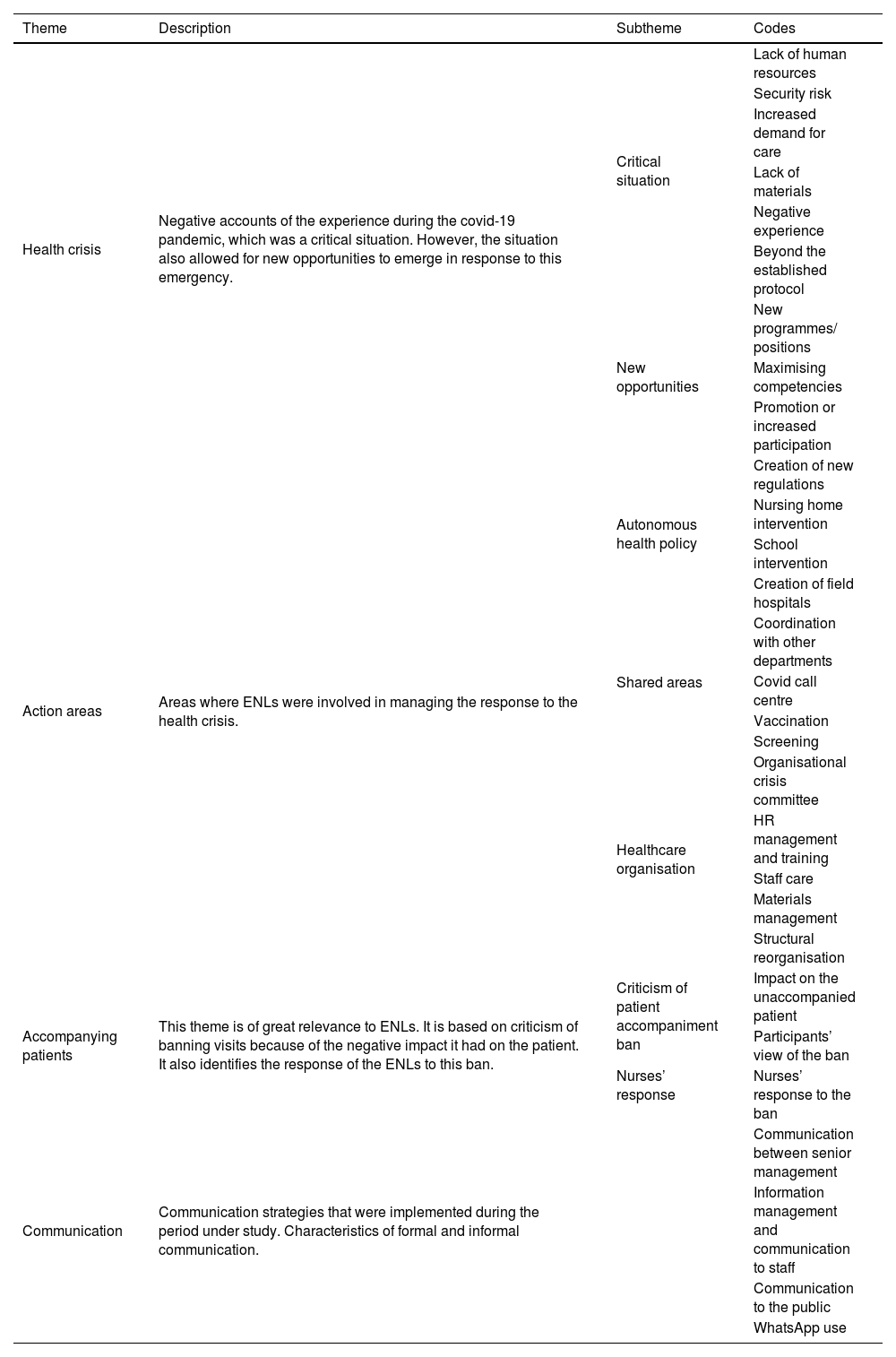
In total, 29 codes were grouped and related to the three categories. To analyse the latent content in more detail, the codes of different categories were related, grouping them according to general meaning, identifying recurrent ideas, and the relevance that respondents gave to those concepts.34 This deeper examination of the units of analysis made it possible to capture the latent meaning of the interviewees, resulting in the themes.34 The relationship between the themes and subthemes and the codes is presented in Table 2.
Definition of themes and their connection to subthemes and codes.
| Theme | Description | Subtheme | Codes |
|---|---|---|---|
| Health crisis | Negative accounts of the experience during the covid-19 pandemic, which was a critical situation. However, the situation also allowed for new opportunities to emerge in response to this emergency. | Critical situation | Lack of human resources |
| Security risk | |||
| Increased demand for care | |||
| Lack of materials | |||
| Negative experience | |||
| Beyond the established protocol | |||
| New opportunities | New programmes/ positions | ||
| Maximising competencies | |||
| Promotion or increased participation | |||
| Action areas | Areas where ENLs were involved in managing the response to the health crisis. | Autonomous health policy | Creation of new regulations |
| Nursing home intervention | |||
| School intervention | |||
| Creation of field hospitals | |||
| Shared areas | Coordination with other departments | ||
| Covid call centre | |||
| Vaccination | |||
| Screening | |||
| Healthcare organisation | Organisational crisis committee | ||
| HR management and training | |||
| Staff care | |||
| Materials management | |||
| Structural reorganisation | |||
| Accompanying patients | This theme is of great relevance to ENLs. It is based on criticism of banning visits because of the negative impact it had on the patient. It also identifies the response of the ENLs to this ban. | Criticism of patient accompaniment ban | Impact on the unaccompanied patient |
| Participants’ view of the ban | |||
| Nurses’ response | Nurses’ response to the ban | ||
| Communication | Communication strategies that were implemented during the period under study. Characteristics of formal and informal communication. | Communication between senior management | |
| Information management and communication to staff | |||
| Communication to the public | |||
| WhatsApp use |
The verbatim transcript of each interview was sent to the participant for their approval. Seven participants modified and/or further clarified their answers. The transcript was reviewed and approved by the participant and used in the analysis of this study.
After data saturation, a preliminary report with the findings was sent to the participants. The participants then approved this report. The participants’ observations of the preliminary report are shown in the results section.
The resulting themes represent all participants.34 The study reports numerous verbatim quotations to show the consistency of the themes in the interviews. Furthermore, it ensures that all ENLs are represented by referencing each participant two to six times with verbatim excerpts from their responses. This procedure supports the reliability of the study and the transfer of data from the interviews done with the ENLs.
Two internationally recognised reporting guidelines for qualitative research were applied to the report.32,38
Researcher positioningThe research team, composed of experienced nursing and professionals with backgrounds in clinical, academic, and managerial roles, brought first-hand knowledge of executive decision-making in the Spanish health system. Professional proximity was addressed through investigator triangulation, participant validation, and reflexive practices to minimise bias and ensure rigour.
Ethical considerationsThe study received ethical approval from the Human Research Ethics Committee (HREC) of Jaume I University in Castellón de la Plana (Spain). Ethical approval file (CEISH/93/2023).
Participants gave their written consent to be included in the study. The interviewees’ recordings and transcriptions are kept on a secure virtual disk owned by Jaume I University.
ResultsParticipants’ characteristicsFifty-nine invitations were sent by email to potential participants. Twenty-five individuals agreed to be interviewed. The research team excluded one interview from the study after they analysed the content and found that it referred expressly to one of the individual’s positions as a supervisor (Ward Manager), which was excluded from the study.
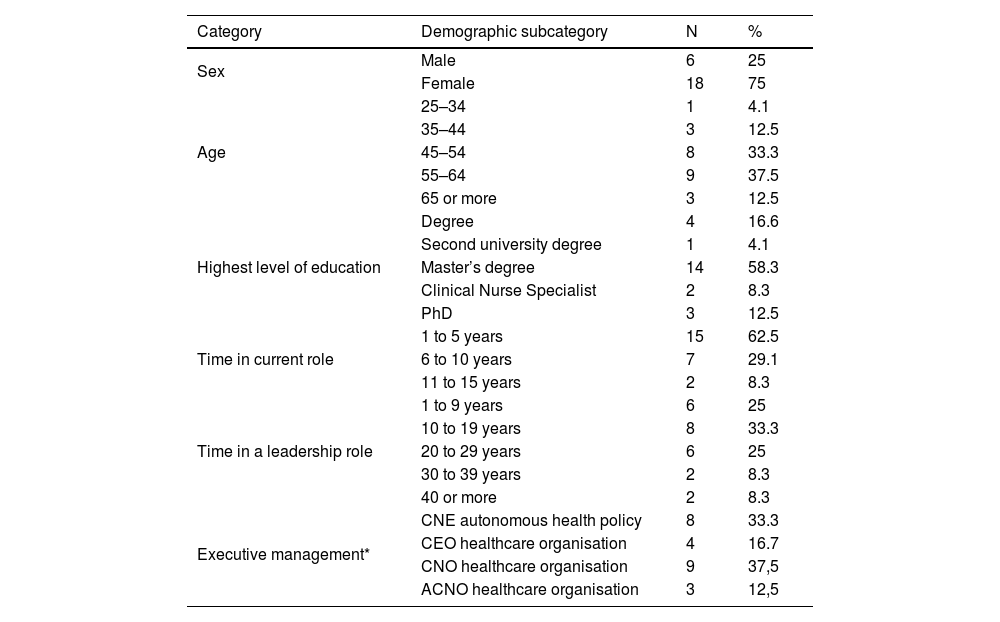
The final sample size was 24 ENLs. The socio-demographic characteristics of the ENLs are presented in Table 3. It is a representative sample of Spain, as 13 of the 17 ACs are represented, with participants from different areas of executive management. The majority are women between 45 and 54 years of age with a master’s degree.
Sociodemographic data.
| Category | Demographic subcategory | N | % |
|---|---|---|---|
| Sex | Male | 6 | 25 |
| Female | 18 | 75 | |
| Age | 25–34 | 1 | 4.1 |
| 35–44 | 3 | 12.5 | |
| 45–54 | 8 | 33.3 | |
| 55–64 | 9 | 37.5 | |
| 65 or more | 3 | 12.5 | |
| Highest level of education | Degree | 4 | 16.6 |
| Second university degree | 1 | 4.1 | |
| Master’s degree | 14 | 58.3 | |
| Clinical Nurse Specialist | 2 | 8.3 | |
| PhD | 3 | 12.5 | |
| Time in current role | 1 to 5 years | 15 | 62.5 |
| 6 to 10 years | 7 | 29.1 | |
| 11 to 15 years | 2 | 8.3 | |
| Time in a leadership role | 1 to 9 years | 6 | 25 |
| 10 to 19 years | 8 | 33.3 | |
| 20 to 29 years | 6 | 25 | |
| 30 to 39 years | 2 | 8.3 | |
| 40 or more | 2 | 8.3 | |
| Executive management* | CNE autonomous health policy | 8 | 33.3 |
| CEO healthcare organisation | 4 | 16.7 | |
| CNO healthcare organisation | 9 | 37,5 | |
| ACNO healthcare organisation | 3 | 12,5 |
Eight people were recruited using the snowball method by PAC, AZY and FVM. In the remaining 16 interviews, convenience and maximum variation sampling techniques were applied, consulting the official websites of health autonomous governments and health institutions throughout Spain in search of potential participants.
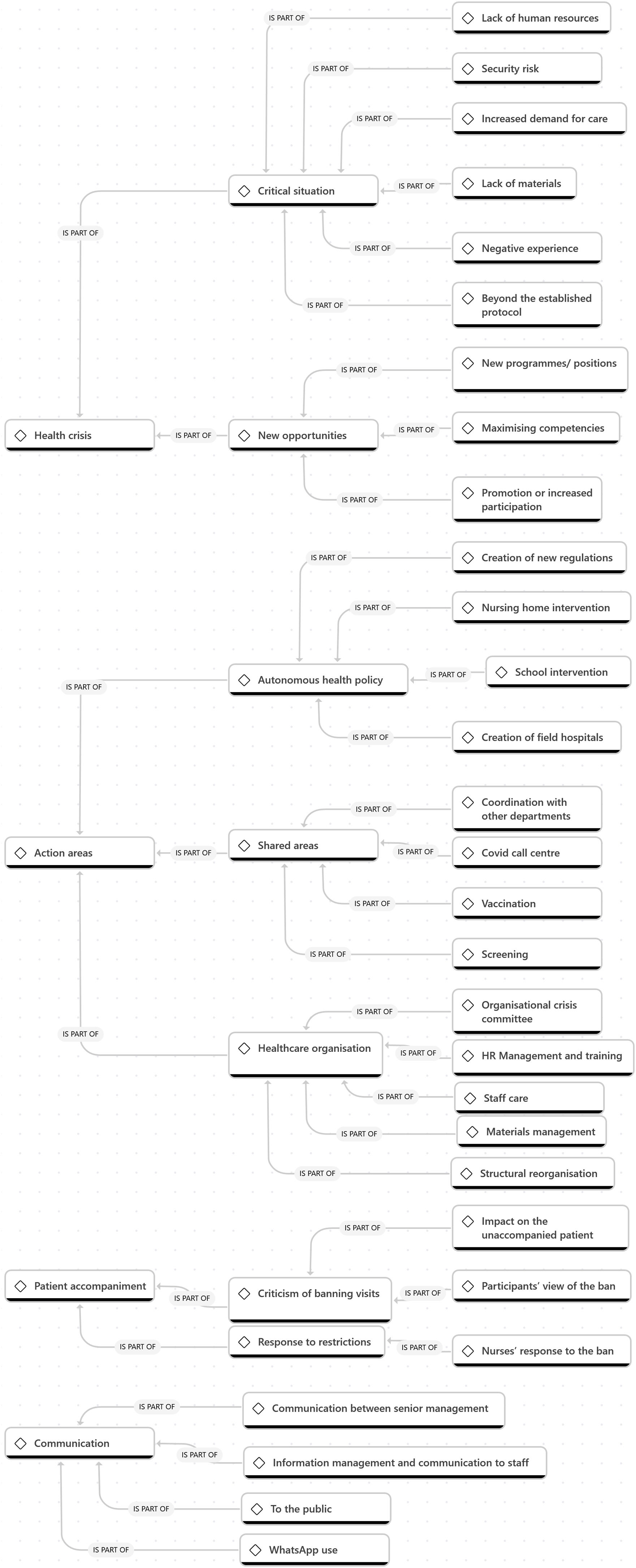
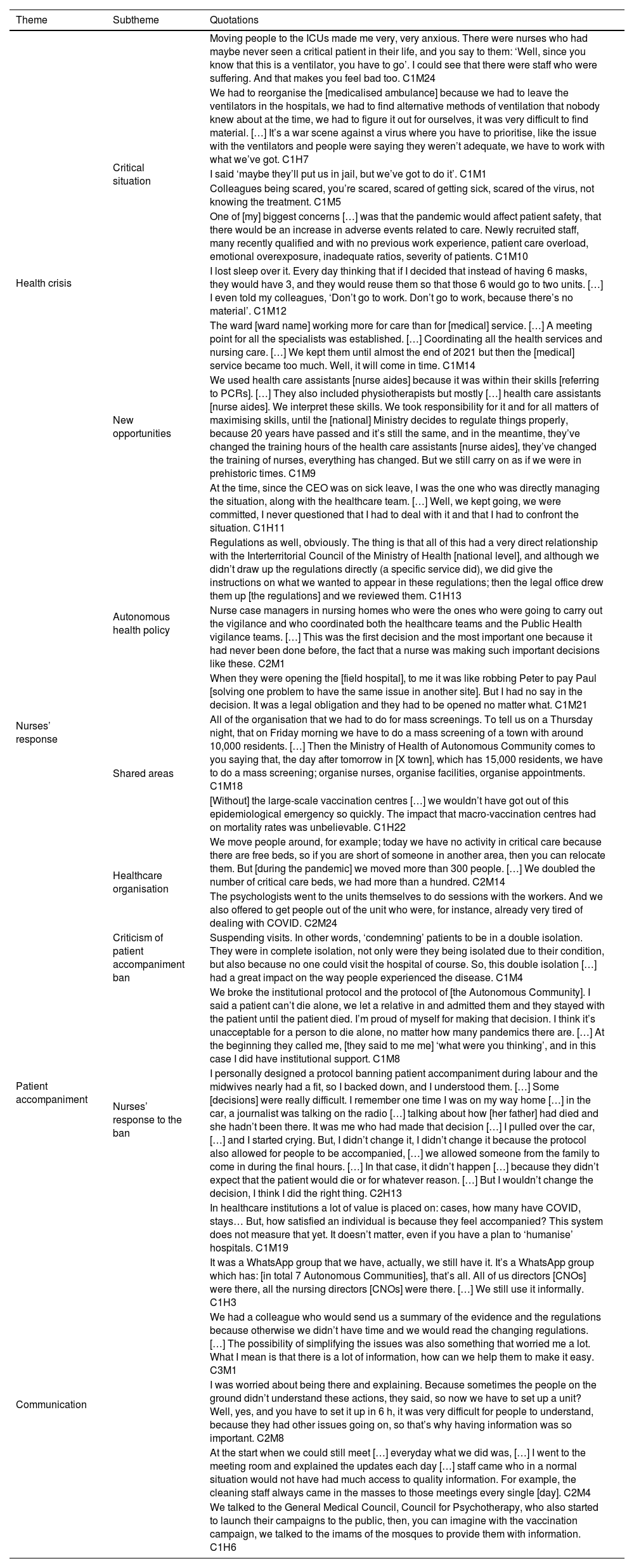
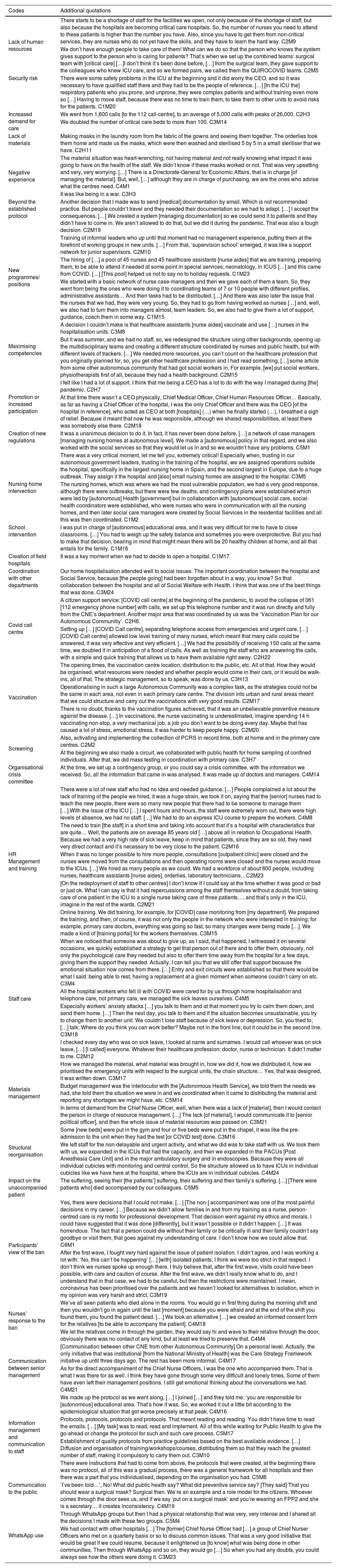
Main themesFour themes and seven subthemes were identified. Table 2 shows the definition of the themes and their relation to the codes used. The coding tree is shown in Fig. 1. The most relevant literal quotations are listed in Table 4. Supplementary quotations have been added (Annex B) to illustrate the meaning of the codes. Eighty-three literal quotations are reported and coded according to the citation order indicated after the letter ‘C’ and the participant’s code.
Themes and subthemes associated with literal quotations.
| Theme | Subtheme | Quotations |
|---|---|---|
| Health crisis | Critical situation | Moving people to the ICUs made me very, very anxious. There were nurses who had maybe never seen a critical patient in their life, and you say to them: ‘Well, since you know that this is a ventilator, you have to go’. I could see that there were staff who were suffering. And that makes you feel bad too. C1M24 |
| We had to reorganise the [medicalised ambulance] because we had to leave the ventilators in the hospitals, we had to find alternative methods of ventilation that nobody knew about at the time, we had to figure it out for ourselves, it was very difficult to find material. […] It’s a war scene against a virus where you have to prioritise, like the issue with the ventilators and people were saying they weren’t adequate, we have to work with what we’ve got. C1H7 | ||
| I said ‘maybe they’ll put us in jail, but we’ve got to do it’. C1M1 | ||
| Colleagues being scared, you’re scared, scared of getting sick, scared of the virus, not knowing the treatment. C1M5 | ||
| One of [my] biggest concerns […] was that the pandemic would affect patient safety, that there would be an increase in adverse events related to care. Newly recruited staff, many recently qualified and with no previous work experience, patient care overload, emotional overexposure, inadequate ratios, severity of patients. C1M10 | ||
| I lost sleep over it. Every day thinking that if I decided that instead of having 6 masks, they would have 3, and they would reuse them so that those 6 would go to two units. […] I even told my colleagues, ‘Don’t go to work. Don’t go to work, because there’s no material’. C1M12 | ||
| New opportunities | The ward [ward name] working more for care than for [medical] service. […] A meeting point for all the specialists was established. […] Coordinating all the health services and nursing care. […] We kept them until almost the end of 2021 but then the [medical] service became too much. Well, it will come in time. C1M14 | |
| We used health care assistants [nurse aides] because it was within their skills [referring to PCRs]. […] They also included physiotherapists but mostly […] health care assistants [nurse aides]. We interpret these skills. We took responsibility for it and for all matters of maximising skills, until the [national] Ministry decides to regulate things properly, because 20 years have passed and it’s still the same, and in the meantime, they’ve changed the training hours of the health care assistants [nurse aides], they’ve changed the training of nurses, everything has changed. But we still carry on as if we were in prehistoric times. C1M9 | ||
| At the time, since the CEO was on sick leave, I was the one who was directly managing the situation, along with the healthcare team. […] Well, we kept going, we were committed, I never questioned that I had to deal with it and that I had to confront the situation. C1H11 | ||
| Nurses’ response | Autonomous health policy | Regulations as well, obviously. The thing is that all of this had a very direct relationship with the Interterritorial Council of the Ministry of Health [national level], and although we didn’t draw up the regulations directly (a specific service did), we did give the instructions on what we wanted to appear in these regulations; then the legal office drew them up [the regulations] and we reviewed them. C1H13 |
| Nurse case managers in nursing homes who were the ones who were going to carry out the vigilance and who coordinated both the healthcare teams and the Public Health vigilance teams. […] This was the first decision and the most important one because it had never been done before, the fact that a nurse was making such important decisions like these. C2M1 | ||
| When they were opening the [field hospital], to me it was like robbing Peter to pay Paul [solving one problem to have the same issue in another site]. But I had no say in the decision. It was a legal obligation and they had to be opened no matter what. C1M21 | ||
| Shared areas | All of the organisation that we had to do for mass screenings. To tell us on a Thursday night, that on Friday morning we have to do a mass screening of a town with around 10,000 residents. […] Then the Ministry of Health of Autonomous Community comes to you saying that, the day after tomorrow in [X town], which has 15,000 residents, we have to do a mass screening; organise nurses, organise facilities, organise appointments. C1M18 | |
| [Without] the large-scale vaccination centres […] we wouldn’t have got out of this epidemiological emergency so quickly. The impact that macro-vaccination centres had on mortality rates was unbelievable. C1H22 | ||
| Healthcare organisation | We move people around, for example; today we have no activity in critical care because there are free beds, so if you are short of someone in another area, then you can relocate them. But [during the pandemic] we moved more than 300 people. […] We doubled the number of critical care beds, we had more than a hundred. C2M14 | |
| The psychologists went to the units themselves to do sessions with the workers. And we also offered to get people out of the unit who were, for instance, already very tired of dealing with COVID. C2M24 | ||
| Patient accompaniment | Criticism of patient accompaniment ban | Suspending visits. In other words, ‘condemning’ patients to be in a double isolation. They were in complete isolation, not only were they being isolated due to their condition, but also because no one could visit the hospital of course. So, this double isolation […] had a great impact on the way people experienced the disease. C1M4 |
| Nurses’ response to the ban | We broke the institutional protocol and the protocol of [the Autonomous Community]. I said a patient can’t die alone, we let a relative in and admitted them and they stayed with the patient until the patient died. I’m proud of myself for making that decision. I think it’s unacceptable for a person to die alone, no matter how many pandemics there are. […] At the beginning they called me, [they said to me me] ‘what were you thinking’, and in this case I did have institutional support. C1M8 | |
| I personally designed a protocol banning patient accompaniment during labour and the midwives nearly had a fit, so I backed down, and I understood them. […] Some [decisions] were really difficult. I remember one time I was on my way home […] in the car, a journalist was talking on the radio […] talking about how [her father] had died and she hadn’t been there. It was me who had made that decision […] I pulled over the car, […] and I started crying. But, I didn’t change it, I didn’t change it because the protocol also allowed for people to be accompanied, […] we allowed someone from the family to come in during the final hours. […] In that case, it didn’t happen […] because they didn’t expect that the patient would die or for whatever reason. […] But I wouldn’t change the decision, I think I did the right thing. C2H13 | ||
| In healthcare institutions a lot of value is placed on: cases, how many have COVID, stays… But, how satisfied an individual is because they feel accompanied? This system does not measure that yet. It doesn’t matter, even if you have a plan to ‘humanise’ hospitals. C1M19 | ||
| Communication | It was a WhatsApp group that we have, actually, we still have it. It’s a WhatsApp group which has: [in total 7 Autonomous Communities], that’s all. All of us directors [CNOs] were there, all the nursing directors [CNOs] were there. […] We still use it informally. C1H3 | |
| We had a colleague who would send us a summary of the evidence and the regulations because otherwise we didn’t have time and we would read the changing regulations. […] The possibility of simplifying the issues was also something that worried me a lot. What I mean is that there is a lot of information, how can we help them to make it easy. C3M1 | ||
| I was worried about being there and explaining. Because sometimes the people on the ground didn’t understand these actions, they said, so now we have to set up a unit? Well, yes, and you have to set it up in 6 h, it was very difficult for people to understand, because they had other issues going on, so that’s why having information was so important. C2M8 | ||
| At the start when we could still meet […] everyday what we did was, […] I went to the meeting room and explained the updates each day […] staff came who in a normal situation would not have had much access to quality information. For example, the cleaning staff always came in the masses to those meetings every single [day]. C2M4 | ||
| We talked to the General Medical Council, Council for Psychotherapy, who also started to launch their campaigns to the public, then, you can imagine with the vaccination campaign, we talked to the imams of the mosques to provide them with information. C1H6 |
Theme 3 (accompanying patients) and 4 (communication) are emerging themes, as the research team identified the high importance that most participants attach to them.
Theme 1: Health crisis
Subtheme 1.1: Critical situation
Based on respondents’ accounts of the situation during the COVID-19 pandemic. They describe the situation as critical, hostile, uncertain and frightening; some even describe it as warlike. A situation that was so critical and exceptional that, in some cases, led to decisions being made that were not in accordance with the security recommendations or even, on occasion, going beyond the established protocol. An increase in demand for care and a lack of human resources and materials were some of the factors that prompted this response.
Subtheme 1.2: New opportunities
In contrast to this critical situation, it can also be noted that the situation made it possible for new opportunities to emerge in response to the health emergency. New programmes, job positions, and roles were created. These new strategies were sometimes maintained over time, but this was not always the case. Options for maximising the competencies of different professional groups also emerged during the period under study. Discrepancies are found in some areas of competence maximisation, e.g., vaccination by non-nursing staff.
During the pandemic, there were occasions when participants were promoted or expanded their roles by being more involved in making decisions. Sometimes, it was for different exceptional reasons. In one case, this promotion or increased responsibilities is not described as an entirely positive experience, and this participant ‘breathed a sigh of relief’ when she returned to her usual responsibilities.
Theme 2: Action areas
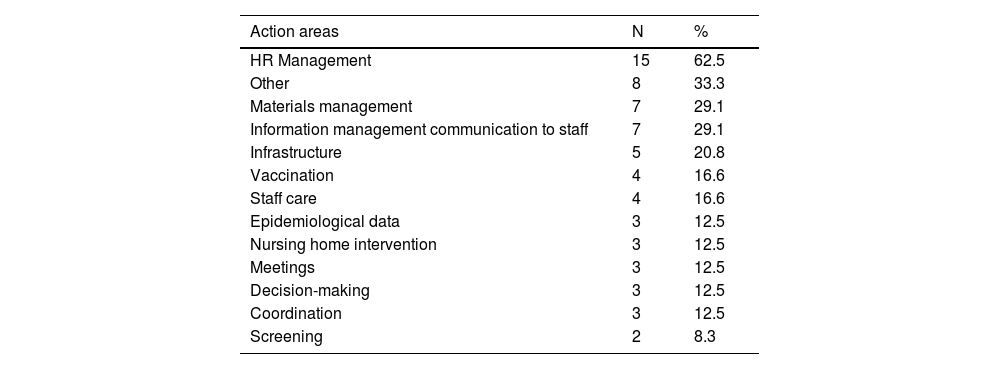
The population under study is divided into two managerial areas to analyse this topic. The first group is the autonomous health policy without a healthcare function; the second group comprises of the rest of the executive levels, which have a relationship with a healthcare organisation with direct healthcare provision. Table 5 describes the actions areas of the most frequent tasks performed by the ENLs.
Action areas of the most relevant tasks performed by ENLs.
| Action areas | N | % |
|---|---|---|
| HR Management | 15 | 62.5 |
| Other | 8 | 33.3 |
| Materials management | 7 | 29.1 |
| Information management communication to staff | 7 | 29.1 |
| Infrastructure | 5 | 20.8 |
| Vaccination | 4 | 16.6 |
| Staff care | 4 | 16.6 |
| Epidemiological data | 3 | 12.5 |
| Nursing home intervention | 3 | 12.5 |
| Meetings | 3 | 12.5 |
| Decision-making | 3 | 12.5 |
| Coordination | 3 | 12.5 |
| Screening | 2 | 8.3 |
These interventions vary from region to region, and there are differences in the action areas of the ENLs and the level of involvement.
Subtheme 1: Action areas of the autonomous health policy
In the non-healthcare field, the most relevant areas where ENLs participated were epidemiological surveillance and case management at the autonomous level, both in nursing homes and educational centres; participation in decisions for the expansion of infrastructures, such as the opening of new temporary hospitals; and involvement in planning or influencing autonomous health regulations. There are significant differences among the interviewees in their level of participation according to the region, with some ENLs not influencing in planning new regulations at all.
Subtheme 2: Shared areas
Some ENLs from healthcare organisations were involved in actions that, in other regions, were assumed by ENLs from autonomous health policy. Therefore, these interventions were shared by ENLs in both managerial areas studied.
The actions in this subtheme are highly relevant as they had a significant impact on the evolution of the COVID-19 pandemic. Some examples are mass screening, the COVID Call Centre, mass vaccination, coordination with other departments within the Ministry of Health of Autonomous Community (MoHAC) or with other autonomous ministries, and the development of protocols. Intervention in nursing homes was also carried out by an ENL at the healthcare level, but it only involved the nursing homes of the health area assigned to the healthcare organisation.
Subtheme 3: Action areas of the healthcare organisation
In healthcare, all ENLs were part of their organisation’s crisis committee. The actions most frequently mentioned by the majority of the ENLs are those related to the management of their staff: the large redeployment of human resources (HR) in all healthcare centres. HR interventions were carried out in the autonomous health policy area, such as managing hiring pools or redeployment between organisations. However, this intervention was much more significant and relevant in the healthcare organisation area.
The narratives express concern about the lack of training and experience of newly recruited and/or redeployed staff and the possible adverse effects of this situation. Most of the staff training initiatives pertain to the area of care, especially training in using personal protective equipment (PPE) and critical patient care. The quality of the interventions done to solve the need for training is not specified; one ENL refers to it as ‘express’ training.
Supporting actions are also identified regarding staff well-being and mental health, coded as ‘staff care’. The other two general actions identified in most of the interviews refer to material management and the structural reorganisation within the hospital to expand the capacity of the healthcare organisation.
Theme 3: Accompanying patients
Subtheme 1: Criticism of Patient Accompaniment Ban
Half of the interviewees addressed this issue, and the majority negatively criticised the restriction of visits due to its impact on the patient.
Subtheme 2: Nurses’ response
Most of the participants report that they did not make the decision regarding the visit ban and that it was imposed by their superiors or by regional protocols. Only one interviewee acknowledges that he participated in this type of decision and that, in some cases, it may have been a mistake.
Among the ENLs’ responses to the visitor ban were examples of breaking the rules or creating new initiatives to solve the problem.
Theme 4: Communication
During the pandemic, the organisation’s rules and protocols changed daily. The changing incoming information on COVID-19 had to be managed and shared.
Communication between ENLs in similar positions in different regions was personal; there was no formal channel. At the policy level, a recent initiative of the Ministry of Health has started to establish a more formal dialogue between autonomous health policy-level ENLs.
This informal communication occurred when ENLs met in person and often via WhatsApp during the pandemic. This application was also used internally within health organisations to keep different members informed.
To communicate with the staff, they used different communication strategies, such as summaries of new protocols, meetings in the conference room, or face-to-face meetings in the healthcare units. There were also lines of communication with the public.
Observations on the findings from the ENLsThe summary of the results sent to the participants did not receive any negative feedback. Five ENLs made some clarifications that were not significant to the meaning of the results. In this respect, the authors consider that it should not be changed, as the terms are referenced with textual quotations from the interviewees.
DiscussionThe description of the situation as critical can be extrapolated to other contexts. Concepts such as ‘uncertainty’,14,16,17 ‘fear’16,20 and ‘war’21,39 are found in the literature. The concern raised by ENLs about safety risk issues for staff and patients during the response to the coronavirus is directly related to the increased demand for care and the shortage of human and material resources.
A key concern for the ENLs in our findings was the lack of staff and the challenge of managing staff with little experience and/or training18,19. This shortage was a major challenge, especially in critical care units.40 For critical patient care, models implemented to solve this problem have been studied.40,41 It is necessary to provide specific training in critical care for nursing staff.42 HR management is an institutional challenge with significant room for improvement. One proposal is to create a national professional network to be mobilized.42 The shortage of material resources, especially Personal Protective Equipment (PPE), has been documented nationally39,42,43 and internationally.13,20,39 The lack of official data on infections in each professional group makes it difficult to evaluate the measures taken to protect staff.6 This lack of material resources caused ethical dilemmas for the people responsible for distributing them.39
Not all new actions or roles created during the pandemic have been maintained over time. It may be interesting to conduct further research on the influencing factors for keeping actions that led to effective healthcare improvements and increased nurse leadership. Several studies indicated that the pandemic expanded the role of nurse managers.16 However, it has not been possible to determine whether this expansion has been maintained over time.
In other countries, rapid upskilling of nurses was also undertaken during the pandemic.9 In this study, there are conflicting views on how the strategy of maximising competencies should be developed, specifically regarding which competencies and which healthcare profession.
It is important to highlight that in Spain, the health sector is decentralised. The 17 autonomous governments are responsible for managing the health services of their autonomous health system. Although during the state of alarm, the central government controlled the national strategy,42 each MoHAC managed its regions. This decentralisation allowed the ENLs in Spain to have different ways of managing their response and competency areas.
Other studies share some of the ENLs’ action areas: structural reorganisation to increase hospital capacity,20,24 human resource management20,22,25 and material management.18,20
Support, well-being and mental health strategies for staff are also described in the literature,16,18,21,24,25,44,45 but these strategies were not always well implemented.45 Some leaders felt that they did not have the right skills to be able to give this support to their staff.23 It is necessary to have a mental health program for healthcare workers.42 The data obtained showed diverse and inconsistent actions by the ENLs; great importance was given to the ENLs’ active listening and physical presence. There is existing research on the need for presence and visibility in times of crisis.16,21,46 The leadership behaviour of directors plays a crucial role in protecting the emotional well-being of their workers.21,44
The emerging themes found in the content analysis are highly relevant to nursing science. Ethical principles and communication skills are part of the core competencies of nursing management.47
The ethical concern about the lack of patient accompaniment is an intrinsic result of the cultural context in which the study was conducted. In Spain, it is common for patients to be accompanied by relatives 24 h from admission. Other national studies have discussed the issue of avoiding the social isolation of patients.24,48 It has also been identified as an ethical dilemma internationally.23,49
There is extensive research on the management of the new information16,23 and the development of protocols.24 Effective communication is crucial at all levels during periods of crisis such as COVID-19.16,50 During public health emergencies, the presence of nurses is considered essential for conveying critical information to support decision-making.50 In this study, the management of new information and the development of protocols were questioned, as well as the adaptation of indications given by the National Ministry of Health and MoHAC. A lack of an official repository of new nursing knowledge on procedures and processes of care during the pandemic has been described by participants. WhatsApp was the most used communication channel among healthcare leaders, managers and workers. Unfortunately, most of the information and knowledge shared in this application has not been recorded and officially reported. Establishing formal communication channels and collecting all information in a safe repository will improve future effectiveness and rigour in decision-making. Therefore, the governmental and organisational responsibility should include improving the communication channels for sharing best practices at all levels.42
WHO member states have recently agreed to design an international instrument to strengthen pandemic prevention, preparedness, and response.51 The development of this instrument aims to address the gaps identified during the pandemic, with the ultimate goal of strengthening and improving global public health.51 The results show areas for improvement in nursing leadership in health crises in the scope studied. The Spanish healthcare model is strongly biomedical where nursing leadership still has lots of barriers despite the vast professional development of nurses, currently the university Bachelor’s degree lasts four years and a large number of professionals have Master’s degrees and even doctoral studies.
Study limitationsThis study has limitations that must be considered when applying its results to an international context, mainly due to the decentralised management of the Spanish healthcare system. Another possible limitation is the lack of transparency on the official websites of health institutions. It was very challenging to identify contact details of potential ENLs likely to participate in the study.
At the healthcare organisational level, most of the sample was responsible for managing acute care hospitals. Although there were ENLs who were responsible for managing primary care, mental health hospitals, and long-stay hospitals, the study may have under-represented the management of ENLs from these healthcare organisations.
ConclusionsThe results demonstrate the critical role that ENLs played in managing the response to the pandemic. Understanding their involvement will help raise awareness of the essential role they play in responding to a health crisis. This visibility is essential for health institutions to recognise the work done and encourage participation in the disaster management cycle. In addition, understanding their actions will help identify the potential training needs of nurses who may want to fill these positions in the future.
In the context studied, the extent and level of participation of the ENLs was not equal across the autonomous communities. The study shows the need for a national task force with nursing experts to share knowledge, resources, and solutions to the problems faced in a health crisis. The study also highlights the need for an official appointment (with specific competencies, responsibilities and budget) of a Spanish Government Chief Nurse Officer who can lead the nursing executive management at the national level in a health emergency. Further analysis of the reasons behind this unequal participation of the ENLs would be helpful in order to homogenise and expand the competencies in the regions where the participation of the ENLs was low. Encouraging their participation at the executive level will improve the country’s preparedness for future health crises.
Finally, reflecting on the shortages that existed, the impact that the COVID-19 pandemic had on the health workforce, and the measures to prevent both should be one of the fundamental pillars underpinning new strategies to restructure a more resilient health system in preparing for and responding to future crises.
FundingThis article forms part of the first phase of the research project ‘Nurse participation in health crisis management in a national context’, which has benefited from the 2023 research grant from the Spanish General Council of Nursing awarded by the Valencia Council of Nursing. Project code: inv_cge_2023_06.
The present study is part of the first author’s PhD thesis. The authors have declared no conflict of interest.
The research team is grateful to all those who participated in the study and contributed their time and expertise to ensure the success of this project.
- 1
Describe in brief your role in your institution during the COVID-19 pandemic.
- 2
Give a brief summary of your involvement in decision making before the pandemic.
- 3
List the 3 most frequent tasks related to decision-making that you performed during the COVID-19 pandemic.
- 4
Were you able to get a general understanding of the impact that the COVID-19 pandemic would have played out from the beginning?
- 5
List 3 trigger factors that made it clear you had to make decisions during the COVID-19 pandemic.
- 6
Were you aware of the consequences of the decisions you made during the COVID – 19 pandemic?
- 7
List up to 3 most relevant decisions you had to make during the COVID-19 pandemic.
- 8
For each of these 3 decisions, how would you describe them?
- 9
If applicable, did you have any concerns when making decisions during COVID - 19? Can you describe these concerns?
- 10
Do you think that having had a general understanding of the COVID-19 pandemic had influenced your decision-making? (If answered yes to Question #4) OR- Do you think that the lack of a general understanding of the COVID-19 pandemic had influenced our decision-making? (If answered no to Question #4)
- 11
Were there some decisions you could not make? Please, further elaborate on the obstacle that hindered your decisions.
- 12
Could you describe the criteria you used to prioritise your decisions?
- 13
Did you feel that you had the authority to make decisions you have made? Do you perceive that you were considered by others to be in the right role to make decisions?
- 14
Did you feel confident in making decisions you have made? Do you perceive that you were considered confident enough by others to make decisions?
- 15
Did the decisions you made result in positive outcomes? Would you, in hindsight, make the same decisions again?
- 16
Did you have to readjust your decisions? Which decisions did you have to readjust and why did you have to do so?
- 17
List up to 3 consequences of your decisions you are more satisfied with. Why do these decisions make you satisfied? What impact on your institution society did they have?
- 18
List up to 3 consequences of your decisions you are less satisfied with. Why do these decisions make you unsatisfied?
- 19
What differences have you found in your decision-making role compared to the pre-pandemic situation? Has the degree of your involvement in decision-making during the pandemic changed in some ways?
- 20
Is there anything else you would like to add?
| Codes | Additional quotations |
|---|---|
| Lack of human resources | There starts to be a shortage of staff for the facilities we open, not only because of the shortage of staff, but also because the hospitals are becoming critical care hospitals. So, the number of nurses you need to attend to these patients is higher than the number you have. Also, since you have to get them from non-critical services, they are nurses who do not yet have the skills, and they have to learn the hard way. C2M9 |
| We don’t have enough people to take care of them! What can we do so that the person who knows the system gives support to the person who is caring for patients? That’s when we set up the combined teams: surgical team with [critical care] […]I don’t think it’s been done before, […] from the surgical team, they gave support to the colleagues who knew ICU care, and so we formed pairs, we called them the QUIROCOVID teams. C2M5 | |
| Security risk | There were some safety problems in the ICU at the beginning and it did worry the CEO, and so it was necessary to have qualified staff there and they had to be the people of reference. […] [In the ICU the] respiratory patients who you prone, and unprone, they were complex patients and without training even more so […] Having to move staff, because there was no time to train them, to take them to other units to avoid risks for the patients. C1M20 |
| Increased demand for care | We went from 1,600 calls [to the 112 call-centre], to an average of 5,000 calls with peaks of 26,000. C2H3 |
| We doubled the number of critical care beds to more than 100. C3M14 | |
| Lack of materials | Making masks in the laundry room from the fabric of the gowns and sewing them together. The orderlies took them home and made us the masks, which were then washed and sterilised 5 by 5 in a small steriliser that we have. C2H11 |
| Negative experience | The material situation was heart-wrenching, not having material and not really knowing what impact it was going to have on the health of the staff. We didn’t know if these masks worked or not. That was very upsetting and very, very worrying. […] There is a Directorate-General for Economic Affairs, that is in charge [of managing the material]. But, well, […] although they are in charge of purchasing, we are the ones who advise what the centres need. C4M1 |
| It was like being in a war. C3H3 | |
| Beyond the established protocol | Another decision that I made was to send [medical] documentation by email. Which is not recommended practice. But people couldn’t travel and they needed their documentation so we had to adapt. […] I accept the consequences. […] We created a system [managing documentation] so we could send it to patients and they didn’t have to come in. We aren’t allowed to do that, but we did it during the pandemic. That was also a tough decision. C2M19 |
| New programmes/ positions | Training of informal leaders who up until that moment had no management experience, putting them at the forefront of working groups in new units. […] From that, ‘supervision school’ emerged, it was like a support network for junior supervisors. C2M10 |
| The hiring of […] a pool of 45 nurses and 45 healthcare assistants [nurse aides] that we are training, preparing them, to be able to attend if needed at some point in special services; neonatology, in ICUS […] and this came from COVID. […] [This pool] helped us not to say no to holiday requests. C1M23 | |
| We started with a basic network of nurse case-managers and then we gave each of them a team. So, they went from being the ones who were doing it to coordinating teams of 7 or 10 people with different profiles, administrative assistants… And then tasks had to be distributed. […] And there was also later the issue that the nurses that we had, they were very young. So, they had to go from having worked as nurses […] and, well, we also had to turn them into managers almost, team leaders. So, we also had to give them a lot of support, guidance, coach them in some way. C1M15 | |
| Maximising competencies | A decision I couldn’t make is that healthcare assistants [nurse aides] vaccinate and use […] nurses in the hospitalisation units. C3M8 |
| But it was summer, and we had no staff, so, we redesigned the structure using other backgrounds, opening up the multidisciplinary teams and creating a different structure coordinated by nurses and public health, but with different levels of trackers. […] We needed more resources, you can’t count on the healthcare profession that you originally planned for, so, you get other healthcare profession and I had read something, […] some article from some other autonomous community that had got social workers in. For example, [we] put social workers, physiotherapists first of all, because they had a health background. C2M15 | |
| Promotion or increased participation | I felt like I had a lot of support. I think that me being a CEO has a lot to do with the way I managed during [the] pandemic. C2H7 |
| At that time there wasn’t a CEO physically, Chief Medical Officer, Chief Human Resources Officer… Basically, as far as having a Chief Officer of the hospital, I was the only Chief Officer and there was the CEO [of the hospital in reference], who acted as CEO at both [hospitals] (…) when he finally started (…), I breathed a sigh of relief. Because it meant that now he was responsible, although we shared responsibilities, at least there was somebody else there. C2M18 | |
| Creation of new regulations | It was a unanimous decision to do it. In fact, it has never been done before, […] a network of case managers [managing nursing homes at autonomous level]. We made a [autonomous] policy in that regard, and we also worked with the social services so that they would let us in and so we wouldn’t have any problems. C5M1 |
| Nursing home intervention | There was a very critical moment, let me tell you, extremely critical! Especially when, trusting in our autonomous government leaders, trusting in the training of the hospital, we are assigned operations outside the hospital, specifically in the largest nursing home in Spain, and the second largest in Europe, due to a huge outbreak. They assign it the hospital and [also] small nursing homes are assigned to the hospital. C3M5 |
| The nursing homes, which was where we had the most vulnerable population, we had a very good response, although there were outbreaks, but there were few deaths, and contingency plans were established which were led by [autonomous] Health [government] but in collaboration with [autonomous] social care, social-health coordinators were established, who were nurses who were in communication with all the nursing homes, and then later social care managers were created by Social Services in the residential facilities and all this was then coordinated. C1M2 | |
| School intervention | I was put in charge of [autonomous] educational area, and it was very difficult for me to have to close classrooms. […] You had to weigh up the safety balance and sometimes you were overprotective. But you had to make that decision, bearing in mind that might mean there will be 20 healthy children at home, and all that entails for the family. C1M16 |
| Creation of field hospitals | It was a key moment when we had to decide to open a hospital. C1M17 |
| Coordination with other departments | Our home hospitalisation attended well to social issues. The important coordination between the hospital and Social Service, because [the people going] had been forgotten about in a way, you know? So that collaboration between the hospital and all of Social Welfare with Health. I think that was one of the best things that was done. C3M24 |
| Covid call centre | A citizen support service: [COVID call centre] at the beginning of the pandemic, to avoid the collapse of 061 [112 emergency phone number] with calls, we set up this telephone number and it was run directly and fully from the CNE’s department. Another major area that was coordinated by us was the ‘Vaccination Plan for our Autonomous Communitiy’. C2H6. |
| Setting up […] [COVID Call centre], separating telephone access from emergencies and urgent care. […] [COVID Call centre] allowed low level training of many nurses, which meant that many calls could be answered, it was very effective and very efficient. […] We had the possibility of receiving 150 calls at the same time, we doubled it in anticipation of a flood of calls. As well as training the staff who are answering the calls, with a simple and quick training that allows us to have them available right away. C2H22 | |
| Vaccination | The opening times, the vaccination centre location, distribution to the public, etc. All of that. How they would be organised, what resources were needed and whether people would come in their cars, or it would be walk-ins, all of that. The strategic management, so to speak, was done by us. C3H13 |
| Operationalising in such a large Autonomous Community was a complex task, as the strategies could not be the same in each area, not even in each primary care centre. The division into urban and rural areas meant that we could structure and carry out the vaccinations with very good results. C2M17 | |
| There is no doubt, thanks to the vaccination figures achieved, that it was an unbelievable preventive measure against the disease. […] In vaccinations, the nurse vaccinating is underestimated, imagine spending 14 h vaccinating non-stop, a very mechanical job, a job you don’t want to be doing every day. Maybe that has caused a lot of stress, emotional stress. It was harder to keep people happy. C2M20 | |
| Screening | Also, activating and implementing the collection of PCRS in record time, both at home and in the primary care centres. C2M2 |
| At the beginning we also made a circuit, we collaborated with public health for home sampling of confined individuals. After that, we did mass testing in coordination with primary care. C3H7 | |
| Organisational crisis committee | At the time, we set up a contingency group, or you could say a crisis committee, with the information we received. So, all the information that came in was analysed. It was made up of doctors and managers. C4M14 |
| HR Management and training | There were a lot of new staff who had no idea and needed guidance. […] People complained a lot about the lack of training of the people we hired, it was a huge strain, we took it on, saying that the [senior] nurses had to teach the new people, there were so many new people that there had to be someone to manage them […].With the issue of the ICU […] I spent hours and hours, the staff were extremely worn out, there were high levels of absence, we had no staff. […] We had to do an express ICU course to prepare the workers. C4M8 |
| The need to train [the staff] in a short time and taking into account that it’s a hospital with characteristics that are quite… Well, the patients are on average 85 years old […] above all in relation to Occupational Health. Because we had a very high rate of sick leave, keep in mind that patients, since they are so old, they need very direct contact and it’s necessary to be very close to the patient. C2M16 | |
| When it was no longer possible to hire more people, consultations [outpatient clinic] were closed and the nurses were moved from the consultations and then operating rooms were closed and the nurses would move to the ICUs. […] We hired as many people as we could. We had a workforce of about 800 people, including nurses, healthcare assistants [nurse aides], orderlies, laboratory technicians…C2M23 | |
| [On the redeployment of staff to other centres] I don’t know if I could say at the time whether it was good or bad or just ok. What I can say is that it had repercussions among the staff themselves without a doubt, from taking care of one patient in the ICU to a single nurse taking care of three patients…. and that’s only in the ICU, imagine in the rest of the wards. C2M21 | |
| Online training. We did training, for example, for [COVID] case monitoring from [my department]. We prepared the training, and then, of course, it was not only the people in the network who were interested in training; for example, primary care doctors, everything was going so fast, so many changes were being made […]. We made a kind of [training portal] for the workers themselves. C3M15 | |
| Staff care | When we noticed that someone was about to give up, as I said, that happened, I witnessed it on several occasions, we quickly established a strategy to get that person out of there and to offer them, obviously, not only the psychological care they needed but also to offer them time away from the hospital for a few days, giving them the support they needed. Actually, I can tell you that we still offer that support because the emotional situation now comes from there. […] Entry and exit circuits were established so that there would be what I said: being able to rest, having a replacement at a given moment when someone couldn’t carry on etc. C3M4 |
| All the hospital workers who fell ill with COVID were cared for by us through home hospitalisation and telephone care, not primary care, we managed the sick leaves ourselves. C4M5 | |
| Especially workers’ anxiety attacks […] you talk to them and at that moment you try to calm them down, and send them home. […] Then the next day, you talk to them and if the situation becomes unsustainable, you try to change them to another unit. We couldn’t lose staff because of sick leave or depression. So, you tried to; […] talk: Where do you think you can work better? Maybe not in the front line, but it could be in the second line. C3M18 | |
| I checked every day who was on sick leave, I looked at name and surnames. I would call whoever was on sick leave, […] [I called] everyone. Whatever their healthcare profession: doctor, nurse or technician. It didn’t matter to me. C2M12 | |
| Materials management | How we managed the material, what material was brought in, how we did it, how we distributed it, how we prioritised the emergency units with respect to the surgical units, the chain structure… Yes, that was designed, it was written down. C3M17 |
| Budget management was the interlocutor with the [Autonomous Health Service], we told them the needs we had, she told them the situation we were in and we coordinated when it came to distributing the material and reporting any shortages we might have, etc. C5M14 | |
| In terms of demand from the Chief Nurse Officer, well, when there was a lack of [material], then I would contact the person in charge of resource management. […] The lack [of material], I would communicate it to [senior political officer], and then the whole issue of material resources was passed on. C3M21 | |
| Structural reorganisation | Some [new beds] were put in the gym and four or five beds were put in the chapel, it was like the pre-admission to the unit when they had the test [or COVID test] done. C3M16 |
| We left staff for the non-delayable and urgent activity, and what we did was to take staff with us. We took them with us, we expanded in the ICUs that had the capacity, and then we expanded in the PACUs [Post Anesthesia Care Unit] and in the major ambulatory surgery and in endoscopies. Because they were all individual cubicles with monitoring and central control. So the structure allowed us to have ICUs in individual cubicles like we have here at the hospital, where the ICUs are in individual cubicles. C4M24 | |
| Impact on the unaccompanied patient | The suffering, seeing their [the patients’] suffering, their suffering and their family’s suffering. […] [There were patients who] died accompanied by our colleagues. C5M5 |
| Participants’ view of the ban | Yes, there were decisions that I could not make. […] [The non-] accompaniment was one of the most painful decisions in my career. […] Because we didn’t allow families in and from my training as a nurse, person-centred care is my motto for professional development. That decision went against my ethics and morals. I could have suggested that it was done [differently], but it wasn’t possible or it didn’t happen. […] It was horrendous. The fact that a person could die without their family or be critically ill and their family couldn’t say goodbye or visit them, that goes against my understanding of care. I don’t know how we could allow that. C6M1 |
| After the first wave, I fought very hard against the issue of patient isolation. I didn’t agree, and I was working a lot with: ‘No, this can’t be happening’ […] [with] isolated patients, I think we were too strict in that respect. I don’t think we nurses spoke up enough there. I truly believe that, after the first wave, visits could have been possible, with care and caution of course. After the first wave, we didn’t really know what to do, and I understand that in that case, we had to be careful, but then the restrictions were maintained. I mean, coronavirus has been prioritised over the patients and we haven’t looked for alternatives to isolation, which in my opinion was very harsh and strict. C3M19 | |
| Nurses’ response to the ban | We’ve all seen patients who died alone in the rooms. You would go in first thing during the morning shift and then you wouldn’t go in again until the last [moment] because you were afraid and at the end of the shift you found them, you found the patient dead. […] We took an alternative […] we created an informed consent form for the relatives [to be able to accompany the patient]. C4M18 |
| We let the relatives come in through the garden, they would say hi and wave to their relative through the door, obviously there was no contact of any kind, but at least we tried to preserve that. C4M4 | |
| Communication between senior management | [Communication between other CNE from other Autonomous Community] On a personal level. Actually, the only initiative that was institutional [from the National Ministry of Health] was the Care Strategy Framework initiative up until three days ago. The rest has been more informal. C4M17 |
| As for the direct accompaniment of the Chief Nurse Officers, I was the one who accompanied them. That is what I was there for as well. I think they have gone through some very difficult and lonely times. Some of them have even left their management positions. I still get emotional thinking about the conversations we had. C4M21 | |
| Information management and communication to staff | We made up the protocol as we went along, […] I joined […] and they told me: ‘you are responsible for [autonomous] educational area. That’s how it was. So, we worked it out a little bit according to the epidemiological situation that got worse precisely at that peak. C4M16 |
| Protocols, protocols, protocols and protocols. That meant reading and reading. You didn’t have time to read the emails. […] [My task] was to read, read and implement. All of this while waiting for Public Health to give the go-ahead or change the protocol for such and such care process. C5M17 | |
| Establishment of quality protocols from practice guidelines based on the best available evidence. […] Diffusion and organisation of training/workshops/courses, distributing them so that they reach the greatest number of staff, making it compulsory to carry them out. C3M10 | |
| There were instructions that had to come from above, the protocols that were created, at the beginning there was no protocol, all of this was a gradual process, there was a general framework for all hospitals and then there was a part that you individualised, depending on the organisation you had. C5M8 | |
| Communication to the public | ‘I’ve been told…’, No! What did public health say? What did preventive service say? [They said] That you should wear a surgical mask? Surgical then. We’re an example and a role model for the citizens. Whoever comes through the door sees us, and if we say ‘put on a surgical mask’ and you’re wearing an FPP2 and she is a secretary… it creates inconsistency. C4M19 |
| WhatsApp use | Through WhatsApp groups but then I had a physical relationship that was very, very intense and I shared all the decisions I made with these two groups. C5M4 |
| We had contact with other hospitals […] The [former] Chief Nurse Officer had […] a group of Chief Nurser Officers who met on a quarterly basis or so to discuss common issues. That was a very good initiative that would be great if we could resume, because it enlightened us [to know] what was being done in other communities. Then through WhatsApp and so on, they would go […] So when you had any doubts, you could always see how the others were doing it. C3M23 |


