


metricas
covid
Enfermería Clínica (English Edition) Are cognitive level and nutritional status determinants of low muscle mass? A cr...
Journal Information
Original Article
Available online 1 December 2025
Are cognitive level and nutritional status determinants of low muscle mass? A cross-sectional study in institutionalized older adults
¿Son determinantes de la baja masa muscular el nivel cognitivo y el estado nutricional? Estudio transversal en personas mayores institucionalizadas
Rubén Lópeza, Paula Cisternas-Vallejosb, Valentina Vilches-Gómezc, Lydia Lerad, Ignacio Roae, Alejandro Gómez-Brutonf, Pablo A. Lizanag,
Corresponding author
pablo.lizana@pucv.cl

Corresponding author.
a Escuela de Kinesiología, Pontificia Universidad Católica de Valparaíso, Valparaíso, Chile
b Universidad Andrés Bello, Viña del Mar, Chile
c Programa de Magister en Ciencias Biológicas, Instituto de Biología, Pontificia Universidad Católica de Valparaíso, Valparaíso, Chile
d Latin Division, Keiser University eCampus, Fort Lauderdale, FL, United States
e Unidad de Morfología, Departamento de Ciencias Básicas Biomédicas, Facultad de Ciencias de la Salud, Universidad de Talca, Talca, Chile
f EXERCISE-Growth, Exercise, Nutrition and Development Research Group (Exer-GENUD), Faculty of Health and Sport Sciences, Department of Physiatry and Nursing, Universidad de Zaragoza, Zaragoza, Spain
g Laboratory of Epidemiology and Morphological Sciences, Instituto de Biología, Pontificia Universidad Católica de Valparaíso, Valparaíso, Chile
Article information
Abstract
Full Text
Bibliography
Download PDF
Statistics
Tables (3)
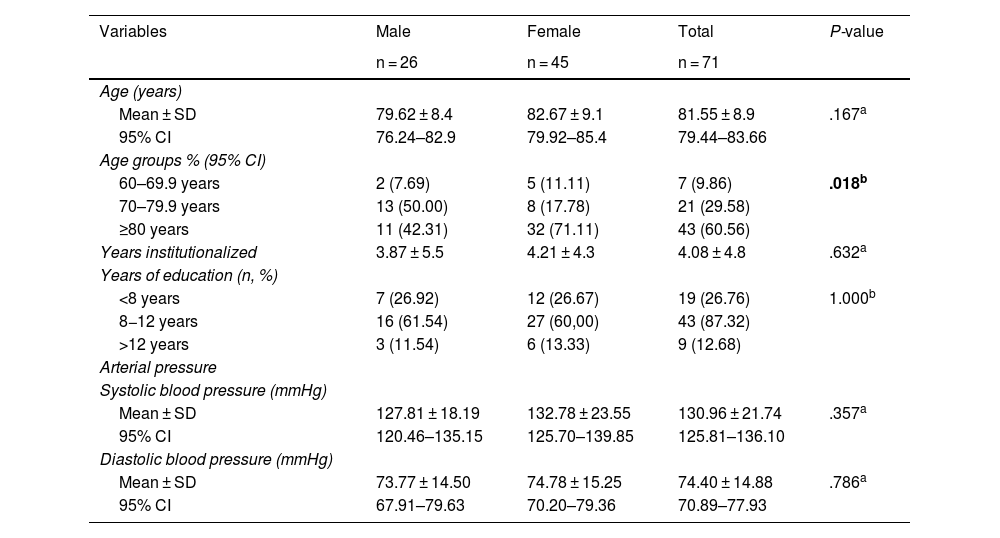
Table 1. Sociodemographic and health characteristics of the study sample by gender.
Tables
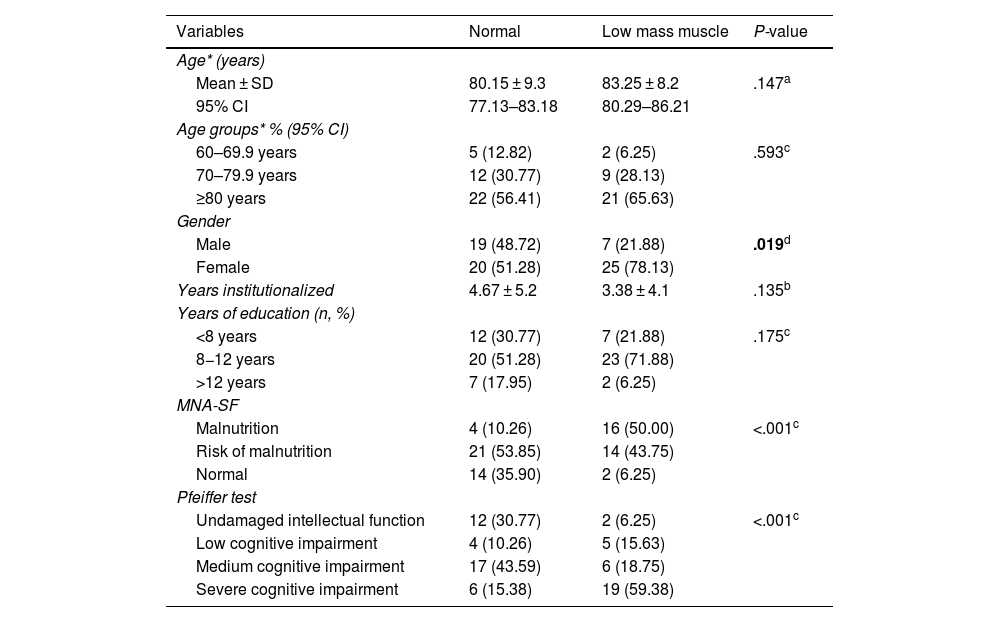
Table 2. Characteristics of patients according to the presence or absence of risk of sarcopenia.
Tables
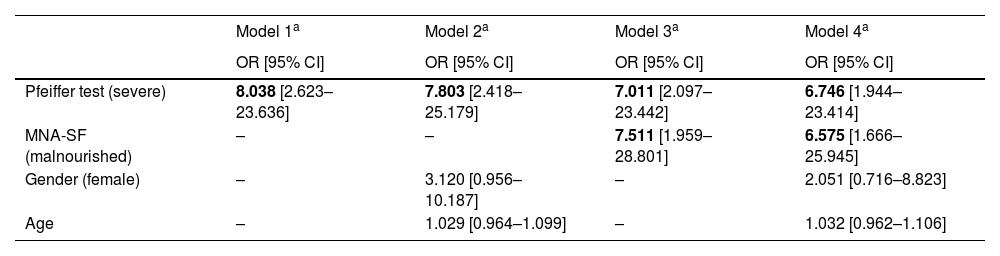
Table 3. Logistic regression for the association between low mass muscle with cognitive impairment and malnutrition, adjusted for gender and age in long-term care homes for the elderly.
Tables
Show moreShow less
Abstract
Objectives

The number of older adults is rising annually, which is accompanied by an increase in the number of individuals residing in long-term care facilities. Muscle mass is a determinant of mobility and autonomy in these individuals. Therefore, the aim of the present study is to evaluate the association between malnutrition and cognitive impairment with low muscle mass among institutionalized older adults.

Methods

Patients’ sociodemographic data and body measurements were analyzed. Low muscle mass was determined by leg perimeter being < 31 cm; cognitive status was evaluated with the Pfeiffer test; and nutritional status, was assessed with the Mini Nutritional Assessment Short-Form. Logistic regression models were used to analyze whether malnutrition and cognitive impairment are associated with low muscle mass, adjusted for gender and age.

Results

Among participants with low muscle mass, 50% presented malnutrition and 59% presented high cognitive deterioration. Participants with a high cognitive deterioration and malnutrition showed a greater risk of low muscle mass (OR 6.75; P = .003 and OR 6.58; P = .007, respectively) regardless of gender and age.

Conclusions

Both malnutrition and cognitive deterioration were associated with low muscle mass which is determinant to maintain mobility and independence in older adults.

Keywords:
Senior citizens
Dependency
Sarcopenia
Cognitive deterioration
Malnutrition
Pfeiffer scale
Resumen
Objetivos

El número de personas mayores aumenta cada año, lo que va acompañado de un incremento en el número de personas que residen en centros de cuidados de larga duración. La masa muscular es un factor determinante de la movilidad y la autonomía de estas personas. Por lo tanto, el objetivo del presente estudio es evaluar la asociación entre la desnutrición y el deterioro cognitivo con la baja masa muscular en personas mayores institucionalizadas.

Métodos

Se analizaron los datos sociodemográficos y medidas corporales de los pacientes. La baja masa muscular se determinó por el perímetro de pierna < 31 cm; el estado cognitivo se evaluó con la prueba de Pfeiffer; y el estado nutricional se evaluó con la Mini Nutritional Assessment Short Form. Se utilizaron modelos de regresión logística para analizar si la desnutrición y el deterioro cognitivo están asociados con la masa muscular baja, ajustados por género y edad.

Resultados

Entre los participantes con baja masa muscular, el 50% presentaba desnutrición y el 59% presentaba un alto deterioro cognitivo. Los participantes con un alto deterioro cognitivo y desnutrición mostraron un mayor riesgo de baja masa muscular (OR 6,75; P = ,003 y OR 6,58; P = ,007, respectivamente), independientemente de género y edad.

Conclusiones

Tanto la desnutrición como el deterioro cognitivo se asociaron con una baja masa muscular, lo cual es determinante para mantener la movilidad y la independencia en los adultos mayores.


Palabras clave:
Personas mayores
Dependencia
Sarcopenia
Deterioro cognitivo
Desnutrición
Escala de Pfeiffer

Article

These are the options to access the full texts of the publication Enfermería Clínica (English Edition)
Subscriber
Subscriber

If you already have your login data, please click here .

If you have forgotten your password you can you can recover it by clicking here and selecting the option “I have forgotten my password”
Subscribe
Subscribe to

Enfermería Clínica (English Edition)

Purchase
Purchase article

Purchasing article the PDF version will be downloaded

Purchase now
Contact
Phone for subscriptions and reporting of errors
From Monday to Friday from 9 a.m. to 6 p.m. (GMT + 1) except for the months of July and August which will be from 9 a.m. to 3 p.m.
Calls from Spain
932 415 960
Calls from outside Spain
+34 932 415 960
E-mail
Article options
Tools