
Gastrointestinal norovirus infections are highly prevalent, causing outbreaks especially in institutions such as nursing homes. We describe an outbreak caused by an emerging norovirus genotype.
Material and methodsWe defined a case as a resident or worker of the centre with clinical signs and symptoms of AGE from 14 to 29 May 2022, with no underlying pathology to justify it. A clinical-epidemiological survey was carried out and stool samples were collected from patients with diarrhoea at the time of the study. Virological analysis was performed at the Microbiology Department of our hospital by antigenic detection (Certest®, Biotec SL) and/or multiplex PCR (AllplexTM GI-Virus Assay, Seegene®). Viral genotyping by sequencing was performed by the Centro Nacional de Microbiología (CNM).
ResultsThe outbreak totaled 114 cases (99 residents, 15 workers), extending over 16 days. The most frequent symptoms were vomiting and diarrhoea. The overall attack rate was 30.8% (in workers 12.7%). Cases increased rapidly in the first 48h, falling progressively over successive days. Food contamination was ruled out, with person-to-person transmission being the most likely. Those affected improved clinically in less than 72h, with no deaths. We tested 14 samples from residents, which were positive for norovirus GII. The CNM received 8 samples, detecting norovirus genogroup GII, genotype 17 [P17] in 6.
ConclusionsOutbreaks of norovirus GEA in nursing homes can affect numerous users. In our case, norovirus genotype GII.17 was the aetiological agent, confirming its widespread dissemination in the last decade worldwide.
Las infecciones gastrointestinales por norovirus tienen una elevada prevalencia, causando brotes especialmente en instituciones como residencias de mayores. Describimos un brote originado por un genotipo de norovirus emergente.
Material y métodosDefinimos caso como residente o trabajador del centro con clínica de GEA del 14al 29 de mayo de 2022, sin patología de base que la justificara. Se elaboró una encuesta clínico-epidemiológica, recogiéndose muestras de heces de pacientes con diarrea en el momento del estudio. El análisis virológico fue realizado en el Servicio de Microbiología de nuestro hospital mediante detección antigénica (Certest®, Biotec SL) y/o PCR multiplex (AllplexTM GI-Virus Assay, Seegene®). El Centro Nacional de Microbiología (CNM) realizó el genotipado viral mediate secuenciación.
ResultadosEl brote sumó 114 casos (99 residentes, 15 trabajadores), extendiéndose durante 16 días. Los síntomas más frecuentes fueron vómitos y diarrea. La tasa de ataque global fue del 30,8% (en trabajadores 12,7%). Aumentaron rápidamente los casos en las primeras 48horas, cayendo progresivamente en días sucesivos. Se descartó la contaminación de alimentos, siendo la transmisión persona a persona la más probable. Los afectados mejoraron clínicamente en menos de 72horas, sin fallecimientos. Analizamos 14 muestras de residentes, resultando positivas para norovirus GII. El CNM recibió 8 muestras, detectándose en 6 norovirus genogrupo GII, genotipo 17 [P17].
ConclusionesLos brotes de GEA por norovirus en residencias de mayores pueden afectar a numerosos usuarios. En nuestro caso, norovirus genotipo GII.17 fue el agente etiológico, confirmando su gran difusión en la última década por todo el mundo.
Noroviruses are a heterogeneous group of icosahedral, non-enveloped, single-stranded RNA viruses. They are recognised as one of the leading causes of non-bacterial food-borne illnesses (FBI) and acute gastroenteritis (AGE). Gastrointestinal infections caused by norovirus are highly contagious and frequently cause outbreaks, especially in closed institutions such as nursing homes, hotels and cruise ships.1 Most outbreaks of norovirus illness occur when infected people spread the virus to others through direct contact, such as caring for others or sharing food or eating utensils with them. Food, water and surfaces contaminated with norovirus can also cause outbreaks.2,3 The most common source of food poisoning is water, although foods such as bivalve molluscs, meat, ice cream and fruit handled by infected people can also be the source.4 The infectious dose of norovirus is very low. Symptoms usually begin between 24 and 48h after exposure and last from 48 to 72h.5 Infected individuals can shed viruses through their faeces hours before the onset of clinical symptoms and maintain viral shedding for a few days and even up to three weeks after the resolution of symptoms, so asymptomatic individuals may continue to be infectious. There are not thought to be chronic carriers.6
Noroviruses are subdivided into 10 genogroups and 49 genotypes based on sequence homology.7 Genogroups GI, GII, and GIV include human pathogens. Multiple genotypes are recognised within each genogroup. In the last ten years, the most prevalent norovirus genotype causing viral AGE outbreaks worldwide, including Spain, has been GII.4. The first outbreak of norovirus GII.17 was reported in Argentina in 2006.8 In the winter of 2014–2015, following an increase in norovirus outbreaks in China, GII.17 was reported as the main cause of this increase.9 An increase in the number of sporadic cases of gastroenteritis caused by this variant has also been reported in other areas, such as Korea, Taiwan, Japan, Australia, France and the United States.10 It is currently most prevalent in the Japan area and it has spread worldwide.11–14 In Spain, studies such as that by Navarro-Lleó et al. show the norovirus to have been the most commonly detected enteric virus, with a positivity rate of 9.5%, where 78% belonged to genogroup II. The GII.4 genotype was the most common, followed by GII.2, GII.3, GII.6 and GII.17.15 There have been studies of GII outbreaks published in Spain in recent years, such as that by Galmés Truyols A. et al., with 266 affected by norovirus GII16 or Cornejo-Sánchez T. et al., with 61 cases confirmed as positive.17
In May 2022, an outbreak of AGE was declared in a nursing home in Albacete. This genotype had been described in 2014 in a nursing home in China, affecting 30 people, including residents and workers.18 Although this genotype has previously been detected in Spain, our study is the first to provide a detailed description of an outbreak of this genotype in a nursing home. The aim of this article is to report the epidemiological and microbiological study of this outbreak caused by norovirus GII.17 and so contribute to the understanding of the evolving of outbreaks caused by emerging viruses in nursing homes.
MethodsThe institution, in the city of Albacete, included 338 people during the study period, 220 of whom were residents, distributed over five floors that accommodate people with different cognitive and/or functional problems, and 118 workers. Following notification of the outbreak, we conducted a descriptive epidemiological study in relation to the variables of person, place and time. Cases with symptom onset prior to official communication were studied retrospectively, and the rest were studied prospectively. The operational definition of a case was as follows: residents and staff with signs and/or symptoms compatible with AGE without any underlying disease to explain those signs and symptoms in the period from 14th to 26th May 2022. The Epidemiology Section of the Albacete Delegación Provincial de Sanidad [Provincial Health Office] designed a data questionnaire that collected information corresponding to the following variables: link with the institution (resident, staff), age, gender, date of admission to the residence, floor, room, lack of autonomy (not able), date of onset of symptoms, foods ingested, habits of residents, clinical manifestations (vomiting, diarrhoea and fever), duration, outcome, sampling and observations. All data was completed by the technical staff of this section, in coordination and collaboration with the healthcare staff of the geriatric centre. Information was provided on standards of action in outbreaks of AGE in nursing homes.19 The importance of maximising the usual personal hygiene measures was emphasised, especially hand hygiene, the use of disposable gloves and the cleaning and disinfection of objects and surfaces. The affected employees were removed from the workplace until they fully recovered.
For the microbiological diagnosis, stool samples were collected from patients with symptoms of AGE at the time of the study. Eight samples were sent for analysis by the epidemiology service from patients in the residence and four samples from patients treated in Accident and Emergency were sent from there.
The analysis was carried out at the Microbiology Department of Complejo Hospitalario General Universitario de Albacete (CHUA) [Albacete General University Hospital Complex] using antigen detection (Certest®, Biotec SL) and/or Multiplex PCR (AllplexTM GI-Virus Assay, Seegene®, AllplexTM GI-Bacteria Assay, Seegene®). Virological confirmation analysis was carried out at Spain's Centro Nacional de Microbiología [National Microbiology Centre], with the detection of norovirus by PCR and genotyping of positive cases by sequencing of the PCR products obtained and analysis of the sequences (BLAST/phylogenetic analysis/norovirus online genotyping tool, https://www.rivm.nl/mpf/typingtool/norovirus/).
Statistical analysis was performed using the Chi-square test or Fisher's exact test and comparison of proportions, with p values considered significant < 0.05. Quantitative variables are expressed in terms of mean and standard deviation and qualitative variables in terms of absolute values and percentages. To measure the causal association, we used the odds ratio (OR) with its corresponding 95% confidence interval. We used the Epidat statistical program.
ResultsThe outbreak affected 113 cases, 98 residents and 15 workers, and lasted a total of 12 days. Among residents, 79.6% (n=78) of the cases were female and among the staff, 93.3 % (n=14). No differences were found in terms of gender. The most common symptoms were diarrhoea (72.6%) and vomiting (51.3%); vomiting was significantly more common in the workers than in residents. Only in 10 cases had fever, all of them residents. Cases in residents showed clinical improvement in 3–4 days; in staff the average was 2 days. No one affected required hospital admission and no deaths were recorded. The demographic characteristics and results are shown in Table 1.
Clinical–epidemiological characteristics of the cases.
| Variable | Residents | Staff | Total |
|---|---|---|---|
| Number of cases | 98 (86.7%) | 15 (13.3%) | 113 (100%) |
| Descriptive variables of the cases | |||
| Mean age | 84.9±9.6 | 39.7±12.4 | 78.9±18.3 |
| Gender | |||
| Male | 20 (20.4%) | 1 (6.7%) | 21 (18.6%) |
| Female | 78 (79.6%) | 14 (93.3%) | 92 (81.4%) |
| Sharing room | 76 (77.6%) | N/A | 76 (77.6%) |
| Variables related to the symptoms | |||
| Mean duration of illness (h) | 73±2.2 | 48.5±0.9 | 69±12.0 |
| Diarrhoea | 68 (69.4%) | 14 (93.3%) | 82 (72.6%) |
| Vomiting | 45 (45.9%) | 13 (86.7%) | 58 (51.3%)* |
| Diarrhoea+vomiting | 22 (22.4%) | 12 (80.0%) | 34 (30.1%)* |
| Fever | 10 (10.2%) | 0 (0%) | 10 (8.8%) |
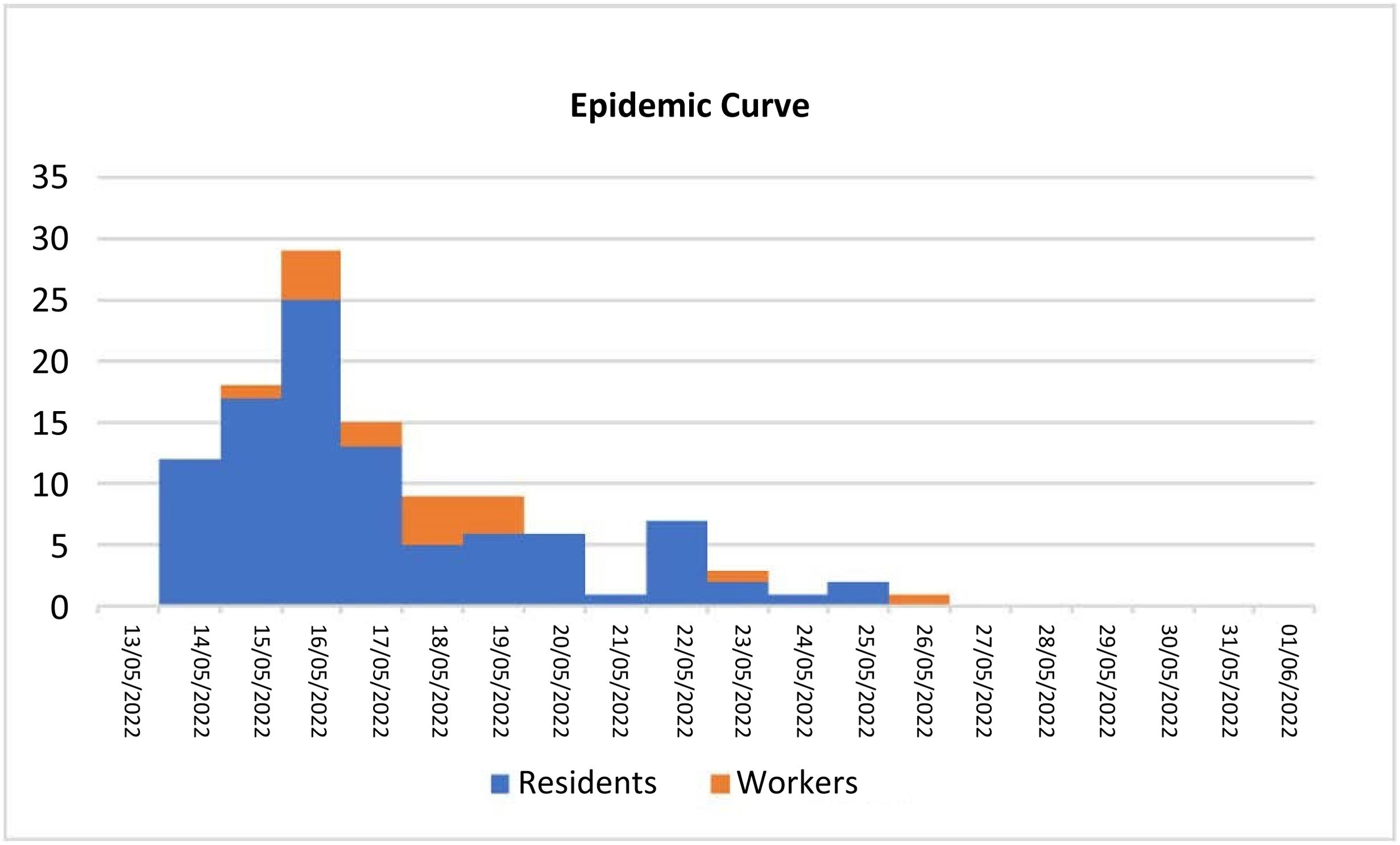
The overall attack rate was 44.5% in residents and 12.7% in workers at the home. Among the residents, the statistical analysis found significant differences between sharing a room (and bathroom) and developing the disease (OR; 3.57 [1.97−6.46]). This association was also found with female residents (OR: 3.31 [1.80−6.07]) and the location of the cases on the second floor of the institution (OR: 3.47 [1.52−7.90]), the floor that accommodates residents with behavioural and cognitive problems (Table 2). The first cases appeared in residents. The first case of the outbreak began showing symptoms on 14 May 2022. As shown by the epidemic curve (Fig. 1), there was a rapid rise in the number of cases in the first 48h and a progressive decline over the following days. This is a typical pattern of interpersonal transmission. The source of infection was not identified.
Overall attack rates, by gender and by floor.
| Floor | Care areas | No.° of residents | No.° of cases | Attack rate (%) | OR (95% CI) |
|---|---|---|---|---|---|
| 1st floor | Cognitive moderately good | 50 | 16 | 32.0 | 1.00 |
| 2nd floor | Behavioural and cognitive | 50 | 31 | 62.0 | 3.47 (1.52−7.90)* |
| 3rd floor | Functional and cognitive | 50 | 24 | 48.0 | 1.96 (0.87−4.42) |
| 4th floor | Cognitive moderately good | 50 | 22 | 44.0 | 1.67 (0.74−3–77) |
| 5th floor | Able | 20 | 5 | 25.0 | 0.71 (0.21−2.29) |
| Residents | 220 | 98 | 44.5 | 5.52 (3.02−10.08)* | |
| Staff | 118 | 15 | 12.7 | ||
| Total | 338 | 113 | 33.4 | ||
| Female residents | 144 | 78 | 54.2 | 3.31 (1.80−6.07)* | |
| Male residents | 76 | 20 | 26.3 | ||
| Sharing room | 136 | 76 | 55.9 | 3.57 (1.97−6.46)* | |
| Not sharing room | 84 | 22 | 26.2 |
95% CI: 95% confidence interval; OR: odds ratio.
The CHUA Accident and Emergency Department treated four residents, requesting stool culture for all of them. Analysis of these samples was positive for norovirus GII in all four cases. The institution later sent eight more stool samples from residents who met the definition for outbreak case to the CHUA Microbiology Department for bacteriological and virological study. Among these, five were positive for norovirus GII. In total, among the nine positive samples analysed, eight were sent to the Centro Nacional de Microbiología. Norovirus was detected in six of them (75%), characterised as genogroup GII, genotype 17 [P17] (GII.17 [P17]).
DiscussionWe have reported here an outbreak of gastroenteritis in a nursing home, the causal agent of which was norovirus genogroup GII, genotype 17 [P17], with no additional pathogens detected. Gastroenteritis due to this virus is usually mild and self-limiting in healthy adults but can be severe in young children and older adults.20 In the post-rotavirus vaccine era, norovirus remains the most frequently detected virus in all settings, almost twice as common as the next most common pathogens: sapovirus and rotavirus.21 Noroviruses are highly contagious and can be associated with both community-acquired and nosocomial outbreaks. The attack rates recorded in our case are similar to those found in other outbreaks studied.4,22,23 The duration of the symptoms, approximately 72h, as well as the symptoms of this outbreak, diarrhoea, vomiting and fever, were similar to those reported in other studies.4,23,24
We found that sharing a room or having behavioural and cognitive problems, affecting patients' autonomy, was associated with the development of the disease. In the above situation, the attack rate was 62%, compared to positive cases in care areas where patients were autonomous, where the attack rate was kept to 25%. The number of cases in women was much higher (81.4%) than in men (18.6%).
Since there is no effective antiviral treatment for norovirus, preventive measures are essential to control infections caused by this pathogen. Hand washing and instrument disinfection do not appear to be sufficient to control the spread of AGE outbreaks, but they are sufficient to reduce their incidence.22 They are non-enveloped viruses, very resistant to physical and chemical agents, which allows them to remain on surfaces for a long time. There is ample evidence of the virus's ability to survive in the environment and cause repeated outbreaks. Furthermore, patients are contagious for as long as three weeks after the onset of the disease. For these reasons, early notification of the outbreak to epidemiological services is essential for taking control measures. In our study, the first cases occurred in early May 2022. On the same day of the communication, the AGE outbreak was declared to the Central Services of the Department of Health (Epidemiology Service of Toledo). The Public Health Supervision and Audit section was also informed.
In managing this outbreak, information was provided to the residential care centre on the measures to be taken with residents and workers, with special emphasis on recommendations such as hand hygiene and disinfection with diluted bleach solutions to clean surfaces and any material that could be contaminated, as recommended by the US Centers for Disease Control and Prevention,25 following the same guidelines as in other cases of norovirus outbreaks.4
In order to implement appropriate control measures, it is essential to know the causal agent of the outbreak. Nowadays, virological molecular techniques based on PCR allow for rapid and accurate diagnosis. In our case, the aetiological agent initially identified in the hospital microbiology laboratory was norovirus GII. The Centro Nacional de Microbiología subsequently characterised it as genogroup GII genotype 17 [P17]. There could be cases of the outbreak that were not caused by GII. genotype 17, as the microbiological studies were negative (three of the eight samples sent from the residence), which could be due to poor sample preservation, the AGE not being caused by norovirus or the delay in taking the sample because norovirus disease is self-limiting. Two of the samples sent to the Centro Nacional de Microbiología were reported as negative for GII.17. This could be due to the small amount of necessary genetic material for performing the sequencing.
The first outbreak of norovirus GII.17 was described in Argentina in 2006.8 During the winter of 2014–2015, a new norovirus strain GII.17 emerged as a cause of large outbreaks of gastroenteritis in Asia,9 displacing GII.4, which had been the predominant strain in that area. Other outbreaks due to this variant and sporadic cases have been reported in other parts of the world.10–14
As regards the distribution in Spain, a study of the diversity of norovirus in Catalonia showed 21 different circulating genotypes, with epidemiological differences between them (genotype GII.4 Sydney was frequently isolated in outbreaks in nursing homes and GII.2[P16] and GI.3[P3] occurred most frequently in youth hostels or camps).26 Santiso-Bellón et al. reported seven complete norovirus genomes from sporadic cases and outbreaks, including GII.17.27 In Spain, outbreaks of norovirus GII have been reported in hotel complexes associated with the consumption of contaminated food,4,28 in rural populations due to contamination of a water supply,3,29 and in residences for older people.17,30
In conclusion, outbreaks of norovirus-induced AGE in nursing homes can affect numerous users and be highly explosive. Close collaboration between epidemiology and microbiology services is necessary for better management of these outbreaks in vulnerable populations. The application of molecular methods in the diagnosis of these infections is making it possible to determine their aetiology in just a few hours, and provide us with a fuller understanding of the real impact they cause. In our case, norovirus genotype GII.17 was the aetiological agent of the outbreak, confirming the considerable spread of this virus throughout the world over the last ten years. The analysis of these data would be useful not only for epidemiological studies, but also for the development of diagnostic tools and the design of effective vaccines in the future.
FundingThis study received no specific funding from public, private or non-profit organisations.
The authors declare that they have no conflicts of interest.