


metricas
covid
Clínica e Investigación en Arteriosclerosis (English Edition) sICAM-1 concentrations are associated with inflammation in contralateral carotid...
Journal Information
Vol. 37. Issue 2.
(March - April 2025)
Share
Download PDF
More article options
Vol. 37. Issue 2.
(March - April 2025)
Original article
sICAM-1 concentrations are associated with inflammation in contralateral carotid plaque in patients with ischemic stroke
Las concentraciones de sICAM-1 están asociadas con la inflamación en placa carotídea contralateral en los pacientes con ictus isquémico
Núria Puiga, Pol Camps-Renomb, Eduardo Garciac, Aleyda Benítez-Amaroc, Ana Aguilera-Simónb, Alejandro Fernández-Leónd, Jose Luis Sanchez Quesadaa,e, Vicenta Llorente-Cortésc,f,
Corresponding author
cllorente@santpau.cat

Corresponding authors.
, Sonia Beniteza,e,
Corresponding author
sbenitez@santpau.cat

Corresponding authors.
a Cardiovascular Biochemistry, Cardiovascular Biochemistry, Research Institute Sant Pau (Institut de Recerca Sant Pau, IR Sant Pau), Barcelona, Spain
b Stroke Unit, Department of Neurology, Hospital de La Santa Creu I Sant Pau, IR Sant Pau, Barcelona, Spain
c Lipids and Cardiovascular Pathology, Institut d’Investigacions Biomèdiques de Barcelona (IIBB-CSIC), IR Sant Pau, Barcelona, Spain
d Department of Nuclear Medicine, Hospital de la Santa Creu i SantPau, IR SantPau, Barcelona, Spain
e CIBER of Diabetes and Metabolic Diseases (CIBERDEM), Madrid, Spain
f CIBER of Cardiovascular (CIBERCV), Madrid, Spain
Article information
Abstract
Full Text
Bibliography
Download PDF
Statistics
Figures (1)
Tables (5)
Table 1. Clinical characteristics and biochemical parameters of the patients.
Tables
Table 2. Bivariate linear regression analyses of the association between each inflammatory biomarker and carotid inflammation (mean SUVmax).
Tables
Table 3. Bivariate linear regression analyses of the association between clinical variables and mean SUVmax, and multivariable linear regression analyses of predictors of carotid plaque inflammation measured by 18F-FDG PET (mean SUVmax).
Tables
Table 4. Bivariate linear regression analyses of the association between each inflammatory biomarker and contralateral carotid inflammation (contralateral SUVmax).
Tables
Table 5. Bivariate linear regression analyses of the association between clinical variables and contralateral SUVmax, and multivariable linear regression analyses of predictors of contralateral carotid plaque inflammation measured by 18F-FDG PET (contralateral SUVmax).
Tables
Show moreShow less
Additional material (1)
Abstract
Background

Atherosclerotic plaques in the internal carotid artery are responsible for more than 15% of ischemic strokes. Carotid 18F-fluorodeoxyglucose positron emission tomography (18F-FDG PET) detects plaque inflammation. Plasma ICAM-1 and LRP1 concentrations have been associated with inflammation in ipsilateral carotid plaque. The aim of the present study was to test the association between the soluble (s) form of these biomarkers and contralateral carotid plaques.

Methods

Prospective study conducted in 53 patients with a recent ischemic stroke and at least one atherosclerotic plaque in both carotid arteries. All of the patients underwent an early carotid 18F-FDG PET, and a blood sample was obtained at 7±1 days. Several plasma inflammatory markers were evaluated by Multiplex and sLRP1 levels were measured by commercial ELISA. Bivariate and multivariable linear regression was used to assess the association between inflammatory markers and the clinical variables, including contralateral maximum standardized uptake value (SUVmax) and mean SUVmax (mean of contralateral and ipsilateral SUVmax) of 18F-FDG uptake. Hazard ratio (HR) was estimated with Cox models adjusted for potential confounding factors to evaluate recurrence.

Results

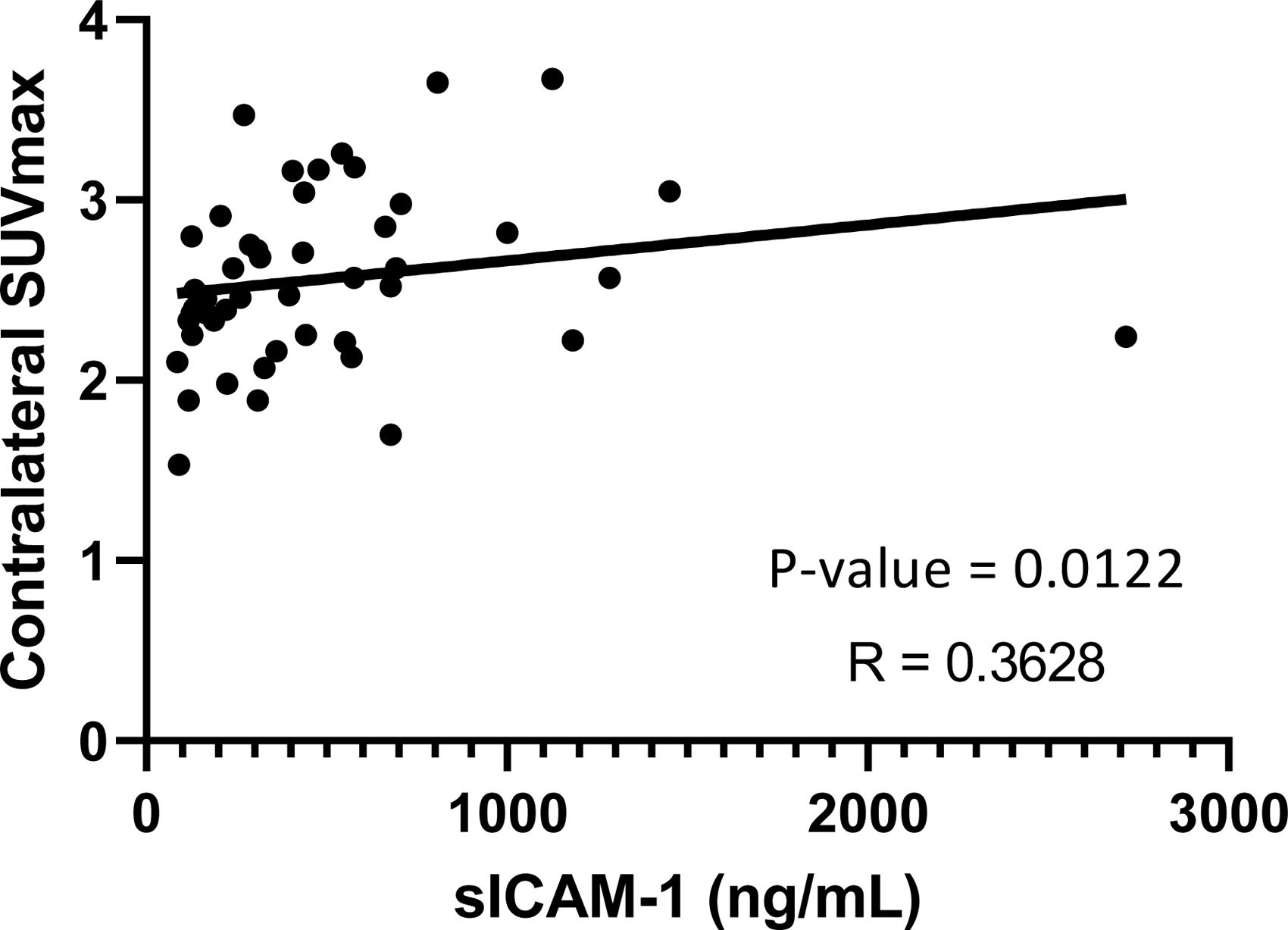
Multivariable linear regression analysis showed an independent association between sICAM-1 and sVCAM-1 and mean SUVmax (CI=−0.064–0.325, p=0.004; CI=0.079–0.554, p=0.010). In addition, in bivariate regression analysis, sICAM-1 was associated with contralateral SUVmax (CI=0.049–0.382, p=0.012). Cox regression showed that mean SUVmax was associated with stroke recurrence (HR=5.604, p=0.044).

Conclusions

sICAM-1 was independently associated with mean carotid plaque inflammation and with inflammation in contralateral plaque. sICAM-1 could be an indicator of plaque inflammation even in asymptomatic plaques.

Keywords:
Carotid atherosclerosis
Ischemic stroke
Contralateral plaque inflammation
18F-FDG PET computed tomography
sICAM-1
sLRP1
Resumen
Antecedentes

Las placas ateroscleróticas en la arteria carótida causan más del 15% de ictus isquémicos. La tomografía carotídea por emisión de positrones con 18F-fluorodesoxiglucosa (18F-FDG PET) detecta inflamación de la placa. La concentración plasmática de ICAM-1 y LRP1 se ha asociado con inflamación en placa ipsilateral. El objetivo del estudio fue estudiar la asociación entre la forma soluble (s) de estos biomarcadores y las placas carotídeas contralaterales.

Métodos

Estudio prospectivo de 53 pacientes con ictus isquémico reciente y al menos una placa aterosclerótica en ambas carótidas. A los pacientes se les realizó 18F-FDG PET y se obtuvo sangre entre los 7±1 días. Se evaluaron biomarcadores inflamatorios por Multiplex y los niveles de sLRP1 mediante ELISA. Se evaluó mediante regresión lineal bivariable y multivariable la asociación entre los biomarcadores y las variables clínicas, incluido el valor máximo de captación estandarizado contralateral (SUVmáx) y el SUVmáx medio (media decontralateral e ipsilateral). El índice de riesgo de recurrencia (HR) se estimó con modelos Cox.

Resultados

La regresión multivariable mostró la asociación independiente entre sICAM-1 y sVCAM-1 y SUVmáx medio (IC=−0,064-0,325; p=0,004; IC=0,079-0,554; p=0,010). Además, en análisis de regresión bivariado, sICAM-1 se asoció con SUVmáx contralateral (IC=0,049-0,382; p=0,012). La regresión de Cox mostró que el SUVmáx medio se asoció con recurrencia del ictus (HR=5,604; p=0,044).

Conclusión

sICAM-1 se asoció de forma independiente con la inflamación media de la placa carotídea y con la inflamación de la placa contralateral. sICAM-1 podría ser un indicador de inflamación de la placa incluso en placas asintomáticas.

Palabras clave:
Aterosclerosis carotídea
Ictus isquémico
Inflamación en placa contralateral
Tomografía computarizada PET con 18F-FDG
sICAM-1
sLRP1

Article

These are the options to access the full texts of the publication Clínica e Investigación en Arteriosclerosis (English Edition)
Subscriber
Subscriber

If you already have your login data, please click here .

If you have forgotten your password you can you can recover it by clicking here and selecting the option “I have forgotten my password”
Subscribe
Subscribe to

Clínica e Investigación en Arteriosclerosis (English Edition)

Purchase
Purchase article

Purchasing article the PDF version will be downloaded

Purchase now
Contact
Phone for subscriptions and reporting of errors
From Monday to Friday from 9 a.m. to 6 p.m. (GMT + 1) except for the months of July and August which will be from 9 a.m. to 3 p.m.
Calls from Spain
932 415 960
Calls from outside Spain
+34 932 415 960
E-mail
Article options
Tools
Supplemental materials