


metricas
Cirugía Española (English Edition) Results at one year of the TROPIS technique in the treatment of complex anal fis...
Journal Information
Visits
1342
Vol. 103. Issue 3.
Pages 125-178 (March 2025)
Original article
Full text access

Results at one year of the TROPIS technique in the treatment of complex anal fistula

Resultados al año de la técnica TROPIS en el tratamiento de la fístula anal compleja
Visits
1342
María Luisa Reyes Díaza, Fatima Hinojosa-Ramirezb,
Corresponding author
, Irene María Ramallo Solísb, Rosa María Jiménez Rodríguezc, Jose Pintor Tortolerob, Ana María García Cabrerab, Jorge M. Vázquez Monchuld, Fernando de la Portilla de Juane
a Associate Professor at the University of Seville, Specialist Area Faculty of the Department of General and Digestive Surgery, Specialised Coloproctology Unit, Virgen del Rocío University Hospital, Seville, Spain
b Department of General and Digestive Surgery, Specialised Coloproctology Unit, Virgen del Rocío University Hospital, Seville, Spain
c Sernior lecturer at the University of Seville, Specialist Area Faculty of the Department of General and Digestive Surgery, Specialised Coloproctology Unit, Virgen del Rocío University Hospital, Seville, Spain
d Associate Professor at the University of Seville, Department of General and Digestive Surgery, Specialised Coloproctology unit Virgen del Rocío University Hospital, Seville, Spain
e Full professor at the University of Seville, Department of General and Digestive Surgery, Head of the Coloproctology Unit, Virgen del Rocío University Hospital, Seville, Spain
Related content
This item has received
Article information
Abstract
Full Text
Bibliography
Download PDF
Statistics
Tables (4)
Table 1. Fistula characteristics.
Tables
Table 2. Univariate analysis of faecal incontinence after TROPIS.
Tables
Table 3. Healing after TROPIS.
Tables
Table 4. Univariate analysis of healing after TROPIS.
Tables
Figures (1)
fig0005
Abstract
Introduction

It is a priority to find surgical techniques that guarantee acceptable healing rates without sequelae in the treatment of complex anal fistula. The concept of the deep intersphincteric space as the origin of perianal sepsis has provided a new perspective, allowing the emergence of techniques such as TROPIS (Transanal Opening of Intersphincteric Space), with few published series to date. The aim of this study is to evaluate the healing rate and complications one year after the TROPIS technique as a treatment for complex anal fistula without hospitalization.

Method

Prospective, observational study from January 2021 to January 2023. Patients with complex anal fistulas who met the inclusion criteria were treated using the TROPIS technique. A one-year follow up review was conducted, assessing healing rates, recurrence, continence, and complications.

Results

A total of 23 patients with cryptoglandular complex perianal fistula were included (87% male, mean age 54.7 ± 9.6 years). 78.3% were treated for recurrent fistulas with an average of 3.3 ± 3.2 previous interventions. At one month, 82.6% of the patients had complete healing. At three, six, and twelve months, complete healing occurred in 63.6%, 61.9%, and 55.6%, respectively. One patient developed an abscess at one month. Continence was altered in 8.7%.

Conclusions

The treatment of cryptoglandular complex anal fistula with this procedure was safe and showed acceptable healing rates.

Keywords:
TROPIS
Complex anal fistula
Intersphincteric space
Recurrence
Fecal incontinence
Resumen
Introducción

Es prioritario encontrar técnicas quirúrgicas que garanticen tasas de curación aceptables sin secuelas en el tratamiento de la fístula anal compleja. El concepto de espacio interesfintérico profundo como origen de la sepsis perianal ha dado una nueva perspectiva, permitiendo la aparición de técnicas como, TROPIS (Transanal Opening of Intersphincteric Space), con escasas series publicada hasta el momento. El objetivo de este estudio es valorar la tasa de curación y las complicaciones al año de la técnica TROPIS, como tratamiento de la fistula anal compleja sin ingreso.

Método

Estudio ambispectivo, observacional, desde enero del 2021 a enero del 2023. Se trató mediante técnica TROPIS a pacientes con fístula anal compleja que cumplían criterios de inclusión. Se realizó una evaluación al año, valorando tasas de curación, recurrencia, de continencia y complicaciones.

Resultados

Se han incluido un total de 23 pacientes con fistula anal compleja criptoglandular (87% varones, edad media 54,7 ± 9,6 años). El 78,3% fueron fistulas recidivadas con una media de 3,3 ± 3,2 intervenciones previas. Al mes, un 82,6% de las pacientes tuvieron una curación completa. A los tres, seis y doce meses la curación completa se dio en un 63,6%, 61,9% y 55,6% respectivamente. Un paciente tuvo un absceso al mes. La continencia se modificó en un 8.7%.

Conclusiones

El tratamiento de la fístula anal compleja criptoglandular con este procedimiento fue seguro y mostró aceptables tasas de curación.


Palabras clave:
TROPIS
Fistula anal compleja
Espacio interesfintérico
Recidiva
Incontinencia fecal
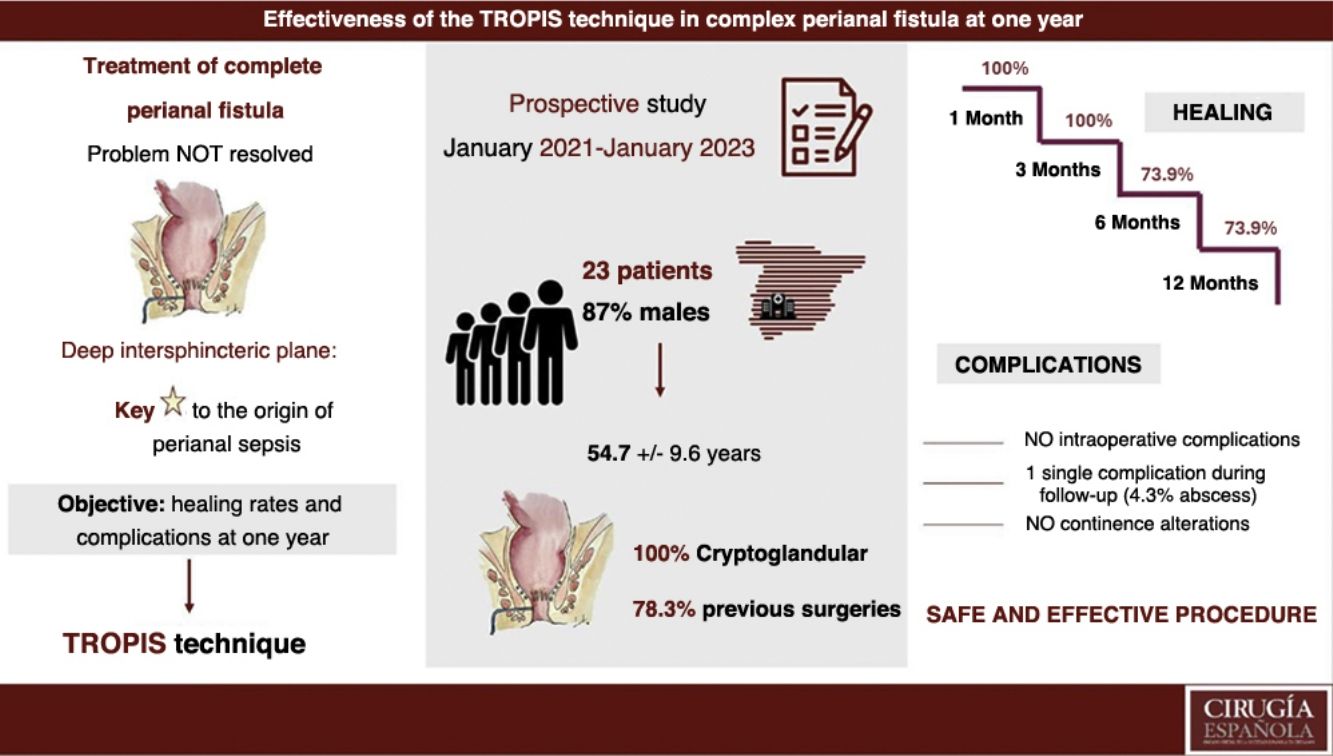
Graphical abstract
Full Text
Introduction

Anal fistula (AF) is a benign anorectal pathology characterised by the formation of an aberrant path between the anal canal and the skin of the perianal region. It is one of the most frequent anorectal disorders, with an incidence in the adult population that varies between 8.6–10 per 100,000/year.1

Although the data are underdiagnosed, it currently represents between 10% and 30% of all anorectal surgical interventions.2,3

Surgery remains the first-line treatment for AF. Fistulotomy is the procedure of choice for simple fistulas, with a cure rate of 90% and very low rates of faecal incontinence.4 These data are far from those published on the treatment of complex AF, which constitute a challenge for the surgeon.

Complex anal fistulas are those that represent a risk to the function of the sphincter apparatus (tracts involving >30% of the external sphincter, recurrent, multiple tracts, anterior fistulas in women, or those associated with anal incontinence, immunosuppression, Crohn's disease, radiotherapy or neoplasia).5–7 In these cases, finding surgical techniques that can eradicate the infectious process, without altering continence and avoiding recurrence is an unmet challenge. The invasive techniques described to date have achieved continence rates of close to 95%–98%, similar to fistulotomy; While the cure and recurrence rates are lower than those obtained after performing a fistulotomy, approximately 50% cure with fibrin plugs and 66%–87% after LIFT (Ligation of intersphincteric fistula tract).8

In recent years, new information has been provided on the role of the deep intersphincteric space in the pathogenesis of AF. In contrast to the classic Parks theory, which focuses on fistula tracts and infection of the anal glands as the origin of these fistulas, the intersphincteric space shares a similar pathophysiological basis to that of the postanal space where this deep space is the origin of sepsis and acts as a reservoir of the same, leading to the perpetuation of abscesses and perpetuating fistulas.9,10

The TROPIS technique, developed on this new pathophysiological understanding, directly addresses the intersphincteric space by opening it transanally, allowing complete and controlled drainage of sepsis in this confined region. This approach not only breaks with classical concepts, but offers a new surgical strategy specifically designed to improve healing rates in patients with complex AF.10 Taking into account the reflected considerations, the aim of this prospective clinical study was to evaluate the complications and healing rate at one year of the technique called Transanal Opening of Intersphincteric Space (TROPIS), which acts on the intersphincteric space, as a surgical treatment in patients with complex AF.

Materials and methods

An ambispective, observational, single-centre study was conducted in patients with complex AF who underwent surgery using the TROPIS technique. The study was carried out in Spain, in a Level III Hospital, in the Department of Colorectal Surgery.

Informed consent was obtained from all patients.

The study was conducted in accordance with the protocol and under the approval of the Ethics Committee.

  • Sample

Patients diagnosed with complex AF who underwent surgery between January 2021 and January2023 using the TROPIS technique.

Inclusion criteria: People over 18 years of age with complex AF (tracts involving more than 30% of the external sphincter, recurrent, multiple tracts, anterior fistulas in women, or those associated with anal incontinence) of cryptoglandular origin.

Exclusion criteria: people under 18 years of age, simple AF, AF associated with immunosuppression, Crohn's disease, secondary cancers or radiation.

  • Definitions

  • -

    Mid-low anal canal was defined as the end of the mid-anal canal and the lower anal canal, as seen by endoanal ultrasound.

  • -

    Mid-high anal canal was defined as the beginning of the mid-anal canal and the upper anal canal, as seen by endoanal ultrasound.

  • -

    Complete cure was defined as the absence of suppuration and complete epithelialisation of the external fistula orifice.

  • -

    Partial cure was defined as the absence of suppuration despite the lack of complete epithelialisation of the external fistula orifice.

  • -

    Persistent absence of cure or maintenance of symptoms in the first 6 months after the intervention.

  • -

    Recurrence: reappearance of symptoms, 6 months after the intervention, after having been diagnosed as complete or partial cure.

  • -

    Complication: any undesirable sign, symptom or clinical condition that occurs after the start of therapy.

  • Study design

Diagnosis

The diagnosis was made by clinical examination and 3D endoanal ultrasound, using a BK Pro Focus 2202 ultrasound system with a 2050 BK transducer probe (BK Medical, Herlev, Denmark).

Procedure

All patients were prepared at home with a phosphate enema the night before surgery. In all cases, the anaesthesia received was epidural. Antibiotic prophylaxis was not performed.

The approach was transanal on an outpatient basis. The surgical technique consisted of:

  • 1

    Identification and tutoring of the fistula tract with a stylet.

  • 2

    Identification of the intersphincteric space (ISS).

  • 3

    Unroofing of the ISS by means of sectioning the internal anal sphincter (IAS) and the mucosa with electrocautery from inside the anal canal, at the level of the internal fistula orifice (IFO). In this way, a tract is opened in the ISS that will subsequently heal by secondary intention.

  • 4

    Curettage of the ISS and the fistula tract.

  • 5

    Marsupialisation of the ISS at the level of the external sphincter with a 3.0 sterile absorbable surgical suture.

  • 6

    Removal of the external fistula orifice (IFO).

The recommendations upon discharge consisted of hygiene of the area, daily sitz baths, analgesia only if there is pain, and avoiding constipation.

Postoperative follow-up

The study consisted of 4 consecutive postoperative visits, at one month, three months, six months and twelve months.

Faecal incontinence (FI)

This was assessed using the Claveland Clinic Incontinence Score (CCIS), with values ​​<9 being considered mild incontinence and values ​​>9 being severe incontinence.11,12

Postoperative pain

This was assessed using the verbal numerical scale (NS) where the patient scored their pain from 0 to 10, with 0 being the absence of pain and 10 being the maximum pain. Mild pain was considered <3, moderate pain 3–7, severe pain >7.

  • Variables

Qualitative variables: sex (male/female), American College of Anaesthesia Risk Index (ASA) (I, II, III, IV), origin of the fistula, previous recurrences, previous treatments for AF, Parks classification, types of fistulous tract, type of admission, intraoperative complication, postoperative complication (1, 3, 6 and 12 months), re-intervention, healing (1, 3, 6 and 12 months), continence prior to the technique and continence after the technique.

Quantitative variables: age (years), body mass index (BMI), time with AF (months), number of previous interventions, operating time (min), number of fistulous tracts, number of OFIs, number of OFEs, postoperative stay (days), degree of faecal incontinence (CCIS), verbal numerical scale (EN, 0–10).

  • Statistical analysis

A descriptive study of the variables was performed. Patient characteristics were summarised using continuous and categorical variables. Continuous variables were presented as mean ± standard deviation (SD). Categorical variables were presented as frequencies and percentages (%).

Statistical analysis to check normality was performed with the Kolmogorov-Smirnov test, considering the distribution to be normal if P > .05, and homoscedasticity was checked with the Lavenne test, considering it homogeneous if P > .05. Qualitative variables were evaluated using the Chi2 or McNemar test for paired samples, while categorical variables were evaluated using the Student T-test if they followed a normal distribution or the Mann-Whitney U test if the sample had a non-normal distribution. A P value <.05 was considered statistically significant. Data were analysed using the statistical software BM® SPSS® Statistics.21

Results

A total of 23 patients were included, with complex anal confluents of cryptoglandular origin, using the TROPIS technique. All patients completed the study.

Eighty-seven per cent of the operated patients were men, while 13% were women. The mean age was 54.7 ± 9.6 years. 73.9% had a preoperative ASA of II. The mean BMI (kg/m2) was 29.7 ± 5.6.

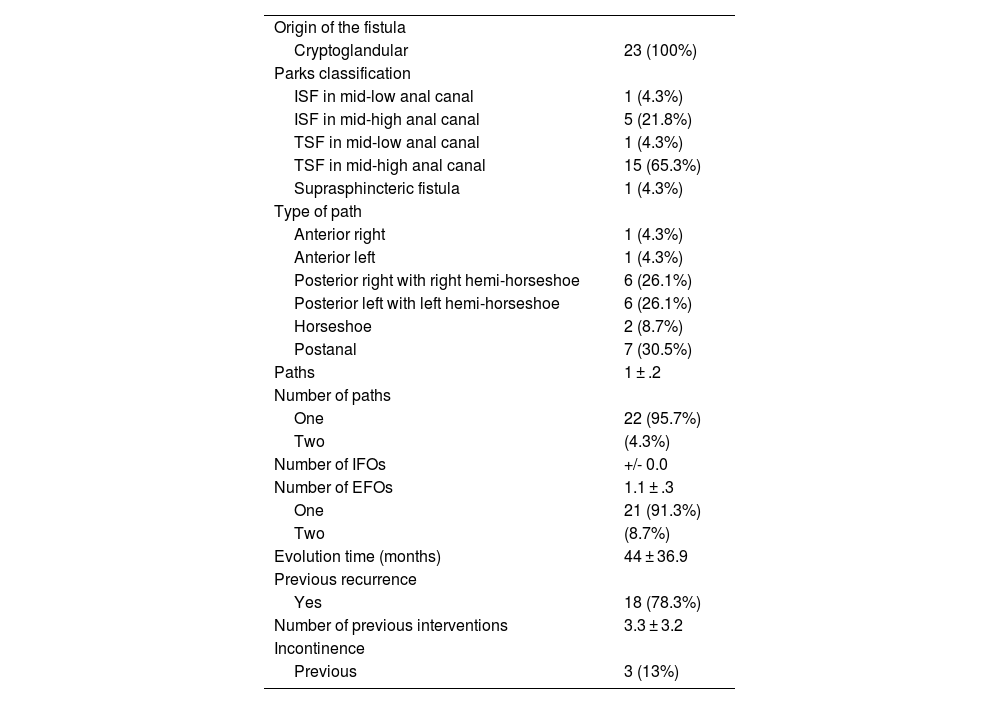
All fistulas were diagnosed by physical examination plus endoanal ultrasound (3D). The type of fistula according to the Parks classification was transphincteric (TS), 69.6% (versus 26.1% intersphincteric (IS)). 78.3% (18 cases) were recurrent fistulas with a mean of 3.3 ± 3.2 previous interventions. In none of the cases was seton placement used prior to surgery. The characteristics of the fistulas are detailed in Table 1.

  • Follow-up

Table 1.

Fistula characteristics.

Origin of the fistula   
Cryptoglandular  23 (100%) 
Parks classification   
ISF in mid-low anal canal  1 (4.3%) 
ISF in mid-high anal canal  5 (21.8%) 
TSF in mid-low anal canal  1 (4.3%) 
TSF in mid-high anal canal  15 (65.3%) 
Suprasphincteric fistula  1 (4.3%) 
Type of path   
Anterior right  1 (4.3%) 
Anterior left  1 (4.3%) 
Posterior right with right hemi-horseshoe  6 (26.1%) 
Posterior left with left hemi-horseshoe  6 (26.1%) 
Horseshoe  2 (8.7%) 
Postanal  7 (30.5%) 
Paths  1 ± .2 
Number of paths   
One  22 (95.7%) 
Two  (4.3%) 
Number of IFOs  +/- 0.0 
Number of EFOs  1.1 ± .3 
One  21 (91.3%) 
Two  (8.7%) 
Evolution time (months)  44 ± 36.9 
Previous recurrence   
Yes  18 (78.3%) 
Number of previous interventions  3.3 ± 3.2 
Incontinence   
Previous  3 (13%) 

Abbreviations: ISF, inter-sphincteric fistula; TSF, trans-sphincteric fistula; EFO, external fistulous orifice; IFO, internal fistulous orifice.

All patients underwent surgery on an outpatient basis and the mean surgery time was 30 ± 4.8 min. There were no intraoperative complications during the procedure. During follow-up visits, only one complication was noted one week after surgery (4.3%), which consisted of an abscess in the EFO that required drainage under anaesthesia. Pain in the immediate postoperative period was 1.5 ± 1.1 (EN) and decreased during follow-up.

  • Faecal incontinence

Due to previous surgeries, 3 patients (13%) suffered from mild FI (CCIS < 9) prior to surgery. After surgery, a total of 5 patients (21.7%) suffered from FI, all of them with a score <9 on the CCIS, of which only 2 patients (8.7%) presented de novo FI. This increase in incontinence was not significant (P = .25).

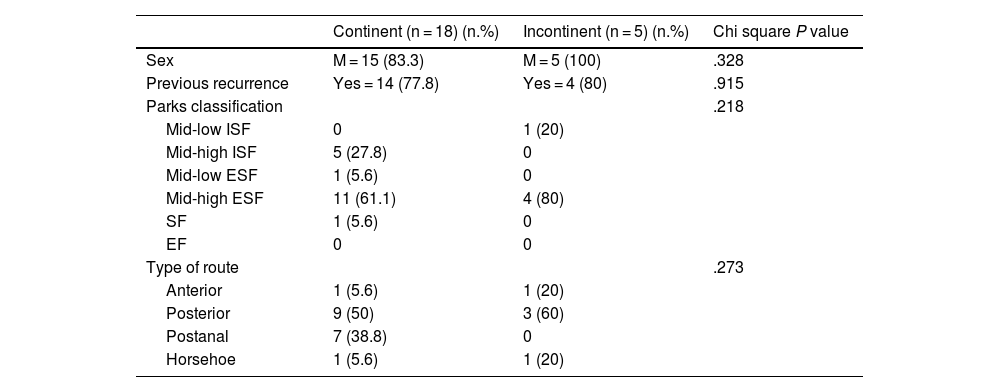
A univariate analysis was performed to assess the possible relationship between the different clinical variables (age, sex, time of evolution, type of fistula, type of tract…) and the result of faecal incontinence that can be seen in Table 2. None of the values ​​analysed showed a significant relationship with incontinence.

  • Healing

Table 2.

Univariate analysis of faecal incontinence after TROPIS.

  Continent (n = 18) (n.%)  Incontinent (n = 5) (n.%)  Chi square P value 
Sex  M = 15 (83.3)  M = 5 (100)  .328 
Previous recurrence  Yes = 14 (77.8)  Yes = 4 (80)  .915 
Parks classification      .218 
Mid-low ISF  1 (20)   
Mid-high ISF  5 (27.8)   
Mid-low ESF  1 (5.6)   
Mid-high ESF  11 (61.1)  4 (80)   
SF  1 (5.6)   
EF   
Type of route      .273 
Anterior  1 (5.6)  1 (20)   
Posterior  9 (50)  3 (60)   
Postanal  7 (38.8)   
Horsehoe  1 (5.6)  1 (20)   
  Continent (n = 18) (mean. DS)  Incontinent (n = 5) (mean. DS)  T-Student P value 
Age (years)  55.5 ± 9.7  52 ± 9.8  .484 
BMI (Kg/m2)  28.9 ± 5.1  31.2 ± 7.8  .502 
  Continent (n = 18) (mean. DS)  Incontinent (n = 5) (mean. DS)  U-Mann-Whitney P value 
Evolution time  27 (12.7−73)  43 (21−92,1)  .363 
Number of paths  1 (1−1)  1 (1−1)  .857 
Number of IFOs  1 (1−1)  1 (1−1) 
Number of EFOs  1 (1−1)  1 (1−1)  .745 

FIE, inter-sphincteric fistula; FTE, trans-sphincteric fistula; FS, supra-sphincteric fistula; FE, extra-sphincteric fistula; BMI, body mass index; EFO, external fistulous orifice; IFO, internal fistulous orifice.

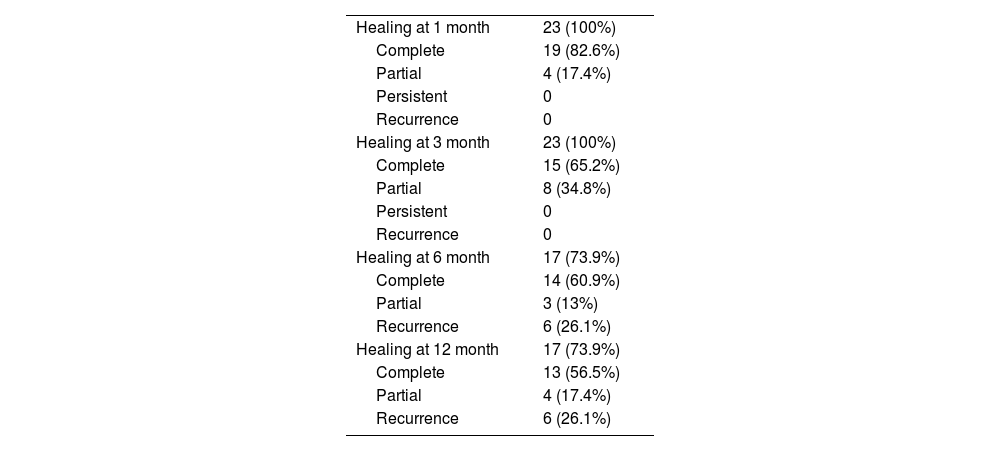
Table 3 shows the healing rates during follow-up. Of note is that the overall healing rate at one year was 73.9%, with complete healing in 56.5% and partial healing in 16.4%.

Table 3.

Healing after TROPIS.

Healing at 1 month  23 (100%) 
Complete  19 (82.6%) 
Partial  4 (17.4%) 
Persistent 
Recurrence 
Healing at 3 month  23 (100%) 
Complete  15 (65.2%) 
Partial  8 (34.8%) 
Persistent 
Recurrence 
Healing at 6 month  17 (73.9%) 
Complete  14 (60.9%) 
Partial  3 (13%) 
Recurrence  6 (26.1%) 
Healing at 12 month  17 (73.9%) 
Complete  13 (56.5%) 
Partial  4 (17.4%) 
Recurrence  6 (26.1%) 

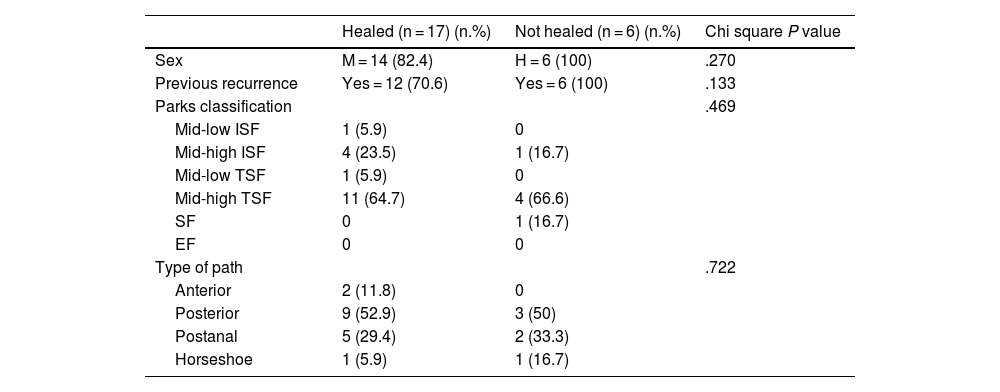
A univariate analysis was performed to evaluate the relationship between the different clinical variables (age, sex, time of evolution, type of fistula, type of tract, etc.) and the healing rates obtained with the TROPIS technique. None of the values ​​analysed showed a significant relationship with healing (P > .05). The results of this analysis can be seen in Table 4.

Table 4.

Univariate analysis of healing after TROPIS.

  Healed (n = 17) (n.%)  Not healed (n = 6) (n.%)  Chi square P value 
Sex  M = 14 (82.4)  H = 6 (100)  .270 
Previous recurrence  Yes = 12 (70.6)  Yes = 6 (100)  .133 
Parks classification      .469 
Mid-low ISF  1 (5.9)   
Mid-high ISF  4 (23.5)  1 (16.7)   
Mid-low TSF  1 (5.9)   
Mid-high TSF  11 (64.7)  4 (66.6)   
SF  1 (16.7)   
EF   
Type of path      .722 
Anterior  2 (11.8)   
Posterior  9 (52.9)  3 (50)   
Postanal  5 (29.4)  2 (33.3)   
Horseshoe  1 (5.9)  1 (16.7)   
  Healed (n = 17) (mean. SD)  Not healed (n = 6) (mean. SD)  Student t-test P value 
Age (years)  52.6 ± 9.6  60.8 ± 6.9  .070 
BMI (Kg/m2)  30.3 ± 5.8  27.9 ± 5.1  .388 
  Healed (n = 17) (median. IQR)  Not healed (n = 6) (median. IQR)  U-Mann-Whitney P value 
Evolution time  27 (14−82.5)  27 (15.3−87.5)  .759 
Number of routes  1 (1−1)  1 (1−1)  .865 
Number of IFOs  1 (1−1)  1 (1−1) 
Number of EFOs  1 (1−1)  1 (1−1)  .708 

FIE, inter-sphincteric fistula; FTE, trans-sphincteric fistula; FS, supra-sphincteric fistula; FE, extra-sphincteric fistula; BMI, body mass index; EFO, external fistulous orifice; IFO, internal fistulous orifice.

Discussion

Finding a surgical technique that eradicates the infectious process in complex AF, without affecting the sphincter apparatus, continues to be a priority objective of research in proctology.13–15

Garg and Garg16 has given provided and prominence to the role of the intersphincteric space in AF in the last decade, demonstrating the need for new surgical techniques that act at this level, thus describing the TROPIS technique, in which only the IAS is sectioned to reach the ISS. This way of accessing the ISS without altering the EAS is the differential point of this technique with respect to other more widespread techniques such as fistolotomy.17

In 2015, they published a procedure16 that acted on this space to treat complex AF. In 2017, they described the technique under the name TROPIS.10 The aetiopathogenic basis of this technique lies in the behaviour of the intersphincteric space as a closed compartment that is difficult to access, where sepsis tends to perpetuate itself. In order to treat this infection, continuous drainage or debridement of this space is needed until complete healing is achieved. The TROPIS technique complies with both principles: the opening of the intersphincteric space and its continuous drainage. However, despite the favourable outcomes reported in its initial studies, its limited impact on continence and its technical simplicity,18 its use has not become widespread, and there are few publications on the subject.19–21

Garg and Garg16 initially described a series of 51 patients with primary healing rates of 79.5%. Our data show a complete healing rate at one year of 55.6%. This difference is probably due to several factors: smaller sample size (23 versus 51), shorter follow-up in the Pankaj group (9 months versus 12 months), greater experience with this technique in the Indian group, and differences in the type of fistula. Both studies deal with recurrent complex AF (recurrence rates of 76.5% and 78.3% respectively), but in Pankaj's group 50% were horseshoe fistulas, while in our sample 69.5% were transsphincteric without horseshoe fistula involvement. Of the 51 patients operated on in 2015, the only complication was a tract that did not heal in 9.1% of patients. There was no alteration in continence, data comparable to those of our sample, where 4.3% of complications and two de novo incontinences were observed with a rate of 8.7%.

In 2022, Li et al.20 published a series with 41 patients with high transsphincteric AF, 22% of them recurrent, treated by transanal opening of the intersphincteric space, showing overall cure rates of 86.5%, with no significant changes in continence scores, but with a variable follow-up between 6 and 23 months, which makes it difficult to obtain comparable conclusions. The same occurs in the article published by Mishra et al.,21 where they describe the procedure in 35 patients with complex fistula, 45% intersphincteric, only 4 of the 35 recurrent, with a cure rate of 82.86%, with no significant change in the continence score, but with a short 3-month follow-up,

Based on the existing literature,22–24 the endorectal advancement flap and ligation of the intersphincteric tract (LIFT) are the most popular sphincter-preserving surgeries for the treatment of complex cryptoglandular AF, 25 which is why it may be useful to compare the results of the present study with those reported in these techniques.

In 2019, in the meta-analysis published by Stellingwerf et al.26 that included 1295 patients with complex PF treated with a sphincter-preserving technique, an overall weighted success rate with the endorectal advancement flap technique of 69.9% was observed in 797 patients included in 18 studies. Although the mean duration of follow-up varied widely (3–84 months), an analysis of those with a 12-month follow-up showed no change from the figures previously reported. These data can be compared to our study with the TROPIS technique, where the cure rate is 55.6% at a 12-month follow-up. Furthermore, the incontinence rate is similar 7.8% in the flap procedure versus 8.7% in TROPIS, although we cannot rule out that the small sample size negatively impacts this point.

These data are reinforced by the subsequent publication of Chaveli et al.,24 in 2021, with a prospective cohort of 115 patients with complex cryptoglandular AF treated with an endorectal advancement flap, presenting a cure rate of 76.2% but with continence impairment in 16.9% of cases.

Stellingwerf et al.26 reported a success rate of 68.9% with the intersphincteric ligation procedure, involving 488 patients from 13 different studies, with a 12-month follow-up. In this case, the incontinence rate was 1.6%, again worse than that reported with TROPIS.

Extrapolation of data from Stellingwerf et al.26 with those of our study is complicated, although both act on complex cryptoglandular AF, because we have mainly found TS AF, while in the meta-analysis described above, there is a wide variability and a non-comparable sample size. What should be highlighted is that with the TROPIS technique continence was not affected, which does not occur with either the advancement flap or the LIFT, proving to be a technique to be taken into account in the current therapeutic arsenal.

Our study has limitations such as the small sample size, the fact that it was from a single centre or the type of fistula tract (26% ISF), although despite this tract the fistulas had other characteristics that led them to be classified as complex (previous or recurrent incontinence). Likewise, it also has some limitations in the study of incontinence, the main limitation being that the sample is mainly made up of young men and the second is the use of the CCIS scale to measure incontinence, since it is not the most appropriate for the analysis of soiling or faecal urgency.

To conclude our study shows the TROPIS technique as a feasible and safe procedure, but multicentre studies with a larger sample size are needed for it to be validated in our field.

CRediT authorship contribution statement

  • -

    María Luisa Reyes Díaz: Study conception and design, data analysis and interpretation; Writing the paper and revising it critically for important intellectual content; Final approval of the version to be published; agreement to be accountable for all aspects of the work in ensuring that questions related to the accuracy or integrity of any part of the work are appropriately investigated and resolved.

  • -

    Fatima Hinojosa-Ramirez: study design, data acquisition, analysis and interpretation; Writing the paper and revising it critically for important intellectual content; Final approval of the version to be published; agreement to be accountable for all aspects of the work in ensuring questions related to the accuracy or integrity of any part of the work are appropriately investigated and resolved.

  • -

    Irene María Ramallo Solís: data acquisition, analysis, and interpretation; Drafting the paper and revising it critically for important intellectual content; Final approval of the version to be published; Agreement to be accountable for all aspects of the work in ensuring that questions related to the accuracy or integrity of any part of the work are appropriately investigated and resolved.

  • -

    Rosa María Jiménez Rodríguez: Drafting the paper and revising it critically for important intellectual content; Final approval of the version to be published; Agreement to be accountable for all aspects of the work in ensuring that questions related to the accuracy or integrity of any part of the work are appropriately investigated and resolved.

  • -

    José Pintor Tortolero: Drafting the paper and revising it critically for important intellectual content; Final approval of the version to be published; agreement to be accountable for all aspects of the work in ensuring that questions related to the accuracy or integrity of any part of the work are appropriately investigated and resolved.

  • -

    Ana María García Cabrera: Drafting the paper and revising it critically for important intellectual content; Final approval of the version to be published; agreement to be accountable for all aspects of the work in ensuring that questions related to the accuracy or integrity of any part of the work are appropriately investigated and resolved.

  • -

    Jorge M Vázquez Monchul: Drafting the paper and revising it critically for important intellectual content; Final approval of the version to be published; agreement to be accountable for all aspects of the work in ensuring that questions related to the accuracy or integrity of any part of the work are appropriately investigated and resolved.

  • -

    Fernando de la Portilla de Juan: study conception and design, analysis and interpretation of data; Drafting the paper and revising it critically for important intellectual content; Final approval of the version to be published; agreement to be accountable for all aspects of the work in ensuring that questions related to the accuracy or integrity of any part of the work are appropriately investigated and resolved.

Ethical statement

All patients gave their informed consent to participate in this study.

The study was approved by the Ethics Committee of the centre.

Funding

This study did not require funding.

References
[1]
M. Maternini, A. Guttadauro, P. Avella, A. Buondonno, D. Mascagni, G. Milito, et al.
Collagen treatment of complex anorectal fistula: 3 years follow-up.
Open Med (Warsz)., 18 (2023),
[2]
W.B. Gaertner, P.L. Burgess, J.S. Davids, A.L. Lightner, B.D. Shogan, M.Y. Sun, et al.
The American society of colon and rectal surgeons clinical practice guidelines for the management of anorectal abscess, fistula-in-Ano, and rectovaginal fistula.
Dis Colon Rectum., 65 (2022), pp. 964-985
[3]
M. Jimenez, N. Mandava.
Anorectal fistula. 2023 Feb 2.
StatPearls [Internet], StatPearls Publishing, (2024),
[4]
L. Abramowitz, D. Soudan, M. Souffran, D. Bouchard, A. Castinel, J.M. Suduca, et al.
Groupe de Recherche en Proctologie de la Société Nationale Française de Colo-Proctologie and the Club de Réflexion des Cabinets et Groupe d’Hépato-Gastroentérologie. The outcome of fistulotomy for anal fistula at 1 year: a prospective multicentre French study.
Colorectal Dis., 18 (2016), pp. 279-285
[5]
A.G. Parks, P.H. Gordon, J.D. Hardcastle.
A classification of fistula-in-ano.
Br J Surg., 63 (1976), pp. 1-12
[6]
Y.P. Sangwan, L. Rosen, R.D. Riether, J.J. Stasik, J.A. Sheets, I.T. Khubchandani.
Is simple fistula-in-ano simple?.
Dis Colon Rectum., 37 (1994), pp. 885-889
[7]
V.W. Fazio.
Complex anal fistulae.
Gastroenterol Clin North Am., 16 (1987), pp. 93-114
[8]
S.H. Emile, Z. Garoufalia, P. Aeschbacher, N. Horesh, R. Gefen, S.D. Wexner.
Endorectal advancement flap compared to ligation of inter-sphincteric fistula tract in the treatment of complex anal fistulas: a meta-analysis of randomized clinical trials.
Surgery., 174 (2023), pp. 172-179
[9]
H. Courtney.
The posterior subsphincteric space; its relation to posterior horseshoe fistula.
Surg Gynecol Obstet., 89 (1949), pp. 222-226
[10]
P. Garg.
Transanal opening of intersphincteric space (TROPIS) - a new procedure to treat high complex anal fistula.
Int J Surg., 40 (2017), pp. 130-134
[11]
J. Rothbarth, W.A. Bemelman, W.J. Meijerink, A.M. Stiggelbout, A.H. Zwinderman, M.E. Buyze-Westerweel, et al.
What is the impact of fecal incontinence on quality of life?.
Dis Colon Rectum., 44 (2001), pp. 67-71
[12]
C. Ciriza de Los Ríos, A. Ruiz de León, F. García Durán, E. Tomás Moros, J.A. Carneros Martín, T. Muñoz Yagüe, et al.
Quality of life and its association with the severity of fecal incontinence.
Gastroenterol Hepatol., 33 (2010), pp. 621-628
[13]
J. Stijns, D.D.E. Zimmerman.
Anal fistula, there is more than meets the eye!.
Tech Coloproctol., 26 (2022), pp. 331-332
[14]
Z. Tian, Y.L. Li, S.J. Nan, W.C. Xiu, Y.Q. Wang.
Video-assisted anal fistula treatment for complex anorectal fistulas in adults: a systematic review and meta-analysis.
Tech Coloproctol., 26 (2022), pp. 783-795
[15]
T. You, H. Yuan, S. Zhong, Y. Li.
A rare anal fistula.
Asian J Surg., 46 (2023), pp. 4691-4692
[16]
P. Garg, M. Garg.
PERFACT procedure: a new concept to treat highly complex anal fistula.
World J Gastroenterol., 21 (2015), pp. 4020-4029
[17]
P. Garg, S.S. Sodhi, N. Garg.
Management of complex cryptoglandular anal fistula: challenges and solutions.
Clin Exp Gastroenterol., 11 (2020), pp. 555-567
[18]
P. Garg, B. Kaur, A. Goyal, V.D. Yagnik, S. Dawka, G.R. Menon.
Lessons learned from an audit of 1250 anal fistula patients operated at a single center: a retrospective review.
World J Gastrointest Surg., 13 (2021), pp. 340-354
[19]
S.H. Emile.
Modified parks’ technique and TROPIS procedure for treatment of complex anal fistulas: similar concept and different technique.
J Gastrointest Surg., 25 (2021), pp. 1640-1641
[20]
Y.B. Li, J.H. Chen, M.D. Wang, J. Fu, B.C. Zhou, D.G. Li, et al.
Transanal opening of intersphincteric space for Fistula-in-Ano.
Am Surg., 88 (2022), pp. 1131-1136
[21]
S. Mishra, D.S. Thakur, U. Somashekar, A. Verma, D. Sharma.
The management of complex fistula in ano by transanal opening of the intersphincteric space (TROPIS): short-term results.
[22]
S.O. Adegbola, K. Sahnan, P. Tozer, J. Warusavitarne.
Emerging data on Fistula Laser Closure (FiLaC) for the treatment of perianal fistulas; patient selection and outcomes.
Clin Exp Gastroenterol., 6 (2021), pp. 467-475
[23]
S. Carr, A.L. Velasco.
Fistula-in-Ano. 2023 Jul 31.
StatPearls [Internet], StatPearls Publishing, (2024),
[24]
C. Chaveli Diaz, I. Esquiroz Lizaur, J. Marzo Virto, F. Oteiza Martínez, G. Gonzalez Álvarez, M. de Miguel Velasco, et al.
Fistulectomy and endorectal advancement flap repair for cryptoglandular anal fistula: recurrence and functional outcome over 10 years of follow-up.
Int J Colorectal Dis., 36 (2021), pp. 841-846
[25]
S.H. Emile, Z. Garoufalia, P. Aeschbacher, N. Horesh, R. Gefen, S.D. Wexner.
Endorectal advancement flap compared to ligation of intersphincteric fistula tract in the treatment of complex anal fistulas: a meta analysis of randomized clinical trials.
Surgery., 174 (2023), pp. 172-179
[26]
M.E. Stellingwerf, E.M. van Praag, P.J. Tozer, W.A. Bemelman, C.J. Buskens.
Systematic review and meta-analysis of endorectal advancement flap and ligation of the intersphincteric fistula tract for cryptoglandular and Crohn’s high perianal fistulas.
BJS Open., 21 (2019), pp. 231-241
Article options
Tools
