


Intrahepatic cholangiocarcinoma (ICC) is the second most common primary tumor (representing 10%–20% of all primary malignant liver tumors), whose incidence has been increasing over the last decade.1,2 The optimal treatment for ICC is surgery, which may require complex hepatectomies with potentially serious surgical and medical complications.1,2 Adequate and early postoperative management of patients with major complications (MC) (Clavien–Dindo > II) may be more effective to actually improve outcomes instead of simply decreasing the overall frequency of complications.3,4
One parameter that allows us to evaluate the quality of hospital care is failure to rescue (FR), defined as the percentage of patients who die after presenting a major complication (MC), divided by the patients who present an MC.3,4 It was proposed by Silber et al. in 1992, and it reflects the ability to rescue a patient with MC from death.3–6 A low FR rate seems to be related to a high volume of cases attended, multidisciplinary postoperative management and standardization of perioperative care.4 No previously published articles have determined FR in ICC, whereas only 2 refer to hilar cholangiocarcinoma.7,8 The objective of our study is to determine the FR rate and the factors associated with FR in patients treated surgically for ICC.
We have conducted a retrospective, multicenter, observational study of patients who had undergone ICC surgery in Spain (SPAIC study: SPAnish Intrahepatic Cholangiocarcinoma). The participating study centers had operated on more than 10 patients with ICC during the study period (January 2016 to December 2021). The inclusion criteria were: patients over 18 years of age who had undergone resection with curative intent for histologically proven ICC. The variables studied were epidemiological, clinical, diagnostic, surgical, histological and serum. Postoperative complications were measured 90 days after surgery using the Clavien-Dindo and CCI® classifications. MC were defined as Clavien–Dindo > II. FR was defined as patients who died after presenting an MC divided by patients who presented an MC. Among the patients presenting MC, 2 groups were established: those with FR vs those who did not present FR. Quantitative data were expressed as median and interquartile range, qualitative data as frequencies or percentages. To study the differences between groups, the Kruskall-Wallis nonparametric test was used in the case of quantitative variables, and the Pearson chi-squared test for qualitative variables.
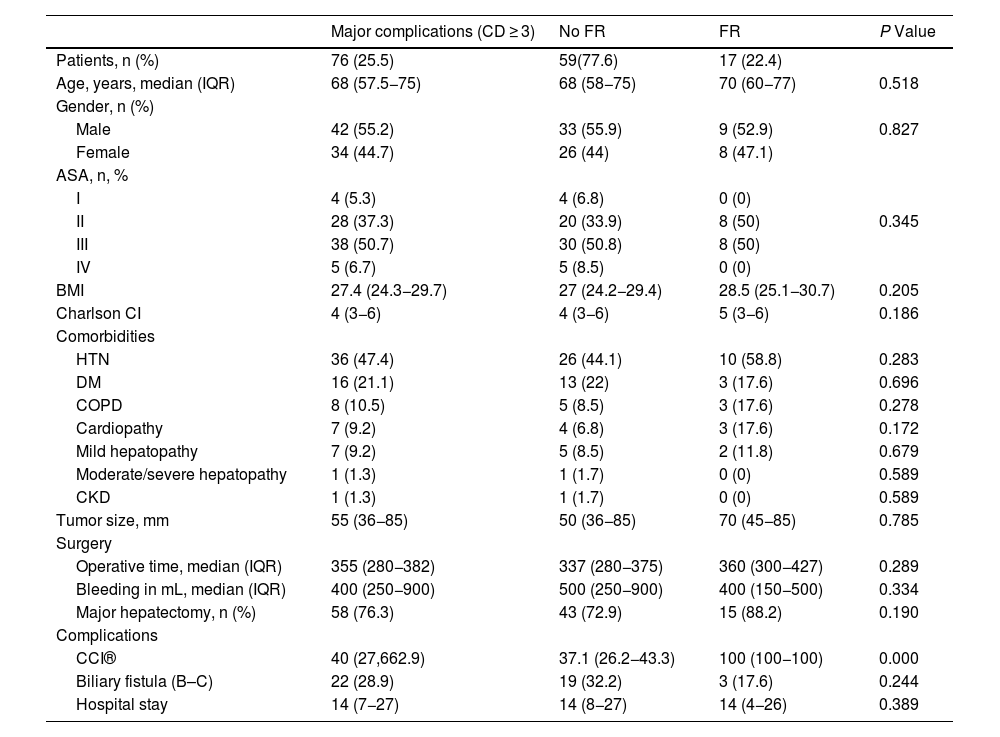
In total, 18 medical centers participated in the study, including 298 patients treated for ICC. The pre-, intra-, and postoperative data of patients with MC, MC + FR, and MC without FR are included in Table 1. Seventy-six patients presented MC (25.5%), with a mortality rate of 5.7% (17 patients). Therefore, the FR rate was 22.4%. We found no significant differences between the 2 groups except for the CCI® score, which was 100 in the deceased patients and 37.1 in the group without FR.
Comparison of patients with MC: FR group vs non-FR group.
| Major complications (CD ≥ 3) | No FR | FR | P Value | |
|---|---|---|---|---|
| Patients, n (%) | 76 (25.5) | 59(77.6) | 17 (22.4) | |
| Age, years, median (IQR) | 68 (57.5−75) | 68 (58−75) | 70 (60−77) | 0.518 |
| Gender, n (%) | ||||
| Male | 42 (55.2) | 33 (55.9) | 9 (52.9) | 0.827 |
| Female | 34 (44.7) | 26 (44) | 8 (47.1) | |
| ASA, n, % | ||||
| I | 4 (5.3) | 4 (6.8) | 0 (0) | |
| II | 28 (37.3) | 20 (33.9) | 8 (50) | 0.345 |
| III | 38 (50.7) | 30 (50.8) | 8 (50) | |
| IV | 5 (6.7) | 5 (8.5) | 0 (0) | |
| BMI | 27.4 (24.3−29.7) | 27 (24.2−29.4) | 28.5 (25.1−30.7) | 0.205 |
| Charlson CI | 4 (3−6) | 4 (3−6) | 5 (3−6) | 0.186 |
| Comorbidities | ||||
| HTN | 36 (47.4) | 26 (44.1) | 10 (58.8) | 0.283 |
| DM | 16 (21.1) | 13 (22) | 3 (17.6) | 0.696 |
| COPD | 8 (10.5) | 5 (8.5) | 3 (17.6) | 0.278 |
| Cardiopathy | 7 (9.2) | 4 (6.8) | 3 (17.6) | 0.172 |
| Mild hepatopathy | 7 (9.2) | 5 (8.5) | 2 (11.8) | 0.679 |
| Moderate/severe hepatopathy | 1 (1.3) | 1 (1.7) | 0 (0) | 0.589 |
| CKD | 1 (1.3) | 1 (1.7) | 0 (0) | 0.589 |
| Tumor size, mm | 55 (36−85) | 50 (36−85) | 70 (45−85) | 0.785 |
| Surgery | ||||
| Operative time, median (IQR) | 355 (280−382) | 337 (280−375) | 360 (300−427) | 0.289 |
| Bleeding in mL, median (IQR) | 400 (250−900) | 500 (250−900) | 400 (150−500) | 0.334 |
| Major hepatectomy, n (%) | 58 (76.3) | 43 (72.9) | 15 (88.2) | 0.190 |
| Complications | ||||
| CCI® | 40 (27,662.9) | 37.1 (26.2−43.3) | 100 (100−100) | 0.000 |
| Biliary fistula (B–C) | 22 (28.9) | 19 (32.2) | 3 (17.6) | 0.244 |
| Hospital stay | 14 (7−27) | 14 (8−27) | 14 (4−26) | 0.389 |
The FR rate in our series was 22.4%. We cannot make comparisons with other series since this is the first time that FR has been measured in ICC. In the 2 series of hilar cholangiocarcinoma where the FR was determined, it was 16% and 24%, respectively.7,8 In these series, the number of affected lymph nodes, poorly differentiated tumors, reoperation, prognostic nutritional index <40, right hepatectomy and age >65 years were associated with FR.7,8 In our study, we have found no factors associated with FR in ICC that would allow us to adopt specific measures for improvement; most likely, despite being a series with a significant number of patients, it may not be high enough to reach statistical significance, and it may also be influenced by the variety of surgical techniques used depending on the location of the ICC.
Postoperative morbidity and mortality rates are generally the most commonly used tools to evaluate results after surgery.9 In recent years, the postoperative mortality rate after liver surgery has decreased to 1.7%, with a postoperative MC rate of 11%, but these rates are higher among patients with ICC (5.7% and 25.5% in our series).1 It has been demonstrated that the incidence of MC is not always directly related to mortality.3,4 Several studies have emphasized the importance of early recognition and treatment of MC.3,6 Being able to know whether the diagnosis and treatment of MC has been appropriate over time is complex, even more so in a retrospective study.
FR may not only be related to the technical skill of an experienced surgical team and surgical volume, but also to the availability of a specialized multidisciplinary team,3,4 consisting of anesthesiologists, ICU specialists, interventional radiologists, endoscopists, hepatologists, and nursing staff, who can all contribute towards preventing mortality after MC associated with complex surgeries.3,4,6
The limitations of this study include its retrospective nature and lack of other series with which to compare. Its great strength, however, is that it is the largest ICC series published in Spain and the first in the international literature to determine FR.
In conclusion, strict determination of postoperative morbidity and mortality is essential to identify areas for improvement in hospitals. FR can be an effective complement due to its ease of measurement and the possibility to make comparisons among medical centers. Since no factors related to FR have been found in ICC, we believe that a detailed study of each death is the only way to improve care protocols and try to reduce postoperative mortality due to ICC.
FundingThis study has received no funding.
- •
Departamento de Cirugía. Hospital de Cruces (Bilbao): Mikel Gastaca, Beatriz Villota, Teresa Pascual-Vicente
- •
Departamento de Cirugía. Hospital de Bellvitge (Barcelona): Laura Lladó, Josefina Lopez-Dominguez, Emilio Ramos
- •
Departamento de Cirugía. H. Universitario Miguel Servet (Zaragoza): Mario Serradilla Martín, Daniel Aparicio López, Alejandro Serrablo.
- •
Departamento de Cirugía. Hospital Universitario Dr. Balmis: M. Franco, C. Alcázar, C. Villodre, JM Ramia.
- •
Unidad HPB y Trasplante Hepático. Departamento de Cirugía General y Digestiva. Clínica Universitaria de Navarra. Instituto de Investigación Sanitaria de Navarra. (IdisNA) (Pamplona): Gabriel Zozaya, Daniel Aliseda, Fernando Rotellar.
- •
Departament de Cirurgía HPB y Transplants. Hospital Universitari Vall d'Hebron, Vall d'Hebron Institut de Recerca (VHIR), Universitat Autónoma de Barcelona (Barcelona): Rodrigo Mata, Concepción Gómez-Gavara, Cristina Dopazo
- •
Departamento de Cirugía. Hospital Politécnico y Universitario La Fe (Valencia): David Calatayud Mizrahi, Ana Hernando Sáez, Eva Mª Montalvá Orón
- •
Departamento de Cirugía. Hospital Carlos Haya (Málaga): María Pérez Reyes, Julio Santoyo Villaba, Julio Santoyo Santoyo.
- •
Departamento de Cirugía. Hospital Arrixaca (Murcia): Víctor López-López, Celia Martagón, Ricardo Robles,
- •
Departamento de Cirugía Santa Creu i Sant Pau (Barcelona): Víctor Molina, Santiago Sánchez-Cabús
- •
Departamento de Cirugía. Hospital Clínico Universitario (Valencia). INCLIVA Elena Muñoz-Forner e Isabel Mora-Oliver
- •
Departamento de Cirugía. Hospital Josep Trueta. Girona: Santiago Lopez Ben, Maite Albiol Quer
- •
Departamento de Cirugía. Complejo Hospitalario de Badajoz: Isabel Jaén Torrejimeno, Gerardo Blanco
- •
Unidad de Cirugía HPB y Trasplante Hepático. Departamento de Cirugía. Hospital Virgen de las Nieves: Ana Belén Vico Arias, Natalia Zambudio, Mario Serradilla.
- •
Departamento de Cirugía. Hospital Universitario Virgen del Rocío: MA Gómez Bravo, C Bernal Bellido
- •
Departamento de Cirugía. Hospital Clínico Universitario de Málaga: Luis Carlos Hinojosa Arco, Miguel Ángel Suarez-Muñoz
- •
Departamento de Cirugía. Hospital Germans Trias i Pujol: Fernando Pardo, Esteban Cugat
- •
Departamento de Cirugía. Hospital del Mar (Barcelona). Benedetto Ielpo, Patricia Sánchez-Velázquez.



