


Moderate-risk mutations (such as CHEK2, ATM and RAD51C) have emerged as significant factors in breast cancer. Although not extensively studied, some research indicates that individuals carrying these mutations are more susceptible to developing breast cancer. This study aims to characterize this subgroup of patients at our institution through a comprehensive analysis of epidemiological data, genetic profiles, clinical history and genetic counseling outcomes. In this retrospective observational cohort study, we collected data from women with CHEK2, ATM and RAD51C mutations followed in the Genetic Breast Cancer Risk Clinic at our institution. The statistical analysis was performed using SPSS® software.
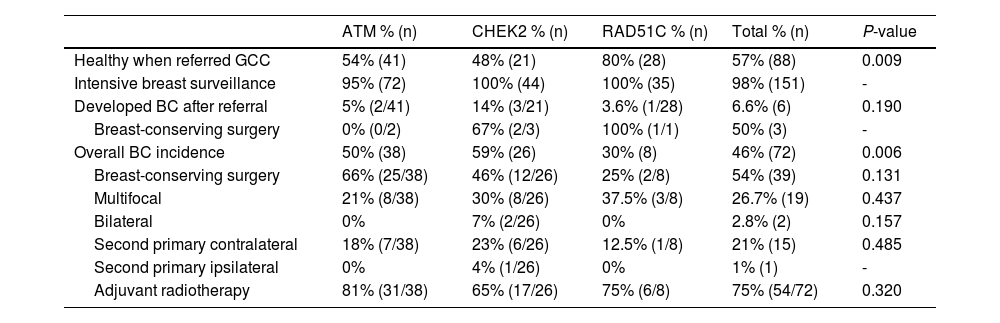
The study included 155 women with CHEK2 (28.4%), ATM (4.9%) and RAD51C (22.6%) mutations followed in the Genetic Breast Cancer Risk Clinic from December 2015 to September 2022. Median age at referral was 48 years, and the median follow-up period was 33 months. The table below presents the descriptive analysis of the 3 mutation groups (Table 1):
Descriptive analysis of the 3 mutation groups.
| ATM % (n) | CHEK2 % (n) | RAD51C % (n) | Total % (n) | P-value | |
|---|---|---|---|---|---|
| Healthy when referred GCC | 54% (41) | 48% (21) | 80% (28) | 57% (88) | 0.009 |
| Intensive breast surveillance | 95% (72) | 100% (44) | 100% (35) | 98% (151) | - |
| Developed BC after referral | 5% (2/41) | 14% (3/21) | 3.6% (1/28) | 6.6% (6) | 0.190 |
| Breast-conserving surgery | 0% (0/2) | 67% (2/3) | 100% (1/1) | 50% (3) | - |
| Overall BC incidence | 50% (38) | 59% (26) | 30% (8) | 46% (72) | 0.006 |
| Breast-conserving surgery | 66% (25/38) | 46% (12/26) | 25% (2/8) | 54% (39) | 0.131 |
| Multifocal | 21% (8/38) | 30% (8/26) | 37.5% (3/8) | 26.7% (19) | 0.437 |
| Bilateral | 0% | 7% (2/26) | 0% | 2.8% (2) | 0.157 |
| Second primary contralateral | 18% (7/38) | 23% (6/26) | 12.5% (1/8) | 21% (15) | 0.485 |
| Second primary ipsilateral | 0% | 4% (1/26) | 0% | 1% (1) | - |
| Adjuvant radiotherapy | 81% (31/38) | 65% (17/26) | 75% (6/8) | 75% (54/72) | 0.320 |
GCC: genetic counseling clinic; BC: breast cancer.
Population-based studies suggest that the risk of breast cancer associated with these mutations is nearly as high as in women with BRCA2 mutations.1 In our study, the penetrance of breast cancer ranged from 30% to 59%. Understanding the prevalence of breast cancer in this population allows for more informed and appropriate genetic counseling.
The incidence rate of a second breast cancer, both ipsilateral and contralateral, is significantly lower than the overall breast cancer penetrance in this population. This knowledge supports the safety of adopting an intensive surveillance strategy to monitor this population. Although no statistically significant differences were observed between the groups, the incidence of contralateral breast cancer appears to vary depending on the present mutation. In a 2023 study, Yadav et al. concluded that women with BRCA1, BRCA2, PALB2, and CHEK2 mutations have a higher risk of contralateral breast cancer, yet this increased risk is not observed in women with ATM mutations.2 Therefore, the same type of follow-up strategy may not be applicable to all 3 groups in our study.
The results of our study help healthcare professionals develop personalized follow-up and counseling plans for this relatively understudied population, while also implementing individualized preventive measures for women with moderate-risk breast cancer mutations.



