







Every year hundreds of medical residents choose their specialization in various surgical fields. However, these numbers have been poorly analyzed. The objective of this study was to evaluate the selection of General and Digestive Surgery by medical residents and compare these results with the selection of other surgical specialties.
MethodsCross-sectional observational study. The data from the selection of the medical residents from surgical specialties and the top 10 most demanded specialties between the years 2018 and 2022 were included. An analysis of adjusted ranking numbers based on the number of available positions was also conducted.
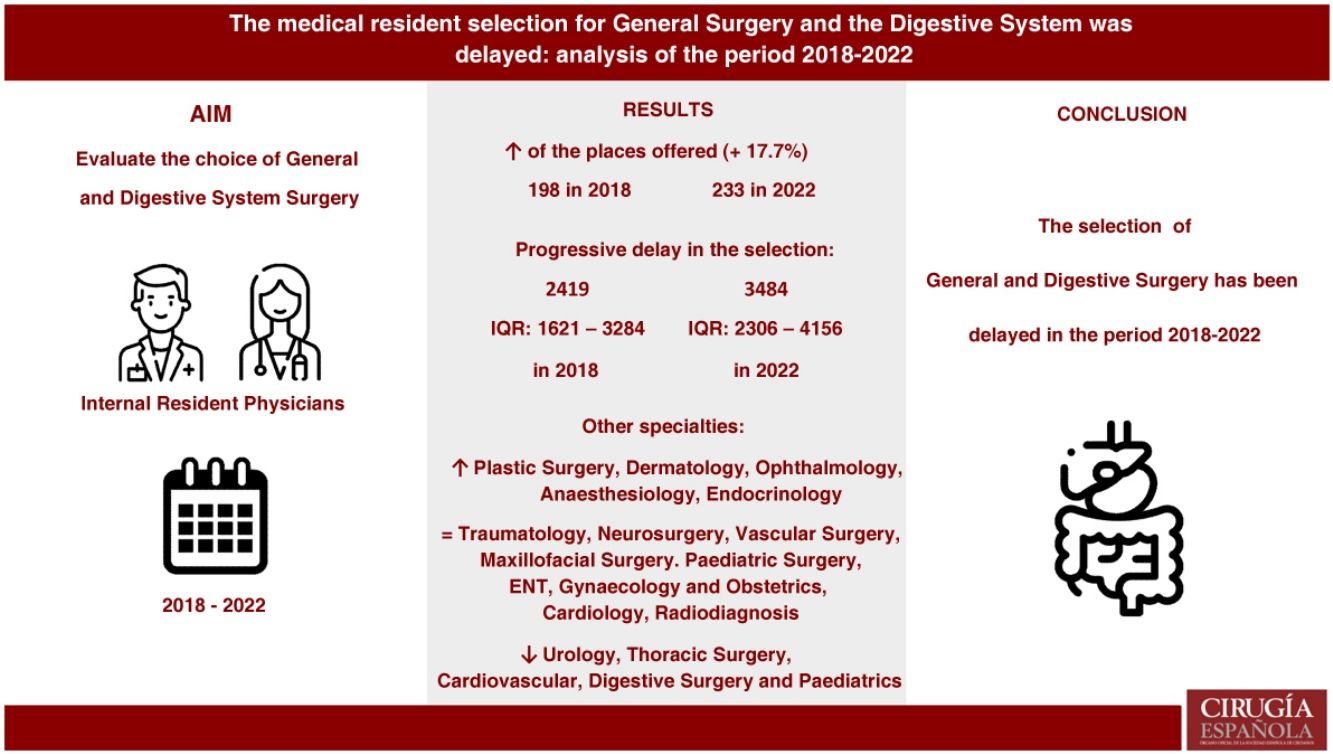
ResultsThe number of available positions in General and Digestive Surgery increased by 17.7% during the study period. However, the selection of our specialty has been delayed, with a median ranking number of 2419 (IQR: 1621–3284) in 2018, and 3484 (IQR: 2306–4156) in 2022 (p: .000). These differences remained significant after adjusting for the number of available positions (p: .000).
The choice of Urology, Thoracic Surgery, Cardiovascular Surgery, Gastroenterology, and Paediatrics also declined during this period, while Plastic Surgery, Dermatology, Ophthalmology, Anesthesiology, and Endocrinology improved their numbers.
ConclusionThe choice of General and Digestive Surgery has been delayed according to the data from the MIR selection of 2018–2022. The increase in the number of available positions has not been associated with a proportional increase in demand.
Cada año cientos de residentes eligen plaza en alguna de las especialidades quirúrgicas. No obstante, estos números han sido poco analizados. El objetivo de este estudio fue evaluar la elección de Cirugía General y del Aparato Digestivo por parte de los Médicos Internos Residentes (MIR), comparando estos resultados con la elección de las otras especialidades.
MétodosEstudio observacional transversal. Se incluyeron los datos de la elección de los Médicos Internos Residentes (MIR) de las especialidades quirúrgicas y de las 10 especialidades más demandadas entre los años 2018 y 2022. Se realizó también un análisis de los números de orden ajustados por las plazas ofertadas.
ResultadosCirugía General y del Aparato Digestivo ha aumentado un 17,7 % el número de plazas ofertadas en el periodo estudiado. Su elección se ha retrasado durante el periodo 2018–2022, de una mediana de número de orden de 2419 (RIQ: 1621–3284) en 2018 a 3484 (RIQ: 2306–4156) en 2022 (p: 0,000). Estas diferencias se mantuvieron al realizar el ajuste por el número de plazas ofertadas (p: 0,000).
La elección de Urología, Cirugía Torácica, Cirugía Cardiovascular, Aparato Digestivo y Pediatría también decayó en este periodo, mientras que Cirugía Plástica, Dermatología, Oftalmología, Anestesiología y Endocrinología mejoraron sus números.
ConclusiónLa elección de Cirugía General y del Aparato Digestivo se ha retrasado atendiendo a los datos de la elección MIR de 2018–2022. El aumento en el número de plazas ofertadas no ha asociado un aumento proporcional de la demanda.

Every year hundreds of medical residents choose their specialised health training place in one of the many surgical specialties. However, outside of the reports produced by the Ministry of Health itself,1 these numbers have been little analysed.
Among the factors that favour the choice of a surgical specialty are positive experiences with the specialty as a student,2,3 the desire to acquire specific manual skills,2 a liking for the operating room environment,2 or identification with figures who act as role models.2,4 However, the poor quality of life in surgical specialties,5,6 the difficulty in reconciling personal and work life,7 or long working hours5,7 are often cited as factors that make it difficult to choose a surgical specialty. Furthermore, in countries such as the United Kingdom,2 Ireland4 or Canada8 there has been a progressive decrease in the interest of medical students in surgery.
Another relevant factor in recent years has been the incorporation of Generation Z into residency programmes. Individuals born since 1996 have distinctive characteristics compared to previous generations. For example, their career choice is based more on intellectual motivation, they have a greater interest in mental health and, although they tend to select more lucrative specialties, they find greater motivation in career advancement and positive feedback from their co-workers.9
The main objective of this study was to evaluate the choice of the speciality is General and Digestive Surgery by Resident Internal Physicians (MIR) in recent years. The secondary objective was to evaluate the choice of other specialties in this same period, and to assess differences in the choice of the speciality is General and Digestive Surgery in the different Autonomous Communities.
Material and methodsStudy designCross-sectional observational study.
ParticipantsData from the Resident Internal Physicians selection between the years 2018 and 2022 were included. The five-year surgical specialties were included in the analysis: The speciality is General and Digestive Surgery, Angiology and Vascular Surgery, Cardiovascular Surgery, Oral and Maxillofacial surgery, Orthopaedic and Trauma Surgery, Paediatric Surgery, Plastic, Aesthetic and Reconstructive Surgery, Thoracic Surgery, Neurosurgery and Urology.
Also included were the 10 specialties that had previously exhausted their places on offer, outside of those already mentioned previously: Dermatology (758), Ophthalmology (2751), Cardiology (2799), Otorhinolaryngology (3563), Anesthesiology (4052), Endocrinology (4421), Gynaecology and Obstetrics (4462), Radiology (4561), Gastroenterology (4682) and Paediatrics (5081).
The data analysed are anonymous, so approval from the Research Ethics Committee was not required to carry out the study. The 2022 data were extracted from the official website of the Ministry of Health as of May 11, 2023.10 Data from 2018 to 2021 were extracted from the Curso Intensivo Mir Asturias11 and Academia AMIR12 databases.
ProcedureAccess to specialised health training is regulated by article 22 of Law 44/2003, of November 21, on the regulation of health professions.13 The offer of places and the call for selective tests for access to the places in the following year are approved annually.14 In this way, the 2018 call is the one that regulates access to places in 2019, and so on until the 2022 call, which regulates access to places in 2023.
The applicant obtains an order number based on the score obtained in the medical resident exam (90%) and the academic record (10%). The selection of a place is made following the descending order of the score recognised in the definitive list of results. Electronically, the interested person indicates in order of preference all the places they wish to apply for, and cannot apply for places not included in the application. Telematic selection has been mandatory since the 2020 call.15 Previously, the selection of a position could be carried out through a personal application.
VariablesThe evolution in the number of places in each of the mentioned specialties, the order number with which they were chosen and the year of election were analysed. To improve the comparison with the 2018 order numbers, an adjustment was made for the number of places in the specialty in the corresponding year, according to the following formula:

Adjusted order numbers were rounded up to the nearest natural number. Thus, for example, number 1952 chose General Surgery and the Gastroenterology in the year 2022. In 2022 there were 233 places for the speciality is General and Digestive Surgery, while in 2018 there were 198 places. Thus:
Statistical analysis
Descriptive analysis of the evolution of the number of places was carried out, with the increases or decreases expressed in percentages. The distribution of order numbers was expressed by median, interquartile range (IQR). The box plot was also used to represent these variables. The test used to evaluate differences in the choice by specialties was the Kruskal Wallis test. In those results in which statistically significant differences were found, the Mann-Whitney U was used to evaluate which years had been responsible for the differences. The level of statistical significance was set at .05. The analysis was performed with SPSS Statistics 26® (IBM, Chicago, IL).
ResultsParticipants and evolution of the number of placesA total of 15,509 residents chose a place in the specialties analysed during the period 2018–2022. Of them, 1098 chose the specialty of General and Digestive Surgery. The rest of the five-year surgical specialties were chosen by 3155 residents during the same period. The total number of places by specialty is shown in Table 1.
Number of places by speciality and variation with respect to 2018.
| 2018 | 2019 | Variation 2018 | 2020 | Variation 2018 | 2021 | Variation 2018 | 2022 | Variation 2018 | Total | |
|---|---|---|---|---|---|---|---|---|---|---|
| n | n | n | n | n | ||||||
| General and digestive surgery | 198 | 210 | +6 % | 227 | +14.6 % | 230 | +16.2 % | 233 | +17.7 % | 1098 |
| Vascular surgery | 35 | 38 | +8.6 % | 46 | +31.4 % | 48 | +37.1 % | 51 | +45.7 % | 218 |
| Cardiovascular Surgery | 24 | 25 | +4.2 % | 21 | −12.5 % | 25 | +4.2 % | 22 | −8.3 % | 117 |
| Maxillofacial surgery | 32 | 32 | 0 % | 32 | 0 % | 34 | +6.3 % | 34 | +6.3 % | 164 |
| Traumatology | 243 | 267 | + 9.9 % | 279 | +14.8 % | 280 | +15.2 % | 285 | +17.3 % | 1354 |
| Paediatric surgery | 23 | 22 | −4.3 % | 20 | −13 % | 23 | +0 % | 25 | +8.7% | 113 |
| Plastic surgery | 36 | 38 | +5.5 % | 50 | +38.9 % | 51 | +41.7 % | 51 | +41.7 % | 226 |
| Thoracic surgery | 26 | 17 | −34.6 % | 23 | −11.5 % | 23 | −11.5 % | 29 | +11.5 % | 118 |
| Neurosurgery | 45 | 45 | 0 % | 41 | −8.9 % | 49 | +8.9 % | 48 | +6.7 % | 228 |
| Urology | 105 | 120 | +14.3 % | 128 | +21.9 % | 130 | +23.8 % | 135 | +28.6 % | 618 |
| Dermatology | 94 | 108 | +14.8 % | 112 | +19.1 % | 114 | +21.3 % | 120 | +27.7 % | 548 |
| Ophthalmology | 170 | 185 | +8.8 % | 198 | +16.5 % | 211 | +24.1 % | 213 | +25.3 % | 977 |
| Otorhinolaryngology | 83 | 99 | +19.3 % | 100 | +2.5 % | 102 | +22.9 % | 102 | +22.9 % | 486 |
| Ginaec. and obstetrics | 266 | 271 | +1.9 % | 275 | +3.4 % | 276 | +3.8 % | 280 | +5.3 % | 1368 |
| Anesthesiology | 344 | 381 | +1.8 % | 389 | +13.1 % | 394 | +14.5 % | 407 | +18.3 % | 1915 |
| Cardiology | 168 | 180 | +7.1 % | 181 | +7.7 % | 190 | +13.1 % | 194 | +15.5 % | 913 |
| Endocrinology | 81 | 87 | +7.4 % | 89 | + 9.9 % | 97 | +19.8 % | 103 | +27.2 % | 457 |
| Gastroenterology | 161 | 172 | +6.8 % | 178 | +1.6 % | 182 | +13 % | 195 | +21.1 % | 888 |
| Paediatrics | 433 | 481 | +11 % | 491 | +13.4 % | 492 | +13.6 % | 502 | +15.9 % | 2399 |
| Radiology | 229 | 257 | +12.2 % | 260 | +13.5 % | 271 | +18.3 % | 287 | +25.3 % | 1304 |
General and Digestive Surgery has progressively increased the number of places offered, going from 198 places in 2018 to 233 places in 2022, which represents an increase of 17.7% in the period studied (Table 1). The surgical specialties with the greatest increase in the number of places offered have been Vascular Surgery (+45.7%) and Plastic Surgery (+41.7%). Some specialties presented restrictions in the places offered during the study period, such as Thoracic Surgery, Paediatric Surgery or Cardiac Surgery. However, only Cardiac Surgery ended up offering a smaller number of places in 2022 than in 2018.
Of the rest of the specialties analysed, only Gynaecology and Obstetrics presented a more limited increase in the places offered, of 5.3%. The rest had variable increases, between 27.7% in Dermatology and 15.5% in Cardiology (Table 1).
Trend in the choice of surgical specialtiesThe choice of the speciality is General and Digestive Surgery was delayed during the period 2018–2022, with statistically significant differences (p: .000). Thus, the median order number for the selection was 2419 (IQR: 1621 3284) in 2018, compared to 3484 (IQR: 2306 4156) in 2022 (Table 2).
Number of order by speciality.
| 2018 | 2019 | 2020 | 2021 | 2022 | p-value | Trend | |
|---|---|---|---|---|---|---|---|
| Median (IQR) | Median (IQR) | Median (IQR) | Median (IQR) | Median (IQR) | |||
| General Surgery | 2419 (1621–3284) | 3016 (2039–3732) | 2795 (1838–3803) | 3360 (2448–4226) | 3484 (2306–4156) | .000 | ↓ |
| Vascular surgery | 2430 (1318–3400) | 3399 (2390–3996) | 3582 (2515–4166) | 3742 (2373–4254) | 3676 (3128–4111) | .000 | ↓ |
| Cardiovascular Surgery | 3330 (2597–3840) | 3999 (1638–4387) | 3985 (2835–4465) | 3659 (3156–4491) | 3644 (2119–4716) | .358 | = |
| Maxillofacial surgery | 1443 (1171–1937) | 1228 (959–1662) | 1313 (926–1729) | 1266 (840–1768) | 1476 (899–2306) | .381 | = |
| Traumatology | 1976 (1206–2812) | 2231 (1281–3009) | 2087 (1266–2902) | 2145 (1230–2931) | 2236 (1265–2989) | .232 | = |
| Paediatric surgery | 2326 (1298–3125) | 2229 (1148–3521) | 2293 (1429–2980) | 2124 (1395–3698) | 2278 (1253–3767) | .934 | = |
| Plastic surgery | 367 (240–566) | 378 (179–611) | 304 (193–516) | 336 (175–591) | 383 (148–509) | .706 | = |
| Thoracic surgery | 3783 (2714–3946) | 3844 (3423–4451) | 4355 (3585–4703) | 4328 (3274–4693) | 4628 (4328–4840) | .000 | ↓ |
| Neurosurgery | 1023 (558–2215) | 1342 (402–1921) | 1441 (692–2638) | 1735 (675–2925) | 1540 (567–2867) | .085 | = |
| Urology | 1475 (973–2224) | 1875 (1169–2875) | 2289 (1449–3426) | 2586 (1641–3191) | 2519 (1721–3275) | .000 | ↓ |
| Dermatology | 298 (120–538) | 269 (117–424) | 297 (147–472) | 315 (177–456) | 216 (119–358) | .029 | ↑ |
| Ophthalmology | 1627 (906–2296) | 2085 (1163–2792) | 2077 (1282–2889) | 1803 (1016–2512) | 1491 (931–1977) | .000 | ↑ |
| Otorhinolaryngology | 1975 (1290–2694) | 2272 (1390–2961) | 2630 (1678–3512) | 2415 (1351–3042) | 2425 (1439–2982) | .009 | ↓ |
| Ginaec. and obstetrics | 2312 (1335–3055) | 2470 (1302–3410) | 2397 (1386–3464) | 2638 (1568–3579) | 2446 (1472–3339) | .014 | ↓ |
| Anesthesiology | 1951 (1123–2845) | 1782 (1281–3009) | 1748 (1036–2658) | 1623 (959–2362) | 1812 (951–2731) | .032 | ↑ * |
| Cardiology | 645 (257–1124) | 667 (270–1296) | 646 (258–1220) | 652 (231–1123) | 682 (322–1289) | .644 | = |
| Endocrinology | 2752 (1644–3718) | 2480 (1666–3372) | 2662 (1586–3671) | 2638 (1566–3852) | 2208 (1372–3280) | .328 | = |
| Gastroenterology | 1116 (646–1700) | 1317 (812–2251) | 1577 (850–2619) | 1962 (1154–3065) | 2356 (1168–3572) | .000 | ↓ |
| Paediatrics | 2185 (1109–3103) | 2409 (1345–3391) | 2626 (1465–3515) | 2715 (1552–3678) | 2718 (1585–3771) | .000 | ↓ |
| Radiology | 1996 (1201–2954) | 2518 (1504–3499) | 2327 (1219–3302) | 2388 (1407–3478) | 2739 (1465–3711) | .000 | ↓ |
↑: Improvement in selection↓: Delay in selection = no significant differences.
* The differences in anesthesiology are due to the improvement in the year 2021, although the period ended in 2022 similarly to early 2018.
In the period under study, the surgical specialties of Urology, Vascular Surgery and Thoracic Surgery also presented a delay in their selection that was statistically significant (p: .000). No statistically significant differences were found in the choice by order number in the rest of the surgical specialties during the period 2018–2022.
When adjusting the order number by the number of places offered, it was observed that General and Digestive Surgery continued the delay in its selection during the period 2018–2022, with statistically significant differences (p: .000). Only the 2020 selection was similar to that of 2018, while 2019, 2020 and 2021 presented delays in the selection of the place (Supplementary Table S1). Thus, the median adjusted order number was 2419 (IQR: 1621 3284) in 2018 compared to 2961 (IQR: 2107 3638) in 2022 (Table 3).
Numbers in adjusted order by number of places.
| 2018 | 2019 | 2020 | 2021 | 2022 | p-value | Trend | |
|---|---|---|---|---|---|---|---|
| Median (IQR) | Median (IQR) | Median (IQR) | Median (IQR) | Median (IQR) | |||
| General surgery | 2419 (1621–3284) | 2843 (1922–3519) | 2438 (1603–3317) | 2892 (2107–3638) | 2961 (2107–3638) | .000 | ↓ |
| Vascular surgery | 2430 (1318–3400) | 3131 (2202–3633) | 2725 (1914–3170) | 2729 (1731–3102) | 2523 (2147–2821) | .009 | = * |
| Cardiovascular Surgery | 3330 (2597–3840) | 3839 (1572–4212) | 4554 (3240–5103) | 3512 (3030–4311) | 3975 (2312–5145) | .017 | ↓ |
| Maxillofacial surgery | 1443 (1171–1937) | 1228 (959–1662) | 1313 (926–1729) | 1191 (791–1663) | 1389 (845–2170) | .452 | = |
| Traumatology | 1976 (1206–2812) | 2030 (1166–2739) | 1818 (1103–2528) | 1861 (1068–2543) | 1906 (1079–2549) | .070 | = |
| Paediatric surgery | 2326 (1298–3125) | 2330 (1200–3682) | 2637 (1643–3427) | 2124 (1395–3698) | 2096 (1153–3465) | .884 | = |
| Plastic surgery | 367 (240–566) | 358 (170–579) | 219 (139–372) | 237 (124–417) | 270 (104–359) | .002 | ↑ |
| Thoracic surgery | 3783 (2714–3946) | 5879 (5235–6807) | 4923 (4053–5316) | 4893 (3701–5305) | 4149 (3880–4339) | .000 | ↓ |
| Neurosurgery | 1023 (558–2215) | 1342 (402–1921) | 1546 (742–2831) | 1558 (606–2626) | 1411 (520–2628) | .154 | = |
| Urology | 1475 (973–2224) | 1640 (1023–2516) | 1877 (1188–2810) | 2088 (1326–2578) | 1959 (1339–2547) | .013 | ↓ |
| Dermatology | 298 (120–538) | 234 (102–369) | 249 (123–396) | 260 (146–376) | 169 (93–280) | .000 | ↑ |
| Ophthalmology | 1627 (906–2296) | 1916 (1069–2567) | 1783 (1100–2480) | 1453 (819–2024) | 1190 (743–1578) | .000 | ↑ |
| Otorhinolaryngology | 1975 (1290–2694) | 1905 (1165–2482) | 2182 (1392–2915) | 1965 (1099–2475) | 1973 (1171–2427) | .049 | = ** |
| Ginaec. and obstetrics | 2312 (1335–3055) | 2424 (1278–3347) | 2319 (1341–3351) | 2542 (1511–3449) | 2324 (1399–3172) | .134 | = |
| Anesthesiology | 1951 (1123–2845) | 1609 (957–2346) | 1546 (916–2351) | 1417 (837–2062) | 1531 (804–2308) | .000 | ↑ |
| Cardiology | 645 (257–1124) | 622 (252–1209) | 600 (239–1132) | 576 (204–993) | 590 (279–1116) | .611 | = |
| Endocrinology | 2752 (1644–3718) | 2309 (1551–3139) | 2423 (1443–3341) | 2202 (1308–3217) | 1736 (1079–2579) | .000 | ↑ |
| Gastroenterology | 1116 (646–1700) | 1233 (760–2107) | 1426 (769–2369) | 1735 (1020–2711) | 1945 (964–2949) | .000 | ↓ |
| Paediatrics | 2185 (1109–3103) | 2169 (1210–3053) | 2316 (1292–3100) | 2389 (1366–3237) | 2345 (1367–3252) | .016 | ↓ |
| Radiology | 1996 (1201–2954) | 2244 (1340–3118) | 2049 (1074–2908) | 2018 (1189–2939) | 2186 (1169–2961) | .127 | = |
* The differences in vascular surgery are due to the delay in selection in 2019.
** The differences in otorhinolaryngology are due to the delay in selection in 2020.
Of the previously mentioned specialties, Urology and Thoracic Surgery also maintained their trend towards a delay in the choice, with statistically significant differences (p: .013 and .000). The differences observed in Vascular Surgery were due to a delay in its selection in 2019, although the median at the end of the period in 2022 was very similar to the initial one in 2018.
The case of Plastic Surgery stands out, whose increase in the number of places associated with maintaining the order numbers that chose them translated into an improvement in the adjusted order numbers, with statistically significant differences (p: .002). In this way, the median adjusted order number for the selection of the position was 367 (IQR: 240,566) in 2018 compared to 270 (IQR: 104,359) in 2022.
The choice of Neurosurgery, Maxillofacial Surgery, Paediatric Surgery and Traumatology remained without statistically significant differences. In the case of Traumatology, the choice remained stable during the 2018–2022 period between an adjusted order number of 1818 (IQR: 1103 2528) in 2020 and 2030 (IQR: 1166 2739) in 2019. The case of Plastic Surgery stands out, whose increase in the number of places associated with maintaining the order numbers that chose them translated into an improvement in the adjusted order numbers, with statistically significant differences (p: .002). In this way, the median adjusted order number for the selection of the position was 367 (IQR: 240,566) in 2018 compared to 270 (IQR: 104–359) in 2022.
Fig. 1 shows the evolution in the choice of the most representative specialties of this period. General and Digestive Surgery experienced a progressive delay in its selection, both in raw and adjusted order numbers, while Traumatology remained stable. Plastic Surgery did not show differences in the choice by order number, but it did when considering the numbers adjusted to the significant increase in the number of places offered.
Trend in the choice of other specialties
Of the other specialties analysed, Dermatology, Ophthalmology, Anaesthesia and Endocrinology experienced a statistically significant improvement in their selection. Dermatology presented a clear improvement with a median order number of 298 (IQR: 120–538) in 2018 compared to 216 (IQR: 119–358) in 2022 (p: .029) (Table 2). The improvement in Ophthalmology and Anaesthesia was more evident in the analysis adjusted by number of places, in which the median adjusted order number went from 1627 (IQR: 906–2296) in 2018 to 1190 (IQR: 743–1578) in 2022 (p: .000), and from a median of 1951 (IQR: 1123–2845) in 2018 to 1531 (IQR: 804 2308) in 2022 (p: .000), respectively (Table 3).
Cardiology did not show statistically significant differences in its selection during the study period. Otorhinolaryngology presented differences due to a delay in its selection in 2020. Gynaecology and Obstetrics and Radiology showed a delay in their selection in the analysis by order number, which was corrected when adjusting by number of places.
Paediatrics showed a progressive lowering in selection, which was maintained in the analysis by adjusted order number (p: .016). Although the difference in the adjusted analysis was only 190 positions, the large number of positions chosen gave it high statistical power. Gastroenterology presented a delay in its selection, both by order number and by adjusted number, going from a median order number of 1116 (IQR: 646–1700) in 2018–2356 (IQR: 1168–3572) in 2022 (p: .000).
Trends in choice of General and Digestive Surgery by Autonomous CommunityThe changes observed in the supply of places in General and Digestive Surgery were uneven according to the Autonomous Communities. Castilla y León and Murcia were the ones that increased their supply the most, by 87.5% and 50%, respectively. Madrid, the Valencian Community and Catalonia increased their places by around 20%. On the other hand, the offer from Rioja and Navarra remained stable, while Aragón, Asturias and the Basque Country limited the number of places offered (Supplementary Table S2).
The analysis of the order numbers indicated a statistically significant delay in the selection of places in Andalusia, Castilla y León, Catalonia, Valencian Community, Galicia and Madrid. The selection of the places in Aragón did not show differences between the years 2018, 2020 and 2022, but it was delayed in the years 2019 and 2021, in which places were offered in Huesca and Teruel (Supplementary Table S3).
In the analysis of the order numbers adjusted by number of places, only Catalonia showed statistically significant differences in the selection of its places offered, going from a median of 2341 (IQR: 1661–3398) in 2018–3516 (IQR: 3109–3834) in 2022 (p: .001). Selection improved in Asturias, which went from a median adjusted order number of 3195 (IQR: 1126–3421) in 2018 to 1397 (IQR: 590–2659) in 2022 (p: .040). In Galicia, statistically significant differences were observed due to a good choice of places in 2020, which worsened in 2021 and ended in 2022 in a similar way to the beginning in 2018 (Supplementary Table S4). Fig. 2 shows the visual representation of the evolution of the election by Autonomous Communities.
Discussion
A decrease has been detected in the choice of the speciality is General and Digestive Surgery in recent years. However, there are few studies that have analysed these trends in surgical specialties in Spain. In 2019, an analysis of the choice of Angiology and Vascular Surgery 16 was published, concluding that the interest in this specialty declined based on the latest registration number that could choose the specialty in the period 2007–2018. The analysis of the central tendency and its dispersion is much more robust and shows that in the period 2018–2022 the changes in the order numbers in this specialty were fundamentally due to the increase in the number of places. However, this is not the only factor that has modified the choice of General Surgery.
Choosing a specialty depends on its previous knowledge, so early exposure has a positive correlation with your future choice.17,18 To increase interest in our specialty, it is necessary to ensure correct teaching during University, with an appropriate internship rotation time that includes students in the activities carried out.18
Another factor that could explain the delay in the choice of General and Digestive Surgery could be due to the preference of medical residents for surgical specialties that offer higher levels of job satisfaction or a better quality of life. Thus, the surveys performed in General Surgery show that up to 47.6% of residents have shown symptoms of work burnout,19 similar to the 44.1% observed in Traumatology.20 However, Traumatology has been identified with high levels of job satisfaction.21 A different case is that of Plastic Surgery, which presents average levels of burnout, but a high quality of life,22 and is also a specialty with good job prospects in the private network.23
Future job prospects can also be a determining factor. Dermatology, in a situation of slight surplus of specialists according to the Ministry,1 presents a deficit of specialists in low and medium complexity hospitals24 and is a good option to combine public and private activity25 Ophthalmology is balanced in status1 and its residents have indicated a high level of satisfaction with the residency carried out, with a large number of surgical procedures completed.26 Anaesthesia, currently facing a slight shortage of specialists,1 enjoys good job prospects upon completion of residency.
On the contrary, the current surplus of specialists in specialties such as Thoracic Surgery1 may have discouraged the choice of this specialty in recent years. General Surgery is currently considered a balanced specialty with regards to the demand and supply of specialists, with 17.9% of specialists over 60 years of age. If the current supply is maintained, the prospects are a slight surplus for 2028, and a moderate surplus for 2035.1 In this context, the future supply of surgeons should be carefully evaluated, since after the peak of retirements, an excessive increase in the number of positions could worsen job prospects, increasing temporary employment and precariousness.27
To improve the choice of General and Digestive Surgery, actions also need to be taken on the modifiable factors that can improve the quality of life of the resident, correcting the factors that contribute to work exhaustion or burnout.19 Thus, in a survey carried out among all residents of medical and surgical specialties, 80.2% declared that they were on duty, 28 while this percentage was only 53% among General Surgery residents.19 Furthermore, 86.1% of residents reported having had a weekly work day of more than 60 h.19 On the contrary, “adequate training does not depend on the number of hours in the hospital, but on its quality following a structured plan, conveniently supervised and evaluated”.29 Ensuring full off-call release could improve residents' work-life balance, allowing more applicants to consider our specialty.
Among the improvement proposals is also the modification of the current telematic election, which has introduced changes in election trends. The system requires applicants to prepare an extensive list of positions they wish to apply for, including even up to 400 positions prior to their final election. This system undermines the specialties with the greatest number of places,30 and may cause some candidates to refrain from choosing good places because they consider that their order number could be insufficient. Therefore, changing the election system towards a real-time telematic process would allow an informed choice under conditions similar to those of the in-person election.30
One of the limitations of the study has been the impossibility of knowing the distribution by sex of the voters, due to not having the Definitive List of Allotted Places, which the Ministry could not provide due to the data protection policy. The reports published in this regard show that, with 66.9% of voters being women, an acceptable proportion of them chose the speciality is General and Digestive Surgery, in a variable percentage between 56.4% and 63.9% in the last five years.31 However, to improve these percentages, it is necessary to address the challenges faced by women in our specialty. Thus, in the survey by the Spanish Association of Surgeons, 75.3% of women declared having suffered gender discrimination; 32.8%, discrimination due to pregnancy or family conciliation; and 21.4%, sexual harassment.19 It was also observed that women residing in the United States finished their training period with a lower number of cases attended than male residents.32 It would undoubtedly be interesting to determine the status of this issue in Spain. Finally, it has been determined that the presence of female mentors in the career of students or residents in training is a positive factor for women to decide to opt for a surgical specialty.33 These roles could be promoted by both universities and the Spanish Association of Surgeons.
Other limitations of the study have been the impossibility of relating the selection data with other variables of interest, such as the average academic record of medical residents or their place of origin. However, we consider that the study is useful to evaluate the trends in the choice of our specialty, something that has not been evaluated to date. With an eye to the future, we consider that it would be of interest to carry out a qualitative study that analyses the variables that lead to choosing one or another specialty, or one or another centre within the speciality is General and Digestive Surgery.
In conclusion, the election of the speciality is General and Digestive Surgery has been delayed based on the data from the 2018–2022 resident selection. The increase in the number of places offered has not been associated with a proportional increase in demand, unlike that which occurred with other specialties.
FundingThe authors did not receive any financial support for the research, authorship and/or publication of this article.
Conflict of interestsThe authors have no conflict of interests to declare.
The following is Supplementary data to this article:

