


metricas
covid
Archivos de la Sociedad Española de Oftalmología (English Edition) Pigmentary chorioretinopathy due to long-chain 3-hydroxyacyl-CoA dehydrogenase d...
Journal Information
Vol. 100. Issue 8.
Pages 497-503 (August 2025)
Vol. 100. Issue 8.
Pages 497-503 (August 2025)
Short communication
Pigmentary chorioretinopathy due to long-chain 3-hydroxyacyl-CoA dehydrogenase deficiency (LCHAD): a case report with long-term follow-up
Coriorretinopatía pigmentaria por déficit de 3-hidroxiacil-CoA-deshidrogenasa de cadena larga (LCHAD): un caso clínico con seguimiento a largo plazo
N. Castro Casal
Corresponding author
nerea.castro.casal@sergas.es

Corresponding author.
, N. Olivier Pascual, R. Arroyo Castillo
Servicio de Oftalmología, Complexo Hospitalario Universitario de Ferrol, A Coruña, Spain
Article information
Abstract
Full Text
Bibliography
Download PDF
Statistics
Figures (4)
Show moreShow less
Abstract

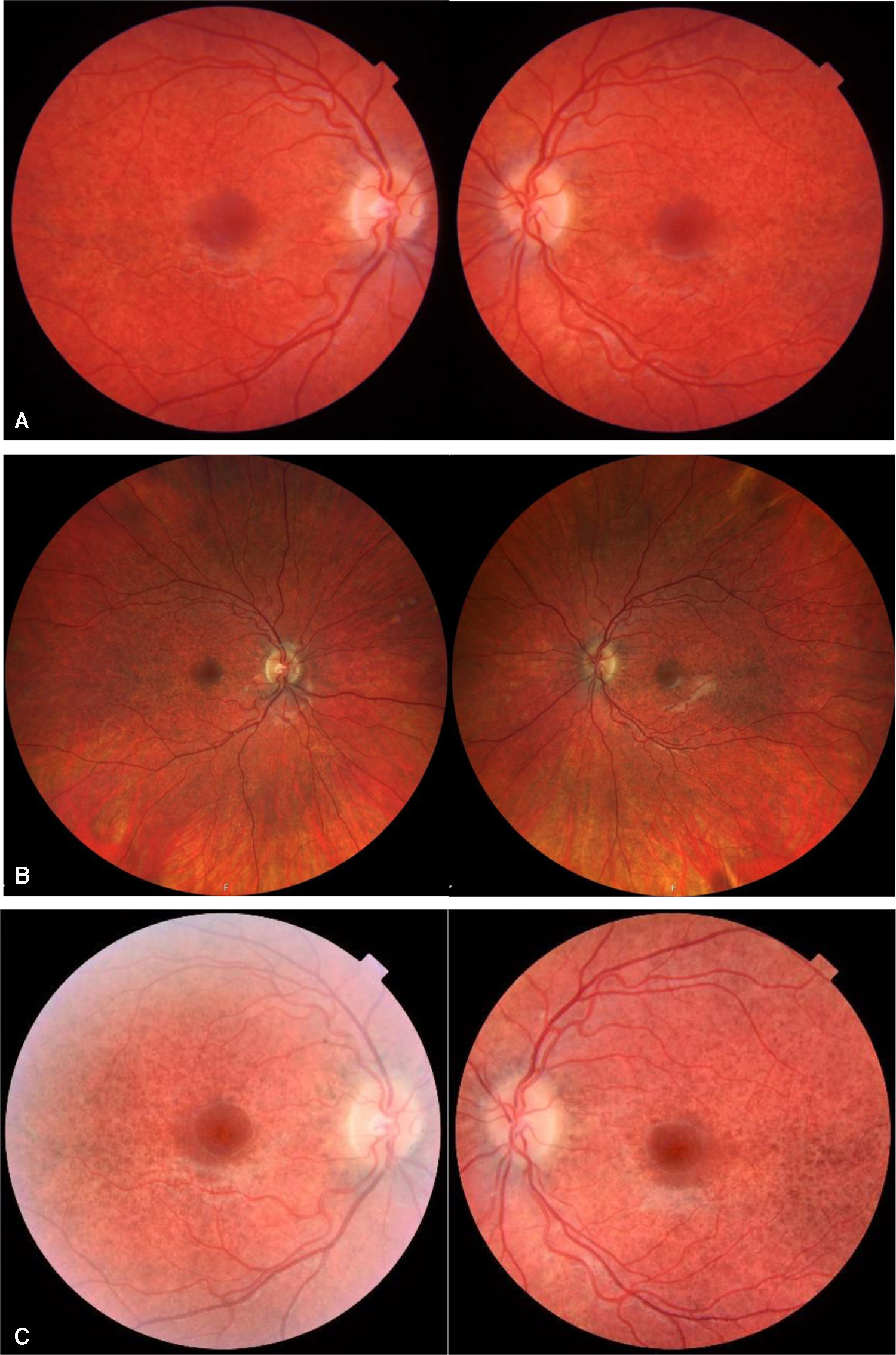
Long-chain 3-hydroxyacyl-CoA dehydrogenase deficiency (LCHAD) is a rare but severe genetic disorder that causes pigmentary chorioretinopathy. We present the case of a 20-year-old female patient diagnosed with LCHAD by neonatal screening with alteration of the retinal pigment epithelium (RPE) since the age of 3 years. Fundus examination showed a salt-and-pepper speckled granular pattern and diffuse peripheral chorioretinal atrophy. The patient is stable, visually asymptomatic and with good systemic control after more than 15 years of follow-up with retinography, optical coherence tomography (OCT), autofluorescence (FAF) and electroretinogram (ERG), essential for control. This case highlights the importance of early diagnosis and treatment to prevent decompensation and improve survival and progression.

Keywords:
Long-Chain 3-hydroxyacyl-CoA dehydrogenase deficiency (LCHAD)
Chorioretinopathy
Neonatal screening
Resumen

El déficit de 3-hidroxiacil-CoA-deshidrogensa de cadena larga (LCHAD) es un trastorno genético poco común pero grave que produce coriorretinopatía pigmentaria. Presentamos el caso de una paciente de 20 años diagnosticada de LCHAD mediante cribado neonatal con alteración del epitelio pigmentario de la retina (EPR) desde los 3 años. En el fondo de ojo presenta un patrón granular de aspecto moteado en sal y pimienta y atrofia coriorretiniana difusa periférica. La paciente y se encuentra estable, asintomática a nivel visual y con un buen control sistémico tras más de 15 años de seguimiento con retinografía, tomografía de coherencia óptica (OCT), autofluorescencia (FAF) y electrorretinograma (ERG), fundamentales para el control. Este caso destaca la importancia del diagnóstico y el tratamiento precoz para prevenir las descompensaciones y mejorar la supervivencia y la progresión.


Palabras clave:
Déficit 3-hidroxiacil-CoA-deshidrogenasa de cadena larga (LCHAD)
Coriorretinopatía
Cribado neonatal

Article

These are the options to access the full texts of the publication Archivos de la Sociedad Española de Oftalmología (English Edition)
Subscriber
Subscriber

If you already have your login data, please click here .

If you have forgotten your password you can you can recover it by clicking here and selecting the option “I have forgotten my password”
Subscribe
Subscribe to

Archivos de la Sociedad Española de Oftalmología (English Edition)

Purchase
Purchase article

Purchasing article the PDF version will be downloaded

Purchase now
Contact
Phone for subscriptions and reporting of errors
From Monday to Friday from 9 a.m. to 6 p.m. (GMT + 1) except for the months of July and August which will be from 9 a.m. to 3 p.m.
Calls from Spain
932 415 960
Calls from outside Spain
+34 932 415 960
E-mail
Article options
Tools