metricas
covid
Annals of Hepatology TEMPORAL TRENDS IN CHARACTERISTICS AND OUTCOMES OF SIMULTANEOUS LIVER–KIDNEY T...
Journal Information
Vol. 30. Issue S2.
Abstracts of the 2025 Annual Meeting of the ALEH
(September 2025)
Vol. 30. Issue S2.
Abstracts of the 2025 Annual Meeting of the ALEH
(September 2025)
#52
Full text access
TEMPORAL TRENDS IN CHARACTERISTICS AND OUTCOMES OF SIMULTANEOUS LIVER–KIDNEY TRANSPLANT RECIPIENTS IN LATIN AMERICA FROM 2003 TO 2025
Visits
185
Jorge Carlos Martinez Morales1, Valeria Descalzi2, Adrián Gadano1, Graciela Elia Castro Narro3, Mario Vilatobá4, Alina Zerega5, Fernando Cairo6, Manuel Mendizabal7, Wellington Andraus8, Josefina Pagés7, Ignacio Roca6, Maria Laura Reyes Toso2, Pedro Marin-Castro8, Fernanda Maria Farage Osório9, Elodie Hyppolito10, Carlos Benitez11, Alvaro Urzua12, Paulo Lisboa Bittencourt13, Adriana Varon14, Gilberto Mejia15..., Bertha Eliana Cárdenas Ramírez16, Julia Brutti17, Romina Rey18, Renato Palma-Fernández19, José Huygens Parente-Garcia10, Diego Hernan Giunta20, Sebastián Marciano1Ver más
1 Unidad de Hepatología y Trasplante Hepático. Hospital Italiano de Buenos Aires. Buenos Aires. Argentina.
2 Unidad de Trasplante Hepático y Hepatología. Fundación Favaloro. Buenos Aires. Argentina.
3 Departamento de Gastroenterología del Instituto Nacional de Ciencias Médicas y Nutrición "Salvador Zubirán". Ciudad de México. México.
4 Departamento de Trasplantes del Instituto Nacional de Ciencias Médicas y Nutrición "Salvador Zubirán". Ciudad de México. México.
5 Unidad de Trasplante Hepático del Sanatorio Allende. Córdoba. Argentina.
6 Unidad de Hepatología y Trasplante Hepático. Hospital de Alta Complejidad "El Cruce". Florencio Varela. Provincia de Buenos Aires. Argentina.
7 Unidad de Hepatología y Trasplante Hepático del Hospital Universitario Austral. Pilar. Provincia de Buenos Aires. Argentina.
8 Trasplante Hepático y Órganos de los Aparatos Digestivos. Hospital das Clínicas. São Paulo. Brasil.
9 Unidade de Transplante Hepático do Hospital das Clínicas da Universidade Federal de Minas Gerais. Minas Gerais. Brasil.
10 Hospital Universitário Walter Cantídio. Universidade Federal do Ceará. Fortaleza. Brasil.
11 Hepatología de Trasplante. Instituto de Trasplante. Hospital Clínico UC-Christus. Santiago de Chile. Chile.
12 Sección de Gastroenterología y Unidad de Trasplante. Hospital Clínico Universidad de Chile. Santiago de Chile. Chile.
13 Unidade de Gastroenterologia e Hepatologia. Hospital Português da Bahia. Salvador. Bahia. Brasil.
14 Servicio de Hepatología. La Cardio - Fundación Cardio Infantil. Bogotá. Colombia.
15 Servicio de Trasplante. La Cardio - Fundación Cardio Infantil. Bogotá. Colombia.
16 Servicio de Trasplante Hepático. Hospital Nacional “Guillermo Almenara”. Lima. Perú.
17 Unidad de Trasplante Hepático. Hospital Alemán. Buenos Aires. Argentina.
18 Unidad Bi-Institucional de Trasplante Hepático. Programa Nacional de Trasplante Hepático. Montevideo. Uruguay.
19 Departamento de Gastroenterología. Facultad de Medicina. Pontificia Universidad Católica de Chile. Santiago de Chile. Chile.
20 Universidad Hospital Italiano de Buenos Aires. Buenos Aires. Argentina.
Ver más
This item has received
Article information
Abstract
Full Text
Download PDF
Statistics
Figures (2)
Special issue
This article is part of special issue:
Vol. 30. Issue S2

Abstracts of the 2025 Annual Meeting of the ALEH

More info
Introduction and Objectives

Tracking simultaneous liver–kidney transplantation SLKT trends supports clinical decision-making, center-level improvements, and regional policy development. We aimed to describe changes in donor and recipient characteristics, transplant indications, and 1-year outcomes in Latin America from 2003 to 2025.

Materials and Methods

Retrospective cohort study including SLKT recipients from seven Latin American countries. Data were analyzed across six eras: 2003–2009, 2010–2013, 2014–2016, 2017–2018, 2019–2021, and 2022–2025. Outcomes included 1-year patient survival and 1-year renal function (estimated glomerular filtration rate (eGFR) ≥ 45 mL/min/1.73 m2, a surrogate of adequate graft performance linked to favorable long-term outcomes).

Results

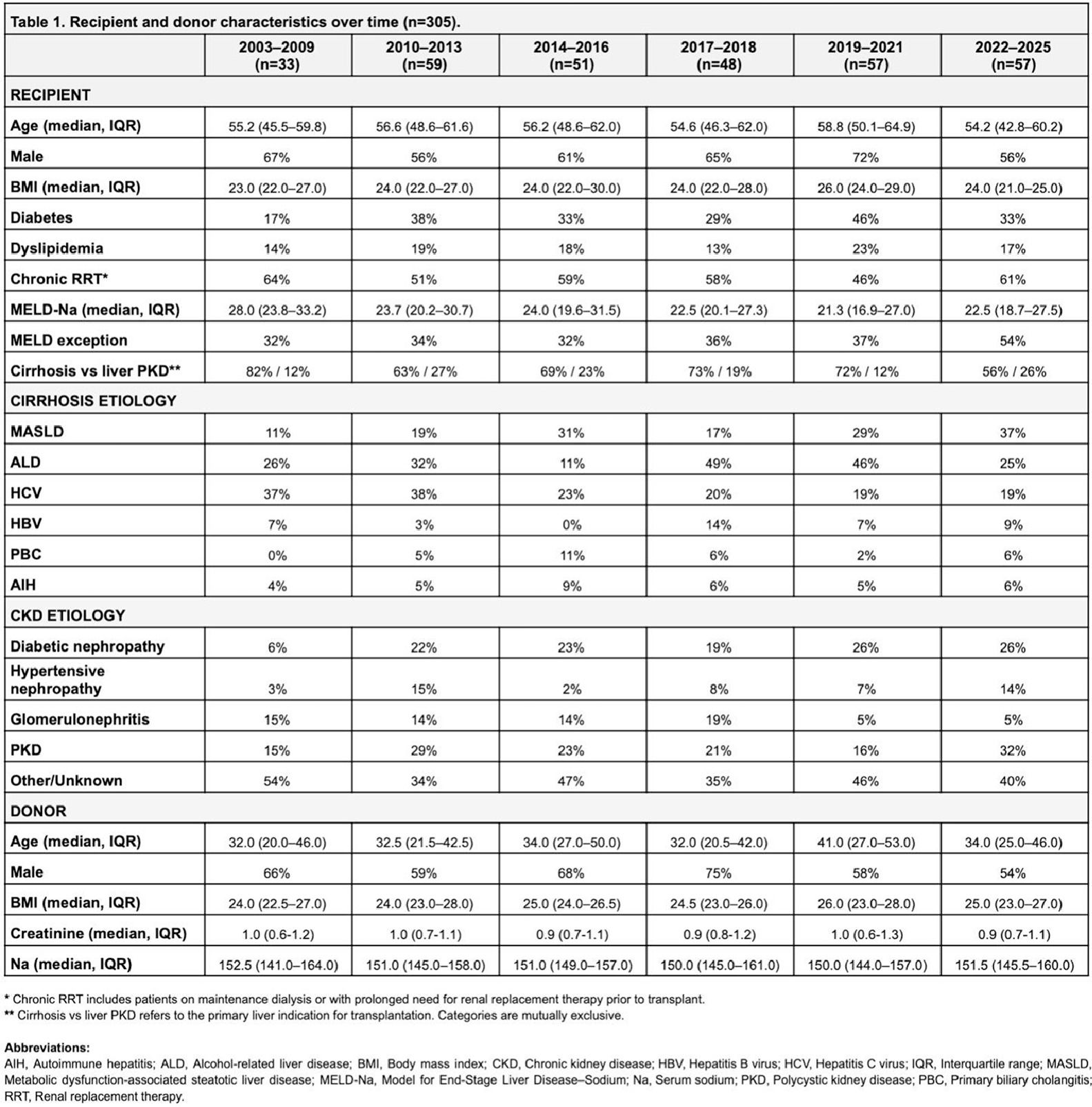
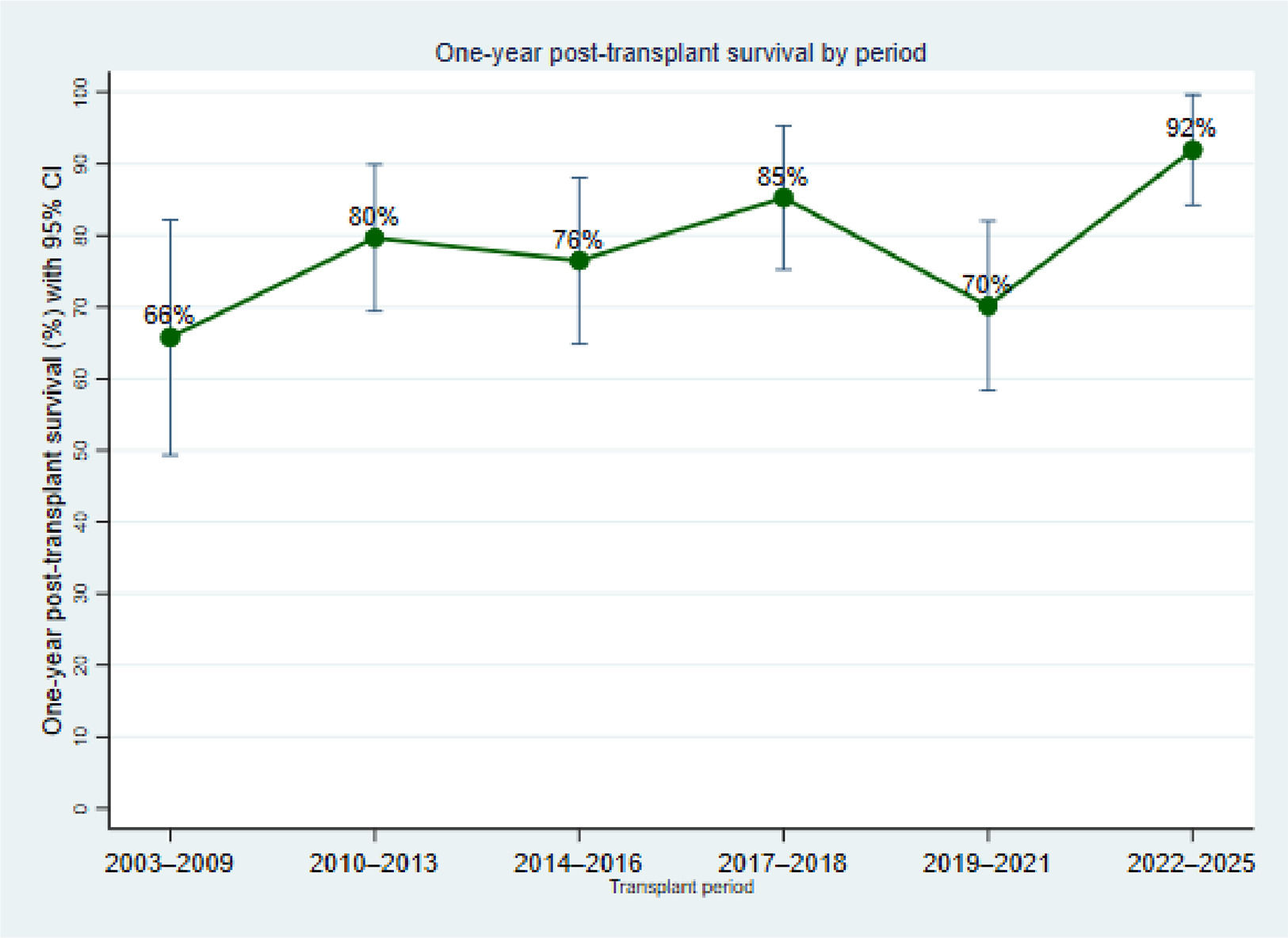
A total of 305 patients were included. Recipient age and sex remained stable. Diabetes prevalence increased from 6% to 46%; hypertension and dyslipidemia varied minimally. Indications for liver transplantation shifted: cirrhosis declined from 82% to 56%, while polycystic disease rose to 26%. HCV-related cirrhosis fell from 38% to 18%; MASLD increased from 11% to 37%. Alcohol-related cirrhosis fluctuated, peaking at 48%. Diabetes became the leading indication for kidney transplantation, while glomerulonephritis declined. MELD exceptions increased, reaching 50% by 2022–2025. Donor characteristics remained stable. One-year survival improved from 66% (95% CI, 49–82) to 92% (95% CI, 84–100). Approximately 70% of recipients met the threshold of eGFR ≥ 45 across all periods.

Conclusions

Despite a more complex recipient profile and evolving transplant indications, SLKT outcomes in Latin America have shown steady improvement over the past two decades. This progress reflects the growing expertise and coordination within transplant systems, highlighting the need to sustain region-specific data collection efforts.

Full Text

Conflict of interest: None

One-year post-transplant survival by period.

Download PDF
Article options
Tools