





Abstracts Asociación Mexicana de Hepatología (AMH) 2024
More infoLiver steatosis (LS) can develop in liver transplant (LT) recipients, with different studies reporting prevalence of 30-60%, our country has a high prevalence of the components of metabolic syndrome. The objective of this study is to describe the characteristics of liver transplant recipients who develop steatosis.
Materials and PatientsRetrospective, transversal and descriptive study in which 28 LT recipients with diagnosis of LS after LT were included, data was retrieved from patients clinical file and the following data were considered: age, sex, history of obesity, arterial hypertension, diabetes mellitus (DM), dyslpidemia and metabolic syndrome (MS) prior and after LT. Other data included were etiology of cirrhosis, immunosuppressive treatment and liver biochemistry at the moment of diagnosis.
ResultsA statistic sample of 28 LT recipients who developed LS after LT was analyzed, 12 were male (42.9%) and 16 female (57.1%) with a medium age of 52 (27-74). The medium of post-LT years at diagnosis was 8 years (1-19). Etiology of cirrhosis was autoimmune in 14 (50%) patients, viral in 6 (21.4%), steatosis in 4 (13.8%) and alcohol in 4 (13.8%), the diagnostic method was imaging in 15 (53.6%) patients and biopsy in 13 (46.4%). The medium body mass index (BMI) was 28.6 (22-39), presence of pre-LT DM in 4 (13.8%) patients and post-LT DM in 15 (53.6%), pre-LT and post-LT obesity was found in 5(10.7%) and 15 (53.6%) patients, respectively, pre-LT and post-LT arterial hypertension in 3 (10.7%) and 11 (39.3%) patients respectively, pre-LT and post-LT dyslipidemia in 0 (0%) and 22 (78.6%) respectively, pre-LT and post-LT MS in 0 (0%) and 15 (53.6%) respectively. 24 (85.7%) patients used prednisone at diagnosis with a medium dose of 11.8 milligrams (5-30). Previous to diagnosis, 24 (85.7%) received tacrolimus and 23 (82.1%) sirolimus. Liver biochemistry showed the following mediums: ALT 85.3 (16-406), 50.5 (14-273), ALP 139.8 (38-519), GGT 237 (11-2296) and TBIL 0.7 (0.2-1.5).
ConclusionsThis study highlights the frequency with which metabolic comorbidities after LT presented in comparison to the ones presented before LT, especially DM, obesity and dyslipidemia. Concluding, LT recipients should be tightly monitored for these metabolic parameters to prevent LS in a timely manner.
Ethical statement: The identification of patients was protected; informed consent was obtained.
Declaration of interests: None.
Funding: This research did not receive any specific grant from funding agencies in the public, commercial, or not-for-profit sectors.
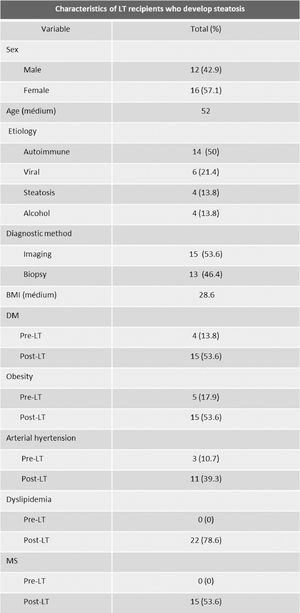
Table 2.
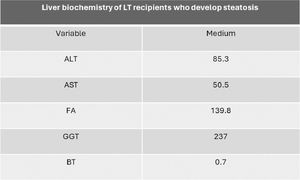
ALT, Alanine aminotransferase; AST, Aspartate aminotransferase; BT, Total bilirubin; FA, Alkaline phosphatase; GGT, Gamma-glutamyl transferase.





