




metricas
covid
Vacunas (English Edition) Predictive demographic factors of Covid-19 vaccine hesitancy in Venezuela: A cro...
Journal Information
Vol. 23. Issue S1.
Pages S22-S25 (August 2022)
Share
Download PDF
More article options
Visits
98
Vol. 23. Issue S1.
Pages S22-S25 (August 2022)
Original article
Predictive demographic factors of Covid-19 vaccine hesitancy in Venezuela: A cross-sectional study
Factores demográficos predictivos de las dudas sobre la vacuna Covid-10 en Venezuela: estudio transversal
Visits
98
G. Andrade
Ajman University, United Arab Emirates
This item has received
Article information
Abstract
Full Text
Bibliography
Download PDF
Statistics
Tables (3)
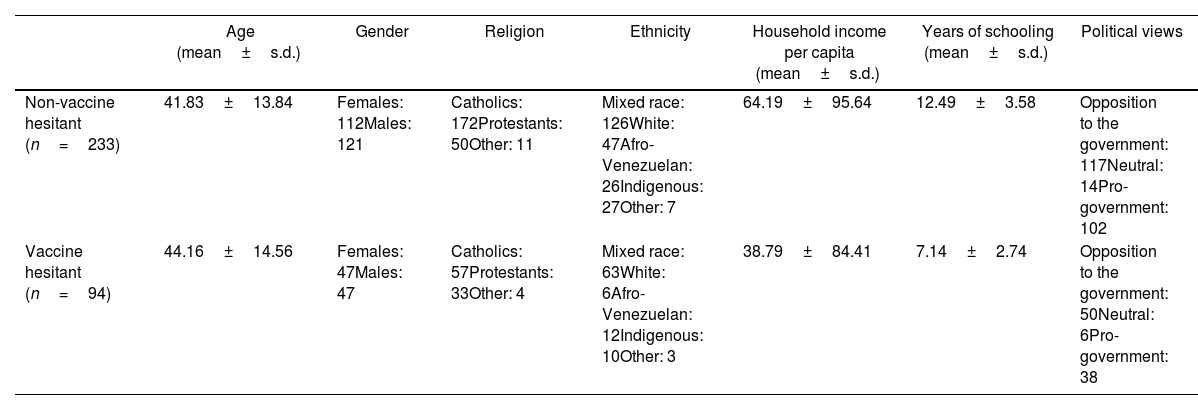
Table 1. Descriptive statistics.
Tables
Table 2. Chi-square analyses of vaccine hesitancy with gender, religion, ethnicity and political views.
Tables
Table 3. Point biserial correlations between vaccine hesitancy and age, household income per capita, and years of schooling.
Tables
Show moreShow less
Special issue
This article is part of special issue:
Vol. 23. Issue S1
More info
Abstract
Objective

To assess if seven demographic variables (age, gender, religion, ethnicity, income, educational level, and political views) are predictive of Covid-19 vaccine hesitancy.

Material and methods

327 participants completed a survey asking questions regarding each of the variables.

Results

Age, gender and political views have no statistically significant correlation with vaccine hesitancy. Ethnicity and religion are predictive of vaccine hesitancy. Income has a weak negative correlation with Covid-19 vaccine hesitancy, and educational level has a moderate negative correlation with Covid-19 vaccine hesitancy.

Conclusion

In order to curb Covid-19 vaccine hesitancy, public health authorities in Venezuela need to focus efforts on marginalized ethnic groups, Protestants, and those with lower levels of education.

Keywords:
Venezuela
Vaccine hesitancy
Demographic variables
Resumen
Objetivo

Evaluar si 7 variables demográficas (edad, género, religión, origen étnico, ingresos, nivel educativo y opiniones políticas) son predictivas del rechazo a la vacuna del Covid-19.

Material y métodos

Trescientos veintisiete participantes completaron una encuesta con preguntas sobre cada una de las variables.

Resultados

La edad, el género y las opiniones políticas no tienen una correlación estadísticamente significativa con el rechazo a la vacuna. El origen étnico y la religión predicen el rechazo a las vacunas. Los ingresos tienen una correlación negativa débil con el rechazo de la vacuna Covid-19, y el nivel educativo tiene una correlación negativa moderada con el rechazo de la vacuna Covid-19.

Conclusión

Para frenar el rechazo a la vacuna del Covid-19, las autoridades de salud pública en Venezuela deben concentrar sus esfuerzos en los grupos étnicos marginados, los protestantes y aquellos con niveles más bajos de educación.

Palabras clave:
Venezuela
Rechazo a la vacuna
Variables demográficas

Article

These are the options to access the full texts of the publication Vacunas (English Edition)
Subscriber
Subscriber

If you already have your login data, please click here .

If you have forgotten your password you can you can recover it by clicking here and selecting the option “I have forgotten my password”
Subscribe
Subscribe to

Vacunas (English Edition)

Purchase
Purchase article

Purchasing article the PDF version will be downloaded

Purchase now
Contact
Phone for subscriptions and reporting of errors
From Monday to Friday from 9 a.m. to 6 p.m. (GMT + 1) except for the months of July and August which will be from 9 a.m. to 3 p.m.
Calls from Spain
932 415 960
Calls from outside Spain
+34 932 415 960
E-mail
Article options
Tools