


The COVID-19 pandemic led to the suspension of football leagues worldwide, resulting in changes to tournament formats and player performance. While European leagues have reported injury characteristics during this period, similar analyses are lacking in South America. This study aimed to compare injury incidence, burden, and patterns between a regular season (2023) and the pandemic-affected season (2020) in Peruvian professional football.
MethodsA total of 266 and 360 official matches were analyzed from the 2020 and 2023 seasons, respectively. Injury data were collected through video analysis of official broadcasts, sports media publications, and official statements from club medical departments. Injury severity was classified based on days absent until return to full competition. Injury burden was defined as total days absent per 1000h of exposure. Injury incidence rates (injuries per 1000h) and injury characteristics (type, anatomical location, mechanism, and severity) were compared between seasons.
ResultsThe 2020 season included 19 teams, 521 registered players, and 28 matches per team. In 2023, 20 teams and 532 players participated, with each team playing 37 matches. No significant difference was found in match injury incidence between seasons. However, injury burden in 2020 was 1.23 times higher (95% CI, p<.01) compared to 2023, with a median difference of 6 days absent per injury (U=77, p<.001). Contact injuries significantly decreased in the 2020 season (RR 0.58, 95% CI, p<.05).
ConclusionsAlthough injury incidence remained similar, the 2020 pandemic season showed higher injury burden and fewer contact injuries, highlighting the need for adaptive strategies to protect athlete health during unexpected interruptions.
La pandemia por COVID-19 suspendió las ligas de fútbol, generando cambios en los torneos y el desempeño de futbolistas. Si bien en Europa se ha reportado las características de las lesiones durante este periodo, Sudamérica carece de análisis similares. Este estudio compara la incidencia, la carga y los patrones de lesiones entre una temporada regular (2023) y la temporada pandémica (2020) en el fútbol peruano.
MétodosSe analizaron 266 y 360 partidos en las temporadas 2020 y 2023, respectivamente. La información sobre las lesiones se obtuvo mediante análisis de video de transmisiones oficiales, publicaciones en prensa y comunicados oficiales de los departamentos médicos. La severidad se categorizó según los días de ausencia hasta la reincorporación competitiva. La carga se definió como el número de días de ausencia por 1.000h de exposición. Se compararon las tasas de incidencia (lesiones por 1.000h de exposición) y las características de las lesiones entre ambas temporadas.
ResultadosLa temporada 2020 registró 19 equipos, 521 jugadores y 28 partidos. En 2023, participaron 20 equipos y 532 jugadores, disputando 37 partidos. No hubo diferencia en la incidencia de lesión entre temporadas. La carga de lesión en 2020 fue 1,23 veces mayor (IC del 95%; p<0,01) en comparación con la temporada 2023, con una mediana de diferencia de 6 días (U=77; p<0,001). Las lesiones por contacto durante la temporada 2020 disminuyeron (RR: 0,58, IC del 95%; p<0,05).
ConclusionesLas temporadas analizadas reportaron similar incidencia de lesión, pero diferencias en cuanto a la carga de lesión y lesiones por contacto durante la pandemia en el fútbol peruano.
Towards the end of the year 2019, a sudden increase in viral pneumonia emerged in Wuhan, China. The causative agent was identified as SARS-CoV-2, later described as COVID-19.1 Cases multiplied globally, leading the WHO to declare a global health emergency in January 2020, and subsequently a pandemic in March.2 Strategies to limit the spread of the virus included quarantines and social distancing, which forced the suspension of group activities, such as amateur and professional football tournaments.3 Football, the most widely played sport worldwide,4 halted its competitions for several months.5 In response, players resorted to unconventional, non-contact training methods.6
Considering the numerous changes in competitive dynamics, several studies explored whether during the 2020 season, which unfolded during the COVID-19 pandemic, the incidence of injuries was altered. According to the Elite Club Injury Study (ECIS) by the Union of European Football Associations (UEFA), no significant differences were observed compared to previous seasons between 2015 and 2019.7 Most studies focused on European leagues, with little information available on other regions.8 In Japan, injury rates remained similar between 2019 and 2020.9 In South America, reports existed prior to the pandemic,10,11 but subsequent information was limited. Only one study was identified that described protocols implemented for the resumption of international tournaments.12
In Peru, the absence of an injury registration system until 2023 limited scientific output in this area. In 2020, the pandemic interrupted the national tournament after just seven matchdays, suspending it for five months. Upon its resumption, matches were played exclusively in Lima under strict protocols, including pre-match swab tests. The championship was reduced from 38 to 27 rounds. During the following seasons, restrictions were gradually eased, finally allowing a full return to normality in 2023.
Due to the scarcity of regional information on sports injuries during the COVID-19 pandemic and the specific characteristics of professional football in Peru, evidence needed to be gathered to determine the real effect of that context on athletes’ health. This study therefore aims to compare the incidence rates, burden, and injury patterns between the 2023 regular season and the 2020 season, which took place under atypical conditions during the pandemic. It is proposed that, despite a similar overall incidence, the limitations observed in the monitoring and recovery processes during 2020 may have influenced a greater injury burden and an increase in days of absence, as well as a modification of the predominant injury mechanisms, particularly a reduction in contact injuries.
MethodsStudy designA retrospective observational study was conducted in which all competitive matches of the Peruvian men's first division were reviewed during the 2020 (pandemic) and 2023 (regular) seasons, with the objective of describing all injuries that occurred during the tournament. This design was selected due to the exceptional conditions of the 2020 season, characterised by travel restrictions and limited availability of official digital broadcasts. Furthermore, this media-based approach has been used in other leagues, demonstrating sufficient reliability.13 The study was conducted in accordance with ethical standards and the guidelines of the Declaration of Helsinki. The study was approved as a research project by the ethics committee of a university in Peru. Additionally, an informed consent waiver was requested from and approved by the ethics committee.14
Study population and periodThe 2020 season initially began with 20 participating teams. However, one team was excluded from the study due to television rights restrictions, preventing access to reliable data and resulting in 19 teams being analysed. The season started with 7 matches over a 2-month period, followed by a mandatory 5-month quarantine. Competition then resumed with an additional 20 matches during the remaining 5 months of the year. In the 2023 season, 20 teams participated, and the tournament proceeded smoothly over 38 matches during a 10-month period. The study included all players registered with the participating teams who played in at least one official league match during the study period. Anthropometric data and playing positions were obtained from the teams’ official digital channels and corroborated with information available on the transfermarkt.pe website. This methodology, based on open-access sources, had already been used and reported successfully in epidemiological studies of football injuries.15
Study procedureThe operational definitions of injury, severity, mechanism, and type followed the guidelines published by the UEFA Elite Club Injury Study, recognised as the international standard for epidemiological research in football.16 Injury was defined as any physical condition sustained during a match that resulted in the inability to participate in subsequent training or competitive matches. Severity was defined as the number of days between the injury diagnosis and the date the player was available to compete again. Injuries were classified according to the number of days of absence as follows: minimal (1–3 days), mild (4–7 days), moderate (8–28 days), and severe (>28 days). The injury mechanism was classified as contact or non-contact. Finally, the injuries were classified by type (ligamentous, muscular, or other) and anatomical location.17
Data collectionData collection followed a systematic methodology. Recordings of all official matches of the tournament were reviewed. A video analysis was performed each time a player fell on the field presenting a physical complaint or requiring medical attention during the match. It was then observed whether the affected player continued playing or required substitution. All recorded injury situations were downloaded to a personal computer and analysed using the free software Kinovea version 0.9.5. (http://www.kinovea.org) independently by two orthopaedic surgeons and a sports medicine physician to determine the injury pattern, mechanism, and location. If discrepancies arose between the assessors, they were resolved through discussion and consensus. The information obtained was cross-referenced with official sources from the championship (television, radio, and live broadcasts) and reports from the medical departments of the participating clubs. Discrepancies between sources were resolved by prioritising official club records. Finally, if a player was found to have an injury, their return-to-play time was tracked until they were reinstated to the matchday squad. The study included all injuries documented on video and those for which complete and verified official information was available. Injuries for which information was unavailable or incomplete were excluded. For all other players who were not injured during a match, the minutes played were calculated.
Statistical analysisFor statistical analysis, Microsoft Office® 365 Excel® was used to organise all collected data, followed by statistical analysis using the Statistical Package for the Social Sciences, version 26 (SPSS®, IBM, New York, USA). Descriptive statistics were performed to calculate frequencies, means, and percentages. The injury incidence during matches was calculated using the following formula: Σ number of injuries/Σ hours of exposure per 1000h of competition, along with a 95% confidence interval (CI). The standard method based on incidence rates was used for the CI. The standard error was estimated as the square root of the inverse of the total number of injuries. Subsequently, the lower and upper limits of the confidence interval were obtained by adding and subtracting 1.96 times the standard error to the calculated incidence, respectively. Furthermore, the injury burden was calculated as follows: Σ number of days of absence/Σ hours of exposure per 1000h of competition, accompanied by the corresponding interquartile range (IQR). For the 2020 and 2023 seasons, the IQR is presented as the values corresponding to the first and third quartiles of all participating teams. The Kolmogorov–Smirnov test was used to determine whether the incidence and burden found in both seasons followed a normal distribution. Additionally, the chi-square test was used to explore the relationship between categorical variables such as injury type, mechanism, and severity between the two seasons. To compare incidence rates, the relative risk (RR) calculation was applied. Similarly, to assess the difference in injury incidence between the 2020 and 2023 seasons, the incidence rate ratio (IRR) was used, employing the Z-test with a 95% confidence interval that did not include the number 1. Injury burden was compared analogously to the IRR. For non-parametric data, the Mann–Whitney U test was used. Significance was set at a p-value under .05.
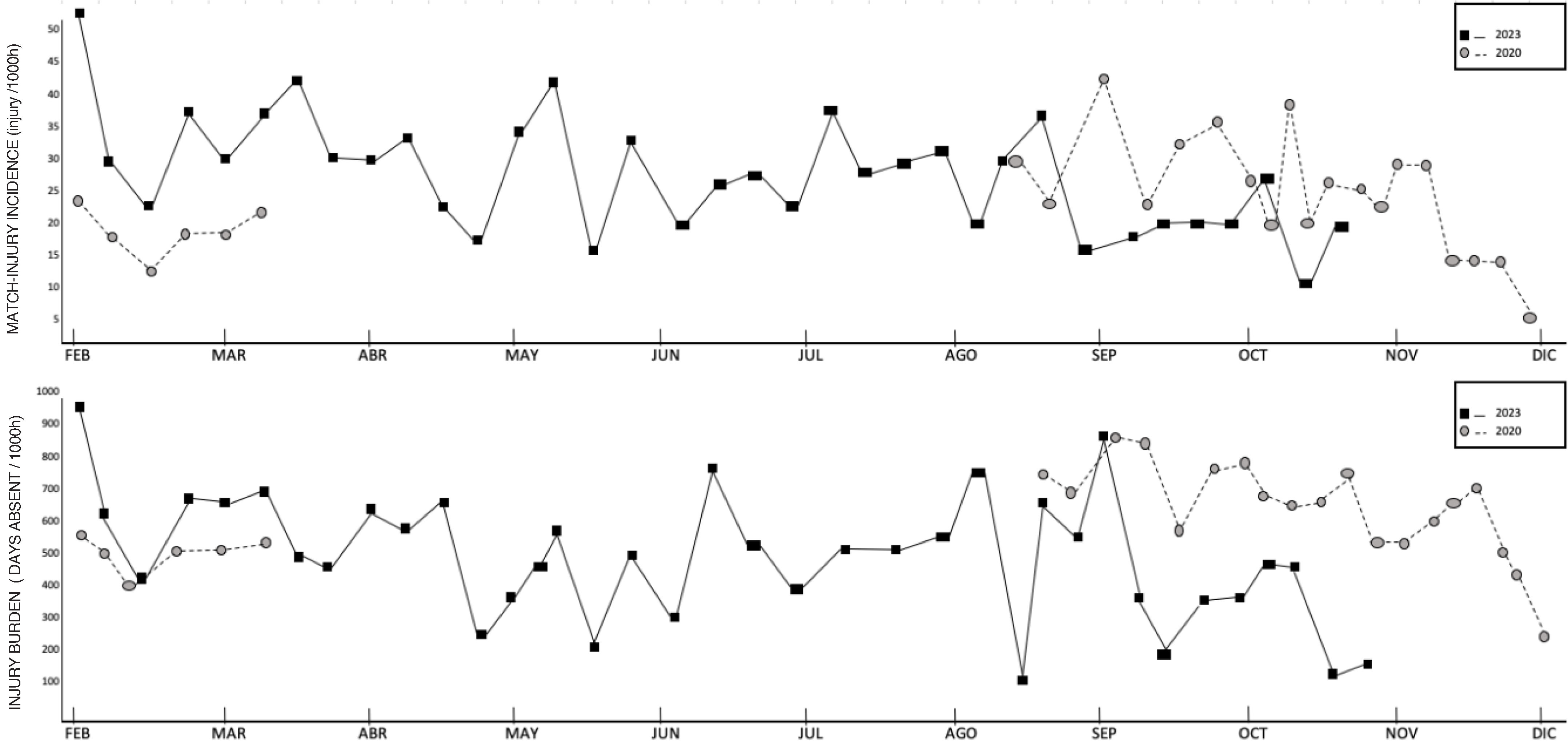
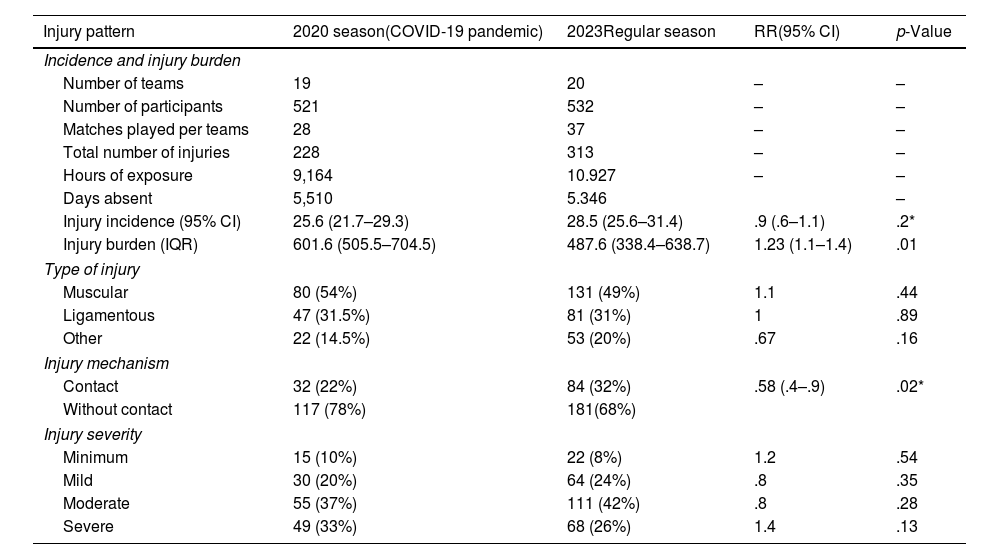
ResultsInjury incidence and burdenDuring the 2020 season, a total of 521 registered footballers participated in 19 teams, each playing 28 competitive matches. A total of 9164h of exposure were recorded, resulting in 228 injuries and 5510 days of absence. Follow-up and complete information were obtained for 149 injuries (67%). The injury incidence for this season was calculated at 25.6 (95% CI: 21.7–29.3) injuries per 1000h of exposure. Furthermore, the injury burden was calculated at 601.6 (IQR: 505.5–704.5) per 1000h of exposure. Regarding the 2023 season, a total of 532 footballers participated across 20 teams, each playing 37 competitive matches (one full matchday was cancelled due to broadcasting rights issues). A total of 10,927h of exposure were recorded, with 313 injuries occurring in competitive matches, 265 (85%) of which were fully followed up. These injuries resulted in 5346 days of absence. An injury incidence of 28.5 (95% CI: 25.6–31.4) and an injury burden of 487.6 (IQR: 338.4–638.7) were calculated. The monthly variation in incidence shows similar fluctuations between seasons. On the other hand, a notable increase in injury burden can be observed after the mandatory break and resumption in August of the 2020 season compared to the 2023 season. These results are reflected in Fig. 1. No difference was observed in the incidence of injuries during matches between seasons (RR: .9, 95% CI: .63–1.1). In contrast, the injury burden during the 2020 season, amid the COVID-19 pandemic, was 1.23 times greater than that of the regular 2023 season (RR: 1.23; 95% CI: 1.1–1.4; p<.01). Furthermore, a comparison of the median number of days of absence due to injury between the seasons showed significant differences. In 2020, the median was 24.5 days (mean: 25.5±4; n=28), while in 2023 the reported median was 18 days (mean: 16.9±5; n=37). A median difference of 6 days was calculated (U=77,000, Z=−5,852; p<.001), indicating a longer recovery time in the 2020 season.

Monthly variation in match injury incidence and match injury burden during the COVID-19 pandemic season (2020) and the regular season (2023) in the Peruvian football league. Match injury incidence is calculated as the number of injuries per 1000h of exposure, while injury load is determined by the number of injury days absent per 1000h of exposure.
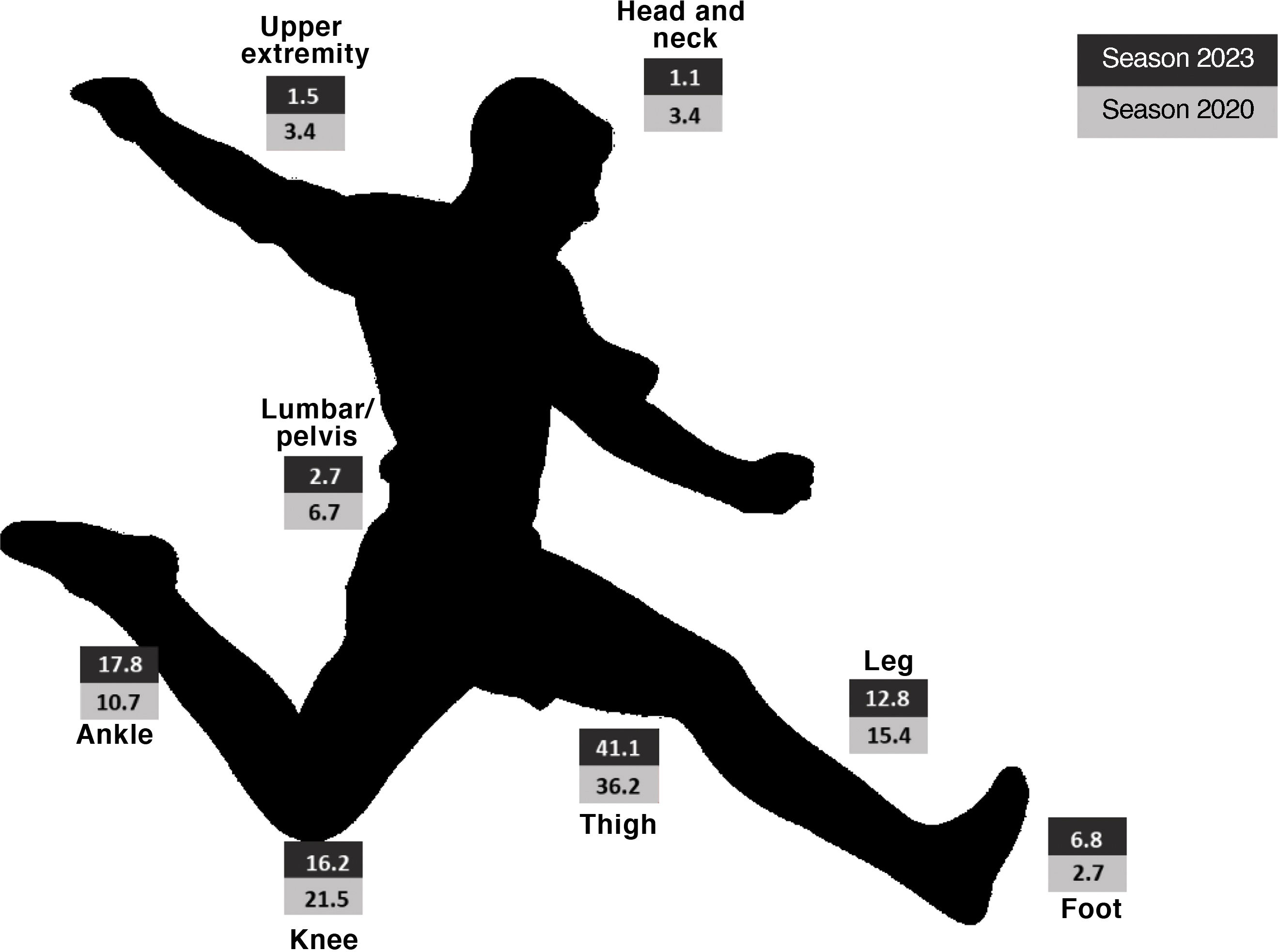
Regarding injury location, the thigh was the most affected region, accounting for 54 injuries (36.2%) in the 2020 season and 109 injuries (41.1%) in the 2023 season. The knee was the second most frequent injury in the 2020 season with 32 injuries (21.5%), while the ankle held that position in the 2023 season with 47 injuries (17.8%). The complete distribution of injuries is shown in Fig. 2. Regarding the type of injury during the 2020 season, muscle injuries were the most frequent, with 80 injuries (54%), followed by ligamentous injuries (47 injuries, 31.5%), with the remaining 22 injuries (14.5%) being of other types. Similarly, in the 2023 season, 131 muscle injuries (49%) were observed, followed by 81 ligamentous injuries (31%) and 53 (20%) other types of injuries.

Regarding the injury mechanism, non-contact injuries were the most common, accounting for 117 (78%) injuries during the 2020 season and 181 (68%) injuries during the 2023 season. In terms of severity, moderate injuries accounted for 55 (37%) injuries, followed by 49 (33%) severe injuries, 30 (20%) mild injuries, and 15 (10%) minimal injuries. The 2023 season followed a similar distribution, with 111 (42%) injuries classified as moderate, 68 (26%) as severe, 64 (24%) as mild, and 22 (8%) as minimal. Following statistical analysis of injury pattern variables, a significant difference in injury mechanism was observed. During the 2020 season, injuries resulting from contact mechanisms showed a relative risk (RR) of .58 (95% CI: .36–.92; p<.05) compared to the 2023 season. The difference between all injury patterns between the two seasons is presented in Table 1.
Injury incidence is reported as the number of injuries per 1000h of exposure. Injury burden is defined as the number of days of absence due to injury per 1000h of exposure.
| Injury pattern | 2020 season(COVID-19 pandemic) | 2023Regular season | RR(95% CI) | p-Value |
|---|---|---|---|---|
| Incidence and injury burden | ||||
| Number of teams | 19 | 20 | – | – |
| Number of participants | 521 | 532 | – | – |
| Matches played per teams | 28 | 37 | – | – |
| Total number of injuries | 228 | 313 | – | – |
| Hours of exposure | 9,164 | 10.927 | – | – |
| Days absent | 5,510 | 5.346 | – | |
| Injury incidence (95% CI) | 25.6 (21.7–29.3) | 28.5 (25.6–31.4) | .9 (.6–1.1) | .2* |
| Injury burden (IQR) | 601.6 (505.5–704.5) | 487.6 (338.4–638.7) | 1.23 (1.1–1.4) | .01 |
| Type of injury | ||||
| Muscular | 80 (54%) | 131 (49%) | 1.1 | .44 |
| Ligamentous | 47 (31.5%) | 81 (31%) | 1 | .89 |
| Other | 22 (14.5%) | 53 (20%) | .67 | .16 |
| Injury mechanism | ||||
| Contact | 32 (22%) | 84 (32%) | .58 (.4–.9) | .02* |
| Without contact | 117 (78%) | 181(68%) | ||
| Injury severity | ||||
| Minimum | 15 (10%) | 22 (8%) | 1.2 | .54 |
| Mild | 30 (20%) | 64 (24%) | .8 | .35 |
| Moderate | 55 (37%) | 111 (42%) | .8 | .28 |
| Severe | 49 (33%) | 68 (26%) | 1.4 | .13 |
CI: confidence interval; IQR: interquartile range; RR: relative risk.
This study represents the first in South America to analyse the incidence, burden, and patterns of injuries between a regular season (2023) and the season during the pandemic (2020). The main findings of the study demonstrate that during the 2020 season, match-injury burden was 1.23 times higher, and the median time off due to injury differed by 6 days compared to the 2023 regular season. In contrast, no significant differences were identified in the incidence of injuries per match. Comparing our results with other reports from South America, GG Arlani et al. conducted a prospective study compiling injuries that occurred during the 2019 season of the Brazilian professional football championship, showing 214 injuries affecting 645 players over 38 matchdays. The injury incidence per match showed 20.5 injuries per 1000h of exposure.18 This result is lower than those reported for the 2023 regular season and the 2020 season during the pandemic in the Peruvian league. These differences may be due to the reporting methodology, as Brazil has reports on the epidemiology of football injuries and their patterns for over 10 years, with the latest update in 2019. Having this information allows for the adoption of appropriate preventive measures aimed at injury prevention. Furthermore, the implementation of preventative programmes such as FIFA 11+ could explain the decrease in injury occurrence.19 In Peru, mandatory match injury reporting only began in 2024, with no published literature to date. Likewise, the use of the FIFA 11+ programme in professional teams has not yet been formally implemented. On the other hand, a report published by a professional team participating in the Argentine Professional Football League described injuries occurring between 2017 and 2019 in 95 players. It found 1007h of exposure, with an injury incidence of 40.7 injuries per 1000h of competition. This result is significantly higher than our report. The difference can be explained by the Argentine team's heavier match schedule, as, considering the hours of exposure, they report almost twice as many competitive matches as a team in the Peruvian league. A higher density of matches in Argentina could increase fatigue and the risk of injury, especially if the recovery time between matches was insufficient.20
Internationally, Bengtsson et al.21 compared six teams participating in the 2016 Copa Libertadores with six teams belonging to the ECIS during the 2016–2017 seasons. Similar injury incidence rates per match were reported: 20.9 injuries per 1000h of exposure in South America versus 20.3 injuries per 1000h in Europe. Likewise, the injury burden per match was not statistically different.10 These values show a lower incidence of injuries compared to our study. However, the injury burden in the 2020 Peruvian season was higher than the aforementioned report. This may be attributed to the fact that Peruvian teams have lower investment than elite teams, which have greater resources such as better access to infrastructure, nutrition, and rehabilitation facilities, which may lead to better recovery and injury prevention.21
Injuries during the COVID-19 pandemic, 2020 seasonRegarding the incidence during the pandemic, Walden et al. Injuries were reported in 19 first-division teams from 12 countries participating in the ECIS study. There was no increase in the injury incidence per match in the 2020 season (22.5 injuries per 1000h of exposure), compared to the average of the previous 5 seasons (22 injuries per 1000h of exposure), nor differences in the injury burden (582 vs. 426 days of absence per 1000h of exposure).7 Our results showed a higher incidence (25.6 and 28.5 injuries per 1000h in 2020 and 2023, respectively) compared to the ECIS reports, but with similar injury incidence between seasons in the Peruvian league. However, a significantly higher injury burden was observed in 2020 (601.6 days per 1000h in 2020 vs. 487.6 in 2023). This could be attributed to multiple local factors, such as the over-saturation of health services in Peru during the acute phase of the pandemic, which delayed diagnoses (X-rays, MRIs) and rehabilitation, in addition to social distancing protocols that limited training. These differences in training guidelines and mandatory quarantine (which lasted for 5 months in Peru) likely affected the players’ physical condition, increasing their vulnerability to injuries,22,23 reflected in the increased burden (601.6 days per 1000h) and absence time (median: 24.50 vs. 18.00 days). This reality differs significantly from that described by Orhant et al. In the French league, a lower injury incidence was reported during the 2020/21 pandemic season (24.9 vs. 29.4 per 1000h; p>.01) compared to previous seasons, attributing this to the fact that the period of absence was used as a preseason and for better medical/sports coordination.24,25 In Peru, the resumption of the 2020 season involved a series of matches in a short period, and the lack of advanced infrastructure may have limited the benefits observed in France.26
Injury patternsA report that included 11 teams from the Spanish professional football league compared injuries occurring in the 2019/20 season before and after the lockdown, demonstrating a predominance of muscle injuries, lower limb injuries, non-contact injuries, and injuries of moderate severity. None of the variables showed a significant difference between the periods.27 Our study shows similarities to the Spanish league report, finding no differences in injury type, location, or severity. However, we do report a significant decrease in contact injuries during the pandemic season. It is important to mention that the Spanish league generally reports a lower incidence of contact injuries compared to other leagues.28 Furthermore, the decrease in contact injuries could be explained by players becoming more cautious during play, avoiding close contact.29
Media-based approachUntil 2023, the Peruvian football league lacked a standardised format for reporting injuries. This hindered adherence to the ECIS data collection standards, which require a member of each participating team's medical staff to complete a form. The media-based approach was chosen because previous research suggests good results when injury reports are unavailable, as noted in studies of the German Bundesliga.13 This approach is useful for calculating incidence and workload, as well as identifying injury patterns such as type and location, following the definitions provided by the UEFA study.16 However, a drawback of this approach is that the information can be biased by media coverage, providing details of injuries considered serious, while other types of injuries lack diagnostic precision.30 To avoid this bias and improve the quality of the information, video analysis of each injury situation was chosen. This reporting method has been successfully used in the Italian league to describe the mechanisms, situational patterns, and biomechanics.15 However, it is subject to subjective interpretation by observers and the underestimation of minor injuries or those outside the field of vision, reducing the representativeness of the data.
LimitationsAlthough this study provides valuable data as a starting point for describing the incidence, burden, and patterns of injury in the Peruvian league, it has limitations that should be considered. First, the 2020 season, played in an atypical context, may have affected the physical preparation, performance, and presentation of injuries unevenly across teams, generating wide variability. Second, the lack of information on training injuries limits a complete analysis of injury incidence, diminishing the impact of our results. Third, the study does not propose specific causes to justify the differences in injury burden observed between the seasons studied, which limits the ability to propose recommendations for reducing injuries in the championships. Finally, the media-based approach and video analysis introduced biases related to media coverage and limited diagnostic accuracy, affecting the representativeness of the data and the estimates of incidence and workload. Therefore, to improve future studies, a standardised injury reporting system that complies with international regulations and collects injury data from both competition and training should be implemented. Furthermore, to promote injury prevention, it is imperative to put into practice internationally established protocols such as FIFA 11+.
ConclusionIn the 2020 and 2023 seasons of Peruvian professional football, the most common injuries were muscular and ligamentous, primarily affecting the lower extremities. Although the injury incidence during matches was similar in both years, a significantly higher injury burden was observed in 2020, with longer recovery times. This finding could be explained by changes in the dynamics of the game during the pandemic, such as physical distancing and limitations in physical training, which also resulted in a reduction of direct contact injuries.
This study constitutes the first comparative analysis in South America to evaluate the effects of the pandemic on the health of professional football players in an official competition. The findings allow us to understand how extraordinary scenarios, such as a global health crisis, can alter not only the frequency but also the duration and functional impact of sports injuries.
In light of this, the need arises for clubs and medical staff to adopt formal injury reporting systems for both training and matches, along with functional assessment tools that guide a gradual and safe return to sport, strengthening comprehensive athlete monitoring and injury prevention.
Level of evidenceLevel of evidence: IV.
Ethical considerationsNo personally identifiable information was collected in this study, nor was there any interaction with participants. The study was conducted in accordance with the ethical guidelines of the Declaration of Helsinki and the recommendations of the ICMJE, ensuring respect for privacy and the confidentiality of the data analysed. Furthermore, the study was approved as a research project by the ethics committee of a Peruvian university, from which an informed consent waiver was requested.
FundingThis research received no funding from public, commercial, or non-profit sectors.
Conflict of interestsThe authors have no conflict of interests to declare.
