

Spain is expected to be the country with the highest life expectancy in the coming years. In this context, it is important to improve the care of hip fractures. The objective of this work was to describe the results of the registries published on hip fractures in Spain.
Material and methodsSystematic review and meta-analysis of the records published on hip fractures in Spain, the last 10 years. The characteristics of the study, characteristics of the patients, of the fractures, the type of surgery, as well as morbidity and mortality were analyzed.
ResultsA total of 55,680 patients with a mean age of 84.6 years were analyzed, of whom 75% were women. Extracapsular fractures were the most frequent (58%). It was found that conservative treatment was applied in an average of 3% of cases. The average surgical delay was 64.7h, with a mean percentage of patients operated on within 24h at 18%, and within 48h at 40%. A mean hospitalization time of 10.7 days was found. Delirium was found to be the most frequent postoperative complication (42%). The mean transfusion rate was 36%. Mean in-hospital mortality at one month and one year was 4%, 5% and 18%, respectively.
ConclusionsLess than half of patients with a hip fracture undergo surgery within 48h, despite being recommended by the majority of clinical practice guidelines. Delirium is the most frequently reported postoperative complication, and one in every 5 patients will die within a year after a hip fracture. Standardizing the management of hip fractures at the state level could improve healthcare quality and facilitate the establishment of common criteria for good clinical practice.
Se prevé que España sea el país con mayor esperanza de vida en los próximos años. En este contexto, es importante mejorar la atención de las fracturas de cadera. El objetivo de este trabajo fue describir los resultados de los registros publicados sobre fracturas de cadera en España.
Material y métodosRevisión sistemática y metaanálisis de los registros publicados sobre fracturas de cadera en España en los últimos 10 años. Se analizaron las características del estudio, las características de los pacientes, de las fracturas, del tipo de cirugía, así como la morbimortalidad.
ResultadosSe analizó 55.680 pacientes con una edad media de 84,6 años, de los cuales el 75% eran mujeres. Las fracturas extracapsulares fueron las más frecuentes (58%). Se halló que el tratamiento conservador se aplicó en un promedio del 3% de los casos. La demora quirúrgica media fue de 64,7h, mientras que el porcentaje medio de pacientes operados en menos de 24h fue del 18% y el de menos de 48h fue del 40%. Se halló un tiempo de hospitalización medio de 10,7 días. Se encontró al delirium como la complicación postoperatoria más frecuente (42%). El porcentaje de transfusión medio fue del 36%. La mortalidad media intrahospitalaria, al mes y al año fue del 4, 5 y 18%, respectivamente.
ConclusionesMenos de la mitad de loa pacientes con fractura de cadera son operados en menos de 48h a pesar de ser recomendado por la mayoría de guías de práctica clínica. El delirium es la complicación postoperatoria más frecuente reportada y uno de cada 5 pacientes morirá al año, tras la fractura de cadera. Homogeneizar el manejo de la fractura de cadera a nivel estatal podría mejorar la calidad asistencial y permitiría la creación de criterios comunes de buena práctica clínica.
Fragility hip fractures are a common condition in the older population that can lead to long-term disability and even premature death.1 In Europe, hip fractures account for more years of disability lost than most cancers, more than 7200 quality-adjusted life years.2,3 In Spain, there are approximately 40,000–45,000 hip fractures per year, with an annual cost of more than 1.5 billion euros.2–4 Due to their high incidence and the rapid growth of the elderly population, these fractures constitute one of the most challenging and fastest growing public health problems.5
Spain is currently expected to be the country with the highest life expectancy, exceeding 85 years for both sexes in 2040.6 In this context, an adequate estimation of the epidemiological framework of fragility hip fractures in Spain and their impact on the elderly population is increasingly important in order to improve their care.4,7
In Spain, several registries have previously reported on the incidence and complications of hip fractures.8–12 Hip fracture registries have been published for the Community of Castile and León (registry start date [SD] – January 2013).8 A registry from the Community of Madrid has also been published (SD – January 2015).9 There are also studies in different Autonomous Communities, such as the study by Caeiro et al.,10 the multicentre hospital study SPARE-HIP (SD – June 2014),11 and the study of Spain's National Registry of Hip Fractures (RNFC) (SD – January 2017).12 All these studies coincide in the importance of their results because they help stakeholders to formulate policies on this public health problem.7 However, despite the study by Sáez-López et al.,13 published in 2019, which aimed to present the data from the first annual report of the RNFC and compare them with the regional registries and the multicentre studies recently carried out in Spain, finding significant differences between the studies, there are no studies that systematically evaluate the results published by these registries.
The aim of this study was to describe the results of published studies on hip fracture in Spain. A secondary objective was to analyse the areas of greatest importance in the management of hip fractures.8–12 Therefore, time to surgery, length of hospital stay, postoperative complications, and mortality were analysed.
Material and methodsLiterature search strategyThis systematic review was conducted according to the Preferred Reporting Items for Systematic Reviews and Meta-Analyses (PRISMA) statement and the recommendations of the Cochrane Handbook for Systematic Reviews of Interventions.14,15 PROSPERO: ID CRD42023XXXXXX. The electronic search was conducted between April and June 2023. We searched the electronic databases PubMed, Embase (Ovid), MEDLINE (Ovid) using the following terms in English and Spanish: “hip fractures”, “elderly”, “osteoporotic fractures”, “Spain”, “mortality”, “complication”; “fractura de cadera”, “ancianos”, “fracturas osteoporóticas”, “España”, “mortalidad”, “complicaciones”. Potentially eligible studies were limited to those published in the last 10 years. Additional strategies to identify studies included consultation with experts and the use of “related articles” functions. The literature search was limited to the Spanish and English languages. The search strategy is presented in Annex 1.
Eligibility criteriaThe inclusion criteria for the identification of studies were as follows: (1) cohort studies of Spanish adults who had suffered a hip fracture, (2) prospective and retrospective studies that described the demographic characteristics of the patients and/or the characteristics of the fracture, and (3) studies that reported postoperative complications using incidence rates. The following were excluded: (1) studies that focused only on specific subpopulations (patients with diabetes mellitus, patients with chronic obstructive pulmonary disease, etc.), (2) studies that focused only on a specific type of fracture or a specific type of implant, (3) studies that reported postoperative complications as a cumulative percentage or “yes/no”, (4) studies that only assessed prognostic factors and quality of life factors, (5) studies with duplicate data, and (6) studies published more than 10 years ago.
Study selectionTwo authors (JN, FM) assessed the eligibility of the search results. Studies were read in detail, including all sections, abstract, material and methods, to ensure that they met the inclusion criteria. If there was a conflict between the two reviewers, a third reviewer (EG) was consulted to make a decision.
Data extractionData were extracted from the main text and supplementary appendices of the studies. Data extraction was performed by two reviewers who had not been involved in the selection of articles to ensure that data were extracted appropriately and to minimise bias. Data were extracted from the included studies as follows: (1) general characteristics such as first author, year of publication, study design, study location, number of patients included, (2) demographic data of the included patients such as age and sex, (3) fracture and surgery data such as type of fracture (extracapsular, intracapsular, other) and type of implants used for surgery (total hip arthroplasty, hip hemiarthroplasty), hip hemiarthroplasty, intramedullary nail), (4) hospitalisation data such as waiting time between fracture and surgery (hours, number of patients operated before 24 and 48h) and hospital stay (days, mean [standard deviation (SD)]), and (5) data on postoperative complications (number of patients) and mortality (number of patients).
Quality assessmentThe quality of the studies was assessed according to the methodological index for non-randomised studies (MINORS).16 The MINORS checklist consists of 12 items, 8 of which are only applicable to non-comparative studies. Each item is given a score of 0 if the criterion is not reported in the article, 1 if it is reported but not adequately met, or 2 if it is adequately met. Higher scores indicate a higher methodological quality of the article and a lower risk of bias. As used in previous studies,17 for this review a score of <8 was considered poor quality, 9–14 moderate quality, and 15–16 good quality for non-comparative studies (NCS).
Statistical analysisDescriptive statistics were mean and standard deviation (SD) for continuous variables and counts and percentages for categorical variables. Because of the methodological differences between the included studies, random-effects models were used to combine the reported results. Study heterogeneity was estimated using the I2 test: 0% homogeneous, up to 25% low, 25–50% moderate, >50% high heterogeneity. Forest plots were used to visually present the variables studied. Statistical significance was defined as a p-value <.05. Meta-analysis was performed using R statistical software (version 4.0.3).
ResultsSearch results and included articlesOur search yielded 127 published articles (PubMed: 77, Embase (Ovid): 39, MEDLINE (Ovid): 11). After removal of duplicates, selection of inclusion criteria and application of exclusion criteria, 13 articles were selected for analysis (Fig. 1).9,18–26
Study characteristics
The general characteristics of each study are shown in Table 1.9,18–26 Eleven of the included articles were prospective studies9,18–21,23,24,26 and two studies were retrospective.22,25 A total of 55,680 patients were included in the meta-analysis.9,18–26 Two studies included patients aged ≥50 years,11,26 five studies included patients aged ≥65 years,10,19,22,23,25 one study included patients aged ≥69 years,20 two studies included patients ≥75 years,12,24 and three studies included patients of all ages.9,18,21
Characteristics of the patients, the type of fracture, the type of treatment, the surgical times, the complication rates, and the mortality rates of patients with hip fractures in Spain.
| Cordero et al., 2016 | Caeiro et al., 2017 | Cancio et al., 2018 | Molina Hernández et al., 2018 | Prieto-Alhambra et al., 2018 | Lizaur-Utrilla et al., 2018 | Jimenez-Mola et al., 2018 | Ojeda-Thies et al., 2019 | Mayordomo-Cava et al., 2019 | Rey-Rodriguez et al., 2020 | Barcelo et al., 2020 | Gamboa-Arango et al., 2020 | Blanco et al., 2021 | |
|---|---|---|---|---|---|---|---|---|---|---|---|---|---|
| Number of patients | 697 | 487 | 30552 | 3995 | 997 | 1324 | 534 | 7208 | 5543 | 359 | 2788 | 371 | 923 |
| Study design | P | P | R | P | P | P | P | P | R | P | R | P | P |
| Number of centres | 1 | 28 | 62 | 7 | 45 | 1 | 1 | 54 | NM | NM | NM | NM | NM |
| Ages included | All ages | ≥65 | ≥65 | All ages | ≥50 | ≥65 | ≥75 | ≥75 | ≥65 | ≥50 | All ages | ≥69 | ≥65 |
| Follow-up | 12 months | 12 months | NM | In-hospital | 4 months | 12 months | NM | One month | One month | 12 months | 24 months | 12 months | 1 month |
| Age (years)Mean (SD) | 84.7 (8.9) | 83.2 (6.7) | 84 (7.0) | 85.3 (7.2) | 83.6 (8.4) | 83.1 (8.0) | NM (NM) | 86.6 (7.9) | NM (NM) | NM (NM) | NM (NM) | 84.9 (6.1) | 86.2 (6.8) |
| FemalesTotal number (%) | 520 (74.6) | 375 (77) | 22819 (74.7) | NM (NM) | 765 (76.7) | 860 (64.9) | 399 (74.7) | 5406 (75) | 4383 (79.1) | 270 (75.2) | 2160 (77.5) | 297 (80.1) | 673 (72.9) |
| Type of fracture (%) | |||||||||||||
| Intracapsular fractureTotal number (%) | 308 (44.2) | NM (NM) | NM (NM) | 1618 (40.5) | 373 (37.4) | 567 (42.8) | 240 (44.9) | 2.883 (40) | NM (NM) | 149 (41.5) | 1235 (44.3) | 89 (32.6) | 399 (43.2) |
| Extracapsular fractureTotal number (%) | 389 (55.8) | NM (NM) | NM (NM) | 2377 (59.5) | 545 (54.7) | 757 (57.2) | 294 (55.1) | 4253 (59) | 3.121 (57.7) | 210 (58.5) | NM (NM) | 184 (67.3) | 524 (56.8) |
| Other types of fractureTotal number (%) | NM | NM | NM | NM | 7.8 | NM | NM | NM | 4.7 | NM | NM | NM | NM |
| Type of surgery | |||||||||||||
| Conservative (n) | 19 | 21 | 1650 | 136 | NM | 27 | 35 | 173 | 105 | NM | NM | NM | NM |
| Hemiarthroplasty (n) | 228 | 148 | 10546 | 1426 | 294 | 452 | 177 | 2392 | NM | NM | NM | NM | 387 |
| Total hip arthroplasty (n) | 3 | 27 | NM | 11 | 0 | 29 | 211 | NM | NM | NM | NM | 20 | |
| Intramedullary nail (n) | 375 | 205 | 1.8318 | 2.329 | 532 | 102 | 275 | 4221 | 3309 | NM | NM | NM | 516 |
| Sliding plate (n) | 14 | 86 | 44 | 32 | 655 | 0 | 70 | NM | NM | NM | |||
| Cannulated screws (n) | 58 | NM | 40 | 33 | 21 | 18 | 141 | NM | NM | NM | |||
| Surgical delayDays (SD) | 2.11 (2.22) | NM (NM) | NM (NM) | NM (NM) | 2.46 (2.36) | NM (NM) | NM (NM) | 3.15 (NM) | 3.34 (2.45) | NM (NM) | NM (NM) | NM (NM) | 2.89 (2.57) |
| Chronology of the surgery (h, %) | |||||||||||||
| <24 | NM | NM | NM | 35.9 (0–48h) | NM | 49.3 (0–48h) | NM | 18.1 | 37.2 (0–48h) | NM | NM | NM | 18.5 |
| 25–48 | NM | NM | NM | NM | NM | 40.3 | NM | NM | NM | 36.1 | |||
| Length of hospital stayDays (SD) | 11.6 (7.6) | 11.8 (7.9) | NM (NM) | 11.2 (NM) | 11.5 (9.3) | NM (NM) | NM (NM) | 11 (9.4) | 12.3 (8.9) | NM (NM) | NM (NM) | NM (NM) | 8.65 (4.1) |
| Postoperative complications | |||||||||||||
| PneumoniaTotal number (%) | 43 (6.3) | NM (NM) | NM (NM) | NM (NM) | 80 (8) | 32 (2.4) | 79 (14.8) | NM (NM) | 411 (7.5) | 68 (19) | NM (NM) | NM (NM) | 6 (0.7) |
| Urinary tract infectionTotal number (%) | 46 (6.7) | NM (NM) | NM (NM) | NM (NM) | 97 (9.7) | 46 (3.5) | 81 (15.2) | NM (NM) | 536 (9.7) | NM (NM) | NM (NM) | NM (NM) | 31 (3.4) |
| Delirium (n)Total number (%) | NM (NM) | NM (NM) | NM (NM) | 1642 (41.1) | 360 (36.1) | NM (NM) | 196 (36.7) | NM (NM) | 1835 (33.3) | 116 (32.4) | 1401 (50.3) | 178 (48) | NM (NM) |
| Blood transfusionTotal number (%) | NM (NM) | NM (NM) | 7612 (24.9) | 2121 (53.1) | NM (NM) | NM (NM) | 208 (38.9) | NM (NM) | NM (NM) | 70 (19.5) | 583 (20.9) | 159 (42.9) | NM (NM) |
| Heart failureTotal number (%) | 15 (2.2) | NM (NM) | NM (NM) | NM (NM) | 82 (8.2) | 11 (.8) | 64 (11.9) | NM (NM) | 355 (6.4) | 17 (4.7) | NM (NM) | NM (NM) | 46 (5) |
| PTETotal number (%) | NM (<1) | NM (NM) | NM (NM) | NM (NM) | NM (NM) | 7 (.5) | 2 (.4) | NM (NM) | NM (NM) | NM (NM) | NM (NM) | NM (NM) | 2 (.2) |
| Pressure ulcerTotal number (%) | NM (NM) | NM (NM) | 1228 (4) | 124 (3.1) | 36 (3.6) | NM (NM) | 21 (3.9) | 483 (6.7) | 295 (5.4) | NM (NM) | NM (NM) | NM (NM) | 13 (1.4) |
| Surgical wound infectionTotal number (%) | 16 (2.3) | NM (NM) | NM (NM) | NM (NM) | 8 (.8) | 24 (1.8) | 4 (.7) | NM (NM) | 137 (2.6) | NM (NM) | NM (NM) | NM (NM) | NM (NM) |
| Mortality (%) | |||||||||||||
| In-hospital mortalityTotal number (%) | 30 (4.3) | NM (NM) | NM (NM) | 204 (5.3) | 21 (2.1) | NM (NM) | 31 (5.8) | 317 (4.4) | 300 (5.4) | 21 (5.8) | 115 (4) | NM (NM) | 31 (3.4) |
| Mortality at 30 days of follow-upTotal number (%) | 41 (5.9) | 20 (4.1) | NM (NM) | NM (NM) | 42 (4.2) | 25 (1.9) | NM (NM) | 548 (7.6) | 372 (7) | NM (NM) | 207 (7.3) | NM (NM) | 55 (6) |
| Mortality at 12 months of follow-upTotal number (%) | 96 (13.8) | 77 (15.8) | 6721 (22) | NM (NM) | NM (NM) | 177 (13.4) | NM (NM) | NM (NM) | NM (NM) | NM (NM) | 656 (23.2) | NM (NM) | NM (NM) |
col: collaborators; n: number; NM: not mentioned; %: percentage; P: prospective; R: retrospective; SD: standard deviation.
The studies were of moderate quality (MINORS score range 10–11) (Table 2).9,18–26
Summary of the scores of included studies with the methodological index for non-randomised studies (MINORS).
| Cordero et al., 2016 | Caeiro et al., 2017 | Cancio et al., 2018 | Hernández et al., 2018 | Prieto-Alhambra et al., 2018 | Lizaur-Utrilla et al., 2018 | Jimenez-Mola et al., 2018 | Ojeda-Thies et al., 2019 | Mayordomo-Cava et al., 2019 | Rey-Rodriguez et al., 2020 | Barcelo et al., 2020 | Gamboa-Arango et al., 2020 | Blanco et al., 2021 | |
|---|---|---|---|---|---|---|---|---|---|---|---|---|---|
| 1. Clearly defined objective | |||||||||||||
| 2. Consecutive inclusion of patients | |||||||||||||
| 3. Prospective collection of information | |||||||||||||
| 4. Assessments adjusted to the objective | |||||||||||||
| 5. Assessments made neutrally | |||||||||||||
| 6. Follow-up phase consistent with the objective | |||||||||||||
| 7. Dropout rate during follow-up less than 5% | |||||||||||||
| 8. Prospective estimation of sample size | |||||||||||||
| Totala | 11 | 10 | 11 | 11 | 10 | 11 | 10 | 11 | 11 | 10 | 11 | 11 | 10 |


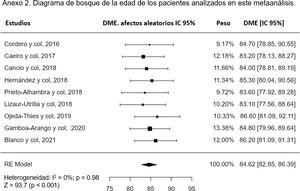
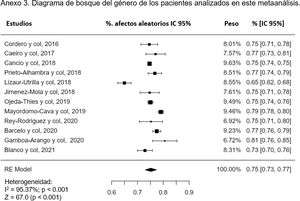
The reported mean age was 84.6 years (95% CI: 82.9–86.4; p<.001), with no heterogeneity (I2=0%; p=.98) (Annex 2).9,19–23 Twelve studies reported the sex of the patients, 75% of whom were women (95% CI: .73–.77; p<.001), with high heterogeneity (I2=95.3%; p<.001) (Annex 3).10,18–26
Type of fracture and type of surgeryExtracapsular fractures were the most common, with a mean reported percentage of 58% (95% CI: .56–.59; p<.001), with moderate heterogeneity (I2=76.01%; p<.001) (Fig. 2a),9,11,12,19–21,23–26 and the mean reported percentage of intracapsular fractures was 41% (95% CI: .39–.43; p<.001), with high heterogeneity (I2=82.9%; p<.001) (Fig. 2b).9,11,12,18–21,23,24,26 The most common types of implants used were intramedullary nails and hip hemiarthroplasty (Fig. 3a–c).9,19,21,23,24 The average percentage of conservative treatment was 3% (95% CI: .02–.05; p<.001), with high heterogeneity (I2=97.1%; p<.001) (Fig. 3d).9,10,12,21–25


Type of treatment and implant used: (a) forest plot of the percentage of patients operated on with intramedullary nails; (b) forest plot of the percentage of patients operated on with hip hemiarthroplasty; (c) forest plot of the percentage of patients operated on with total hip arthroplasty; and (d) forest plot of the percentage of patients not operated on and treated conservatively. 95% CI: 95% confidence interval; %: percentage.
The mean waiting time between fracture and surgery was reported in only four studies, with a mean of 64.7h (95% CI: 52.01–77.33; p<.001), with moderate heterogeneity (I2=65.52%; p=.033) (Fig. 4a).11,19,21,25 Only two articles published the average percentage of patients operated on in less than 24h, with only 18% of cases.12,19 The percentage of patients operated on in less than 48h was reported in five studies, representing only 40% of cases (95% CI: .35–.45; p<.001), with high heterogeneity (I2=97.7%; p<.001) (Fig. 4b).9,13,19,23,25

The mean length of hospital stay was 10.7 days (95% CI: 8.61–2.92; p<.001) with zero heterogeneity (I2=0%; p=.89) (Fig. 4c).10,19,21,25
Data on postoperative complications and mortalityThe most common postoperative complication was delirium with a rate of 42% (95% CI: .33–.51; p<.001), with high heterogeneity (I2=99.0%; p<.001) (Fig. 5a).9,11,18,20,24–26 Postoperative pneumonia (Fig. 5b) and urinary tract infection (Fig. 5c) occurred in 8% of cases, and PTE in less than 1% of cases (Fig. 5e). Pressure ulcers were a complication in 4% of cases (Fig. 5f).9,11,12,19,22,24,25 Finally, the reported need for postoperative transfusion was 36% (95% CI: .22–.49; p<.001), with high heterogeneity (I2=99.7%; p<.001) (Fig. 5h).9,18,20,22,24,26

Postoperative complications: (a) forest plot of percentage of patients with postoperative delirium; (b) forest plot of percentage of patients with postoperative pneumonia; (c) forest plot of percentage of patients with postoperative urinary tract infection (UTI); (d) Forest plot of percentage of patients with postoperative heart failure; (e) forest plot of the percentage of patients with postoperative pulmonary thromboembolism; (f) Forest plot of the percentage of patients with postoperative pressure ulcer; (g) forest plot of the percentage of patients with surgical site infection; and (h) forest plot of the percentage of patients with postoperative transfusion. 95% CI: 95% confidence interval; %: percentage.
In-hospital mortality (Fig. 6a) and one-month mortality (Fig. 6b) were 4% (95% CI: .04–.05; p<.001)9,11,12,18,19,21,24–26 and 5% (95% CI: .04–.07; p<.001),10,18,19,21,23,25 respectively. One-year mortality (Fig. 6c) was 18% (95% CI: .14–.22; p<.001) with high heterogeneity (I2=97.28%; p<.001).10,18,21–23
Discussion
In Spain, several registries and multicentre studies have collected data on the incidence of complications after hip fracture.8–12 However, no study has systematically reviewed the results of these registries and multicentre studies. The main findings of our study were that the average waiting time between fracture and surgery was 64.7h. On average, only 18% and 40% of patients undergo surgery in less than 24 and 48h after their fracture, respectively. The most common postoperative complication is delirium, with an average of 42%, and the need for postoperative transfusion is 36%. The in-hospital mortality rate is 4% and the one-year mortality rate is 18%.
Based on the results of the studies analysed, the average age is 84.6 years and female sex predominates (75%). Both the demographic variables (age and sex) and the fracture type, hospital stay, and mortality have very similar results to those published annually in national registries such as the Minimum Basic Data Set (MBDS) or the Spanish National Hip Fracture Registry (RNFC). These results are also consistent with other international registries, such as the British, Danish, Australian, and American registries.3,12 With regard to surgical delay, it is worth noting that less than half of the patients underwent surgery in less than 48h. Most clinical practice guidelines and meta-analyses recommend surgery within the first 48h, and there are two meta-analyses in the literature that report a lower risk of mortality in these cases.27,28 In fact, the Spanish Ministry of Health sets a delay of less than 48h as an indicator of quality of care.9,12 Similarly, the RNFC recommends that the standard percentage of patients undergoing surgery within 48h of arrival at the emergency department should be 63% as a quality criterion.13 Despite this, the mean time reported in the four studies that collected this data was 64.7h,11,19,21,25 and the percentage of patients operated on in less than 48h in the studies that collected this data was only 40%, with a heterogeneity of 97.7%.9,12,19,23,25 Castillón et al. reported statistically significant differences between the Spanish autonomous communities in terms of surgical delay time, which could be explained by different regional idiosyncrasies and differences in orthogeriatric units.7 An important health policy would be to try to homogenise the time taken to perform surgery after a hip fracture in all hospitals in the country. However, this might be a difficult challenge, given each autonomous community's autonomy in the management of a large part of health competences, as well as the differences between hospitals.7,29 However, despite these difficulties, the authors believe that there is a strong case for minimising surgical delay as an essential measure to improve care and reduce complications. Furthermore, only one of the studies included in the analysis gave a reason for surgical delay, in this case the use or non-use of antiplatelet or anticoagulant drugs.21 Inclusion of the reasons for delay (e.g. non-availability of the operating theatre, antiplatelet or anticoagulant treatment, decompensation of the underlying disease) in future studies could be useful for analysing and optimising surgical delay for each specific subgroup.
In terms of complications, there was a high degree of heterogeneity in the results, but the most common complication was delirium, which occurred in 42% of cases. The reported rate of postoperative delirium is higher than in other published series. de Haan et al. reported a rate of 16%30 and Li et al. a rate of 33%,31 but it is important to note that our patients were older than those in the other reported series. Several factors, such as age, may influence morbidity and mortality in these patients,30–32 and therefore we believe that analyses should be performed in detail, taking into account patient-related factors, such as the ASA or Charlson comorbidity index, and hospital-related factors, such as the presence or absence of an orthogeriatric unit. Pressure ulcers were identified as a complication in 4% of cases, a higher percentage than the RNFC quality criterion, which states that the standard percentage of patients developing an in-hospital grade >II ulcer should be 2.1%.13 Transfusion was required in 36% of cases. This transfusion rate is lower than that reported in some published articles, such as that of Konda et al., who reported a transfusion rate of 40% in patients with hip fracture.33 However, it is also much higher than other published studies such as those by Arshi et al.34 and Farrow et al.,35 who reported transfusion rates of 28.3% and 28.7%, respectively. It is important to reduce the transfusion rate because patients with postoperative transfusion have been reported to have a higher risk of mortality (OR: 1.29; 95% CI: 1.02–1.64; p=.035), higher rate of hospital readmission (OR: 1.27; 95% CI: 1.04–1.55; p=.018), longer total hospital stay, and higher rate of complications (p<.001).34
In terms of mortality, we found a 30-day mortality rate of 5% and an annual mortality rate of 18%. These results are in line with published results. The high mortality rates following hip fracture are well documented, with 30-day mortality rates of around 8% and one-year mortality rates of up to 25%.36–38 This means that almost one in five patients who undergo surgery for a hip fracture in Spain will die within a year of the fracture.
LimitationsSome limitations of the present study should be taken into account. Firstly, the number of trials included was small, only 13, which may result in insufficient evidence, but 55,680 patients were analysed. Secondly, some of the results show moderate to high heterogeneity, which may introduce bias, but also demonstrates the differences in published results, especially in terms of the percentage of complications, intraoperative mortality, one month and one year mortality, rates of time between surgical delay, and percentage of patients operated in less than 48h. For this reason, the authors of this study propose creating a national plan to standardise and homogenise the management of a pathology with such a high prevalence and potential for increase as hip fracture. Although the Spanish Ministry of Health sets a delay of less than 48h as an indicator of quality of care, it has been observed that less than 40% of patients are operated on within this time. Like Spain, through the RNFC or the CMBD, other countries such as England, Wales, and Northern Ireland, have a national registry of hip fracture data from all hospitals in each country, published annually and available to the public.39,40 Since its creation in 2017, participation in the RNFC (25% of Spanish hospitals participate) has been shown to improve care in each hospital and quality indicators overall.13 More than 48% of hospitals improved the proposed indicators, including surgery ≤48h, which increased from 38.9% to 45.8% between 2017 and 2019. For this reason, it is essential to have a national hip fracture registry, preferably implemented by the health administration, to ensure its continuity and continuous improvement. The authors of this study invite the rest of the Spanish hospitals to participate in the RNFC, as this will contribute to the incentive to improve the quality of care in each hospital individually, as they can be compared with national standards, and will allow the establishment of criteria for good clinical practice and the development of indicators to measure it.41 Understanding the clinical and structural factors that influence delay to surgery, as well as the causes of morbidity and mortality and how to address them, are the most important factors to consider. Finally, a limitation of this study is that it does not address secondary prevention of osteoporotic fractures or the role of the Fracture Liaison Service (FLS), as this variable was not included in the objectives. However, it is a relevant topic for future work. In their study, Cairo et al.,10 found that approximately one third of patients with hip fractures had a previous fracture, of which 59.7% were fragility fractures. In addition, only 15.6% of patients were receiving treatment for osteoporosis prior to their hip fracture and only 3% had undergone bone densitometry. Cancio et al.,22 found a significant, albeit moderate, protective effect of antiosteoporosis treatment in reducing mortality after hip fracture (HR: .92; 95% CI: .85–.99; p<.001).
ConclusionFewer than half of patients with hip fractures have surgery within 48h, even though this is recommended by most clinical practice guidelines. Delirium is the most commonly reported postoperative complication, and one in five patients will die within a year of a hip fracture. Standardising the management of hip fractures at national level could improve the quality of care and allow the development of common criteria for good clinical practice.
Level of evidenceLevel of evidence II.
Ethical considerationsAs this is a systematic review and meta-analysis, it does not involve the use of human patients or subjects or animal experimentation, and ethical considerations relating to informed consent, ethical procedures or the privacy rights of human subjects do not apply. However, it is guaranteed that the content of this systematic review and meta-analysis has been written with integrity and respect for the editorial principles of the journal.
FundingNo grant (financial aid) was received from any institution to undertake this article.
Conflict of interestsThe authors have no conflict of interests to declare.
This work was undertaken within the framework of the Doctorate in Surgery and Morphological Sciences of the Autonomous University of Barcelona.