




Despite growing international evidence supporting the effectiveness, safety, and efficiency of simultaneous bilateral total hip arthroplasty (BTHA), its adoption remains limited in Spain, where the sequential approach (stg-BTHA) is still the most common practice. Assuming that the simultaneous option could offer benefits for both patients and the healthcare system in selected cases, this study aimed to compare the total and categorized healthcare costs between both modalities within a public secondary-level hospital in Spain.
Materials and methodsA retrospective observational study was conducted including 14 patients who underwent bilateral THA performed by the same surgical team between March 2022 and March 2024. Seven patients underwent simultaneous BTHA and were matched with seven who underwent staged BTHA, based on age, sex, and ASA classification. Clinical, surgical, and economic variables were collected, and costs were categorized as pre-hospitalization, operating room, hospitalization, and postoperative follow-up.
ResultsNo significant differences were found in baseline characteristics between groups. Simultaneous BTHA showed a significantly shorter total operating room time (210±17min vs. 240±21min; p=.028) and a shorter hospital stay (1.7±0.4 days vs. 2.4±0.3 days; p=.04). The mean total cost was 33.5% lower in the simultaneous group (€8139 vs. €10,868), with lower expenses across all categories. No patients required transfusion or experienced complications or readmissions.
ConclusionSimultaneous bilateral THA is more cost-efficient than the staged approach. It requires appropriate patient selection and a specialized multidisciplinary team, representing a safe and efficient option in the context of public healthcare.
A pesar de la evidencia científica internacional que respalda la efectividad, la seguridad y la eficiencia de la artroplastia total de cadera bilateral (BTHA) simultánea, su implantación en España sigue siendo escasa, optándose en la mayoría de los casos por la modalidad secuencial (stg-BTHA). Bajo la hipótesis de que la opción simultánea puede suponer ventajas para el paciente y el sistema sanitario en determinados escenarios, este estudio tiene como objetivo comparar el coste sanitario total y por categorías entre ambas modalidades en el contexto de un hospital público de segundo nivel.
Material y métodosEstudio observacional retrospectivo con 14 pacientes intervenidos de prótesis total de cadera (PTC) bilateral por el mismo equipo quirúrgico entre marzo de 2022 y marzo de 2024. Se compararon siete casos de artroplastia total bilateral simultánea (sim-BTHA) y siete stg-BTHA emparejados por edad, sexo y American Society of Anesthesiologists (ASA). Se recogieron variables clínicas, quirúrgicas y económicas, clasificando los costes en: prehospitalización, quirófano, hospitalización y seguimiento.
ResultadosNo se observaron diferencias significativas entre grupos en variables basales. La sim-BTHA presentó un tiempo total en el quirófano significativamente menor (210±17min vs. 240±21min; p=0,028) y una estancia hospitalaria más corta (1,7±0,4días vs. 2,4±0,3días; p=0,04). El coste total medio fue un 33,5% inferior (8.139€ vs. 10.868€), con menores gastos en todas las categorías. Ningún paciente precisó transfusión ni presentó complicaciones.
ConclusiónLa artroplastia bilateral simultánea es más costo-eficiente que la secuencial. Requiere una adecuada selección del paciente y un equipo multidisciplinar especializado, representando una opción segura y eficiente en el ámbito de la sanidad pública.
The prevalence of symptomatic hip osteoarthritis in Spain is estimated at 5.13%,1 with around 33% of cases being bilateral.2 The number of total hip replacements has increased steadily in recent decades, with usage rates exceeding 200 operations per 100,000 people per year in countries such as the United States, Germany, and Switzerland. Spain is in an intermediate position, with a rate of around 102 per 100,000 inhabitants per year. This overall increase has been particularly pronounced in patients under 65 years of age, and it is directly associated with a country's level of economic development and its per capita health expenditure.3 Bilateral total hip arthroplasty (BTHA) is typically performed in two separate surgical procedures, with an interval between them that is not defined,4 but it can also be performed simultaneously during a single anaesthetic procedure. Simultaneous bilateral total arthroplasty (sim-BTHA) has been practised for years and has proven to be effective, with a complication rate equal to or lower than that of staged implantation (stg-BTHA).5–9 In fact, there is an even higher risk of aseptic loosening in staged cases where the second prosthesis is implanted more than a year after the first.2 Nevertheless, this type of implantation remains uncommon in our setting.
This dilemma has resurfaced as a topic of study in recent years.10 In an international context, various studies have evaluated this issue from the perspectives of clinical safety, healthcare efficiency, and cost-effectiveness,5,6,11–13 with consistently favourable results in all these areas. These results highlight the reduction in total costs associated with simultaneous intervention. Despite the growing body of international evidence, to our knowledge, no similar studies have been conducted in Spain, let alone within the framework of a comprehensive, publicly managed healthcare system. This difference in context is crucial. In a healthcare system that is not oriented towards economic profit, such as the Spanish National Health System, clinical decisions can be guided by criteria such as overall efficiency and health outcomes rather than the economic margin or profitability of each procedure.
For this reason, the present study aims to compare the healthcare costs associated with simultaneous versus staged bilateral total hip arthroplasty in the context of a second-level public hospital. This will provide objective data to inform the evaluation of simultaneous surgery as a viable alternative for appropriately selected patients.
We hypothesise that simultaneous bilateral total hip arthroplasty results in lower total costs and more efficient use of healthcare resources without compromising patient safety.
Material and methodsTo collect all the variables required for a complete economic analysis, a retrospective observational study was designed at a second-level public hospital in the Region of Murcia, following approval from the hospital's Research Ethics Committee. All patients who underwent simultaneous bilateral total hip arthroplasty (sim-BTHA) by the same surgeon between March 2022 and March 2024, with a minimum follow-up period of 12 months (n=7), were included in the study. To match this cohort 1:1 according to age, sex, and American Society of Anesthesiologists (ASA) classification, seven staged bilateral arthroplasties (stg-BTHA) were selected from a total of nine performed by the same surgeon at the same centre during the established recruitment period.
Patients with an ASA score of ≥4, a baseline haemoglobin level of <14g/dl, a history of chronic anaemia, a history of previous surgery on the affected femur, or an absence of complete clinical, surgical, and economic data for analysis were excluded.
The following variables were obtained (for each individual case and the mean for each group):
- •
Demographic variables: age, sex, BMI, ASA, employment status.
- •
Operating time (OT) and total time in the operating room (TTOT). OT is the time between the skin incision of the first hip and the end of skin closure of the last hip, which in sim-BTHA cases includes the change of positioning between the two. TTOT includes the time from the patient's entry into the operating room until their exit. In cases of stg-BTHA, the times for both independent procedures are added together.
- •
Preoperative, immediate postoperative, and first postoperative day haemoglobin values and transfusion requirements (the indication being Hb <7 in non-cardiac patients and Hb <8 in cardiac patients).
- •
Days of hospital stay.
- •
Days off work.
- •
Days of outpatient visits (first week, one month, three months, six months, one year).
- •
Complications during the first postoperative year, subdivided into: wound complications, infection, instability, thrombosis, and mortality. With regard to the surgical wound, the use of intradermal sutures eliminates reasonable diagnostic doubt between staple intolerance and infection. Any non-traumatic complication of the surgical wound (whether persistent staining, dehiscence, or clinical signs of infection) is considered a surgical site infection and is treated with DAIR (debridement, antibiotics, and implant retention with replacement of mobile components). We do not distinguish between superficial and deep infection because we assume that any periarticular infection can compromise the joint and requires surgical treatment in addition to antibiotics.14
The economic analysis was designed, in which the costs of each type of surgery were collected through the hospital's Accounting Department, using a representative model case from each group with identical implants and hospital length of stay, and mean operating room time, making it possible to calculate total expenses and divide them into subgroups, to later compare them between both surgical modalities:
- •
Prehospitalisation costs.
- •
Direct operating room costs.
- •
Hospitalisation costs.
- •
Postoperative follow-up costs.
Statistical analysis was performed using the SPSS programme. To analyse the sample and determine the comparability of the sim-BTHA case cohort and the stg-BTHA control cohort, the quantitative variables (age, BMI, haemoglobin, and ASA) were analysed first using the Shapiro–Wilk test to assess normality. Continuous variables were expressed as mean and SD, and ordinal variables as median and IQR. Based on the results, either the Student's t-test for independent samples or the Mann–Whitney U test was applied. Qualitative variables were compared using Fisher's exact test. Differences with a p-value <.05 were considered significant and 95% confidence intervals were calculated.
The sample was then described and analysed to determine whether the two cohorts were comparable. This involved studying whether there were statistically significant differences in the main epidemiological variables (gender, age, BMI, ASA, and employment status) and surgical variables (anaesthetic modality and approach).
Next, potential differences relating to the operating room and hospitalisation were detected between the two groups in the other variables under study. Finally, the total and subtotal costs of each procedure were analysed and compared in absolute and relative (percentage) terms.
ResultsThe demographic characteristics of both cohorts are presented in Table 1. No significant differences were observed. Days off work and the resulting indirect costs were not considered, since most patients in each group were not economically active and this did not represent a statistically significant difference.
All patients underwent surgery by the same surgical team (lead surgeon, anaesthetist, and scrub nurse). A piriformis-sparing posterolateral approach was used in all cases, along with transosseous rotator repair and local infiltration analgesia (LIA)15 consisting of tranexamic acid 500mg 2 ampoules, dexamethasone 8mg, ketorolac 30mg, levobupivacaine 0.5% 2 ampoules and Adrenaline 0.5% 1 ampoule, followed by closure with an intradermal suture. A waterproof hydrocolloid occlusive dressing was applied to allow patients to carry out their daily hygiene routine comfortably, including showering. Depending on each case, a hybrid or uncemented fixation was chosen, associated with dual mobility cups. The main difference was the anaesthesia method: general anaesthesia for the sim-BTHA group and neuraxial anaesthesia for the stg-BTHA group. The same anaesthetic principles were used: preoperative intravenous tranexamic acid (1g) and controlled hypotension. A PENG16 (pericapsular nerve group) block was performed in all cases. No drainage was used.
The mean operating time (OT) was 122min (SD±10.1) for sim-BTHA and 118min (SD±15.2) for stg-BTHA, with no significant difference (p=.211). Total operating time was significantly shorter (p=.028) in the sim-BTHA group (210±17.4min) than in the sum of both procedures in the stg-BTHA group (240±21.3min).
The mean preoperative Hb was 14.43g/dl (SD±1.11) in group 1 and 13.4g/dl (SD±1.45) in group 2, without reaching statistical significance (p=.163). The drop in haemoglobin was greater in the sim-BTHA group (3.54±1.63g/dl) than in the stg-BTHA group (2.12g/dl [SD±1.18]), although this did not reach statistical significance (p=.249). No patient required a transfusion; since no events were observed, statistical significance could not be calculated.
The average length of hospital stay was 1.7 days (SD±0.41) for sim-BTHA patients and 2.4 days (SD±0.33) for stg-BTHA patients. This difference was statistically significant (p=.04).
No complications were recorded in either group, neither were there any readmissions for other reasons during the first year of follow-up, so there were no additional costs in this regard.
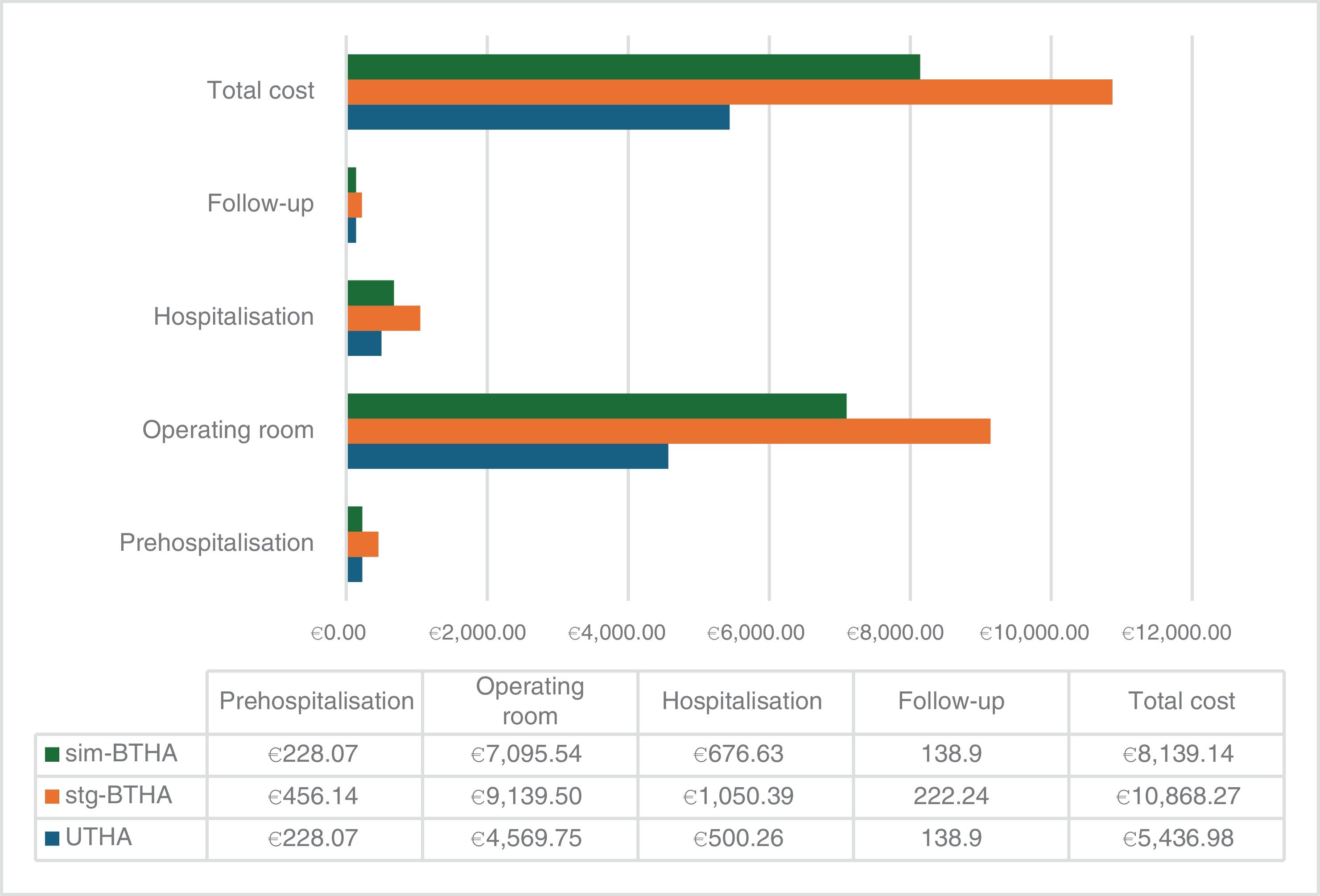
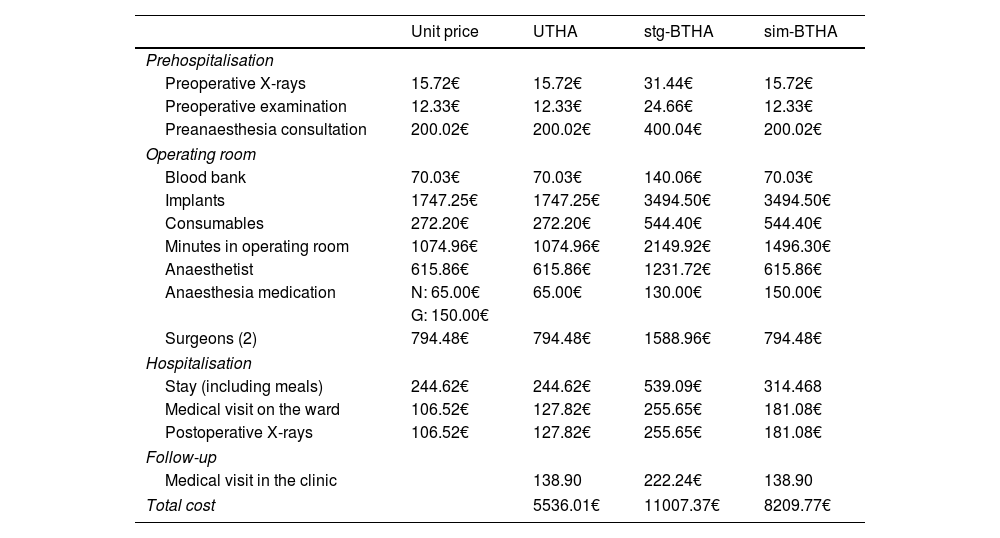
The total costs and itemised costs are shown in Table 2 and Fig. 1, which compare the costs of the different types of unilateral arthroplasty (UTHA), sequential bilateral arthroplasty (stg-BTHA), and simultaneous bilateral arthroplasty (sim-BTHA). These costs are divided into four categories: prehospitalisation, operating room-related, hospitalisation, and postoperative follow-up.
Total costs and comparison between surgical procedures.
| Unit price | UTHA | stg-BTHA | sim-BTHA | |
|---|---|---|---|---|
| Prehospitalisation | ||||
| Preoperative X-rays | 15.72€ | 15.72€ | 31.44€ | 15.72€ |
| Preoperative examination | 12.33€ | 12.33€ | 24.66€ | 12.33€ |
| Preanaesthesia consultation | 200.02€ | 200.02€ | 400.04€ | 200.02€ |
| Operating room | ||||
| Blood bank | 70.03€ | 70.03€ | 140.06€ | 70.03€ |
| Implants | 1747.25€ | 1747.25€ | 3494.50€ | 3494.50€ |
| Consumables | 272.20€ | 272.20€ | 544.40€ | 544.40€ |
| Minutes in operating room | 1074.96€ | 1074.96€ | 2149.92€ | 1496.30€ |
| Anaesthetist | 615.86€ | 615.86€ | 1231.72€ | 615.86€ |
| Anaesthesia medication | N: 65.00€ | 65.00€ | 130.00€ | 150.00€ |
| G: 150.00€ | ||||
| Surgeons (2) | 794.48€ | 794.48€ | 1588.96€ | 794.48€ |
| Hospitalisation | ||||
| Stay (including meals) | 244.62€ | 244.62€ | 539.09€ | 314.468 |
| Medical visit on the ward | 106.52€ | 127.82€ | 255.65€ | 181.08€ |
| Postoperative X-rays | 106.52€ | 127.82€ | 255.65€ | 181.08€ |
| Follow-up | ||||
| Medical visit in the clinic | 138.90 | 222.24€ | 138.90 | |
| Total cost | 5536.01€ | 11007.37€ | 8209.77€ | |
sim-BTHA: simultaneous bilateral total hip arthroplasty; stg-BTHA: staged bilateral total hip arthroplasty; UTHA: unilateral total hip arthroplasty.

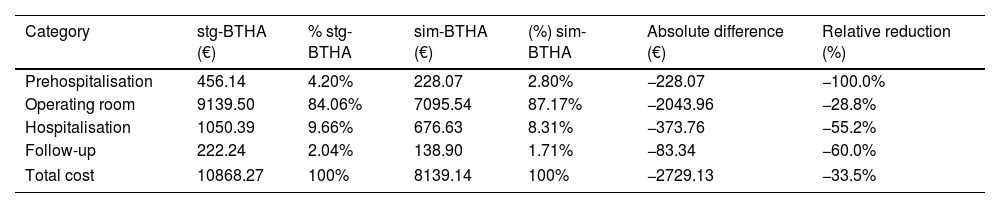
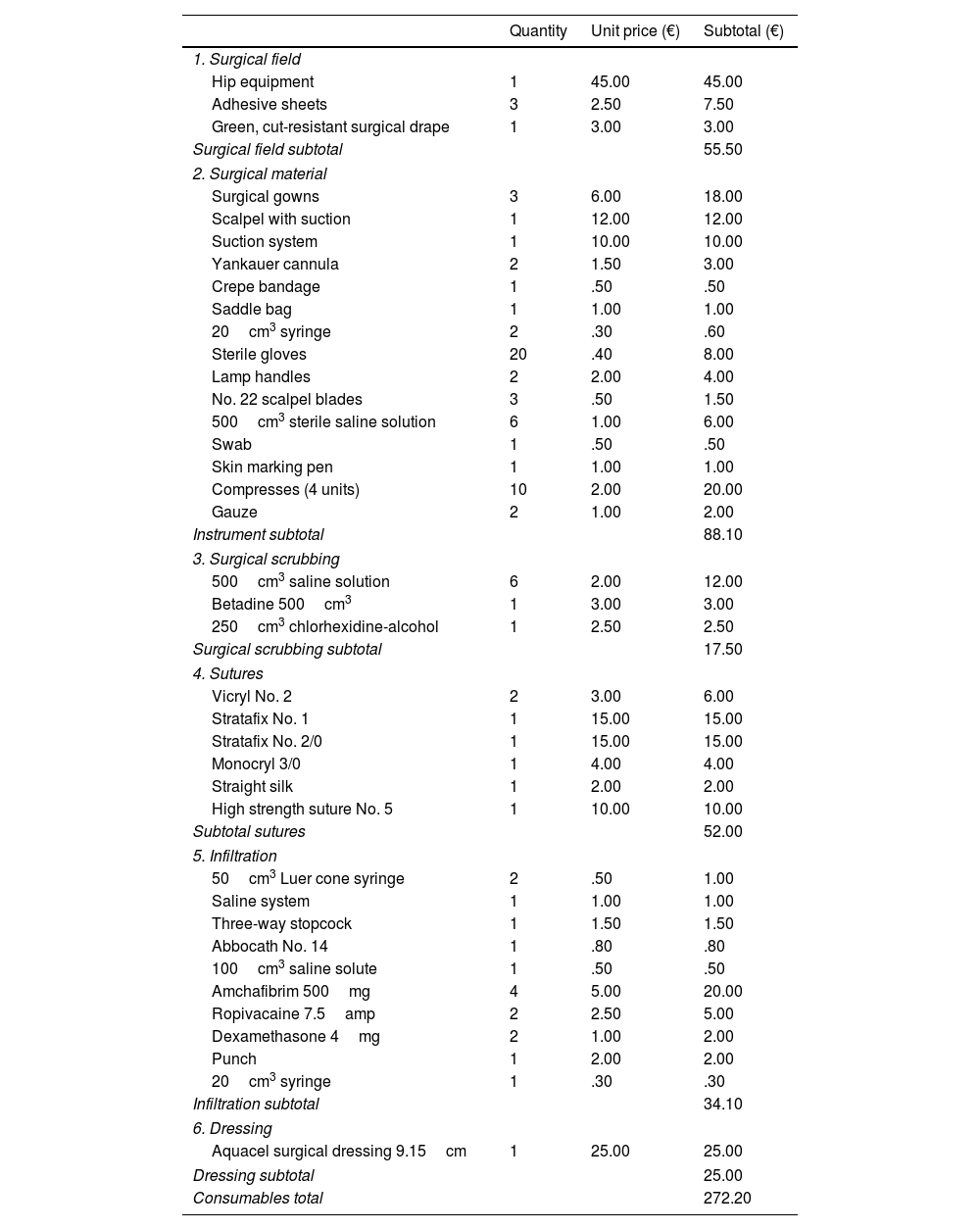
The simultaneous modality results in lower costs in all categories, with a total cost that is 33.5% lower (approximately €2700), as shown in Table 3. Estimates of consumable costs (Table 4) and a list of implant prices (Table 5) are also provided.
Summary of expenses by category, absolute difference, and relative reduction in cost between two-stage and simultaneous surgeries.
| Category | stg-BTHA (€) | % stg-BTHA | sim-BTHA (€) | (%) sim-BTHA | Absolute difference (€) | Relative reduction (%) |
|---|---|---|---|---|---|---|
| Prehospitalisation | 456.14 | 4.20% | 228.07 | 2.80% | −228.07 | −100.0% |
| Operating room | 9139.50 | 84.06% | 7095.54 | 87.17% | −2043.96 | −28.8% |
| Hospitalisation | 1050.39 | 9.66% | 676.63 | 8.31% | −373.76 | −55.2% |
| Follow-up | 222.24 | 2.04% | 138.90 | 1.71% | −83.34 | −60.0% |
| Total cost | 10868.27 | 100% | 8139.14 | 100% | −2729.13 | −33.5% |
sim-BTHA: simultaneous bilateral total hip arthroplasty; stg-BTHA: staged bilateral total hip arthroplasty.
Estimation of consumable costs.
| Quantity | Unit price (€) | Subtotal (€) | |
|---|---|---|---|
| 1. Surgical field | |||
| Hip equipment | 1 | 45.00 | 45.00 |
| Adhesive sheets | 3 | 2.50 | 7.50 |
| Green, cut-resistant surgical drape | 1 | 3.00 | 3.00 |
| Surgical field subtotal | 55.50 | ||
| 2. Surgical material | |||
| Surgical gowns | 3 | 6.00 | 18.00 |
| Scalpel with suction | 1 | 12.00 | 12.00 |
| Suction system | 1 | 10.00 | 10.00 |
| Yankauer cannula | 2 | 1.50 | 3.00 |
| Crepe bandage | 1 | .50 | .50 |
| Saddle bag | 1 | 1.00 | 1.00 |
| 20cm3 syringe | 2 | .30 | .60 |
| Sterile gloves | 20 | .40 | 8.00 |
| Lamp handles | 2 | 2.00 | 4.00 |
| No. 22 scalpel blades | 3 | .50 | 1.50 |
| 500cm3 sterile saline solution | 6 | 1.00 | 6.00 |
| Swab | 1 | .50 | .50 |
| Skin marking pen | 1 | 1.00 | 1.00 |
| Compresses (4 units) | 10 | 2.00 | 20.00 |
| Gauze | 2 | 1.00 | 2.00 |
| Instrument subtotal | 88.10 | ||
| 3. Surgical scrubbing | |||
| 500cm3 saline solution | 6 | 2.00 | 12.00 |
| Betadine 500cm3 | 1 | 3.00 | 3.00 |
| 250cm3 chlorhexidine-alcohol | 1 | 2.50 | 2.50 |
| Surgical scrubbing subtotal | 17.50 | ||
| 4. Sutures | |||
| Vicryl No. 2 | 2 | 3.00 | 6.00 |
| Stratafix No. 1 | 1 | 15.00 | 15.00 |
| Stratafix No. 2/0 | 1 | 15.00 | 15.00 |
| Monocryl 3/0 | 1 | 4.00 | 4.00 |
| Straight silk | 1 | 2.00 | 2.00 |
| High strength suture No. 5 | 1 | 10.00 | 10.00 |
| Subtotal sutures | 52.00 | ||
| 5. Infiltration | |||
| 50cm3 Luer cone syringe | 2 | .50 | 1.00 |
| Saline system | 1 | 1.00 | 1.00 |
| Three-way stopcock | 1 | 1.50 | 1.50 |
| Abbocath No. 14 | 1 | .80 | .80 |
| 100cm3 saline solute | 1 | .50 | .50 |
| Amchafibrim 500mg | 4 | 5.00 | 20.00 |
| Ropivacaine 7.5amp | 2 | 2.50 | 5.00 |
| Dexamethasone 4mg | 2 | 1.00 | 2.00 |
| Punch | 1 | 2.00 | 2.00 |
| 20cm3 syringe | 1 | .30 | .30 |
| Infiltration subtotal | 34.10 | ||
| 6. Dressing | |||
| Aquacel surgical dressing 9.15cm | 1 | 25.00 | 25.00 |
| Dressing subtotal | 25.00 | ||
| Consumables total | 272.20 | ||
Although there are still no clearly established indications, technical details, or perioperative protocols for simultaneous bilateral total hip arthroplasty, the current literature consistently supports the procedure's effectiveness and safety. Several studies agree that it is a more cost-effective alternative than staged surgery, mainly due to reduced hospital and surgical costs associated with a single hospitalisation, without an increase in complications.5,17–22
On surgical indication and patient selectionWalking involves the symmetrical and interactive use of both hips, meaning the function of one depends on the other.2 We consider the two main surgical indications for bilateral prosthetics to be two patient profiles that do not benefit from unilateral prosthetics: (1) bilateral avascular necrosis of the femoral head with collapse, which tends to affect younger patients and (2) bilateral coxarthrosis in patients with lumbopelvic imbalance with structured flexion of both hips, which tends to affect older patients. In the latter case, severe gait disturbance may not achieve relief of symptoms23 and may even lead to additional risks after unilateral joint replacement, especially joint instability secondary to a collision between its components or with the patient's bone.
Furthermore, while other studies emphasise the importance of patients being young and healthy (ASA≤2) in order to withstand major surgery,17,24,25 our approach differs. While it is true that a “greater surgical burden” is involved, consisting of general anaesthesia (rather than neuraxial anaesthesia), and a greater drop in haemoglobin (though without increasing the need for transfusions), we believe that the cumulative aggression of two surgical procedures performed close together in time, with a gap of 3–6 months between surgeries according to the latest consensus,4 may pose a higher risk of medical complications. This is supported by recent studies revealing a lower rate of major complications in simultaneous replacements.5,8,13,21,22 We attach particular importance to this in older patients, for whom concern about one-shot surgery is well established. Thus, rather than favouring the early recovery of young patients capable of tolerating bilateral surgery in one stage, we focus on the fact that staged replacement could be detrimental in selected cases.
In our series, the only and main criterion for anaesthesia is an initial haemoglobin level of at least 14g/dl, the administration of 1g of tranexamic acid intravenously during anaesthetic induction, and controlled hypotension throughout surgery. This is aimed at minimising blood loss and tolerating the predictable drop in haemoglobin (Hb) without requiring transfusion. In general, we have observed an equal or smaller drop in Hb than in similar studies.18,22 For this reason, the most relevant exclusion criterion is ASA ≥4, as these patients cannot tolerate hypotension. The second most relevant criterion is chronic anaemia, as it hinders the initial haemoglobin requirement.
No patient proposed for sim-BTHA was subsequently rejected during the preanaesthetic consultation. This may be due to close collaboration between the professionals responsible for the procedure (one main surgeon and one anaesthetist), and the fact that the pre-anaesthetic approval requirements are simple and well defined (Hb ≥14g/dl, ASA ≤3, tolerance to controlled hypotension). This allows for an accurate assessment to be made in the trauma clinic.
Optimisation of operating room resourcesWith regard to operating times, we believe that the reduction observed in sim-BTHA could be underestimated for two reasons. Firstly, total operating time (TOT) for sim-BTHA includes general anaesthesia, which usually takes longer than the neuraxial anaesthesia used in unilateral procedures. It also includes the blocking of both hips, which in unilateral procedures is performed outside the operating room. Secondly, the operating time (OT) in sim-BTHA includes changing the patient's position between both hips, which may explain why the recorded OT is similar for both modalities, with no statistically significant differences in this variable. Compared to anterior approaches, that save time by allowing the second hip to be operated on while the closure of the first hip,18,19 the necessity of the posterolateral approach for repositioning the patient between the first and second hips provides an opportunity to change drapes and perform a new surgical scrub, thereby ensuring greater asepsis. In all cases, the procedure begins with the hip reported as most symptomatic by the patient, to ensure that, in the event of any intraoperative contingency, the priority side has been addressed first.
At our centre, shorter operating times mean that three primary arthroplasties (2 sim-BTHA+1 stg-BTHA) can be performed in one morning. This approach is consistent with surgical scheduling optimisation programmes published in Spanish hospitals, where a multidisciplinary approach to organisation and coordination has proved capable of improving operational efficiency in the operating room. This allows two to three primary procedures to be performed per session on ‘high-efficiency days’, without involving simultaneous bilateral surgery.26–28
On cost-effectiveness and other healthcare systemsThe findings of our study, which compared sim-BTHA and stg-BTHA, are consistent with those of similar studies in terms of shorter hospital stays, lower total costs, and no differences in complication rates, blood loss, or transfusion requirements.5–8,11 The short mean hospital stay observed in our study is not due to a formal hospital protocol, but rather to the specific organisation of the surgical team performing these procedures. The PENG sensory anaesthetic block16 preserves motor function and enables patients to start sitting up and walking with a walker on the day of the operation. Added to this is local anaesthetic infiltration (LIA),15 which helps minimise postoperative pain and facilitates early functional recovery. Taken together, these measures favour early discharge, which in most cases occurs on the first postoperative day. In our context, patients do not undergo formal preoperative or postoperative rehabilitation. Hospital discharge is based on functional and clinical criteria, including adequate mobility (i.e., independence with a walker), an absence of debilitating pain, haemoglobin levels within an acceptable range on the first postoperative day, a clean surgical wound with an intact hydrocolloid dressing, and the scheduling of a follow-up appointment before the end of the first postoperative week to address any new concerns and detect early complications.
The literature does not hide the greater cost efficiency of the simultaneous modality,9 nor its lack of incentive, nor the underlying reason for this. However, this is not related to patient health. A study conducted in the Lombardy region13 found that simultaneous BTHA had a lower average cost than sequential BTHA (€5754.82 vs. €7624.32, respectively), as well as a shorter hospital stay (5.6 vs. 8.5 days). However, it was emphasised that the regional reimbursement system financially penalises simultaneous surgery, generating a lower hospital margin and therefore discouraging its adoption despite its greater overall efficiency.
In the United States,11 a study conducted in a high-volume, single-speciality hospital retrospectively analysed the costs, revenues, and contribution margins of both modalities. Although simultaneous replacement generated lower revenues for the hospital, it also involved lower direct and indirect costs, resulting in a final economic margin similar to that of sequential surgery. Conversely, financing models based on bundled payments demonstrated a significant reduction in costs for bilateral arthroplasties without increasing complications or hospital readmissions.29 These results support the hypothesis that efficient organisational strategies, such as simultaneous bilateral surgery, can optimise resources without compromising the quality of care.
Meanwhile, a study conducted in the United Kingdom12 concluded that simultaneous surgery was more economical and produced comparable clinical results. According to the Oxford Hip Score, it even produced slightly superior results. However, the study found that the current NHS funding system favours two-stage surgery financially, which limits the institutional viability of the simultaneous alternative.
A retrospective analysis in Japan,6 compared both modalities in 129 patients and found similar results. It concluded that the simultaneous modality is clinically safe and socially preferable due to its efficiency and lower burden on the healthcare system.
None of the aforementioned studies observed a higher complication rate in the single-stage prosthesis group. These results demonstrate how cost-oriented healthcare systems can hinder the implementation of more efficient procedures unless they are adequately incentivised.
Overall, the available literature, in line with the findings of our study, supports the view that, in well-structured contexts, bilateral total hip arthroplasty in one stage is a cost-effective strategy. To implement this strategy, it is essential to organise an experienced multidisciplinary team (without the need for a tertiary hospital), select patients appropriately to maximise safety, and have a health system with adequate institutional incentives.
Limitations and strengths of the studyThis study has some limitations. The small sample size, resulting from the strict application of the inclusion criteria and the minimum required follow-up, limits the generalisability of the results. Furthermore, as it is a single-centre, retrospective observational study, there is a possibility of biases inherent in this type of study design.
Nevertheless, the study has several strengths. Despite the limited number of cases, the statistical analysis lends strength to the conclusions. Additionally, the comparison includes a review of the international literature, placing the results in a global context. Furthermore, the study's implementation in a second-level public hospital adds value in terms of its practical applicability in similar centres. This approach enables the findings to be applied to real clinical practice, facilitating the evaluation of sim-BTHA as a feasible and efficient alternative in our setting.
ConclusionsBilateral hip arthroplasty in a single stage is a more cost-effective procedure than sequential arthroplasty, as it optimises the use of healthcare system resources compared to staged replacement of both hips. However, it requires a specialised multidisciplinary team, appropriate patient selection, and adequate institutional incentives that focus on patient health rather than the profitability of the process.
Level of evidenceLevel III evidence.
Ethical considerationsThe Ethics Committee of the Reina Sofía University General Hospital (Murcia) approved this article.
FundingThis research received no specific grant from any funding agency in the public, commercial, or not-for-profit sectors.
Conflict of interestsThe authors have no conflict of interest to declare.

