




To develop and validate an educational booklet that contributes to alleviating the difficulties experienced by family members of children diagnosed as being on the Autism Spectrum.
MethodsA descriptive exploratory study with a quali-quantitative approach. Ten families of children on the autism spectrum and twelve judges participated in the validation. Data collection took place through open interviews and data was analysed according to the procedures recommended by Bardin.
ResultsDifficulties identified included problems in children's verbal and non-verbal communication, daily care, school inclusion, late diagnosis due to the lack of specialists, and lack of psychological support for the family and for handling the child during an episode of crisis. Informational needs included early diagnosis, evolution and management of crises, children's ability to learn daily life activities, and information about their right to inclusion in formal education. Based on these difficulties and needs, the booklet was created and validated by eight experts and four family members. Comparing the average of positive reviews in each section, which were obtained in the first and second evaluations, there was a general improvement in the quality of the booklet.
ConclusionsThe validation of educational materials on this topic can be essential to improve the quality of life of children, families, and educators.
Desarrollar y validar una cartilla educativa que contribuya a paliar las dificultades que viven los familiares de niños diagnosticados con el espectro del autismo.
MétodosEstudio descriptivo exploratorio con enfoque cualicuantitativo. En la validación participaron 10 familias de niños con espectro autista y 12 jueces. La recolección de datos se realizó a través de entrevistas abiertas y los datos se analizaron de acuerdo con los procedimientos recomendados por Bardin.
ResultadosLas dificultades halladas fueron problemas en la comunicación verbal y no verbal de los niños, cuidado diario, inclusión escolar, diagnóstico tardío por falta de especialistas y falta de apoyo psicológico para la familia y para el manejo del niño durante un episodio de crisis. Las necesidades de información fueron diagnóstico temprano, evolución y gestión de crisis, la capacidad de los niños para aprender actividades de la vida diaria e información sobre su derecho a la inclusión en la educación formal. A partir de estas dificultades y necesidades, la cartilla fue elaborada y validada por 8 expertos y 4 familiares. Comparando el promedio de críticas positivas en cada sección, obtenido en la primera y la segunda evaluación, hubo una mejora general en la calidad de la cartilla.
ConclusionesLa validación de materiales educativos sobre este tema puede ser fundamental para mejorar la calidad de vida de niños, familias y educadores.
In Brazil, the development of public policies related to autism was late and stimulated by actions of managers and workers from the psychosocial care network as well as the Associations of Parents and Families of people in the autistic spectrum. This movement began with the approval of Law 10.216/01, which prioritized the community treatment of people with mental disorders. In 2012, Law 12.764 established that the person in the autistic spectrum has a disability and, therefore, has some rights such as: early diagnosis, treatment with medicines and alternative therapies, which are not offered by the public health system, as well as access to education, work and equal opportunities.1
Autism spectrum disorder (ASD) causes variations in social, communicative, and intellectual skills, which predisposes a person to impairments in the ability to adapt. In this context, psychosocial support is needed during treatment.2
Deficits in communication and socio-emotional reciprocity, difficulty in behavioral adjustment in non-ordinary social situations, restricted and repetitive behaviors, hyper and hyposensitivity to sensory stimuli (sounds, lights, or smells and/or decreased reaction to pain) represent the main characteristics of ASD that may or may not be associated with intellectual disability.2
Currently, the association of pharmacological and non-pharmacological therapies contributes to the minimization of these symptoms and allows for a better management of comorbidities, when they are present.3 It is noteworthy that intensive, continuous, and early interdisciplinary behavioral intervention is effective in most children with the ASD, with emphasis on the development of language skills and motor and intellectual skills, contributing to an adaptive behavior to the exposed environment.4,5
However, a better understanding of the mechanisms that lead to the onset of symptoms of this disorder is still needed, along with investments to improve therapeutic strategies to alleviate its impacts on the adaptive functioning of children with ASD.6
Furthermore, nowadays, ASD is more commonly diagnosed than when compared to the past, which justifies the increase in its incidence (1 in 36) among children. This reality tends to increase the availability of new tests or the discovery and validation of selective biomarkers for ASD that will enable the confirmation of a precise diagnosis and provide greater clarity in determining clinical presentation and prognosis.3 In addition, in the 2020s, approximately half a million teenagers with ASD will transition to adulthood, which has required a lot of effort from families to include these young adults in social and cultural demands.7
Given this reality, it is relevant to involve people who are part of the child's daily life to ensure efficacy in the therapeutic and inclusive process that is represented by development and learning.4,5
To ensure this involvement, family support at the time of the diagnosis is necessary, as the family tends to despair, which reinforces the importance of parents or guardians accepting their condition and offering the care that the child requires in order to develop.8
This reality, in addition to the frequent problems in social, professional, and marital life, tends to generate emotional overload and stress in primary caregivers, who are usually the parents.9 Therefore, it is relevant that nurses, who establish direct and continuous contact during the support of this growing group of children, are aware of the needs of the primary direct caregivers and can use different resources that facilitate their approach and their performance in the context of health education for children with ASD, their families and caregivers.
Thus, it is important to highlight the difficulties of the family members of children diagnosed with ASD and establish educational guidelines for a better daily life, raising the difficulties experienced by family members/caregivers of children with ASD, in order to propose an educational booklet that can minimize these difficulties and improve the family's daily life.
Even in the face of this reality, a recent scientific research10 mentions that the social, educational, and health needs of people with ASD and their families constitute a critical area for resources, research, and education.
Aiming to provide access to information for family members/caregivers of this target audience, this study aimed to develop and validate an educational booklet that contributes to alleviate the difficulties experienced by family members of children diagnosed in the ASD, based on the needs identified by the family members themselves.
MethodsThis is a study with a methodological approach that was approved by the Human Research Ethics Committee (CAAE-03687318.5.0000.5145) and was developed in four stages: Identification of the educational needs of family caregivers of children with ASD; construction of an educational booklet; validation of the educational material by judges; and legitimation of the educational material by family caregivers of children with ASD.11
In the first stage, the needs of the target audience were highlighted and, to do so, an open interview was carried out with approximately 10 family members/caregivers of children with ASD who are assisted by a Child Psychosocial Support Center (CAPSi) in the countryside of the Minas Gerais state. The questions of that interview were: What are the difficulties faced along with the child in the autism spectrum? What would you like to know to improve your child's daily life?
The eligibility criteria for these participants were: Being 18 years old or older and to be taking care of the child for at least 1 year. In turn, the exclusion criteria were: Not living with the child, even with family ties and attending CAPSi to monitor the child.
Interviews were analyzed using the content analysis recommended by Bardin, and initially the statements of each representative were analyzed. Next, similarity and difference points in the content were observed, as well as what could be highlighted as relevant to achieve the research purposes. Results were put into categories discussed based on a literature review on the subject.12
From the results obtained, the priority content that sustained the second stage was defined, in which the literature on the subject was searched for the drawing of a material with updated scientific foundation, which corresponded to the initial content of the booklet that was analyzed by 8 experts, selected by convenience, inserted in the academic environment. Thus, initially, the booklet was analyzed by 4 judges, whose observations were considered to change the booklet. Afterwards, the booklet was analyzed by 4 more judges, who made observations that substantiated the version validated by experts from the academic area.
Inclusion criteria for participating as experts were: Having a lato sensu or stricto sensu graduate degree and having participated in research on AS or having experience in approaching families of children with ASD proven by the lattes curriculum (a national platform for scientists’ curricula). The absence of an e-mail address in this curriculum represented an exclusion criterion.
In the fourth stage, this new version was validated by the target audience (4 family caregivers of children in the ASD), who were selected based on the following criteria: being 18 years-old or older and taking care of the child for at least 1 year. The exclusion criterion was: not living with the child, even with family ties. The final version was structured base on the notes obtained from the fourth stage.
Throughout this validation process, the “Educational material validation instrument” established13 was used, which authorized its use to assess the adequacy of items related to the booklet content. This instrument was translated and adapted from the original Suitability assessment of materials (SAM) by Doak et al. in 1996, adapted in 2002,13 which established 17 questions that are subdivided into the following sections: organization, writing style (ease of understanding texts), appearance and cohesion, and, finally, the motivation (if the material interacts with its text, logical presentation, and if the production is suitable for the target audience), with spaces for the participant to explain his/her answers and tell if the vocabulary was clear and objective.
Data obtained in this validation process was categorized as having “minor” changes (referring to terminology or isolated expressions) or “major” changes (referring to the text sequence; changes in the content of the items in the booklet). All expert recommendations arising from negative evaluations were accepted, and the item(s) were reviewed.
The degree of agreement between expert participants at each stage and the content validity were quantified using the agreement percentage method – simple inter-observer measure.14 To do so, the following formula was applied:
Agreement = number of participants who agree / total number of participants × 100
In this method, the considered minimal agreement is 90%.14 To compare the results between the second, third, and fourth stages, the mean agreement of positive assessments in each section was calculated.
ResultsFor step 1, 10 family members/caregivers of children in the autism spectrum were approached. They were mothers (70%), grandmothers (20%), and fathers (10%), and the thematic categories resulting from the collected data were: “Difficulties faced along with a child with ASD” and “Important information to improve the daily lives of families and children in the autism spectrum”, which will be presented below.
Difficulties faced along with a child with ASDAmong the main characteristics of ASD, problems in verbal communication stand out. Therefore, it was identified through reports that this situation seems to generate daily difficulties with this child, as expressed in the following statements: “I don’t know when she's feeling pain [...] because she's like a baby, she doesn’t know how to speak” (F3). “She has difficulty speaking even the simplest words” (F4). “My difficulty was managing to talk to him. He wanted something and I couldn’t understand” (F7). “If he wants to say a word, he says it backwards [...], or sometimes he says another type of word that is not the one he wants to say” (F8).
Also, regarding communication, one of the participants added that this problem is a matter of concern: “My biggest problem would be communication. He didn’t develop speech, and now he is going to school and I’m very concerned” (F9).
Continuing the approach on difficulties, the participants pointed out that the daily care of a child with ASD requires a lot of attention and renunciation: “There are daily difficulties at home; if I start to do something, he pulls me; he requires a lot of attention” (F1). “My biggest difficulty is that I can’t manage to do anything else. I can’t work outside the home; I have to stop living my life to live his life” (F2).
Considering the need to provide these children with access to education, participants report that school inclusion raises concerns for them: “My daughter tried private school and every day there was a complaint: She bit another child, pinched someone, is crying a lot; they wanted her to be a normal child” (F1). “(We need) a little accessibility to school; when the child is special, they need an exclusive professional and this is not always the reality” (F7).
As for the monitoring of these children, 2 participants pointed out that the late diagnosis due to the lack of specialists, lack of psychological support for the family, and lack of information about the management of children with ASD represent the main difficulties: “The fact that there are no specialists to make the early diagnosis was most important” (F4). “The lack of psychological support for me having a child that is not within my expectations. There should be a disclosure of how to take care of the child in the ASD and the correct place to look for help” (F5).
As a result of the lack of information, one of the participants expressed difficulties in handling the child during episodes of crisis: “When we go for a walk in the mall, for example, and he cries a lot, screams, throws himself on the floor and society doesn’t understand it, this causes a moment of embarrassment” (F1).
Given the different difficulties pointed out, it was considered important to emphasize the most important information, based on the participants’ perception, to improve the daily lives of family members/caregivers and children with ASD.
[2] Important information to improve the daily lives of families and children in the autism spectrum
One of the main information refers to ASD itself (clinical status, diagnosis, prognosis, evolution, and management of crises), as participants expressed the following: “So, I have some doubts because he still doesn’t have a diagnosis; I would like more information because what I know so far is just what the psychologist told me, so sometimes I wonder, is it really this? Or isn’t it?” (F9).
Sometimes the question remains: is there another treatment that could help her more? “Is there any medication that could be used in addition to those that are already being used to further improvement? Am I exaggerating? Is that really it? Do I have to increase the dosage? I don’t know; as much as we do, we always ask ourselves if we’re doing it right” (F1). “She becomes aggressive, screams, cries, ruffles her hair, and the parents don’t know how to deal with this behavior, so we become lost, we don’t know how to deal with all of this, how to behave in the face of it. Something that never happened, she peed her clothes and her hair was completely disheveled. Trying to deal with this is very difficult because she acts like that with a light degree, so imagine a stronger degree, it's very sad” (F4).
The desire to be informed about the children's learning capacity performing daily life activities was also highlighted: “I wanted to help in a better way. I wanted a solution to help him in his daily activities, but he can’t do it, there's no result; we have a habit of encouraging him with letters, colors to see if he can achieve something, but unfortunately, there's nothing; sometimes I think about giving up, stopping along the way; it seems that I have no way out” (F2). “I would just like her to participate more in some activities, to develop more every day” (F3).
Information about the right to formal education was also addressed by the participants: “So, a little accessibility in school, just like at school when the child is special; they need monitoring and usually they don’t have this monitoring” (F7). “I think if he could dive deeper into this part of learning to read and write, as he already knows how to copy, he knows how to identify letters and colors. Some way to be assisting him. Having a follow-up at School” (F8).
These results were the basis for the creation of the educational booklet, which corresponds to the second stage. It covered the following themes: General characterization of the autism spectrum (concept, symptoms, types); crises (preventive and management strategies); family reality (overload and daily life); stigma and fundamental rights for children with ASD.
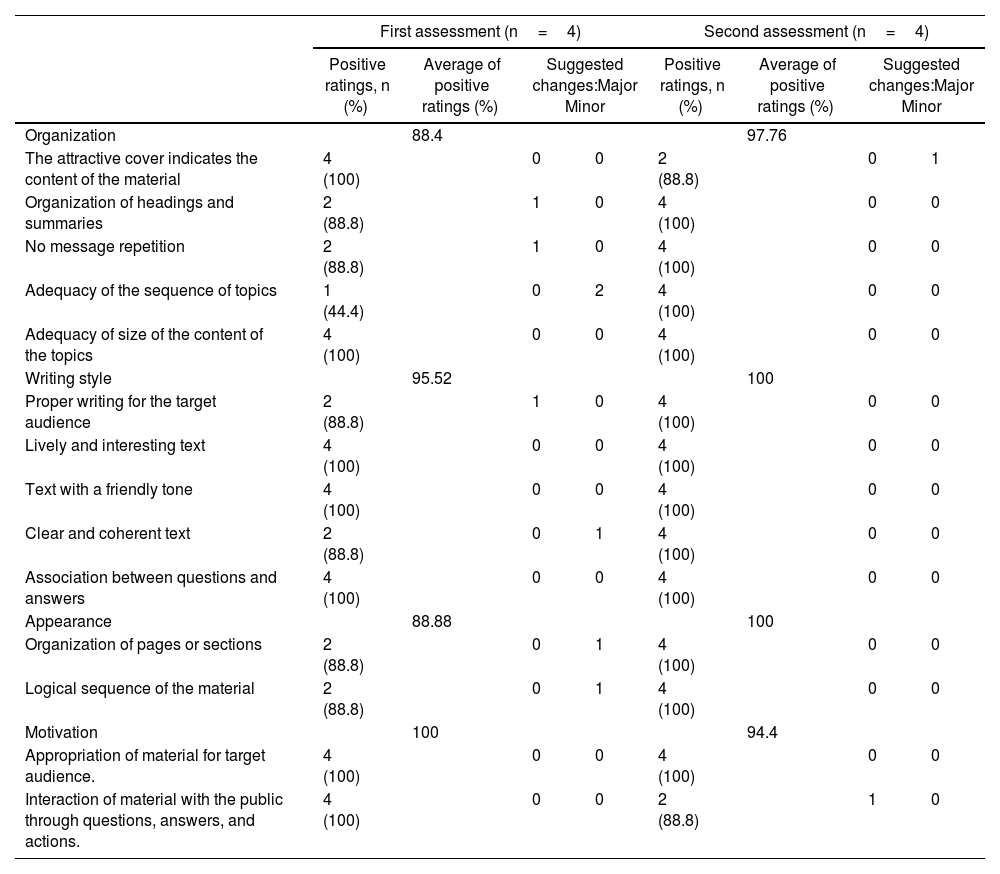
In the third stage, the booklet produced went through a validation process. Regarding content, positive reviews for each item of the used instrument, as well as “minor” or “major” changes suggestions are described in Table 1.
Booklet assessments and changes suggested by experts. Uberaba, Brazil, 2019.
| First assessment (n=4) | Second assessment (n=4) | |||||||
|---|---|---|---|---|---|---|---|---|
| Positive ratings, n (%) | Average of positive ratings (%) | Suggested changes:Major Minor | Positive ratings, n (%) | Average of positive ratings (%) | Suggested changes:Major Minor | |||
| Organization | 88.4 | 97.76 | ||||||
| The attractive cover indicates the content of the material | 4 (100) | 0 | 0 | 2 (88.8) | 0 | 1 | ||
| Organization of headings and summaries | 2 (88.8) | 1 | 0 | 4 (100) | 0 | 0 | ||
| No message repetition | 2 (88.8) | 1 | 0 | 4 (100) | 0 | 0 | ||
| Adequacy of the sequence of topics | 1 (44.4) | 0 | 2 | 4 (100) | 0 | 0 | ||
| Adequacy of size of the content of the topics | 4 (100) | 0 | 0 | 4 (100) | 0 | 0 | ||
| Writing style | 95.52 | 100 | ||||||
| Proper writing for the target audience | 2 (88.8) | 1 | 0 | 4 (100) | 0 | 0 | ||
| Lively and interesting text | 4 (100) | 0 | 0 | 4 (100) | 0 | 0 | ||
| Text with a friendly tone | 4 (100) | 0 | 0 | 4 (100) | 0 | 0 | ||
| Clear and coherent text | 2 (88.8) | 0 | 1 | 4 (100) | 0 | 0 | ||
| Association between questions and answers | 4 (100) | 0 | 0 | 4 (100) | 0 | 0 | ||
| Appearance | 88.88 | 100 | ||||||
| Organization of pages or sections | 2 (88.8) | 0 | 1 | 4 (100) | 0 | 0 | ||
| Logical sequence of the material | 2 (88.8) | 0 | 1 | 4 (100) | 0 | 0 | ||
| Motivation | 100 | 94.4 | ||||||
| Appropriation of material for target audience. | 4 (100) | 0 | 0 | 4 (100) | 0 | 0 | ||
| Interaction of material with the public through questions, answers, and actions. | 4 (100) | 0 | 0 | 2 (88.8) | 1 | 0 | ||
Source: data collection (2019).
Comparing the average of positive reviews in each section obtained in the first and second assessments, there was a general improvement in the quality of the booklet. In the “Organization” section, the average rose from 88.4% to 97.76%; in the “Writing style” section, it went from 95.52% to 100%, and in “Appearance,” it rose from 88.8% to 100%. Only “Motivation” had a reduction in the average of positive reviews, going from 100% to 94.4%.
Regarding the proposed changes, the quantity reduced from 3 major and 2 minor in the first assessment to only 2 major in the second assessment, with no further indications of minor changes. However, major changes proposed in the second assessment were different from those observed in the first assessment. Therefore, the new proposals for major changes were: One in the “Organization” section, “An attractive cover indicates the content of the material” item, and another in the “Motivation” section, “Interaction of the booklet with the public through questions, answers, and actions” item. The content of the suggested major changes is shown in Table 2; however, the items referred to in the second assessment are consistent with the drop in the average of positive assessments in the “Motivation” section, since, although the cover follows the “Organization” section, it is also a motivational stimulus for the public to read.
Table 2 lists topics referring to suggestions for “major” changes (concerning the text sequence, changes in the content of the topics in the booklet) in which there was agreement between at least two experts regarding the suggestion content. All these suggestions were accepted for the improvement of the booklet and refer to the first assessment of the booklet, since in the second assessment there was no agreement between experts in relation to “major” suggestions.
For the composition of figure 1, the positive comments and praise received from experts in the two stages of assessment of the booklet were listed.

It is noteworthy that in the validation process by the target audience, which corresponds to the fourth stage, no changes were proposed and 100% of the participants positively reviewed the material produced.
DiscussionIn Brazil, there are tabus and stigma regarding the clinical and social reality of the ASD and that may be due to the lack of knowledge. In order to face it, it is necessary to implement different education strategies strengthening society's awareness as well as involving the population in the social inclusion of people with ASD, including their family members.15
The general characterization of ASD that was addressed in the booklet highlighted aspects related to the communication difficulties of a child with ASD, which represent an important challenge for parents and still causes concern. Usually, one of the first symptoms evidenced in these children before the age of 3 are social and communication deficits associated with fixed and repetitive behaviors.15 Deficits in socio-emotional reciprocity make the recognition of these children's needs less possible.16 Therefore, the need to value non-verbal communication to favor the understanding of family members/caregivers was described in the booklet. It addressed the need to adapt care strategies to include this type of communication.
Management during episodes of crisis was also addressed in the booklet, with the following recommendations being emphasized for direct caregivers: To keep calm and take a deep breath; to look for the reason for the crisis; to recognize the child's sensitivity and respect it; to not scream or attack.17
Thus, the caring process requires a lot of attention. This is also addressed in scientific studies that show that stress is frequent among caregivers of children with ASD,18 as well as the need to rearrange affective and professional life and the expectations of the family in relation to the child.19 Therefore, family reality was described in the booklet aiming to empathetically welcome readers who care for this target audience, encouraging them to read the material produced.
Arguably, there is still a lot of social prejudice regarding the behavior of children with ASD, which is associated with feelings such as shame and embarrassment by caregivers, especially when the child has a crisis in public spaces.20 Considering these situations, stigma was addressed in the booklet, along with strategies to overcome it, which were described through information about the fundamental rights of these children.
Therefore, the legislation in force at the time of the creation of the material was highlighted. It was Law n° 12,764, which institutes the Person with Autism Spectrum Disorder Rights Protection National Policy, recognizing people with ASD as people with disabilities.21
Furthermore, social inclusion represents one of the main objectives of the Statute of People with Disabilities, with the main purpose of ensuring respect for the individual. This legislation aims to ensure inclusive education for people with disabilities, which is complemented by addressing the role of the State, family, school community, and society to ensure quality education for people with disabilities.22 In addition, the development of human independence is fundamental, thus, the main means to achieve it is through education.21
From this perspective, basic information about the right to formal education was detailed in the booklet, since access to information about this right is important and needs to be guided by current legislation, which aims to ensure the person's basic education, developing their ability to learn and understand the environment around them, thus shaping attitudes and values, strengthening bonds with the family and the ties of human solidarity and mutual tolerance.23 Regarding legislation, Decree n° 8,368 of 2014 regulates the obligation of educational institutions to provide a special needs’ caretaker to the student with ASD, according to their specific needs.24
Still regarding education, the physically structured environment that contributes to the child's learning according to their level of understanding, reducing development deficits and consequences to learning, and serving as a support for the child in the ASD, so they can develop more, was emphasized. Considering the organization of the space according to the individual needs of each child with ASD is very important, therefore, there must be 3 distinct spaces: For learning, independent work, and rest.21
Detailing aspects related to access to formal education is due to the difficulty in the inclusion of children with ASD in regular schools, which raises concern among the participants of this investigation. Such difficulties result from the absence of specific teaching methods in regular schools, which must include activities to improve auditory and tactile processing problems. Therefore, intervention must consider the high function problems that these children experience.25
Another issue that has been detailed was the access of these children and their families to health services, as it became clear that there is a gap in specialized professionals who can provide an early diagnosis of this disorder, which needs to be valued. From this perspective, scientific research26 clarifies that when ASD is not diagnosed early, the learning phase can be limited at a time when the brain is more likely to receive stimuli, thus, the child misses essential learning stages, especially in their first three years of life. Thus, the booklet presented health services that have professionals who can perform this diagnosis, so that family members can access them.
It is noteworthy that in the material's design stage, the theoretical content was based on the knowledge available in the literature, with the concern to transmit information in a complete, but not exhaustive manner to the target population. This aspect is reflected, for example, in the number of printed pages, as well as in the choice of colors, which was made aiming at making the booklet inviting, drawing the reader's attention.27
In general, transmitting knowledge through educational material allows family members and health professionals to read about the topic and favors the organization and adjustment of daily life in favor of an effective care.28 To ensure the booklet's quality, the material was validated in terms of content and appearance both by the judges and target audience, receiving satisfactory rates, which reinforces its applicability during the work process with family members of children with ASD.29
As in the study developed,28 despite the high approval rate, participants also expressed their opinions on some modifications in the material. After changes, the booklet was considered valid in terms of appearance and content, with potential for real use, making its relevance evident and presenting itself as a new guidance material in the health education activities of this population. Such contributions improve the final version of the booklet and validate its purpose as an educational material through the reformulation of information, replacement of some terms, revision of illustrations, and even the need for some information.29
ConclusionsThis study aimed at developing and validating an educational booklet that contributes to alleviate the difficulties experienced by family members/caregivers of children diagnosed with ASD. The assessment of the specific needs of family members/caregivers evidenced in the first stage of this investigation revealed important topics that were systematized in a booklet that addressed: a general characterization of the autism spectrum; crisis (preventive and management strategies); family reality; stigma; and fundamental rights for the child with the aforementioned disorder.
As a significant point of validation, the booklet went through assessments and had changes suggested by experts, such as writing style (proper writing considering the audience; vivid and interesting text; friendly tone text; clear and coherent text; association between questions and answers; motivation; making the material appropriate for the target audience, interaction of the booklet with the audience through questions, answers, and actions).
Based on the aforementioned aspects, the present study resulted in the construction of an educational booklet that has been positively reviewed and with potential for the use of nurses who have, among their attributions, the promotion of education aimed at family members/caregivers of children with ASD in different levels of health care. Considering the impact of the ASD in the family context, it is necessary to raise awareness of the society towards this group of children and to do so, it is important that nurses invest in educational activities and resources that provide greater autonomy for these children and their families/caregivers.
Conflicts of interestThe authors declare that they have no conflict of interest.

