


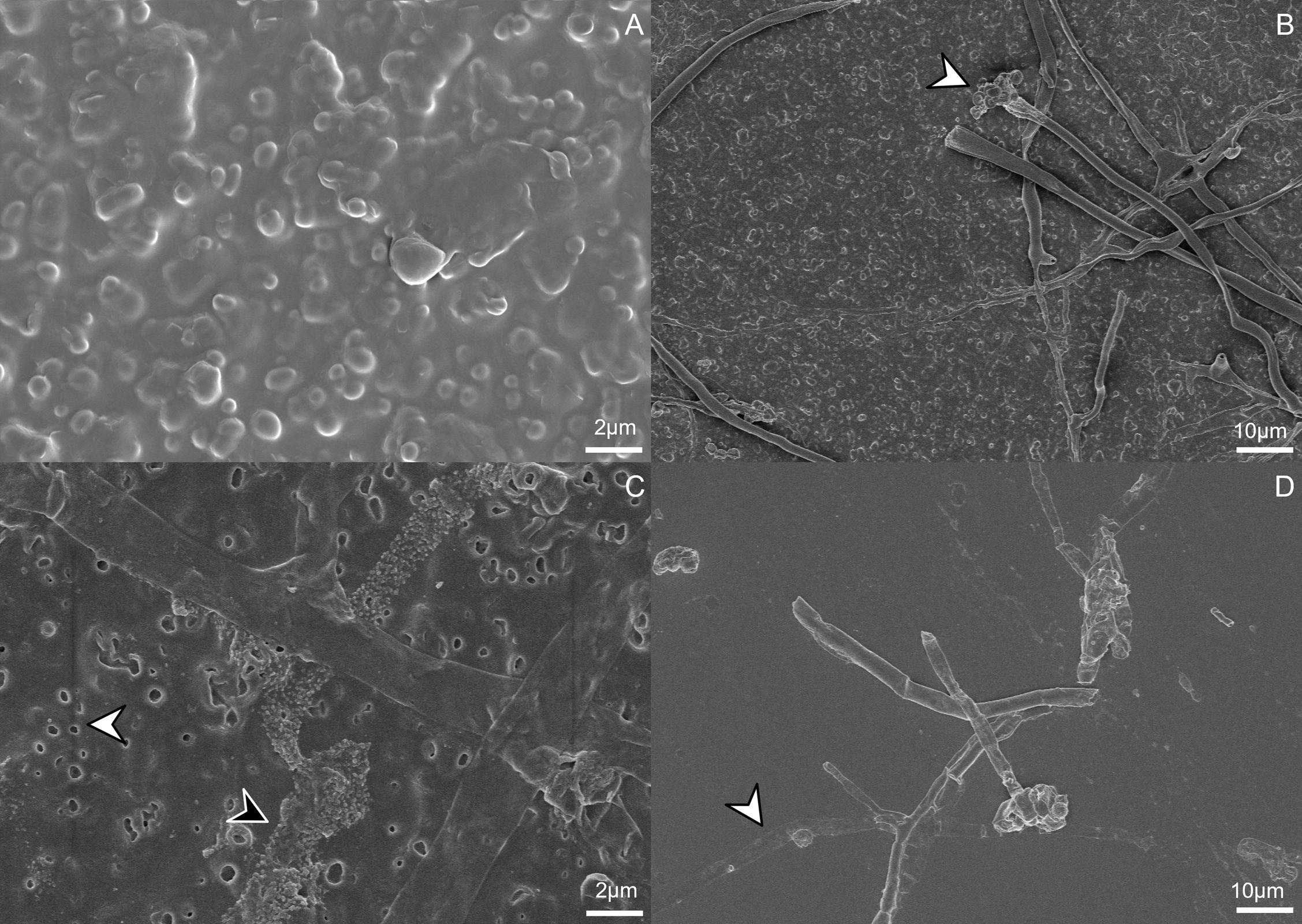
Plastic materials are widely used due to their versatility and low cost. However, their increasing production, long durability, and recycling limitations have led to significant accumulation and negative environmental impacts, particularly on soil4. Therefore, the development of sustainable substitutes for petroleum-based polymers has become urgent. Bioplastics, derived from renewable biomass (starch, cellulose, oils), are considered a promising alternative due to their biodegradability by microorganisms within a short timespan2. Understanding the microbial decomposition of plastic and bioplastic is highly important for reducing environmental pollution. Here, we reported the fungal biodegradation of a commercial bioplastic composed of a blend of polylactic acid (PLA) and the copolymer polybutylene adipate, as well as a plastic film made of polyethylene and vinyl acetate, after exposure to Aspergillus sp., previously isolated from the latter substrate. Sterilized bioplastic (Fig. 1A) and plastic discs (8cm ∅) were placed on sterile sand (60% field water capacity) in 9cm ∅ Petri dishes, inoculated with Aspergillus sp., and incubated at 25°C in the dark for 6 months. Scanning electron microscopy revealed that the fungus developed on the bioplastic surface, penetrated the material, and produced visible holes, roughness, and material decay (Figs. 1B and C), indicating significant enzymatic and physical degradation. In contrast, the plastic film exhibited predominantly superficial hyphal growth, with some hyphae penetrating the material, suggesting physical degradation (Fig. 1D). These results demonstrated the ability of Aspergillus sp. to colonize and degrade commercial bioplastics rapidly. Moreover, fungal development on plastic film might contribute to surface alteration3, potentially enhancing its susceptibility to further degradation. Future research should explore the underlying biodegradation mechanisms, resulting by-products, and the potential application of Aspergillus species in bioaugmentation strategies for plastic waste management.

Scanning electron microscopy (FE-SEM SUPRA 40 ZEISS) images of plastic and bioplastic degradation by Aspergillus sp. (A) Bioplastic surface without fungal inoculation. Protuberances on the material's surface (“droplets”) result from the localized accumulation of PLA, the less abundant polymer of the blend, within the PBAT matrix. This phenomenon occurs due to the low miscibility between the two polymers.1 (B) General view of Aspergillus sp. growth on the bioplastic material; the white arrow shows a fungal reproductive structure (conidiophore). (C) Detail of fungal growth and bioplastic degradation; the white arrow indicates holes caused by chemical/enzymatic degradation, and the black arrow shows evidence of both chemical/enzymatic and physical degradation by hyphal penetration (hyphae not visible in the image). (D) Fungal growth on the surface of the plastic film; the white arrow indicates physical degradation by hyphal penetration into the material.
This research was supported by Universidad de Buenos Aires (UBACYT 20020170100142BA), Consejo Nacional de Investigaciones Científicas y Tecnológicas (PIP 11220200102192CO), and FONTAGRO (ATN RF-18951-RG).
Conflict of interestThe authors have no conflict of interest.

