




Abnormalities of placental implantation, which make up the spectrum of placenta accreta, are associated with high maternal morbidity and mortality due to massive bleeding during delivery. Placing aortic occlusion balloons helps control the bleeding, facilitating surgical intervention. A new device, resuscitative endovascular balloon occlusion of the aorta (REBOA), minimizes the risks and complications associated with the placement of traditional aortic balloons and is also efficacious in controlling bleeding. The aim of this study is to evaluate the usefulness, efficacy, and safety of REBOA in puerperal bleeding due to abnormalities of placental implantation.
Material and methodsBetween November 2019 and November 2021, our interventional radiology team placed six REBOA devices in six women scheduled for cesarean section due to placenta accrete.
ResultsMean blood loss during cesarean section after REBOA (3507.5 mL) was similar to the amounts reported for other aortic balloons. The mean number of units of packed red blood cells required for transfusion was 3.5. Using REBOA provided the surgical team with adequate conditions to perform the surgery. There were no complications derived from REBOA, and the mean ICU stay was <2 days.
ConclusionThe technical characteristics of the REBOA device make it a safe and useful alternative for controlling massive bleeding in patients with placenta accreta.
Las anomalías en la implantación placentaria, que conforman el espectro de la placenta acreta son causa de alta morbimortalidad maternal por la hemorragia masiva que se produce en estas pacientes durante el parto. La colocación previa de balones de oclusión aórticos ayuda a controlar el sangrado, disminuyéndolo y facilitando la intervención quirúrgica. Existe un nuevo balón de oclusión aórtico denominado REBOA que minimiza los riesgos y las complicaciones asociadas a la colocación de los balones aórticos tradicionales además de lograr el control de las hemorragias. El objetivo del presente estudio es evaluar la utilidad, la eficacia y la seguridad del balón REBOA en las hemorragias puerperales por anomalías en la implantación placentaria.
Material y métodosDesde noviembre del 2019 hasta noviembre del 2021 se han colocado, por parte de Radiología intervencionista, 6 balones REBOA en 6 mujeres que iban a ser tratadas mediante cesárea programada por acretismo placentario.
ResultadoEn el estudio realizado, las pérdidas de volumen sanguíneo durante la cesárea tras la colocación del balón REBOA son similares a las reportadas en la literatura con otros balones aórticos, con una media de 3.507,5 ml. La media de requerimientos transfusionales fue de 3,5 concentrados de hematíes. El uso del balón REBOA proporcionó al equipo quirúrgico unas condiciones adecuadas para realizar la cirugía. No hubo complicaciones derivadas de su colocación y la estancia media en UCI de las pacientes fue inferior a 2 días.
ConclusiónEl balón REBOA, gracias a sus características técnicas, se plantea como una nueva alternativa segura y útil para el control de las hemorragias masivas en las pacientes con acretismo placentario.
Placental implantation abnormalities cause high rates of maternal and neonatal morbidity and mortality due to the massive haemorrhage they can cause during delivery. Placenta accreta spectrum (PAS) disorders occur when the placenta grows deeply into the uterine wall, potentially invading the myometrium or even the surrounding tissues, blood vessels and pelvic organs.1 The International Federation of Gynaecology and Obstetrics (FIGO) Consensus Panel have developed a new PAS grading system that divides the spectrum into three categories depending on the depth of the invasion. In grade 1 (placenta adherent or accreta), the villi adhere directly to the myometrium; in grade 2 (increta), the villi extend into the myometrium. In grade 3 (percreta), the villi reach the peritoneal serosa and may even invade neighbouring organs (Fig. 1). The incidence of these abnormalities has increased in recent years in parallel with an increase in the rate of caesareans and have become an increasingly common obstetric complication.2

Ultrasound diagnosis of placenta previa-accreta. Placenta previa can be discerned in the anterior side of the lower part of the uterus (the most frequent position). The myometrium is thinned to the point of being undetectable. The ‘vesical line’, that marks the separation between the uterine and bladder serosa, appears as an echogenic line (arrows), that disappears in some places (+). This sign should make us suspect placenta percreta Pl: placenta; V: bladder; *: vascular lacunae.
Interventional radiology has a crucial role in the management of these patients. The placement of temporary arterial occlusion balloons is a minimally invasive technique that helps to control bleeding during surgery, facilitating the process and reducing blood loss volume.3 Balloons placed in the infrarenal abdominal aorta are the most effective in achieving haemostasis, but the characteristics of the balloons available on the market to date mean that their use is not free of complications.4
Since 2018 there has been a Food and Drug Administration (FDA)-approved balloon on the market called Resuscitative Endovascular Balloon Occlusion of the Aorta (REBOA). These balloons minimise the risks and complications associated with the placement of aortic balloons. They are mainly indicated for polytraumatised patients with massive haemorrhage or the treatment of aortic lesions, such as aneurysm rupture.5 But they may be applied to multiple situations, which have yet to be standardised. The aim of this study is to describe the usefulness, effectiveness and safety of REBOA balloons inserted prior to planned surgeries in patients with placental implantation abnormalities.
Material and methodsA retrospective observational study has been conducted on the advantages and usefulness of REBOA balloons to control postpartum haemorrhage due to placental implantation abnormalities. Between November 2019 and November 2021, six REBOA balloons (6 Fr, 15 mL, REBOA Balloon Kit, REBOA Medical As, Bastad, Norway) were placed in six pregnant women who were undergoing elective caesarean sections for abnormally adherent placenta. All patients were asked to sign an informed consent prior to the procedure. The inclusion criteria were: patients with an ultrasound diagnosis of placenta previa accreta, with strong suspicions of placenta increta or percreta based on the ultrasound study and uterine scarring from a previous caesarean section. Patients with poorly positioned placentas and implantation abnormalities who had not previously undergone caesarean sections were excluded from the study. Placenta accreta was diagnosed by ultrasound during pregnancy.
Table 1 sets out the data collected on the age of the patients, the type of placental implantation abnormality, surgery performed, blood loss volume, transfusion volume, inflation time, days in the recovery room and any complications resulting from the intervention.
Case clinical data.
| Patient | Age (Years) | Placental implantation abnormality | Blood loss | Transfusion volume (RBC units) | Hysterectomy | Inflation time | Days in recovery | Complications from balloon placement or femoral access |
|---|---|---|---|---|---|---|---|---|
| 1 | 37 | CPP with areas of placenta accreta | 1300 cc | 0 | Yes + oophorectomy | Once (6 min) | 1 | No |
| 2 | 36 | CPP and placenta increta | 2645 cc | 0 | Yes+ oophorectomy + salpingectomy | Twice (4 min and 8 min) | 3 | No |
| 3 | 35 | CPP and placenta percreta (invasion of placental blood vessels into the peritoneum and the bladder mucosa) | 6000 cc | 9 | Yes | Once (35 min) | 3 | No |
| 4 | 33 | Placenta percreta | 5000 cc | 8 | Yes + left-side oophorectomy + right-side salpingectomy | Four times (10 min each time) | 1 | No |
| 5 | 37 | Placenta accreta and percreta on the anterior and right side of the uterus | 3100 cc | 2 | Yes | Twice (15 min and 12 min) | 2 | No |
| 6 | 44 | Placenta accreta | 3000 cc | 2 | Yes+ salpingectomy | Three times (20, 7 and 10 min) | 1 | No |
RBC: red blood cells; CPP: complete placenta previa.
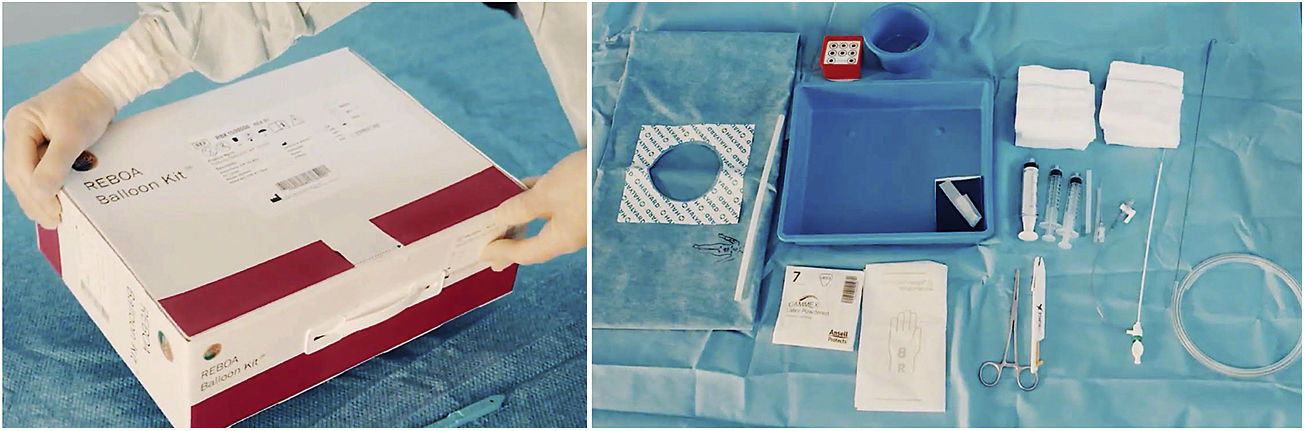
Planned balloon placement was executed in the interventional radiology suite or an obstetrics operating theatre, both equipped with a C-arm machine. Prior to the procedure, all patients were fitted with an epidural catheter for use during surgery. The REBOA kit includes all the material used to place the balloon, as shown in Fig. 2. The components of the kit are: sterile drape, puncture needle, syringes, dressings, PTFE-coated guidewire, introducer sheath and balloon.
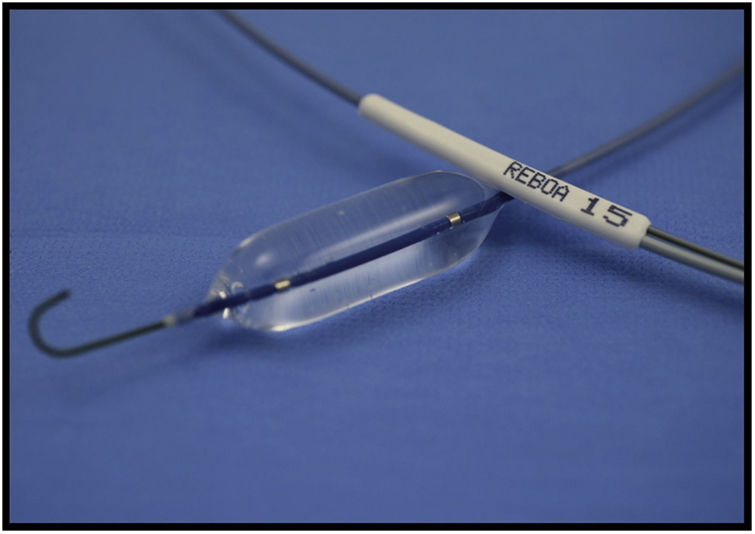
Guided by ultrasound, the right common femoral artery was punctured with a 19 G needle, through which a J-tip 0.035 inch PTFE-coated guidewire was inserted to support the placement of the 23 cm long and 6 Fr diameter sheath. The 23 cm sheath provides a 95% guarantee that placement of the distal end will reach the infrarenal aorta,6 so fluoroscopy was only performed once to check its position (Fig. 3). The use of intravenous contrast was not necessary. Next, the REBOA balloon was inserted via the sheath until the black mark lined up with the valve (Fig. 4). To check the balloon was functioning correctly, the balloon was inflated with 8 ml of saline to check for increased systolic blood pressure in the patient. The balloon was then left deflating connected to a three-way stopcock, ready for use during the subsequent surgery.


During the caesarean section, the anaesthetist and recovery staff operated the balloon, which was inflated after extracting the foetus and clamping the umbilical cord.
The inflation times were between 12–15 min alternating with deflation times of 1 min. After inflating the balloon, an increase in systolic blood pressure and cessation of bleeding was observed. At the end of the surgery, the balloon was removed, leaving the femoral artery sheath in for 24 h in case it needed to be reused. It was then removed, and manual inguinal compression was performed. The surgical procedure was performed under general anaesthesia.
ResultsThe mean age of the patients was 37 years. Mean blood loss during the caesarean sections was 3507.50 ml and on average 3.5 red blood cell units were required for transfusion. All six patients required a hysterectomy, two with a bilateral oophorectomy, three which required no oophorectomy, and one patient required a unilateral oophorectomy only. The mean time spent in recovery was 1.8 days. No patient experienced any peri- or postoperative complications resulting from femoral access or from balloon placement.
DiscussionInteroperative haemorrhage caused by placental implantation abnormalities during caesarean section can lead to hypovolemic shock, multiple organ failure and even death. Blood loss ranges between 3000 and 5000 ml,7 even exceeding 10000 ml in some situations. It usually requires massive blood transfusions, which increase the risk of associated complications, such as disseminated intravascular coagulation, fluid overload, respiratory distress syndrome or infections. A high proportion of caesarean sections in these cases require posterior hysterectomy, and if the placenta has invaded the bladder, other undesired complications related to the surgery may occur, such as bladder or ureteral injury.8
The placement of endovascular balloons prior to caesarean sections has been shown to be effective in reducing blood loss volume and improving perioperative factors such as: operation duration, hysterectomy rate, the need for intensive care and length of hospital stay.9 Balloons can be positioned in the infrarenal abdominal aorta, the common iliac arteries or the internal iliac arteries and, although there are no guidelines that standardise their ideal positioning, systematic reviews and meta-analyses highlight the benefits of positioning balloons in the infrarenal aorta because this tends towards lower blood loss, lower foetus radiation and lower hysterectomy rates.10–13 This appears to be due to the vascularisation of the uterus, which is principally irrigated by the internal iliac artery, but which also counts on extensive collateral circulation from other areas that will continue to supply blood if only iliac occlusion is performed.14,15
Another advantage of aortic balloons is that they can be occluded unilaterally, rather than the bilateral approach necessary with iliac occlusions. This reduces the probability of puncture-related complications and makes the procedure quicker.12
Although aortic balloons have demonstrated their usefulness, their use is not without complications. Due to the size of the balloons, a large sheath (12 Fr) is required, which increases femoral puncture-related complications.16 However, the new REBOA balloons are designed to enter via a small sheath (6 Fr) and the new third-generation models approved recently by the FDA in the United States and Canada can be inserted through a sheath as small as 4 Fr.17
Vascular complications are directly associated with the length of the sheath: short sheaths (most frequently used in these procedures) are associated with more thrombotic complications due to the possible tortuosity of the iliac arteries, while larger sheaths, which reach the abdominal aorta, would avoid this problem.18 The REBOA sheath has a standard length of 23 cm, calculated using a meta-analysis of anthropometric studies which conclude, with 95% probability, that 24 cm is the standard length in the general adult population between the common femoral and infrarenal aorta, independent of ethnicity or sex.6 This is pivotal as it means balloons can even be placed without fluoroscopy, which minimises radiation to the foetus.
REBOA balloons are also non-compliant (Fig. 5), which means that, even if we increase inflation pressure, they will only ever expand up to the predetermined diameter and no further, which means they cannot cause vascular damage as a result of overexpansion.19 Balloons can remain inflated for 15 min alternated with 1 min periods of deflation, without risk of ischaemic complications.5 The short deflation time allows for the reperfusion of the lower extremities, which reduces the risk of thrombosis without the need to administer heparin to the patient, thus reducing the risk of bleeding.18
In our case series, the mean blood loss volume, transfusion volume and hysterectomy rate are somewhat higher than the results reported in the literature,10 which may be due to the high complexity of the cases and the small sample size. Two of the cases (patients 3 and 4 from Table 1) were particularly complex as they were cases of placenta percreta (grade 3), one of whom presented with placental blood vessels that had invaded the peritoneum and the bladder mucosa.
In all six cases in the study, aortic balloons helped to stop the bleeding and facilitated a more comfortable and quicker intervention, improving surgical field visibility. There were no complications related to femoral access. Although fluoroscopy was performed for a few seconds, with a low dose of radiation to ensure correct placement of the balloon, this could be dispensed with because the REBOA kit design provides a 95% guarantee that if the balloon is inserted up to the black line (as shown in Fig. 4), it will reach the infrarenal aorta.
While the balloons have been shown to be useful in obstetrics, they can be applied as haemorrhage control in many other life-threatening emergencies, such as: polytraumatised patients, abdominal/pelvic haemorrhage of various origins and aortic dissections or ruptures. More recent publications have also supported their use in pelvic tumour resections, cardiac arrest and even asystole organ donations.20
The limitations of this study include the small sample size, it being limited to a single centre and the diversity of implantation abnormalities with which the patients presented. The diagnosis of placenta accreta is based on clinical and ultrasound suspicion, which may result in selection bias.
ConclusionREBOA balloons are a safe and useful alternative in the management of patients with PAS; it controls haemorrhage, reduces transfusion requirements and facilitates surgical intervention. Its technical characteristics, with a small (6 Fr), long (23 cm) sheath, standardised to reach the infrarenal aorta, and the fact that they are non-compliant balloons mean that their placement is simple and low risk with few complications.
FundingThis research has not received funding support from public sector agencies, the business sector or any non-profit organisations.
Author contributionsAll authors have made substantial contributions in each of these areas: (1) study concept and design, or data collection, analysis and interpretation; (2) article drafting and critical review of the intellectual content; and (3) the definitive approval of this version.
Research coordinators: LFR, JNT, MDPD, RRD, MLCT, GGM and THC.
Development of study concept: LFR, JNT, MDPD, RRD, MLCT, GGM and THC.
Study design: LFR, JNT, MDPD, RRD, MLCT, GGM and THC.
Data collection: LFR, JNT, MDPD, RRD, MLCT, GGM and THC.
Data analysis and interpretation: LFR, JNT, MDPD, RRD, MLCT, GGM and THC.
Statistical analysis: LFR, JNT, MDPD, RRD, MLCT, GGM and THC.
Literature search: LFR, JNT, MDPD, RRD, MLCT, GGM and THC.
Writing of article: LFR, JNT, MDPD, RRD, MLCT, GGM and THC.
Critical review of the manuscript with intellectually relevant contributions: LFR, JNT, MDPD, RRD, MLCT, GGM and THC.
Approval of the final version: LFR, JNT, MDPD, RRD, MLCT, GGM and THC.
Conflict of interestsThe authors declare that they have no conflicts of interest.


