



Upper airway obstruction is a frequent reason neonates are taken to the accident and emergency (A&E) department. When accompanied by certain warning signs, such as respiratory failure or cyanosis, we must investigate whether the cause could be a treatable congenital anomaly.
We present the case of a 15-day-old male neonate who was taken to A&E because of breathing difficulties linked to common cold symptoms. Relevant medical history included two previous similar episodes since birth, which had been less severe and self-limiting. Upon physical examination, the patient was observed to be in poor general condition, with tachypnoea, subcostal retraction and oxygen saturation below 90%. It was also impossible to insert a nasogastric tube through the nasal cavities. Faced with this situation, orotracheal intubation was performed and computed tomography (CT) imaging of the paranasal sinuses was requested.
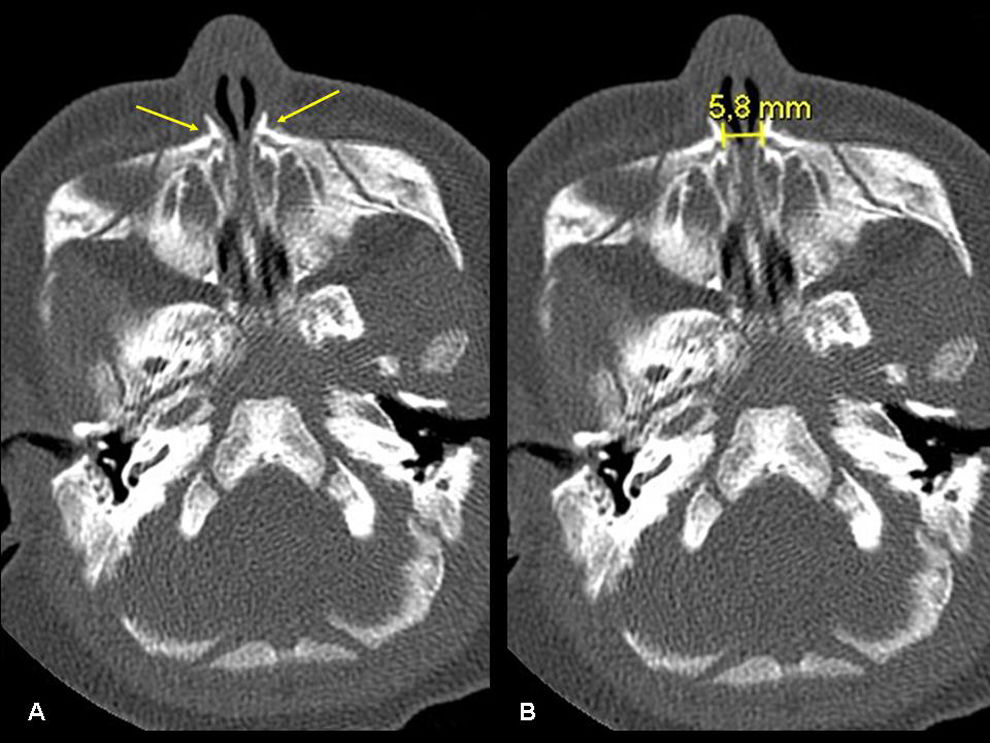
The CT ruled out choanal pathology, the primary clinical suspicion, but abnormal thickening and medial approximation of both nasal processes of the maxilla was detected (Fig. 1A), resulting in pyriform aperture stenosis, with a maximum diameter of 5.8 (Fig. 1B). An associated abnormality, a solitary median maxillary central incisor (also known as a central megaincisor), was also detected (Figs. 2A and B).


To complete the examination, a cranial magnetic resonance image (MRI) was performed to rule out other associated malformations; this came back normal. On the basis of the various tests conducted, the patient was treated conservatively, with a good response. No surgical treatment was needed. The patient is currently being monitored by the ENT department and is progressing favourably.
Congenital pyriform aperture stenosis is an infrequent but treatable obstruction of the upper respiratory tract in neonates. Incidence is estimated at 1/25,000 live births.1 Clinically it manifests with episodes of respiratory distress, difficulty feeding, apnoea crises and cyanosis.2 Choanal atresia, the symptoms of which are very similar, is the primary differential diagnosis.3
Diagnosis is made on the basis of clinical suspicion and the results of imaging tests; CT scan of the paranasal sinuses without intravenous contrast is the method of choice. The characteristic finding is an abnormal medial approximation of both nasal processes of the maxilla, which are usually thickened, resulting in a decrease in the transverse diameter between the two spines, whose normal diameter has been established by consensus as greater than 11 mm.4
It may appear in isolation or, more frequently, associated with other malformations,1 hence the importance of early diagnosis and awareness of this entity. Among the anomalies frequently associated with this pathology are the different forms of holoprosencephaly or the presence of a single central midline megaincisor, which appears in up to 75% of cases, and is considered a minor form of holoprosencephaly.5 Cranial MRI is therefore recommended in these patients to complete the examination. Other potential considerations include hypothalamic-pituitary axis dysfunction, certain genitourinary malformations, cardiac pathologies or clinodactyly,5 which should be ruled out by way of an adequate physical examination and a range of additional complementary tests when there is a reason for suspicion.
The therapeutic management of this condition can be conservative or surgical, depending on the degree of stenosis and the severity of symptoms. In mild cases, conservative treatment is initiated with decongestants or intranasal corticosteroids.3 The degree of stenosis is not an absolute criterion for surgical treatment, although those with diameters of less than 6 mm usually require surgery.2 However, in these cases two weeks’ conservative management are recommended to evaluate response. Sleep apnoea, the need for oxygen therapy, feeding difficulties and cyanosis are the main indications for surgery.2 Surgery involves techniques such as rhinoplasty with duct enlargement and/or stenting.4
Patients usually recover well with a tendency towards progressive improvement. No recurrences have been reported in those treated surgically.4
In conclusion, congenital pyriform aperture stenosis is a rare but treatable congenital malformation of the midline. It can be associated with other more serious entities, for which reason early differential diagnosis is fundamental.
FundingThe work presented in this article has received no funding, nor has it been presented previously at any meeting, conference or symposium.
Conflicts of interestThere are no conflicts of interest.


