


2024 was a great year for Radiología. Following our first impact factor in 2023, we have achieved a Quartile 3 ranking in the Radiology, Nuclear Medicine, and Medical Imaging category1 which indexed 204 journals in the 2024 Journal Citation Reports.
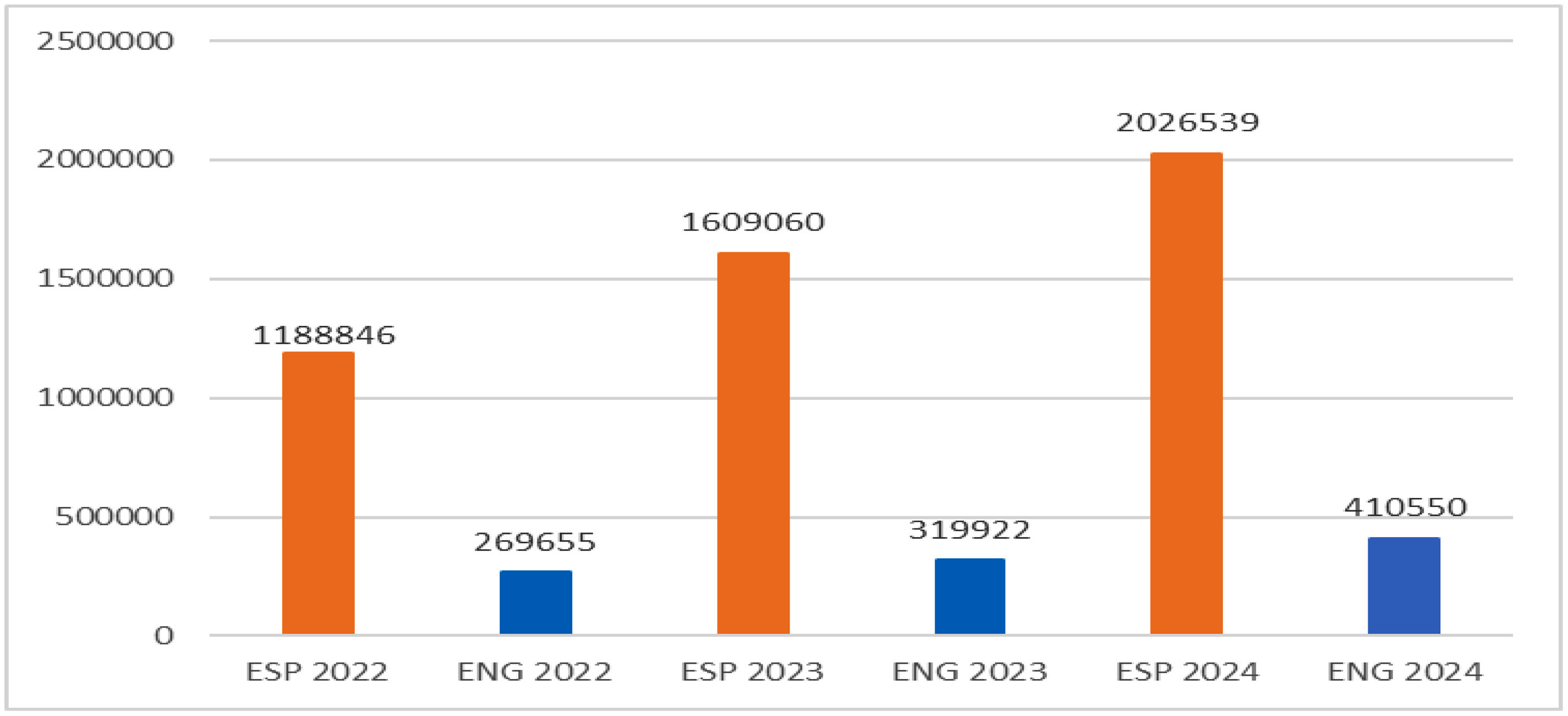
In addition to these metrics, we take pride in the increasing interest our journal continues to attract. Last year, we surpassed 2 million article downloads in Spanish and over 400,000 in English. Compared to article downloads in 2022—when I took on my role with the journal—these numbers have nearly doubled in both languages (Fig. 1).

Average of downloads of Radiología according to Google Analytics and ScienceDirect, accessed in December 2024.
The orange bar shows downloads in Spanish and the blue bar shows downloads in English. We can see how these gradually increased for both languages between 2022 and 2024.
Source: Elsevier Spain.
This increase in downloads may be the result of several concurrent factors. Since 2023, the contents of Radiología, now indexed by issue and volume, have been available on PubMed.2 We also remain engaged in key initiatives, including our collaboration with the European Diploma in Radiology,3 our partnership with the Plataforma de formación continuada de diagnóstico y tratamiento por la imagen (Continuous Training Platform for Diagnostic and Interventional Imaging) led by Dr. Pedraza,4 and the dissemination of articles through our Virtual Editorial Space.5 Moreover, we have introduced a new way of disseminating our journal through the various sections of the Spanish Society of Radiology (SERAM). Radiología expresses its gratitude to the Spanish Society of Management and Quality in Radiology (SEGECA),6 the Spanish Society of Abdominal Imaging (SEDIA),7 the Spanish Society of Cardiothoracic Imaging (SEICAT),8 and the Spanish Society of Musculoskeletal Radiology (SERME)9 for adding sections on their respective websites featuring links to Radiología articles on their areas of interest. We have also begun working with some affiliates, such as the Radiology Society for Northern Central Spain (CENORA),10 which also has a dedicated space for the journal. Throughout 2025, we will continue working to consolidate these relationships and collaborate with more societies.
The growth we are experiencing on social media is also positively influencing article downloads. This is illustrated by the study conducted by Dr. Herrán et al.,11 which noted a significant increase in article downloads when they were shared through Radiología's X account (@revistaRADIOLO2) and the various social media platforms of SERAM.
In 2024, a record number of applications were received for the Dr. Calatayud Editorial Grant, intended for newly qualified radiologists and trainees. This figure is even more significant considering that a whole cohort was unable to take part; the 2020–2024 cohort of trainees did not finish until September because the start of their training was delayed by the SARS-CoV-2 (COVID-19) pandemic. We encourage them all to apply in the next call for applications. There was also an increase in applications for the Dr. Soler reviewer grants compared to last year. Earning continuing education credits for reviewing articles—an initiative launched last year—serves as an extra incentive to become a journal reviewer.12
Another new initiative launched last year was the ‘Radiología Journal Mentoring Programme.’13 This project was created to help bridge the gap for trainees in units with limited publishing history, offering them support and guidance in the world of academic publishing. The number of applications exceeded our expectations, and all those presenting promising articles were selected. We are confident that this will lead to excellent publications and help emerging authors establish themselves.
Radiología remains committed to publishing articles with an educational focus. Due to the large volume of articles in the ‘Update’ and ‘Radiology in Images’ sections, we have decided to expand the journal's continuing education credits. From now on, four articles will be published per issue. Furthermore, two special series will be published this year: The first, on cardiac imaging, will be coordinated by Dr. Bastarrika and Dr. Domenech. It will include six articles, some of which have already been published in the previous issue. The second series, on fetal magnetic resonance imaging, will come out at the end of the year and will be coordinated by Dr. Martínez León.
Furthermore, we have two new projects to announce for 2025, which we hope will be well received by all our members. The first is a grant for systematic reviews and meta-analyses, and the second is a grant for multicentre studies. With these initiatives, we aim to elevate the level of evidence in our journal's publications and encourage all authors to undertake these types of studies. Both grant application processes will be published this year.
Let us consolidate what we have started and move forward to keep growing. Thanks to the dedication of our authors, reviewers, and editors, this year promises to be just as successful and fulfilling as the last. The best is always yet to come.
FundingThis article has not received funding, nor has it been previously presented at any meeting, conference or symposium.


