


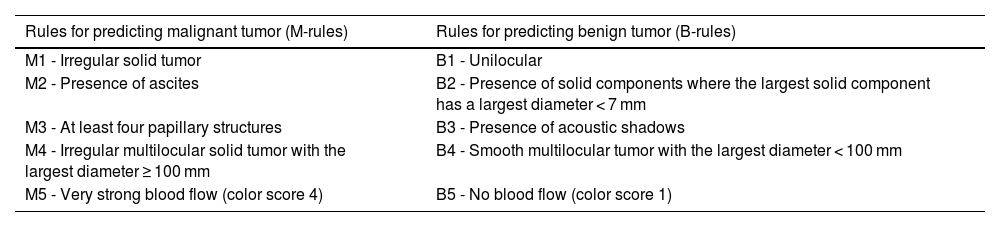
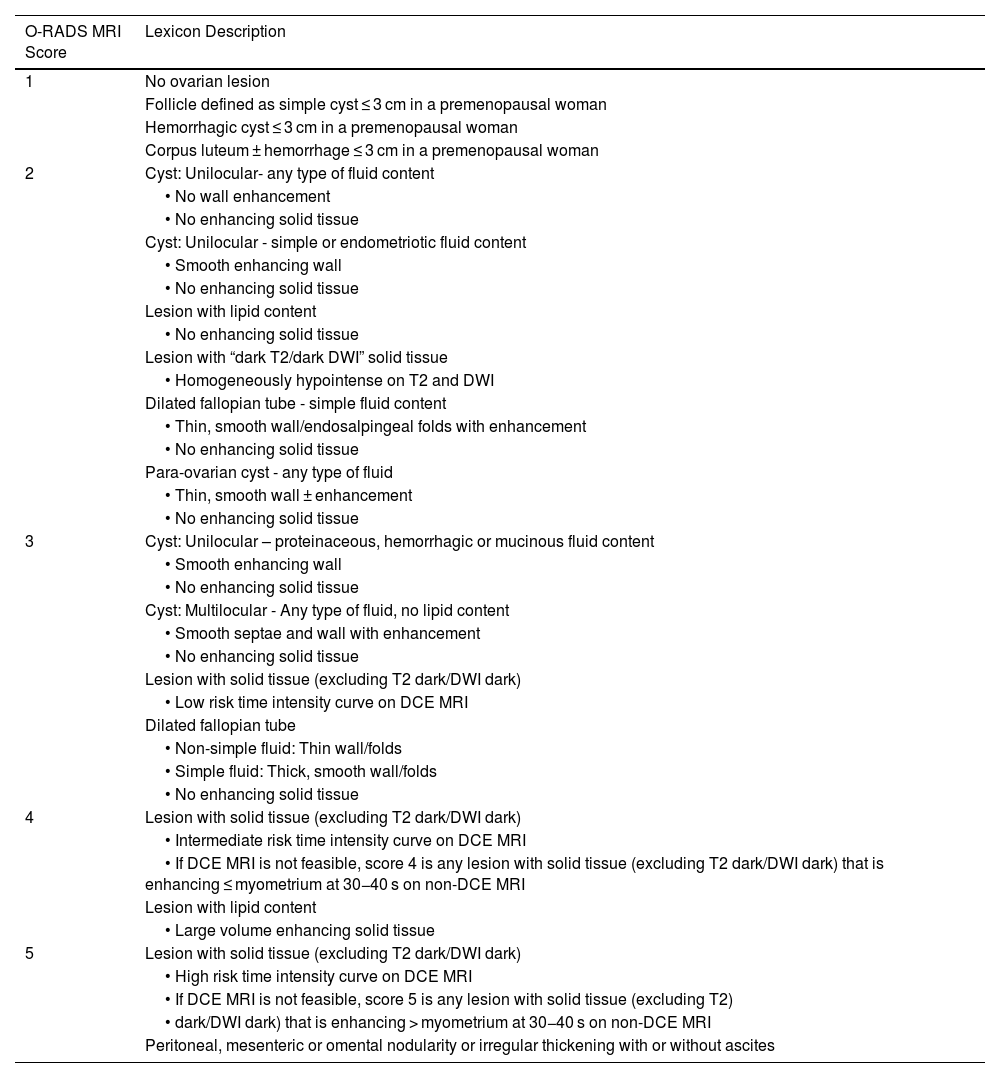
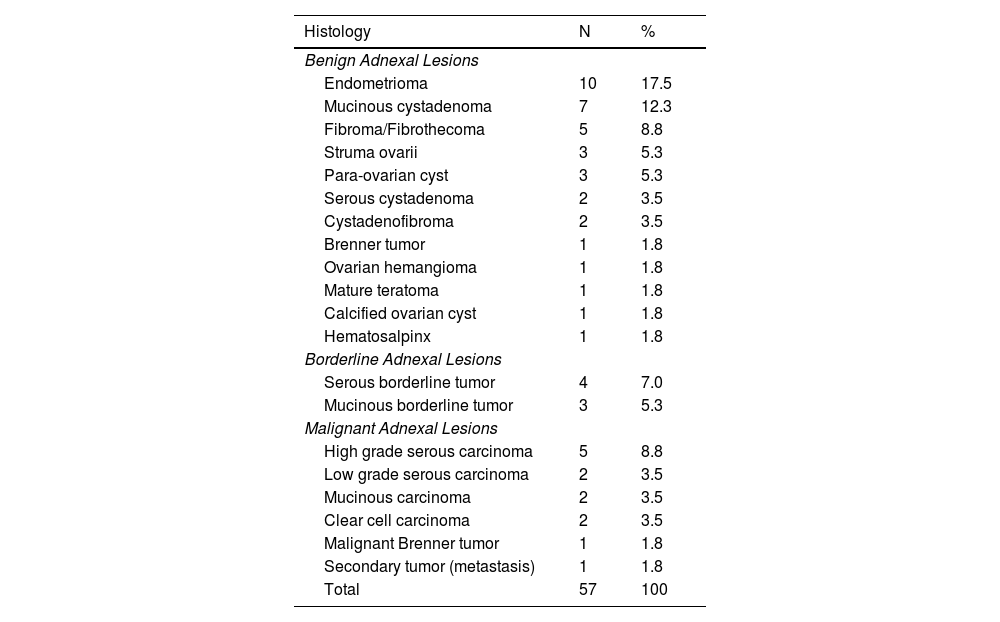

Despite the overall high accuracy of the O-RADS MRI scoring system for characterization of indeterminate adnexal lesions, a non-negligible percentage of adnexal lesions remains indeterminate. Given this, the main objective of this study was to evaluate the value of adding quantitative diffusion-weighted imaging (DWI) to Ovarian-Adnexal Reporting and Data System (O-RADS) MRI to improve the diagnostic accuracy of the scoring system in a cohort of indeterminate adnexal lesions according to International Ovarian Tumor Analysis Group Simple Rules (IOTA-SR).
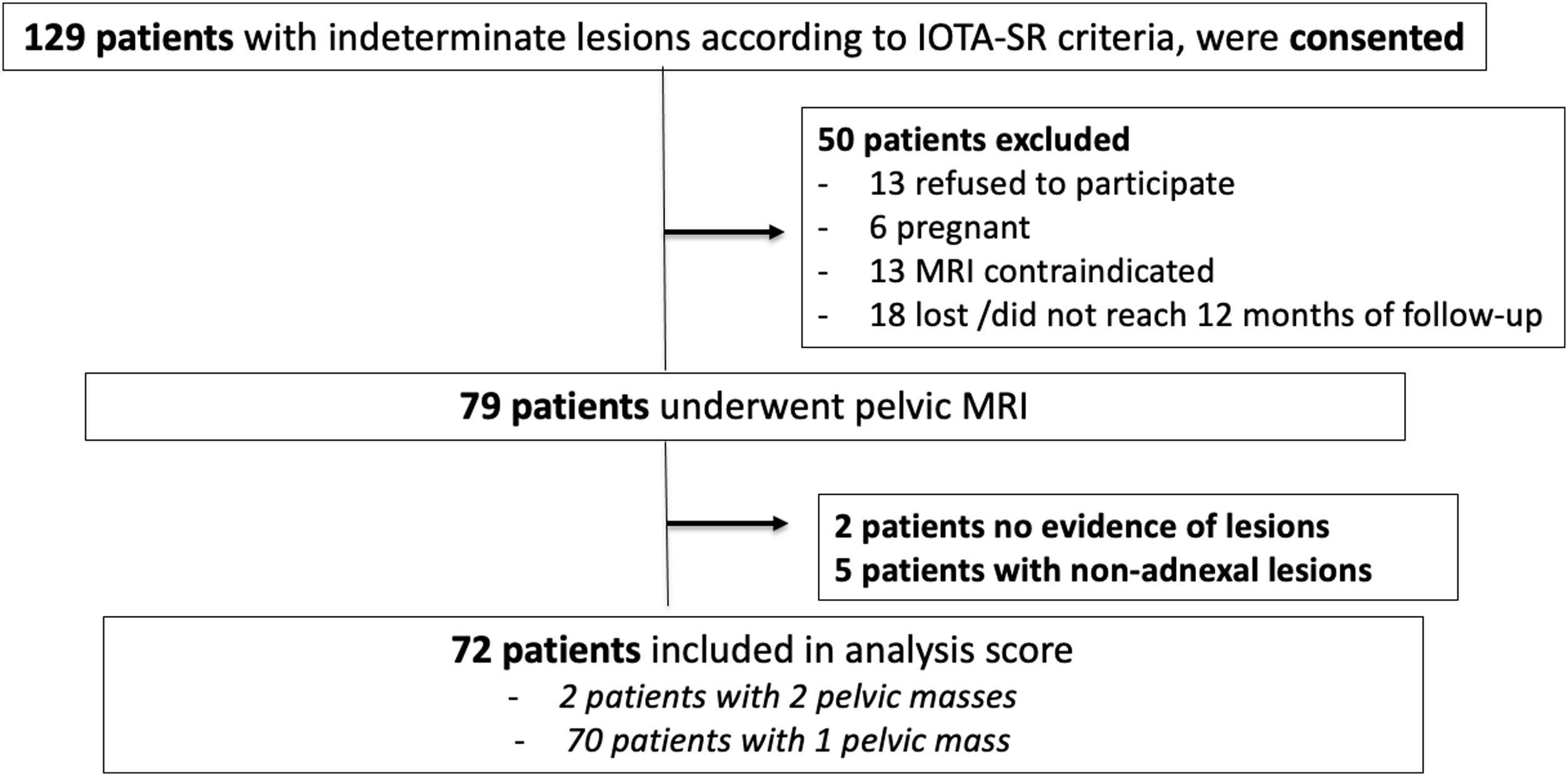
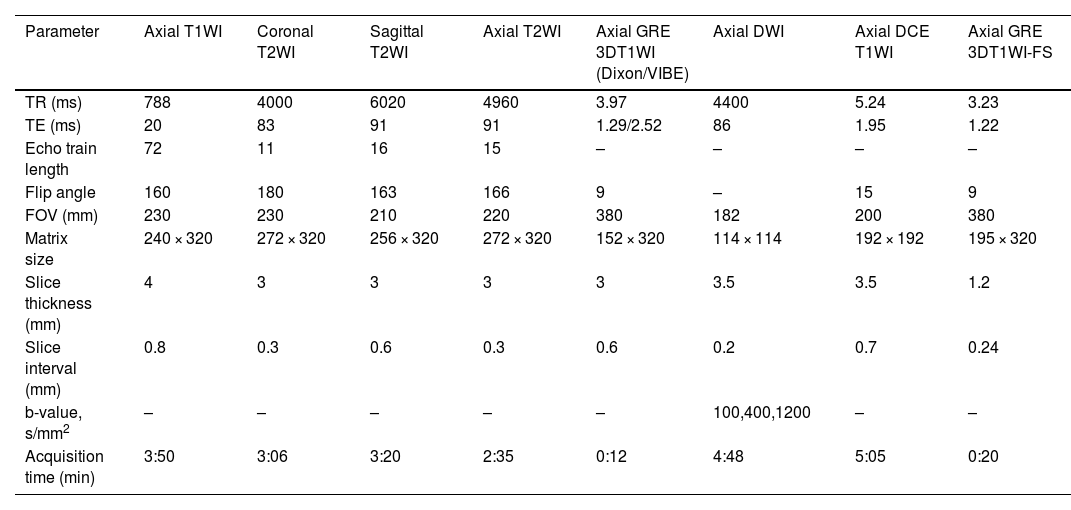
Methods and materialSeventy-nine women with 81 pelvic lesions classified as indeterminate according to IOTA-SR underwent 3-Tesla MRI with a conventional multiparametric protocol. DWI was quantitatively analyzed. Lesions were surgically removed or followed-up, according to a local protocol. Sensitivity, specificity, positive and negative predictive values and accuracy were determined for conventional multiparametric MRI and quantitative DWI-derived data.
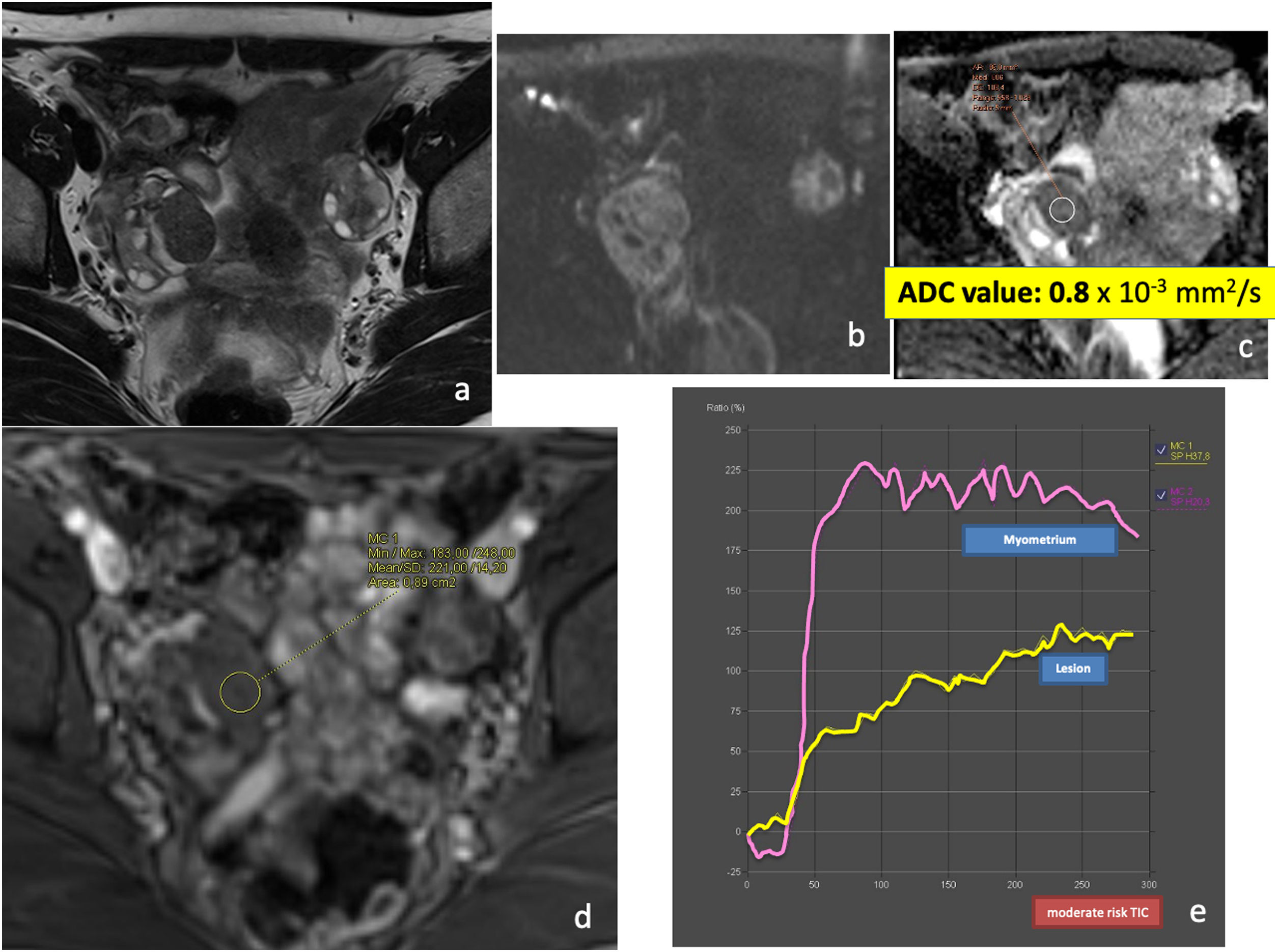
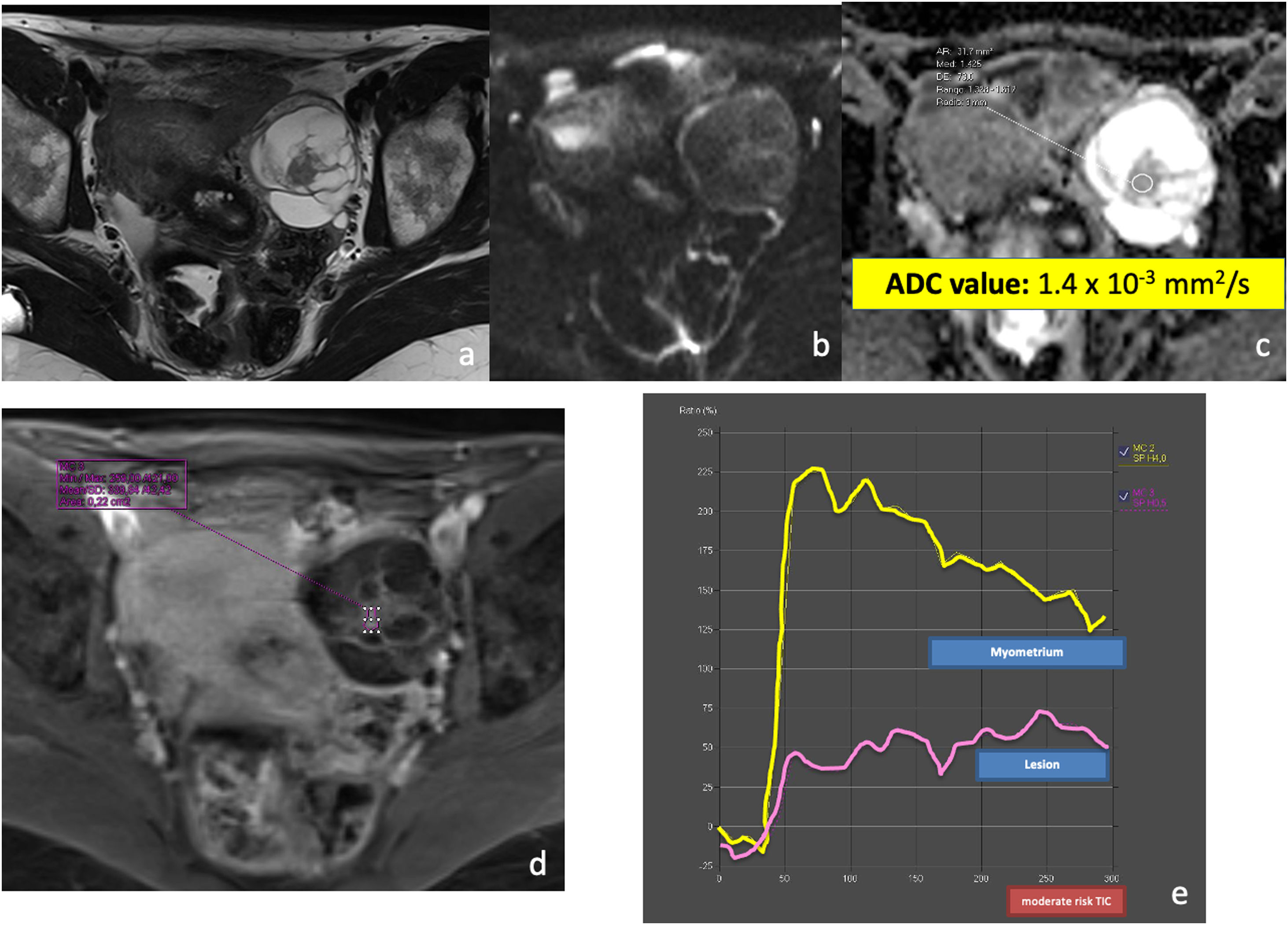
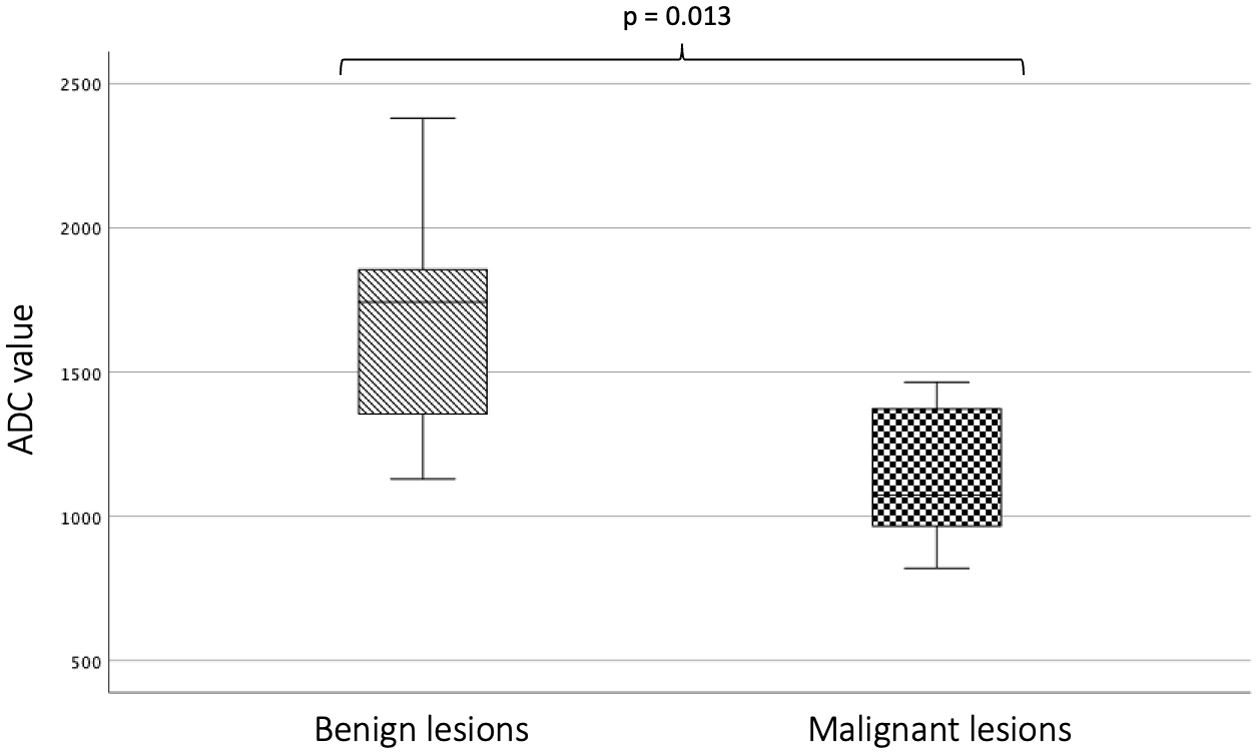
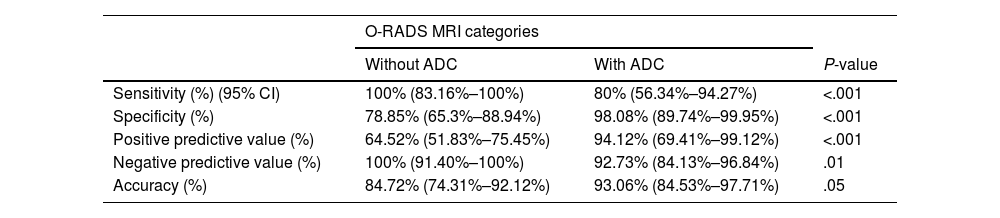
ResultsTwenty masses in 72 patients (27.8%) were malignant. An apparent diffusion coefficient (ADC) cut-off value of 1.30 × 10⁻³ mm2/s had 89% sensitivity and 80% specificity for malignancy. Overall, adding quantitative DWI to O-RADS MRI increased the specificity (98.08%, P < .001), positive predictive value (94.12%, P < .001), and accuracy (93.06%, P = .05). In the specific O-RADS MRI score 4 subgroup, an ADC cut-off value of 1.22 × 10⁻³ mm2/s had 86% sensitivity and 67% specificity for distinguishing benign from malignant lesions.
ConclusionIn IOTA-SR indeterminate adnexal lesions, quantitative DWI significantly improves the diagnostic performance of conventional multiparametric MRI in all O-RADS MRI score groups.
A pesar de la elevada precisión general del sistema de puntuación O-RADS RM para la caracterización de las lesiones anexiales indeterminadas, un porcentaje no desdeñable de lesiones anexiales permanece indeterminado. Por ello, el objetivo principal de este estudio fue evaluar el valor de añadir imágenes cuantitativas potenciadas en difusión (DWI) al sistema de RM Ovarian-Adnexal Reporting and Data System (O-RADS) para mejorar la precisión diagnóstica del sistema de puntuación en una cohorte de lesiones anexiales indeterminadas según las Simple Rules del grupo International Ovarian Tumor Analysis (IOTA-SR).
Métodos y materialSetenta y nueve mujeres con 81 lesiones pélvicas clasificadas como indeterminadas según las IOTA-SR se sometieron a una RM de 3 T con un protocolo multiparamétrico convencional. La DWI se analizó de forma cuantitativa. Las lesiones se extirparon quirúrgicamente o se sometieron a seguimiento, según un protocolo local. Se determinaron la sensibilidad, la especificidad, los valores predictivos positivo y negativo y la precisión para la RM multiparamétrica convencional y los datos cuantitativos derivados de la DWI.
ResultadosVeinte masas de 72 pacientes (27,8%) eran malignas. Un valor de corte del coeficiente de difusión aparente (ADC) de 1,30 × 10⁻³ mm2/s tuvo una sensibilidad del 89% y una especificidad del 80% para la malignidad. En general, añadir la DWI cuantitativa al O-RADS RM aumentó la especificidad (98,08%; P < 0,001), el valor predictivo positivo (94,12%; P < 0,001) y la precisión (93,06%; P = ,05). En el subgrupo específico con puntuación 4 en el O-RADS RM, un valor de corte del ADC de 1,22 × 10⁻³ mm2/s tuvo una sensibilidad del y una especificidad del 67% para distinguir las lesiones benignas de las malignas.
ConclusiónEn las lesiones anexiales indeterminadas según IOTA-SR, la DWI cuantitativa mejora significativamente el rendimiento diagnóstico de la RM multiparamétrica convencional en todos los grupos de puntuación O-RADS RM.


