


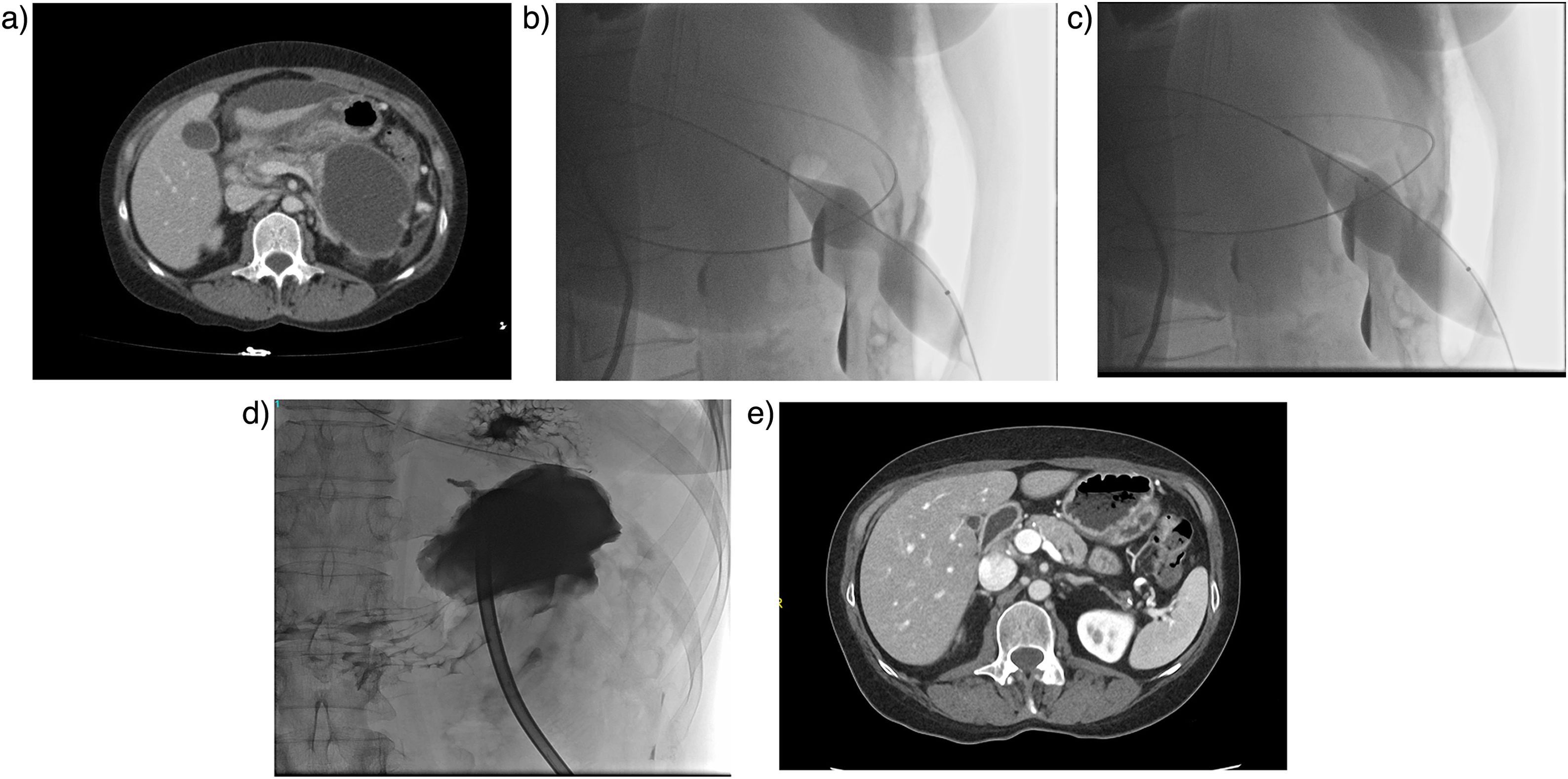
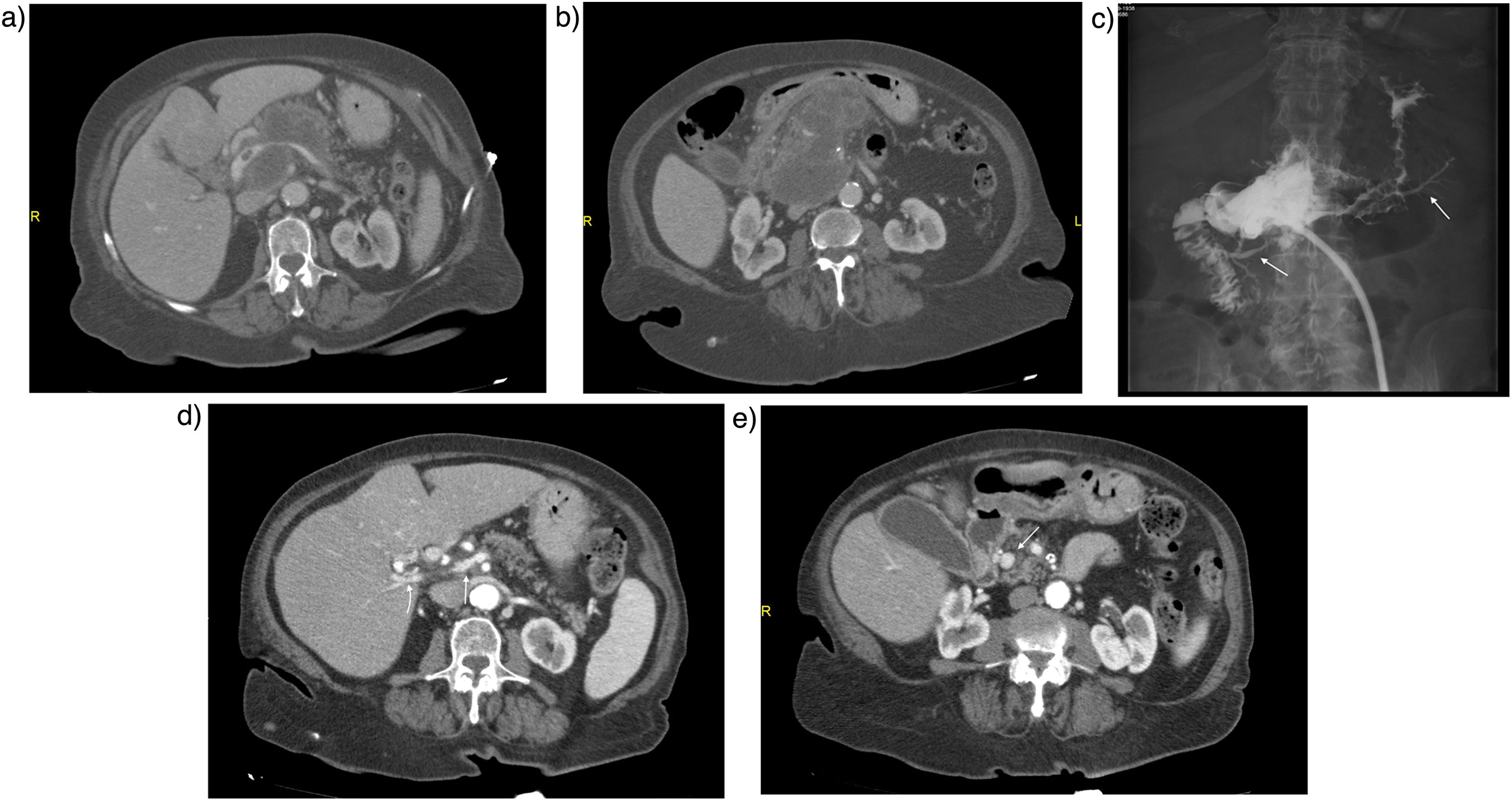
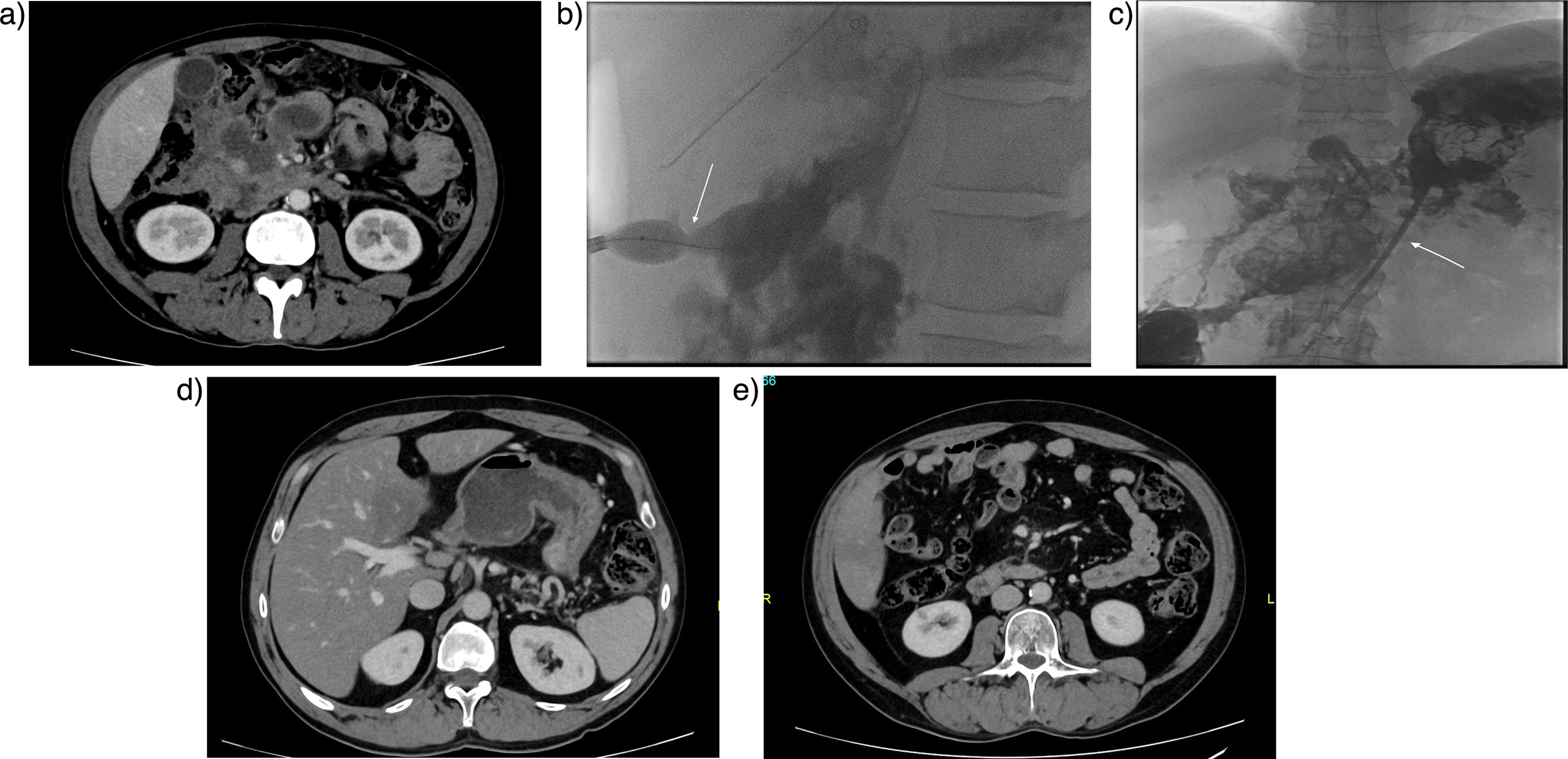
Acute pancreatitis (AP) is an inflammatory condition associated with a potential torpid evolution comprising multiple organ failure, pancreatic necrosis, infected collections and high mortality. Current management tends use the step-up approach, with endoscopic collection drainage, followed by percutaneous drainage by an interventional radiologist and video-assisted necrosectomy. We present our experience with a new percutaneous technique of establishing an anastomosis of the pancreatic collection with the closest loop, stomach, duodenum or jejunum that uses balloon dilation and drainage in cases of infection.
Material and methodsBetween 2009 and 2023 we have applied this technique in 30 patients, aged between 32 and 82 years (mean=67 years), 14 with pseudocysts (infected in six cases) and 16 with encapsulated necrosis (all infected). We use dilation balloons of different calibre, to establish the anastomosis between the digestive loop and the collection, as well as different drainages.
ResultsThe intervention had a primary technical success of 93%. In two patients the cystogastrostomy had to be repeated due to initial technical failure; in both cases a good result was achieved. One patient had a severe postintervention haemorrhage (3%) that required embolisation. Length of follow-up has ranged from between three months and 10 years (mean=4 years), with no recurrence of the anastomosed collection or cutaneous fistula observed in any case.
ConclusionPercutaneous cystogastrostomy is a technique that allows infected collections to be resolved and pancreatic fistulas to be avoided, with few complications, which can be resolved by interventional vascular radiologists.
La pancreatitis aguda (PA) es una patología inflamatoria con una evolución tórpida con fracaso multiorgánico, necrosis pancreática, colecciones potencialmente infectadas y elevada mortalidad. El manejo actual tiende a un escalonamiento, con el drenaje endoscópico de las colecciones, seguida de la radiología intervencionista para el drenaje percutáneo y la cirugía para la necrosectomía videoasistida. Presentamos en este artículo, nuestra experiencia con una nueva técnica consistente en establecer una anastomosis de la colección pancreática con el asa más próxima, estómago, duodeno o yeyuno a través de un abordaje percutáneo, estableciendo una comunicación mediante dilatación con catéter balón y colocando drenaje en los casos de infección.
Material y métodosEntre 2009 y 2023 hemos aplicado esta técnica en 30 pacientes, de edades comprendidas entre 32 y 82 años (media=67 años), 14 con seudoquistes (infectados en 6 casos) y 16 con necrosis encapsulada (todas infectadas). Empleamos balones de dilatación, de diferente calibre, para establecer la anastomosis entre el asa digestiva y la colección, así como diferentes drenajes.
ResultadosLa intervención tuvo un éxito técnico primario en el 93%. En 2 casos hubo que repetir la quistogastroenterostomía por fallo técnico inicial, en ambos se logró buen resultado. Un paciente, presentó una hemorragia grave posintervención (3%) que se solucionó mediante embolización. El seguimiento ha oscilado entre 3 meses y 10 años (media=4 años), no objetivándose recidiva de la colección anastomosada ni fístula cutánea en ningún caso.
ConclusiónLa quistogastroenterostomía percutánea es una técnica que permite resolver las colecciones infectadas y evitar las fístulas pancreáticas, con escasas complicaciones que, en el marco de un manejo multidisciplinar, pueden resolverse mediante radiología vascular intervencionista.


