Chronic refractory cough is a symptom that affects a significant subgroup of asthmatic patients, even when the disease is controlled. This condition negatively impacts quality of life and is often resistant to conventional asthma treatments, posing a significant clinical challenge. Despite its frequency, the pathophysiology of chronic cough in the context of adult asthma remains poorly understood and understudied. This lack of evidence hinders the development of effective and personalized therapeutic strategies. Therefore, it is essential to better characterize this entity and its possible underlying mechanisms to optimize its clinical management.
La tos crónica refractaria es un síntoma que afecta a un subgrupo significativo de pacientes asmáticos, incluso cuando la enfermedad está controlada. Esta condición impacta negativamente en la calidad de vida y suele ser resistente a los tratamientos convencionales del asma, lo que plantea un desafío clínico relevante. A pesar de su frecuencia, la fisiopatología de la tos crónica en el contexto del asma adulta sigue siendo poco comprendida y subexplorada. Esta falta de evidencia dificulta el desarrollo de estrategias terapéuticas efectivas y personalizadas. Por ello, es fundamental caracterizar mejor esta entidad y sus posibles mecanismos subyacentes para optimizar su manejo clínico.
Most studies on refractory chronic cough (CC), defined as cough persisting for ≥8 weeks in adults and ≥4 weeks in children,1 have focused on its diagnosis and treatment. There is little research addressing possible risk factors, and what research is available is mainly experimental. It has been suggested that low birth weight (LBW), prematurity, or recurrent respiratory infections in childhood (RRIs) influence airway neural plasticity, promoting CC in children. No studies have analyzed the association between these factors and the likelihood of developing CC in adults. However, research suggests that factors such as prematurity and low birth weight can induce neuroanatomical changes during early childhood. These changes may include altered plasticity of airway mucosa innervation, such as modifications in receptors, ion channels, neurochemistry, fiber density, or the cells responsible for fiber excitation.2–4 We hypothesize that LBW (<2500g) 2 and RRIs (three or more episodes/year before age five) 3 could increase the risk of CC in adult asthmatics (AA).
We conducted a case-control study comparing the history of AA with and without CC. We have the approval of the ethics committee and the informed consent of the patients included in this research (TOSMIR/08-24). Patients were included who were ≥18 years of age, with an Asthma Control Test (ACT) score ≥20 and good adherence to inhaled treatment (score ≥50 on the Test of Adherence to Inhalers and verification of withdrawal of the inhaled device from the electronic prescription), who were seen in the Pulmonology Department between 2022 and 2024. Information was collected from medical records and telephone interviews. Means, standard deviations (SD), absolute frequencies, and percentages were used to describe the data. Comparative analyses were performed using Student's t-test and Chi-square test, Pearson's correlation to explore the relationship between the Visual Analog Scale (VAS) for cough and the EuroQol-5D, and univariate and multivariate analyses to calculate the odds ratio (OR) of association between CC, LBW, RRIs, and other comorbidities. The data were analyzed using SPSS software (version 25.0.0.0, Armonk, NY, USA); a p-value≤0.05 was considered statistically significant. To determine with 95% confidence and 80% power whether the 5% proportion of sample A is different from the 20% proportion of sample B, we need to take a sample of 52 individuals from each group. The percentage of replacements required is expected to be 10%.
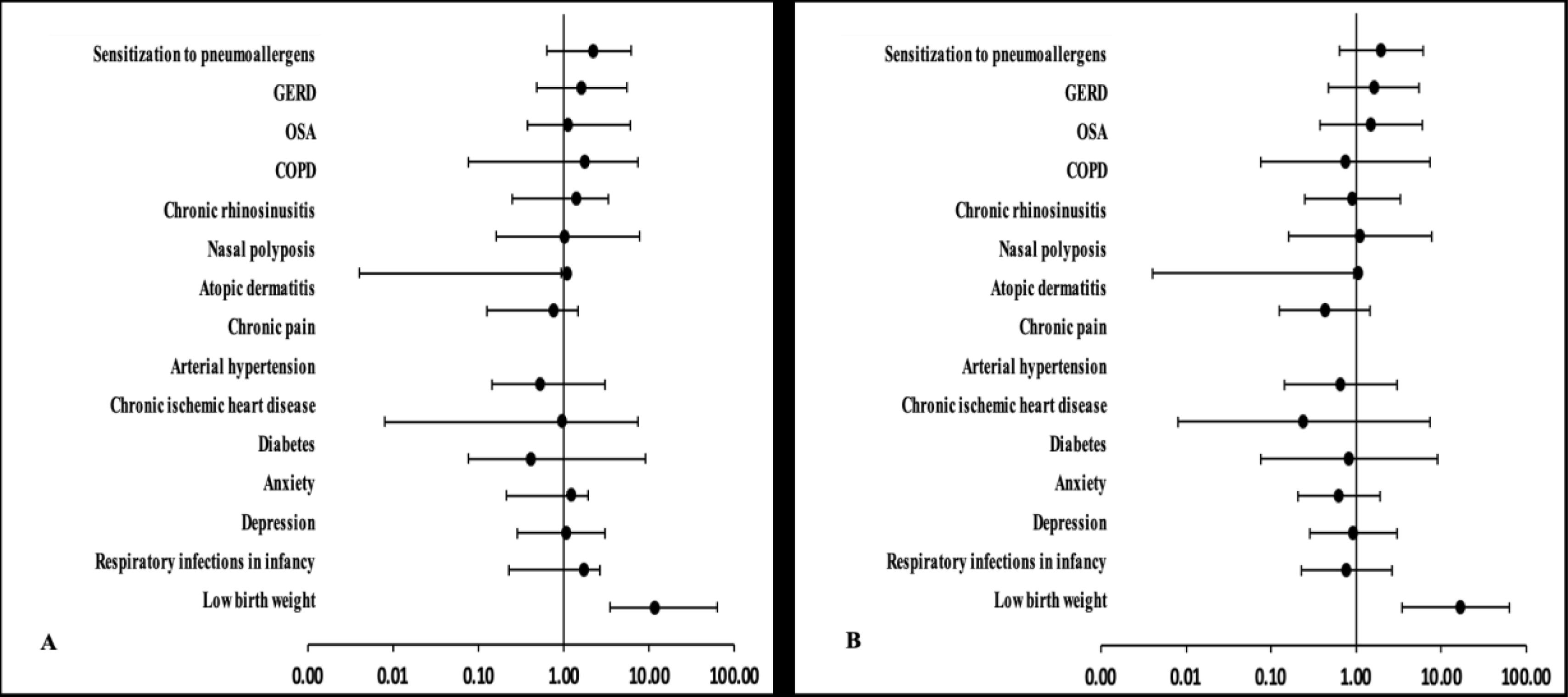
A total of 117 patients were included: 57.3% with CC and 42.7% without CC. Baseline characteristics are summarized in Supplementary Table A.1. Patients with LBW were more likely to have CC (OR: 11.6; p=0.002; 95% CI: 2.504–53.661). No significant association was found between RRIs and the presence of CC (OR: 1.7; p=0.229; 95% CI: 0.705–4.201) (Fig. 1). No statistically significant associations were found with other comorbidities either. 26.5% of patients with CC reported VAS scores between 60 and 70mm, and 16.3% reported scores≥80mm. The EuroQol-5D score was lower in AA with CC (0.55±0.15) compared to those without CC (0.76±0.17; p<0.01). It was found that the higher the VAS score, the worse the EuroQol-5D score (r: 0.640, p<0.01). No association was found between the VAS score and the degree of bronchial obstruction.

(A) Shows the results of the univariate analysis, where each factor is evaluated independently. Conditions such as chronic rhinitis, nasal polyposis, atopic dermatitis, gastroesophageal reflux disease (GERD), obstructive sleep apnea (OSA), chronic obstructive pulmonary disease (COPD), childhood respiratory infections, and low birth weight have OR>1, suggesting a positive association with the likelihood of an asthmatic patient suffering from chronic cough. In particular, a history of low birth weight shows a notable association with a significantly elevated OR, being the only variable where a statistically significant association was detected. (B) Presents the multivariate analysis, adjusted for possible confounding factors. Although some associations were attenuated after adjustment, several comorbidities, including chronic rhinitis, nasal polyposis, atopic dermatitis, sleep apnea, and GERD, maintain an OR>1. Again, low birth weight shows a strong association, suggesting a potential role in the predisposition to chronic cough in adults with asthma.
Our findings indicate that LBW increases the risk of developing CC in AA. Studies in animal models with LBW show a decreased count of microvasculature and pulmonary elastic fibers.4 This causes failed alveolarization and impaired lung function.4,5 This may explain the lower FEV1 and FVC values in those with CC, despite no differences in ACT scores between the two groups. No association was found between RRIs and the risk of CC. However, studies indicate that RRIs induce maturational changes that produce a higher density of C-type nerve fibers and Aδ fibers,4–7 increasing the sensitivity of the airway to various stimuli, even minor stimuli, which causes CC.7 The lack of association in our study may be due to the varying severity of infections and/or genetic factors not evaluated.8
The distribution by age and sex was similar between the groups. As in other studies, CC was more frequent in women.9,10 Elevated levels of fractional exhaled nitric oxide (FeNO), eosinophils, and immunoglobulin E (IgE) have been reported in patients with CC.10,11 We also observed higher IgE levels in asthmatics with CC in our study, probably because sensitization to pneumallergens increases airway reactivity, which could trigger and perpetuate CC.10,11 No differences were found in FeNO levels or eosinophil counts between the groups. It is well established that eosinophils alter nerve function and that airway eosinophilia is present in 50–60% of asthmatics.12 Asthmatics with CC in this study had a mean eosinophil count of 246.1cells/mcL, but we cannot rule out the role of eosinophils in the genesis of CC in asthma. Since we did not have sputum analysis to assess eosinophilia in most patients, it is likely that the eosinophilic response is confined to the airway. Interestingly, no association was observed between chronic pain (CP) and CC, although other studies have reported such an association.12
This could be due to the heterogeneity in the definitions used. In our study, CP was defined as pain lasting more than three months. Differences in temporal criteria and the classification of cough and pain subtypes may have contributed to the reported results.
Our results suggest that LBW could constitute a predisposing factor for the development of CC in AA, possibly due to structural and functional alterations induced in the perinatal stages. Although RRIs did not show a significant association, its pathophysiological role cannot be ruled out. These findings underscore the importance of considering perinatal and childhood history when evaluating AA with CC. Although LBW and RRIs are recognized risk factors for the development of asthma, our study focused exclusively on individuals already diagnosed with this disease. Therefore, the findings presented explore the additional presence of CC, suggesting a possible differentiated vulnerability within the asthma spectrum. There are no studies analyzing the relationship between LBW or RRIs and refractory CC in adult asthmatics. The limitations of this study include its retrospective, single-center nature; possible memory bias in childhood history; relatively small sample size; and the fact that sputum inflammation biomarkers were not evaluated. Despite these limitations, our findings underscore the relevance of certain clinical events in early life in the subsequent development of CC. Prospective, multicenter studies are needed to confirm these observations and to explore possible preventive interventions in at-risk populations.
Artificial intelligence involvementThe authors declare that they have not used any type of generative artificial intelligence in the writing of this manuscript or for the creation of figures, graphs, tables or their corresponding captions or legends.
Informed consentWe have the approval of the ethics committee and the informed consent of the patients included in this research.
FundingThis research has not received any specific grants from agencies in the public, commercial or for-profit sectors.
Authors’ contributionsDesign: SIBA, RGMM and CLSP; draft and final version review: SIBA, JDM and LPM.
Conflict of interestsThe authors state that they have no conflict of interests.
The followings are the supplementary data to this article: