






While emerging digital technologies—such as artificial intelligence, blockchain, big data analytics, and digital twins—have reshaped knowledge management practices, their combined potential to support knowledge-based innovation and sustainability remains underexplored. This study proposes and validates an integrated knowledge management model enabled by digital intelligence that systematically connects open innovation and circular economy strategies. Grounded in the Knowledge-Based View, this study conceptualizes digital intelligence as a dynamic enabler that enhances firms’ capabilities to absorb, integrate, and apply distributed knowledge across organizational boundaries. A comparative multi-case design was applied across four industry benchmark companies, such as PDD Holdings, Huawei, State Grid, and Siemens, using a mixed-methods approach that combined document analysis, 262 survey responses, and expert interviews. Findings show that knowledge management powered by digital intelligence enables the integration of open innovation and circular economy practices by automating knowledge capture, facilitating cross-boundary collaboration, and enabling real-time, sustainability-oriented decision-making. Theoretically, the study extends the knowledge-based view to include digital intelligence-driven mechanisms; empirically, it offers a validated framework applicable across industries. These insights provide practical guidance for organizations to align their innovation performance with sustainability goals in the digital age.
Digital intelligence (DI) technologies have reshaped organizations’ knowledge management by enabling real-time data processing (Pereira & Romero, 2017), automated knowledge extraction (Centobelli et al., 2022), and dynamic organizational learning (Janev, 2021; Bettiol et al., 2022). These technologies enable efficient creation, storage, dissemination, and utilization of information, fostering innovation, enhancing decision-making, and improving resource utilization. However, the combined potential of these technologies for facilitating an integrated approach to knowledge management (KM), open innovation (OI), and circular economy (CE) strategies is largely unexplored. Knowledge management is the systematic acquisition, sharing, and application of knowledge to improve organizational performance (Lopes et al., 2017). Chesbrough (2003) emphasizes that OI is the strategic flow of knowledge across organizational boundaries to enhance innovation (Abdelaty & Weiss, 2023). Circular economy seeks to close material loops and optimize resource use through sustainable designs, recycling, and regenerative practices (Camilleri, 2018). Together, these definitions provide the conceptual foundation for the integrative model proposed in this study.
Each domain—DI, KM, OI, and CE—has individually attracted substantial scholarly attention, but the literature lacks a comprehensive integration of DI-driven KM in the context of combined OI and CE strategies. Existing KM research has focused primarily on internal organizational processes, whereas OI studies have emphasized external knowledge collaboration, often without linking these efforts to broader sustainability goals (Terán-Bustamante et al., 2021), such as those promoted by CE. Jesus and Jugend (2021) identify co-creation as a mechanism through which OI contributes to CE adoption; yet, they note a lack of integrated frameworks that explain how digital tools and knowledge flows enable this process. Their findings reveal that stakeholder collaboration at the micro-level can align incentives and catalyze CE initiatives but demand better knowledge infrastructure and cross-functional capabilities. Empirical insights from Calabrese et al. (2024), based on a meta-analysis of 42 case studies, show that firms aiming to implement circular business models (CBMs) tend to adopt network-based and collaborative OI strategies characterized by both knowledge search depth and cross-sectoral partnership breadth. These strategies are vital for overcoming complexity and uncertainty in CE transitions, although they are poorly integrated with internal KM systems, which limit organizational learning and feedback loops. Building on the relational view, dynamic capabilities theory, and OI literature, Köhler et al. (2022) developed a three-dimensional collaboration framework that underscores knowledge-sharing routines, complementary capabilities, and governance mechanisms as pivotal to the advancement of CE. Using a case analysis, they show that effective CE transformation requires not only partner alignment but also internal dynamic routines that absorb, recombine, and operationalize distributed knowledge—gaps that DI-enabled KM systems are uniquely positioned to address (Lisi et al., 2024). However, their study fails to articulate how internal KM systems should be reconfigured to enable such collaboration through digital means.
This gap limits theoretical understanding and practical implementation strategies that harness digital intelligence to achieve innovation and sustainability goals. To address this critical theoretical and practical gap, this study proposes an integrated DI-driven KM model that systematically connects OI and CE objectives. This study is grounded in the knowledge-based view (KBV), which conceptualizes organizations as institutions for integrating the specialized knowledge of individuals to enable production (Grant, 1996). Unlike earlier approaches that emphasized a reduction in transaction cost or the firm’s role in knowledge creation, KBV emphasizes knowledge application and integration as the firm’s primary function. This strategic theory highlights that production relies on the combination of tacit and explicit knowledge dispersed across individuals, and that firms create value by establishing coordination mechanisms—such as routines, directives, or group decision-making—that facilitate such integration efficiently. Yet, KM models based on KBV models remain underexplored in guiding firms on balancing external openness and internal resource cycles.
Building on this foundation, we extend the KBV by incorporating DI as a dynamic enabler that enhances a firm’s ability to absorb, recombine, and apply distributed knowledge in the context of OI and CE strategies (Samsuden et al., 2024). Hence, this study not only applies but also builds on the KBV for developing a digital-sustainability alignment framework.
This research addresses three central questions:
RQ1: How does DI reshape KM mechanisms within organizations?
RQ2: How does DI-enhanced KM facilitate the integration of OI and CE strategies?
RQ3: What common practices and governance mechanisms across industries enable the successful integration of DI-driven KM with OI and CE strategies?
To answer these questions, this study used a comparative multi-case study approach, investigating companies across different sectors—PDD Holdings (e-commerce), Huawei (technology), State Grid Corporation of China (energy), and Siemens AG (industrial automation)—selected based on their maturity in DI implementation and proactive KM strategies. These four firms represent distinct industries, possess the necessary resources to undertake leading DI-KM initiatives, and offer abundant publicly available data, including annual reports and industry analyses. In fact, the business models of these companies are also relatively complete and representative within their respective sectors.
In addition to case document analysis, 262 responses were collected through semi-structured questionnaires and expert interviews with professionals across these companies and their ecosystems. These insights serve as empirical triangulation and thematic validation, strengthening the conceptual framework and ensuring that the proposed DI-KM-OI/CE integration model is grounded in real-world practices and cross-functional perspectives. This cross-sectoral and multi-source design ensures empirical richness and methodological rigor in validating the model across diverse digital maturity levels.
Fig. 1 presents the proposed conceptual model, illustrating how DI enhances KM processes to support the integration of OI and CE strategies. This framework highlights the dynamic interactions between internal knowledge infrastructures and external innovation ecosystems, offering a unified perspective on achieving both innovation and sustainability through digital capabilities.

The remainder of the paper is structured as follows. Section 2 introduces the theoretical background, including the KBV and related frameworks that inform the proposed model. Section 3 outlines the multi-method research design, including case selection, data collection, and analysis procedures. Section 4 presents the results of the cross-industry data analysis, while Section 5 extends these findings by exploring how representative firms implement DI-driven KM systems in practice. Section 6 discusses the theoretical and practical implications of the integrated model, addressing the research questions posed in the introduction. Finally, Section 7 concludes the study by summarizing key insights and outlining directions for future research.
Theoretical frameworkKnowledge-based view (KBV) and its extension in the digital eraThe KBV posits that knowledge is a strategic resource that serves as the core determinant of sustained competitive advantage (Grant, 1996). According to KBV, firms exist as institutions for integrating and applying the specialized knowledge dispersed across individuals. This perspective underscores two mechanisms: (i) managing heterogeneous knowledge that is distinctive, diverse, and unevenly distributed; and (ii) establishing effective coordination mechanisms, such as routines, communication platforms, and decision protocols—to integrate and leverage this dispersed knowledge (Grant, 1996; Lopes et al., 2017).
The original KBV addresses internal knowledge integration and firm-specific coordination, assuming relatively stable knowledge flows within organizational boundaries. This internally oriented focus limits the framework’s explanatory power in contexts characterized by intensive external collaboration, openness, and rapid adaptation to sustainability imperatives, such as OI and the CE. OI fundamentally depends on the dynamic inflow and outflow of knowledge across organizational boundaries (Naqshbandi & Jasimuddin, 2022), requiring mechanisms that transcend traditional internal-focused KM practices (Chesbrough, 2003). Similarly, CE practices required continuous monitoring and real-time integration of knowledge about resource flows, supply chain partnerships (Cassetta et al., 2023), and sustainability metrics across multiple organizational actors and lifecycle stages (Camilleri, 2018; Köhler et al., 2022). Therefore, extension of the KBV is necessary to accommodate these emerging requirements of inter-organizational knowledge integration and sustainability-driven decision-making.
To address this theoretical limitation, this study extends the KBV by introducing DI as an enabling mechanism of dynamic knowledge integration, capable of bridging internal knowledge resources with external innovation and sustainability-driven demands.
Digital intelligence (DI) as an enabler of dynamic knowledge integrationDigital Intelligence (DI), encompassing advanced technologies such as AI, big data analytics, blockchain, Internet of Things (IoT), and digital twins, has reshaped KM practices through enabling real-time, automated, and decentralized processing of knowledge (Enciso-Alfaro & García-Sánchez, 2024; Cabrilo et al., 2024). Unlike traditional KM systems that rely on static repositories and centralized management of explicit knowledge, DI facilitates dynamic sensing, interpretation, and response to rapidly changing environments—a competence central to the dynamic capabilities framework (Kuzior et al., 2023; Zheng et al., 2024).
Building on this conceptual framework, recent studies have identified three core ways through which DI addresses the limitations of traditional KM. First, DI enables knowledge automation by extracting and integrating unstructured data through AI and machine learning, reducing manual codification and enhancing access to real-time, actionable insights (Bettiol et al., 2022). Second, DI promotes inter-organizational knowledge exchange via blockchain and IoT (Danjou et al., 2024), offering secure and traceable platforms that foster OI (Cuevas-Vargas et al., 2023). Third, it supports eco-aligned decision-making using predictive analytics and digital twins to monitor, simulate, and optimize resource flows, aligning knowledge application with CE principles (Köhler et al., 2022; Calabrese et al., 2024). These digital capabilities form the triadic operational mainstay of the integrated model proposed in the next section.
Integrative digital intelligence-knowledge management-open innovation-circular economy frameworkThis study proposes a structured conceptual framework termed the DI-Driven Knowledge Integration Model, as shown in Fig. 2. This model illustrates how DI dynamically enhances KM to facilitate the concurrent objectives of OI and the CE.

The proposed model comprises three core, interdependent layers that collectively illustrate how DI enables integrated KM to support the objectives of OI and CE. At the foundational level, the DI layer comprises enabling technologies, such as artificial intelligence (AI) for advanced analytics and predictive modeling, blockchain for secure knowledge transactions, IoT for real-time data capture, and digital twins for virtual simulation and scenario planning. These technologies generate accurate, timely, and context-specific data that feed into and enrich the firm’s KM processes. Building on this foundation, the KM layer structures and integrates knowledge by leveraging DI inputs across three key capabilities: (i) first, automated knowledge capture and structuring enhances efficient integration and retrieval of both structured and unstructured information, allowing firms to respond swiftly to changing environmental conditions; (ii) second, secure and open knowledge networks enable inter-organizational knowledge exchange, fostering cross-boundary collaboration and trust among innovation partners; and (iii) third, data-driven decision-making improves organizational responsiveness and strategic adaptability through real-time insights and predictive intelligence. Finally, the application layer translates enhanced KM capabilities into concrete outcomes by facilitating collaborative innovation and supporting CE practices, including lifecycle optimization and resource circularity. Through this layer, firms can systematically leverage their enhanced knowledge capabilities to build collaborative innovation ecosystems, integrate external knowledge, and optimize resource utilization in sustainable and regenerative practices.
The core logic of the proposed model is structured around a set of interrelated knowledge pathways that illustrate how DI facilitates the integration of KM, OI, and CE strategies. First, DI directly transforms internal KM capabilities by enabling automated, secure, and data-driven knowledge processes. These enhanced KM mechanisms improve the efficiency of knowledge capture, structuring, and dissemination, and also establish a foundation for adaptive organizational learning. Second, as KM capabilities are strengthened, firms become better equipped to engage in external innovation networks and simultaneously optimize resource use and lifecycle management—facilitating the integration of OI and CE practices. Third, the simultaneous pursuit of OI and CE strategies, underpinned by a robust DI-enabled KM system, generates synergistic effects that advance both innovation performance and sustainability outcomes. Through these interconnected pathways, the model extends the traditional KBV from a firm-centered perspective of internal knowledge integration to a dynamic, externally engaged, and sustainability-oriented framework enabled by DI technologies.
In summary, this theoretical framework advances the KBV by explicitly incorporating DI as a dynamic integrator of dispersed knowledge, effectively linking internal KM processes with external collaborative innovation and sustainable resource management. Thus, this study makes a dual theoretical contribution: first, by extending the KBV to the digital-sustainability context, and second, by systematically illustrating how DI facilitates the coherent integration of KM, OI, and CE practices. This layered architecture provides a conceptual framework and a practical basis for empirical analysis through cross-case comparison.
To validate this framework, a multi-case study was conducted to examine how DI-driven KM works in different companies. The following section explains the research methods.
MethodologyResearch designThis study adopted a quantitative-dominant, mixed-method, comparative multi-case research design. It combined thematic content analysis with quantitative validation to examine how DI is integrated into KM, specifically in the context of OI and CE frameworks. Methodological triangulation is achieved through the integration of three empirical sources: (1) quantitative data from structured survey ratings, (2) qualitative data from open-ended questionnaire responses, and (3) supplementary organizational materials—such as annual reports and industry analyses—that offer contextual depth and support cross-case interpretation, rather than serving as standalone objects of textual analysis.
As shown in Fig. 3, the design is structured to systematically address the three central research questions (RQ1–RQ3) by combining qualitative and quantitative methods, thematic coding, and cross-case comparison.
Case selection and data sources
Four companies were purposefully selected using theoretical sampling to ensure representativeness and comparability across essential theoretical dimensions identified in the literature. The selection criteria included industry diversity, DI maturity, KM system sophistication, and active engagement in OI and CE practices. The selected cases—Pinduoduo (PDD), Huawei, State Grid Corporation of China, and Siemens AG—encompass the e-commerce, information and communications technology (ICT), energy, and industrial automation sectors, respectively, providing a comprehensive cross-industry perspective. The rationale for selecting these companies is presented in Table 1 below:
Case selection criteria.
| Company | Industry | DI Maturity | KM Systemization | OI/CE Engagement | Data Availability | Justification |
|---|---|---|---|---|---|---|
| PDD Holdings | E-commerce | High (advanced use of big data analytics, AI) | Medium (centralized knowledge base) | High (active external collaboration) | Strong | Rapid growth driven by digital innovation in a niche market exemplifies DI-enabled knowledge integration and sustainability-oriented OI practices. This selection is supported by Chang et al. (2019), who highlight Pinduoduo’s unique positioning, user behavior dynamics, and platform transformation challenges amid competitive e-commerce ecosystems. |
| Huawei | ICT | High (AI, blockchain, IoT leader) | High (structured internal KM systems) | High (established R&D collaborations) | Strong | A representative case of multidimensional OI involving cross-border cooperation, knowledge sharing, and ecosystem-level digital transformation. Demonstrates personalized OI patterns and risk-aware innovation strategies across organizational, project, and consumer dimensions (Li et al., 2023). |
| State Grid | Energy | Medium (initial implementation of IoT, digital twins) | High (comprehensive KM systems) | Medium (moderate innovation efforts) | Moderate | Exemplifies a state-backed intellectual monopoly leveraging national innovation systems and public R&D to lead AI-driven transformation in the energy sector. Demonstrates independent innovation capabilities without reliance on foreign technology transfer, enabling systemized KM and gradual integration of DI tools (Rikap, 2022). |
| Siemens AG | Industrial Automation | High (digital twins, AI extensively implemented) | High (integrated KM platforms) | High (proactive OI and CE integration) | Strong | Demonstrates advanced DI through the Siemens Xcelerator platform, integrating real-time supply chain data with digital twin technologies. Exemplifies cross-functional KM integration and data-driven OI/CE practices, supporting agile, sustainable innovation ecosystems (MENA Report, 2023). |
Source: Authors’ elaboration based on case study materials and supporting literature.
The study data were drawn from both primary and secondary sources to support comprehensive analysis and ensure empirical richness. The primary data comprised 262 valid responses to structured questionnaires collected from industry professionals with experience in DI implementation, KM, and sustainability initiatives. These respondents represent a range of functional roles across the four selected companies and their extended ecosystems. Secondary data were obtained from publicly available organizational materials (e.g., annual reports, sustainability disclosures, official websites, and press releases), which provided contextual and descriptive insights to supplement the primary findings.
Data collection instruments and processA standardized questionnaire (Appendix A) was designed to quantitatively assess employees' perceptions regarding the integration of DI with KM, OI, and CE practices. The questionnaire included five modules covering perceptions of DI, internal KM practices, OI and external collaboration support, CE awareness and knowledge support, and governance and strategic alignment. Responses were measured on a 5-point Likert scale (1 = strongly disagree; 5 = strongly agree).
The questionnaire was distributed electronically to middle- and senior-level managers, KM specialists, and sustainability officers from the selected companies, yielding 262 valid responses. Data were anonymized and analyzed using descriptive statistical methods.
Thematic coding frameworkIn addition to structured questionnaire ratings, the study collected 262 valid open-ended responses addressing three key prompts:
- (1)
most helpful digital tools for knowledge sharing,
- (2)
main obstacles to organizational knowledge sharing, and
- (3)
suggestions for improving the KM–OI–CE link.
These responses were subjected to a theoretically guided, three-level thematic coding process (Table 2), grounded in the extended KBV and DI literature. Thematic coding enabled the identification of the core dimensions (KM, OI, CE), sub-themes, and specific DI-linked mechanisms such as AI retrieval, blockchain sharing, and digital twin optimization.
Three-level thematic coding structure.
Source: Authors’ elaboration based on questionnaire data, 2025.
Table 3 shows the selected coded excerpts to illustrate coding transparency and replicability. While the thematic coding framework was initially theory-driven, especially at the core dimension and sub-theme levels, Level 3 indicators were further refined through iterative coding of open-ended responses. This approach enabled the inclusion of both predefined DI-based mechanisms (e.g., AI-driven retrieval, blockchain collaboration) and emergent themes (e.g., tacit knowledge integration, incentive misalignment) that appeared across multiple cases. This combination of deductive and inductive coding enhanced the theoretical consistency and empirical richness of the analysis.
Example of coded data segments.
Source: Authors’ elaboration based on questionnaire data, 2025.
Data analysis proceeded in three integrated phases to ensure methodological rigor, internal validity, and cross-case comparability. First, structured questionnaire data were analyzed using Python-based statistical tools. Descriptive statistics, reliability tests, and multiple regression models were conducted using libraries such as Pandas, Statsmodels, and Scikit-learn to empirically test the hypothesized relationships among DI, KM, OI, CE, and strategic enablement constructs. Second, open-ended survey responses were analyzed using a hybrid approach combining Python-assisted text analysis—including tokenization, frequency mapping, and co-occurrence analysis—with a three-level thematic coding framework grounded in the extended Knowledge-Based View. A deductive thematic coding strategy was employed, using semantic keyword anchors mapped to a theoretically derived three-level theme hierarchy (see Table 2). This enabled the identification of dominant themes, DI-linked knowledge mechanisms, and recurring organizational patterns across sectors. Third, publicly available firm-level materials (e.g., annual reports, ESG disclosures, product documentation) were examined to extract representative DI-enabled KM practices in the four focal companies. These qualitative case insights were used to not only contextualize the survey results but also serve as the foundation for a comparative cross-industry analysis, which identified shared challenges, enabling mechanisms, and strategic approaches to integrating KM with OI and CE across diverse industrial contexts. This final step strengthened the external validity and practical relevance of the proposed DI-KM-OI/CE framework.
Triangulation and cross-validationThis study employed a multi-level triangulation and cross-validation strategy to ensure methodological rigor and validate the proposed DI-driven KM integration framework across diverse organizational settings. This process integrated three primary sources of empirical evidence: structured survey data, open-ended textual responses, and supplementary firm-level documentation.
The quantitative component served as the foundation for statistically testing the relationships among the key elements. Descriptive statistics and regression analyses provided a robust measure of construct-level associations, disclosing generalizable trends across respondent groups.
Complementing this, qualitative data from the open-ended survey items were analyzed using a three-level thematic coding framework aligned with the theoretical constructs introduced in Section 2. Thematic patterns across the KM, OI, and CE dimensions were derived both deductively (from DI-informed theoretical categories) and inductively (from respondent discourse), offering nuanced insights into how DI mechanisms operate within specific organizational contexts.
To enrich and contextualize these findings, illustrative firm-level data, drawn from annual reports, ESG disclosures, and product documentation, were incorporated into the multi-case analysis. These documents substantiated the practical implementation of DI-enabled KM strategies and highlighted organizational variations in applying DI to support innovation and sustainability goals. A cross-case comparison across four companies revealed both convergent and divergent patterns, indicating how DI infrastructure enables external collaboration and resource circularity under different industry logics.
The integration of these complementary data sources enabled reciprocal validation across methods and levels of analysis, enhancing the study’s theoretical credibility, practical relevance, and empirical robustness.
Despite the benefits of this triangulated mixed-method design, several practical challenges surfaced during implementation. First, the variability in terminology and DI maturity levels across industries posed difficulties in standardizing questionnaire items and interpreting qualitative responses. In addition, due to the relatively early stage of DI adoption, many companies considered core DI-related mechanisms and datasets as proprietary strategic assets and were reluctant to disclose them in detail. This limited the depth of qualitative insights and introduced difficulties in thematic triangulation. Open-ended responses, while valuable in highlighting contextual nuances, inclined toward simplification or generalization and required careful calibration during coding to minimize subjectivity and ensure consistency across cases. Lastly, synthesizing findings across diverse sectors obligated continuous iteration between empirical coding and theoretical framing to ensure comparability without oversimplification.
ResultsQuantitative survey resultsThe structured questionnaire yielded descriptive statistics that provided insights into the adoption and implementation of DI, KM, OI, CE, and strategic enablement across the four surveyed organizations. The study results show consistently high mean scores, reflecting positive perceptions of these constructs.
As shown in Table 4, all five constructs had high mean values, indicating positive perceptions across the dimensions of DI, KM, and strategic innovation. Standard deviations remained within an acceptable range, and Cronbach's alpha values exceeded the 0.80 threshold for each construct, indicating good internal reliability.
Regression analyses provided further empirical support for the hypothesized relationships among the core constructs. When predicting OI, both DI and KM showed significant positive effects, with standardized coefficients (β) of 0.51 and 0.47, respectively (p < 0.001 for both). The overall model explained nearly 79 % of the variance in OI (R² = 0.789), indicating a strong explanatory power. This result demonstrates that organizations with higher levels of DI and mature KM systems are more likely to achieve superior OI outcomes.
A similar pattern was observed in the regression predicting CE outcomes. Both DI and KM served as robust predictors, with coefficients of 0.48 and 0.49 (p < 0.001), and the model accounted for 80 % of the variance in CE (R² = 0.801). These results underscore the mutually reinforcing roles of digital transformation and KM in supporting organizational sustainability and resource efficiency.
Significantly, the analysis of KM itself as a dependent variable further clarified the mediating mechanism within the model. Here, DI had a powerful effect (β = 0.79, p < 0.001), accounting for approximately 66 % of the variance in KM (R² = 0.659). This finding empirically substantiates the theoretical proposition that DI is an essential enabler for building organizational knowledge capabilities, which in turn drive both innovation and sustainability-oriented outcomes.
All the considered models had excellent overall fit, with high F-statistics and extremely low p-values for each regression equation. The Durbin-Watson statistics indicated no severe autocorrelation, and the residual diagnostics (Omnibus and Jarque-Bera tests) confirmed that the assumptions of normality and homoscedasticity were largely satisfied.
Overall, these regression results validate the central theoretical framework of this research. They confirm that DI not only directly enhances OI and CE outcomes but also does so indirectly through its substantial influence on organizational KM. Thus, the pathway DI → KM → OI/CE is robustly supported, offering strong evidence that organizations seeking to advance both innovation and sustainability objectives should prioritize the development of DI capabilities and integrated KM systems. Complete outputs are available in Appendix B.
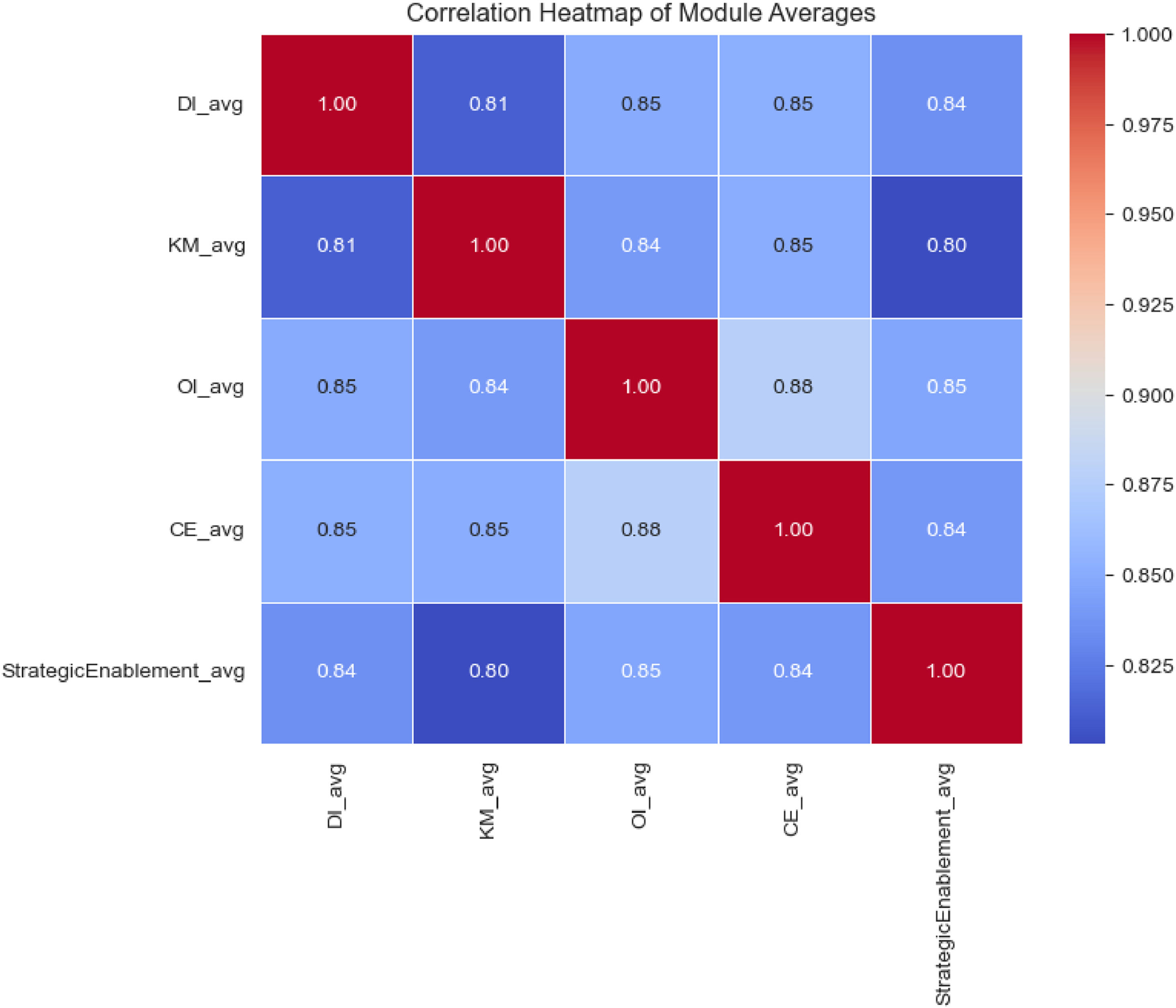
A correlation heatmap was constructed to visually represent the relationships among the five module averages—DI, KM, OI, CE, and Strategic Enablement. As shown in Fig. 4, all pairwise correlations are robust and positive, with coefficients ranging from 0.80 to 0.88. Notably, the relationship between OI and CE is the highest (r = 0.88), indicating that organizations excelling in OI are most likely to embed CE principles in their operations. Both DI and KM display high correlations with OI and CE, supporting the proposition that DI and KM are foundational enablers for organizational innovation and sustainability.

The consistently high intercorrelations among all five constructs underscore the integrated nature of the DI-KM-OI/CE model. The strong association between Strategic Enablement and the other four modules (e.g., r = 0.84 with DI and CE) suggests that governance structures and alignment mechanisms are not only supportive but may be necessary conditions for fully realizing the potential of DI and KM in driving innovative and sustainable outcomes. The heatmap thus provides robust visual evidence for the coherence and structural validity of the proposed conceptual model, justifying subsequent pathway and mediation analyses.
The results confirm that DI reshapes organizational KM mechanisms by enabling automated real-time knowledge capture, dynamic knowledge structuring, and predictive decision-making, thus fundamentally changing traditional static KM practices.
Qualitative open-ended analysisA qualitative analysis of the 262 open-ended responses complemented the quantitative findings and provided deeper insights into how DI transforms KM practices across various organizational contexts. In response to the first open question, commonly cited digital tools included AI-powered search, knowledge management platforms (e.g., Notion, Zotero), and interactive dashboards, underscoring the operational role of DI in automating and enhancing knowledge capture and sharing. In the second question regarding obstacles, frequently mentioned terms such as “siloed departments,” “lack of incentives,” and “security concerns” highlighted structural and cultural challenges that hinder effective KM implementation, particularly in enabling cross-boundary collaboration and knowledge reuse. Suggestions for improvement (Q3) focused on closely aligning KM with OI and CE objectives. Respondents emphasized the need for collaborative platforms, integrating sustainability knowledge, and strengthening links between knowledge flows and innovation governance. High-frequency keywords such as “collaboration,” “green,” “platforms,” and “AI” were systematically mapped to the three-level thematic coding structure described in Section 3.4 and visualized through co-occurrence graphs and heatmaps. To further illustrate these patterns, two visualizations were developed to complement the thematic analysis:
In Fig. 5, the heatmap shows the frequency of the core themes considered, namely KM, OI, and CE, across the three open-ended questions (Q1–Q3). The study results indicate that KM-related content dominates responses to Q1 (digital tools), while CE themes emerged prominently in Q3 (suggestions), reflecting respondents’ emphasis on sustainability-oriented KM improvements.

The bar chart shown in Fig. 6 highlights the most frequently coded sub-themes, with Knowledge Capture, Resource Optimization, and External Collaboration leading the distribution. These results reinforce the critical role of DI in enabling data-driven KM practices and cross-boundary innovation.

These findings support the proposed DI-driven knowledge integration model by demonstrating how DI enhances internal KM capabilities and facilitates the outward integration of OI and CE practices, enabling organizations to construct agile, knowledge-based innovation ecosystems. To further strengthen these findings and provide practical validation, Section 4.3 presents detailed company case studies (i.e., including Pinduoduo, Huawei, State Grid, and Siemens) introduced in Section 3.2. These case studies are additional empirical support and exemplify how organizations effectively apply the principles of DI-driven KM to achieve sustainable innovation and operational excellence.
Case study analysisBuilding on the empirical results presented, this section presents complementary evidence from the four representative company cases to validate the proposed DI-KM-OI/CE integration model in different industrial contexts.
PDD Holdings Inc.: real-time data and AI-driven KM in e-commercePDD Holdings Inc., a multinational commerce group in China, employs DI to build a responsive, data-driven e-commerce ecosystem. Unlike traditional models, it uses AI tools to automate real-time data collection and support agile decision-making among consumers, suppliers, and manufacturers. This enhances KM across the supply chain, enabling faster product iteration aligned with customer needs. A notable example is the New Brand Initiative, which supports small producers through AI-based insights and supply chain flexibility (PDD Holdings, 2019).
The company’s KM system incorporates CE principles. Predictive analytics and AI-optimized logistics reduce overproduction and waste, as illustrated by its e-waybill system and the Farm-to-Consumer model. China’s Farm Cloud Initiative further digitizes agricultural supply chains and supports regional branding, while the 10 Billion Agriculture Initiative applies AI to promote sustainable farming and resource efficiency (PDD Holdings, 2023). To ensure responsible knowledge use, PDD implements strong data governance and compliance frameworks. AI tools enhance transparency, security, and intellectual property protection across its OI processes. While stakeholder alignment remains a challenge, the company’s structured KM enables continuous learning and adaptation.
Overall, PDD demonstrates how DI transforms KM from a back-end function into a strategic driver for innovation and sustainability. These findings reflect broader trends in AI-driven DI systems across the e-commerce industry, supporting agile business strategies and efficiencies at scale.
Huawei: integrating KM for innovation and sustainabilityChina’s Huawei Technologies Co. Ltd. integrates DI into a structured KM system that supports both innovation and sustainability. Unlike firms focused solely on hardware, Huawei embeds DI into its global R&D network, enabling efficient knowledge sharing, real-time project monitoring, and optimized resource use. Over half of its workforce—more than 114,000 employees—is dedicated to R&D, highlighting its strong KM foundation (Huawei, 2023).
Blockchain-enabled traceability ensures transparency in manufacturing and safeguards intellectual property, building stakeholder trust and reinforcing OI. Internally, KM platforms support collaboration across teams, while Huawei partners externally with universities, startups, and industry actors to embed external knowledge into its innovation process. By 2023, it held over 140,000 active patents and engaged 5.7 million developers and 6300 partners through initiatives such as the Huawei Innovation Research Program (HIRP) and its “All-Intelligence” strategy (Huawei, 2023). These efforts extend KM’s impact beyond corporate boundaries, creating an open and scalable innovation ecosystem. Huawei’s DI-guided KM system also underpins its CE strategy. The company uses digital twin technology for predictive maintenance, adopts a modular and energy-efficient product design, and incorporates blockchain into its recycling programs to track and reuse electronic materials. These practices exemplify how KM supports sustainable resource management and lifecycle optimization.
Strong governance and AI-powered compliance tools ensure a secure and transparent exchange of knowledge. Huawei’s case shows how DI, KM, OI, and CE converge to form a resilient and forward-looking innovation model.
State Grid Corporation of China: digital intelligence (DI) as a driver of energy innovation and sustainabilityChina’s State Grid Corporation, the world’s largest utility, leverages DI to manage knowledge across vast power networks, improving energy efficiency, grid stability, and sustainability. Instead of relying on centralized infrastructure, the company integrates smart meters, IoT sensors, and predictive analytics to monitor usage, detect faults, and optimize operations in real time. Blockchain ensures secure information exchange between operators and suppliers, enhancing adaptability and resilience.
To support OI, State Grid funds academic research in AI-driven grid management, energy storage, and renewable optimization. These partnerships enable early-stage innovation while reinforcing structured KM across its ecosystem. Consistent with CE principles, State Grid uses AI for forecasting and real-time adjustments, which reduce energy waste and maximize the use of renewable sources, such as solar and wind. Its KM framework tracks infrastructure lifecycle data, enabling equipment recycling and predictive maintenance. Blockchain-based traceability monitors the performance and reuse of renewable components, such as solar panels and wind turbines.
Strong governance and AI-powered compliance tools secure data while supporting regulatory collaboration. Structured KM ensures transparency and efficient knowledge-sharing among producers, operators, and policymakers (Huajing Industry Research Institute, 2024). Overall, this case highlights how DI-integrated KM enables innovation and sustainability in the energy sector through smart infrastructure and collaborative governance.
Siemens AG: leveraging KM for digital innovation and efficiencySiemens applies DI-driven KM to advance digital transformation, industrial efficiency, and sustainability. A dynamic KM system that collects and shares real-time data across smart factories, notably at the Amberg Electronics Plant, supports Siemens’ global operations. By integrating IoT, AI-based predictive maintenance, and digital twin simulations, Siemens reduces machine downtime and improves energy efficiency by up to 60 % (Siemens, 2024, 2024a).
The company's OI model is built on MindSphere and Xcelerator platforms, which enable external developers, partners, and customers to co-create IoT and AI solutions (Siemens, 2024b). These platforms support real-time knowledge exchange and continuous improvement, linking business operations with technical innovation. Siemens also embeds CE principles through smart energy management systems, such as Desigo CC, sustainable product designs such as SF₆-free switchgear, and lifecycle data tracking for equipment reuse and resource optimization. AI and blockchain tools ensure secure, compliant knowledge-sharing across its ecosystem.
By structuring real-time data, predictive tools, and collaborative platforms, Siemens demonstrates how DI-enabled KM drives both innovation and sustainability. The company's ability to help customers cut 150 million tons of CO₂ and its commitment to achieve carbon neutrality by 2030 exemplify the strategic impact of its integrated approach (Siemens AG, 2023).
Cross-industry analysisInformed by the above four individual case insights, this cross-industry analysis reveals consistent patterns through which DI functions as a strategic enabler of organizational learning and coordination, effectively strengthening KM systems and supporting sustainable innovation across diverse contexts. Consequently, this systematic reinforcement of KM fosters OI and supports CE initiatives, validating the theoretical proposition that DI-KM-OI/CE represents a generalizable and cyclical pathway. The following sections summarize the cross-case findings across three core themes:
- (1)
how DI enhances KM mechanisms (RQ1),
- (2)
how KM facilitates OI and CE outcomes (RQ2), and
- (3)
what governance enablers support sustainable DI-KM-OI/CE integration (RQ3).
These three analytical dimensions—DI tools and infrastructures, KM practices, and DI-KM operational logic—were developed based on the extended KBV and further informed by recent studies on digital-enabled knowledge systems and innovation governance, such as Köhler et al. (2022) and Calabrese et al. (2024).
Enhancing knowledge management through digital intelligenceTo address RQ1, this section compares the application of DI capabilities across the four organizations to strengthen KM. The analysis focuses on three dimensions:
- (1)
specific DI tools and infrastructures deployed,
- (2)
key KM practices enabled, and
- (3)
operational logic linking DI functionalities to KM outcomes.
Table 5 summarizes these dimensions to highlight the mechanisms through which each organization integrates DI into its KM systems.
DI–KM integration across case organizations.
Source: Authors’ elaboration based on case study materials.
Despite differences in operational contexts and industry specifics, each organization uniformly employs real-time data analytics and predictive intelligence to enhance KM capabilities. By capturing immediate shifts in market demands, detecting operational failures promptly, and proactively mitigating disruptions, these firms achieve heightened responsiveness and agility.
Another commonality is the transition toward the platformization of knowledge. Rather than traditional static documentation or fragmented knowledge repositories, digital platforms have evolved into dynamic ecosystems where knowledge flows seamlessly (e.g., Huawei’s HIRP and Siemens’ Xcelerator). These platforms simplify internal knowledge integration and facilitate seamless external collaboration, extending the organizational boundaries of KM. Such digital ecosystems exemplify a fundamental shift toward modular, scalable, and interactive knowledge services that underpin sustained innovation processes.
Facilitating innovation and circularity through intelligent KM systemsTo address RQ2, this section examines how DI-driven KM systems facilitate both OI and CE initiatives across the four case organizations. The comparative analysis focuses on three key dimensions:
- (1)
mechanisms supporting OI collaboration,
- (2)
application of CE practices, and
- (3)
functional role of DI-powered KM systems in linking and enabling both agendas.
Table 6 presents how each organization integrates OI and CE into its operations through intelligent KM infrastructures, demonstrating their pivotal role in integrating external collaboration and sustainability goals within each organization.
Knowledge management (KM) as a bridge between OI and CE.
Source: Authors’ elaboration based on case study materials.
Central to these innovation processes is the role of collaborative intelligence. Across the case studies, OI emerges prominently through structured partnerships with external entities, including suppliers, startups, academic institutions, and cross-industry alliances. Enabled by DI-powered KM systems, these collaborations strike a careful balance between openness and governance to ensure creative knowledge inflow and maintain intellectual property integrity and compliance with regulatory standards. Thus, KM infrastructure functions as both a facilitator and regulator, enhancing the depth and breadth of innovative outcomes without sacrificing security or strategic control.
The integration of CE principles within each organization is not an isolated or supplementary objective. Instead, circular practices arise naturally from the operational insights and efficiency gains enabled by DI-driven KM frameworks. Optimizing design processes, reducing waste generation, improving resource allocation, and managing product lifecycles sustainably, these organizations show how CE becomes an integral component of a comprehensive innovation strategy, rather than an afterthought or isolated initiative.
Cross-industry enablers for sustainable DI-KM-OI/CE integrationAddressing RQ3, this section examines the governance mechanisms that enable effective integration of the four elements across diverse organizational contexts. The comparison focuses on three dimensions:
- (1)
governance and compliance technologies adopted,
- (2)
mechanisms through which these technologies operate, and
- (3)
organizational outcomes secured.
Table 7 summarizes how advanced governance tools support the scalability, security, and sustainability of DI-KM-OI/CE systems across the four cases.
Governance mechanisms as cross-industry enablers of integrated DI-KM-OI/CE strategies.
Source: Authors’ elaboration based on case study materials.
As shown in Table 7, robust governance mechanisms, leveraging advanced technologies such as AI and blockchain, are a vital enabler across all four organizations. AI-driven compliance tools ensure transparency and security of knowledge exchanges, while blockchain technologies offer auditability and enhanced trust in cross-boundary interactions. Such sophisticated governance practices enable organizations to overcome common knowledge-sharing barriers such as data security concerns, protection of intellectual property rights, and internal information silos, ensuring that DI-powered KM systems operate effectively within established regulatory frameworks.
Integrated interpretationThe integration of qualitative and quantitative findings provides compelling evidence in support of the proposed DI–KM–OI/CE model. Regression results reveal strong predictive relationships: DI enhances KM (R² = 0.66), which in turn influences both OI (R² = 0.79) and CE (R² = 0.80). These established clear statistical pathways confirm the model’s structural validity.
Qualitative insights contextualize these relationships by illustrating how organizations deploy DI tools, navigate KM challenges, and align knowledge processes with innovation and sustainability goals. Despite sectoral differences, a shared logic emerges: DI-enabled KM consistently drives strategic innovation and circular practices across industries.
These combined analyses validate the central thesis of this research: effective integration of DI within KM frameworks enhances an organization's capacity for innovation and sustainable development. Building on this integrated understanding, the subsequent section proposes a generalized DI-KM-OI/CE model, synthesizing the core mechanisms identified across industries and delineating their potential applicability to broader organizational contexts.
Generalizable DI-driven KM modelBuilding on the common mechanisms and key patterns identified through the preceding cross-industry analysis, this section proposes a generalizable and theoretically grounded integration model of KM driven by DI. While the earlier case studies emphasized how individual firms apply DI in context-specific ways, it is essential to abstract these insights into a standardized and widely applicable model to enhance the theoretical contribution of this research and offer clear, actionable guidance for managerial practice. The model presented here links the core functions of DI (i.e., real-time data acquisition and structured knowledge organization) with the internal mechanisms of KM, including intelligent processing and collaborative knowledge sharing. This integration enables effective implementation of OI and CE strategies.
The model unfolds across three distinct yet interrelated stages. In the first stage of knowledge capture and structuring, organizations deploy AI, the IoT, and cloud platforms to acquire real-time, multi-source data from internal operations, external partners, and dynamic market environments, thereby laying a robust foundation for knowledge-based decision-making. In the second stage of intelligent knowledge processing and sharing, enterprises use big data analytics, digital twin technology, and blockchain systems to convert unstructured data into actionable strategic insights and establish secure, high-efficiency knowledge-sharing networks both within and across organizational boundaries. In the third stage of strategic application in OI and CE, firms apply this processed knowledge to drive collaborative innovation initiatives, enhance resource efficiency, and reduce environmental impact through sustainable design, optimized supply chains, and lifecycle management.
This model is not a simple linear process but a dynamic, iterative cycle. Each stage generates feedback that informs and improves the others, ensuring that organizational knowledge remains timely, actionable, and responsive to change. This continuous feedback mechanism enables organizations to adapt effectively to external market volatility, maintain an updated knowledge base, and sustain competitive agility. As illustrated in Fig. 7, the model comprises three interlinked phases comprising knowledge capture, intelligent processing, and strategic application, providing a comprehensive and scalable framework that organizations across sectors can adopt to integrate OI and CE principles through DI.

The proposed three-stage DI-driven KM model directly reflects and synthesizes the findings related to this study’s three research questions. This model illustrates how DI enables real-time, structured knowledge capture and reshapes traditional KM practices (RQ1); how KM, when enhanced by intelligent tools and platforms, supports the strategic integration of OI and CE initiatives (RQ2); and how governance mechanisms, emerging consistently across industries, support this integration (RQ3). This theoretical alignment provides the foundation for the following discussion, which expands on these linkages by unpacking the specific mechanisms, industry applications, and governance implications in greater depth.
DiscussionHow DI reshapes KM mechanismsThis study provides theoretical and empirical evidence illustrating how DI profoundly reshapes KM practices within organizations. Technologies shift KM from static, centralized repositories to dynamic, real-time ecosystems. Findings from structured questionnaires and thematic analyses consistently highlight that DI significantly improves organizational agility, efficiency, and responsiveness by automating knowledge processes, enabling instant dissemination, and supporting predictive decision-making. Theoretically, these results extend the KBV by emphasizing dynamic integration of dispersed knowledge, underscoring the strategic necessity of DI adoption for sustaining competitive advantage and adaptability. These findings align with and extend KBV perspectives proposed by Grant (1996), who emphasized knowledge integration as a source of organizational advantage, now redefined in a DI-driven, real-time context.
Integration of DI-enhanced KM with OI and CEEmpirical analyses indicate that DI-enhanced KM facilitates strategic integration with OI and CE. Digital intelligence (DI) technologies enhance cross-boundary collaboration by securely managing external knowledge via blockchain-enabled tools and digital twin simulations. Such integrations not only support co-creation but also align innovation strategies with sustainability goals. However, organizations encounter challenges such as balancing openness with intellectual property protection and cybersecurity. The findings echo insights from Calabrese et al. (2024), who noted that digital infrastructures are key enablers of knowledge flows between OI and CE initiatives. Moreover, the results underscore the importance of advanced governance mechanisms, supported by DI technologies, to effectively manage these challenges and foster a coherent innovation ecosystem.
Cross-industry governance mechanisms and practicesCross-industry analyses identified common governance mechanisms and practices critical for the successful integration of DI-driven KM with OI and CE strategies. Blockchain knowledge-sharing platforms, predictive digital twins, AI-driven compliance systems, and structured collaboration routines consistently emerged across e-commerce, ICT, energy, and industrial automation sectors. Similar cross-industry coordination structures are discussed in Köhler et al. (2022), where blockchain and digital twins are identified as governance tools for circular collaboration. The recurring adoption of these mechanisms across diverse industries validates the broader applicability of the extended KBV framework proposed in this study. Practically, organizations should develop industry-agnostic governance structures leveraging DI to enhance competitive advantage and innovation-driven sustainability.
Practical implications and future research directionsThis research highlights broader theoretical implications and practical applications rather than repeating empirical findings. First, extending KBV, DI is positioned as an essential enabler of dynamic knowledge integration, surpassing traditional KM through real-time analytics and adaptive processes. Organizations are, thus, better equipped to navigate rapidly changing markets. Governance frameworks and structured knowledge-sharing emerge as critical elements for sustainable innovation ecosystems. A notable theoretical shift is evident from internal KM to fostering secure, transparent inter-organizational collaboration via blockchain and AI compliance systems.
Practically, this study provides actionable insights for organizations, particularly SMEs, as highlighted by Jesus and Jugend (2021), who emphasize the need for supportive policy frameworks to lower digital innovation barriers. Scalable DI solutions and strategic partnerships can overcome resource constraints. Policymakers should support digital knowledge ecosystems through regulatory frameworks that ensure transparency, ethics, and fair competition. For business managers, these findings offer practical guidance on operationalizing DI-enabled knowledge management within their organizations. Managers should prioritize the deployment of modular and interoperable DI tools, such as cloud-based knowledge repositories, blockchain collaboration platforms, and predictive analytics systems, to enhance real-time knowledge flow and decision-making. Establishing formal knowledge-sharing routines, incentivizing cross-functional collaboration, and investing in data governance frameworks are essential to ensure trust and traceability across internal and external knowledge sources. Furthermore, developing internal digital capabilities through targeted training can help overcome resistance to change and improve organizational readiness for sustainable innovation.
Challenges remain, including the high implementation cost of DI, skill shortages, and infrastructural deficiencies in emerging markets. Ethical considerations, such as algorithmic bias and reduced human oversight in AI-driven systems, require ongoing attention. Future research should include longitudinal studies examining the evolving impact of DI-driven KM across sectors, comparative analyses of DI adoption in emerging versus developed economies, and deeper exploration into human-AI interactions within knowledge ecosystems.
ConclusionThis study explores how DI transforms traditional KM, enhancing organizational capabilities for OI and CE practices. Empirical validation across multiple industries confirms that DI technologies facilitate real-time knowledge integration, decision-making, and sustainable resource management. The integrative DI-KM-OI/CE framework proposed in this study highlights DI’s dual role in sophisticated knowledge integration and strategic adaptability, emphasizing the importance of robust governance structures for secure and transparent knowledge ecosystems.
Integrating DI into KM frameworks is a strategic imperative for firms seeking to maintain a sustained competitive advantage in complex, interconnected environments. Future research should focus on the dynamic interaction between human expertise, organizational culture, and DI to refine these strategic frameworks further and enhance their adaptability across diverse economic contexts.
FundingThis research was funded by The National Natural Science Foundation of China, “Research on Intelligent Evidence-Based Policymaking Information Awareness and Its Dynamic Deduction Driven by Knowledge Computing” (Grant No. 72374082).
Ethical considerationsResearch procedures strictly adhered to ethical standards. All survey responses were collected under informed consent conditions, guaranteeing confidentiality and anonymity. Participants were informed of the academic purpose of the research and their right to withdraw at any time.
CRediT authorship contribution statementXinping Huang: Writing – review & editing, Supervision, Methodology, Funding acquisition, Conceptualization. Qianwen Zhou: Writing – original draft, Visualization, Validation, Formal analysis.
The authors declare that they have no known competing financial interests or personal relationships that could have appeared to influence the work reported in this paper.
