






Sustainability, which addresses inequality and resource scarcity, has become a central concern for scholars, entrepreneurs and policymakers. However, the interrelationships between different components of regional sustainability in the innovation ecosystem remain underexplored. Grounded in innovation ecosystem theory, this study examines antecedent conditions across two dimensions, soft power and hard power, to explore pathways for promoting high-level regional sustainability. Utilizing publicly available official data from China, we constructed a comprehensive dataset covering 30 provinces and systematically analyzed the contributions of various potential combinations of antecedent conditions to high regional sustainability using fuzzy-set qualitative comparative analysis. This study identifies four pathways to achieve high regional sustainability, with the digital economy playing a core role in all pathways. In contrast, the roles of knowledge innovation, human capital, and technological cooperation were relatively less significant. Furthermore, this study employed Necessary Condition Analysis to evaluate the necessary relationships between each antecedent condition and the outcome. The findings not only enrich the theoretical framework for regional sustainable capacity but also provide actionable insights for policymakers to facilitate the realization of regional sustainable development.
AbbreviationsNCA Necessary Condition Analysis fuzzy-set Qualitative Comparative Analysis clear set qualitative comparative analysis multivalued set qualitative comparative analysis Technological Innovation Knowledge Innovation Human Capital Research and Development Investment Technological Cooperation Digital Economy Innovation Ecosystem Regional Sustainability
Most countries prioritize sustainable development (Li et al., 2023), focusing on ensuring long-term economic, social, and environmental balance. However, challenges, such as climate change, resource scarcity, environmental degradation, and social inequality, pose severe threats to sustainable global development (Chang & Fang, 2023). To effectively address these challenges, governments and academia worldwide are actively exploring transformation paths for the coordinated development of the economy and environment (Lu et al., 2020; Fernandes et al., 2022). As a key driver of global economy and a rapidly developing emerging market, China faces both unique opportunities and considerable challenges in promoting sustainable development (Zhang et al., 2022). On the one hand, China's solid economic foundation, substantial market potential, and strong policy execution provide strong support for promoting green technology innovation (Luo et al., 2023), industrial transformation and upgrading (Wu & Liu, 2021), and sustainable infrastructure construction. On the other hand, China urgently needs to address structural issues, such as resource and environmental constraints (Song et al., 2022), regional and industrial structural imbalances (Yi & Fan, 2022), and inter-regional environmental inequality (Li et al., 2022).
In this context, innovation ecosystem (IE) is increasingly recognized as crucial engines for driving sustainable regional development (Xing et al., 2023). Existing research has recognized the importance of various elements within innovation ecosystems. For example, technological innovation (TI) directly improves productivity and indirectly enhances social welfare (Omri, 2020). Universities and research institutions promote regional economic growth through knowledge creation, technological research and development, and talent cultivation (Wu & Liu, 2021; Audretsch et al., 2022, 2025). Furthermore, investment in research and development is a key indicator to measure national innovation capability and can improve regional development quality by reducing innovation risks and expanding investment scale (Zhao & He, 2024). Inter-regional technological cooperation (TC) among innovation actors (Bøllingtoft & Ulhøi, 2005) also constitutes an important driver of regional sustainable development. The development of the digital economy (DE) significantly enhances regional innovation capacity by optimizing resource allocation (Wu et al., 2021). However, current studies exhibit several limitations in the theoretical framework, methodological application, and contextual applicability. First, there is a lack of a systematic theoretical framework. Although existing literature has extensively explored individual elements of innovation ecosystems, the fragmented analytical perspective and absence of a unified theoretical framework limit the understanding of the holistic effects of innovation ecosystems and also hinder the effective revelation of the synergistic mechanisms between different elements leading to high regional sustainability. Second, linear analytical methods struggle to capture the dynamic characteristics of elements within innovation ecosystems. Traditional linear analysis, based on the assumption of “net effects,” overlooks the inherent non-linearity, configurational nature, and path dependency of innovation ecosystems. This methodological limitation prevents researchers from fully understanding the phenomenon of “equifinality,” where multiple paths can achieve similar high levels of regional sustainability, thus ignoring the diversity and flexibility required in policy design. The third limitation concerns the contextualization of research findings. Particularly in emerging economies like China, with their unique institutional environments, policy heterogeneity, digital transformation, and sustainable development pressures, there is a need to broaden research contexts to ensure the theoretical validity and practical applicability of research conclusions.
Therefore, systematically exploring how innovation ecosystems promote regional sustainable development and ultimately enhance regional sustainability holds significant research value and responds to the need for studies on the complex synergistic pathways between IE elements. In the context of rapid digital transformation reshaping traditional innovation pathways, the United Nations Sustainable Development Goals (SDGs) and China’s “Dual Carbon” strategy highlight the research demand for innovation and sustainability. Given the significant heterogeneity in regional development in China, it provides an ideal research setting for exploring different configurations of innovation ecosystems and their impact on high regional sustainability. This study examines the components of regional sustainability and their interaction mechanisms using 30 provinces in China as the research sample. Based on official statistical data, this study employs Necessary Condition Analysis (NCA) and fuzzy-set Qualitative Comparative Analysis (fsQCA) to systematically examine the effects of technological innovation, knowledge innovation (KI), human capital (HC), technological cooperation, R&D investment (IRD), and the digital economy on regional sustainability. This study reveals how these factors synergistically enhance regional sustainability and provide new perspectives and empirical evidence for the theory and practice of regional sustainable development. Specifically, this study aims to address the following research questions:
RQ1. Which innovation ecosystem elements (e.g., technological innovation, knowledge innovation, human capital, technological cooperation, R&D investment, and the digital economy) are strongly associated with high regional sustainability?
RQ2. How do specific configurations of innovation ecosystem elements synergistically generate to high levels of regional sustainability?
Sustainability can be defined as "the ability to meet the needs of the present without compromising the ability of future generations to meet their own needs" (Brundtland, 1987). Sustainability, as a general guiding principle, can be replaced by regional sustainability at the regional level. Regional sustainability can be understood as the state or capacity of a specific geographical area to maintain healthy ecological systems, ensure social equity and well-being, and foster long-term economic vitality, considering its unique resource base and socio-economic structure (Graymore et al., 2008). Regional sustainable development refers to the dynamic process and strategy set of achieving regional sustainability, involving policy making, resource allocation and collaborative action among all stakeholders (Wheeler, 2013). Clearly, the realization of regional sustainability is not static, but requires a continuous process known as sustainable regional development. Thus, regional sustainability represents the desired outcome, a goal state or capacity to be achieved, while sustainable regional development is the pathway to reach or maintain it, guided by the overarching principles of sustainability. This study focuses on regional sustainability while exploring how various elements of the innovation ecosystem can achieve high levels of regional sustainability through different pathways.
The innovation system (IS) emphasizes the interactions between various actors (such as companies, universities and government agencies) that drive technological innovation (Freeman, 1987; Lundvall, 1992). Regional innovation system, an innovation system at the regional level, primarily focuses on how the internal environment is shaped by regional context, institutional framework and policy environment (Asheim, 2007; Asheim et al., 2017; Huang et al., 2023b). In the context of sustainability, the innovation ecosystem is usually built on the basis of innovation system, which draws on the ecological perspective and puts more emphasis on symbiotic relationship, nonlinear interaction and dynamic collaboration among actors within the system (Dias Sant´Ana et al., 2020; Granstrand & Holgersson, 2020). This strengthens the innovation ecosystem as a theoretical perspective to fully understand the complex interaction patterns in regional sustainability. Therefore, as a research hotspot in the field of innovation and sustainability, innovation ecosystem can be defined as a network of collaborative innovations that produce knowledge, create wealth, and establish normative constraints (Dias Sant´Ana et al., 2020). Actors within this ecosystem can interact across regions, forming relationships of coevolution and interdependence through direct or indirect means and integrating innovative ideas and methods from both internal and external sources into a platform to create shared value for the sustainable development of a society (Breslin et al., 2021).
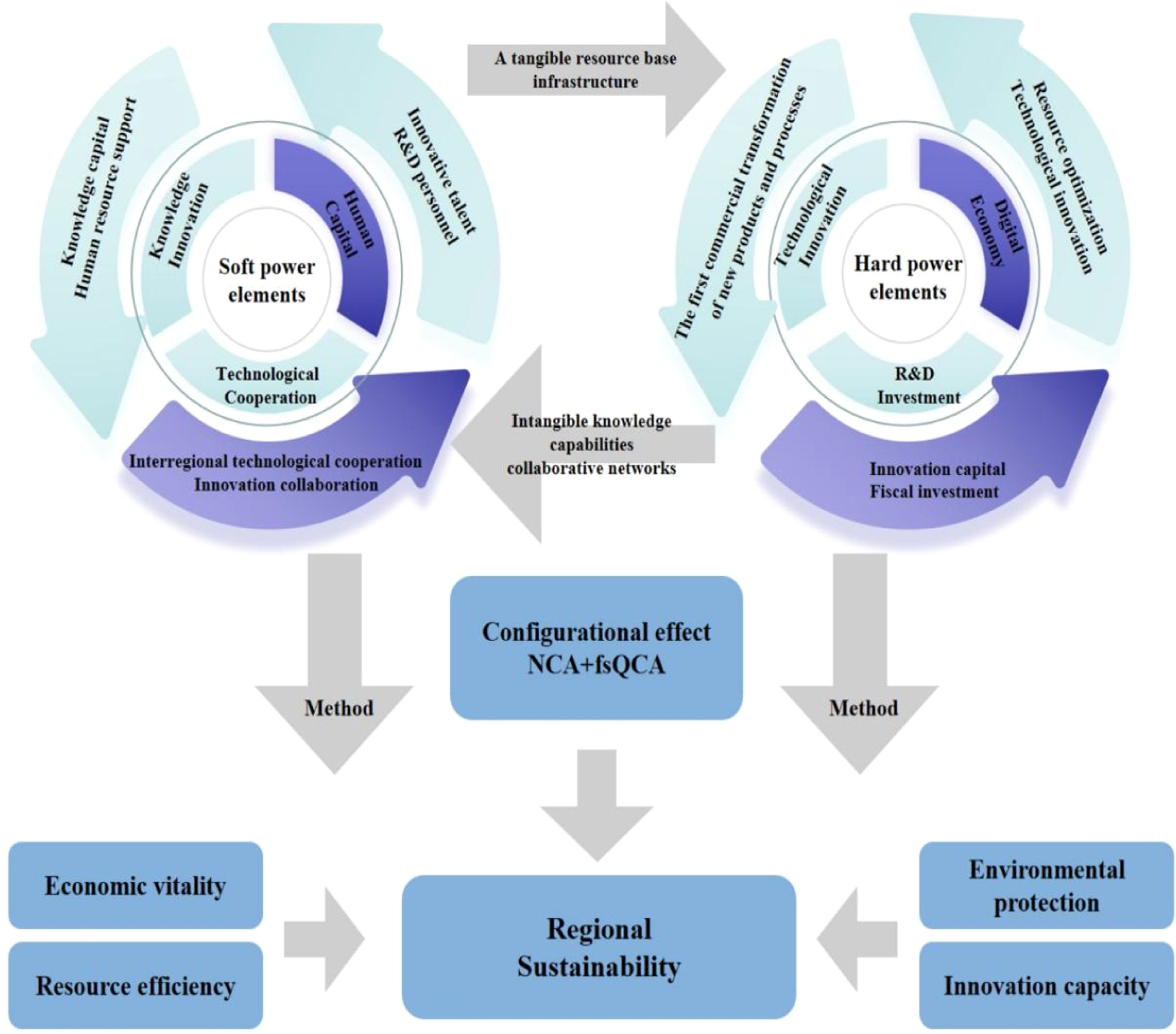
Innovation ecosystem theory has gradually become an important tool for studying regional sustainability, and the consensus on promoting sustainable innovation has increasingly strengthened (Gerstlberger, 2004; Baldwin et al., 2024). This study defined regional sustainability as the ability to achieve long-term economic growth while ensuring environmental sustainability and social equity. The realization of regional sustainability depends on the coordinated development of both "hard power" and "soft power" elements within the innovation ecosystems. Drawing upon Stam and van de Ven’s (2021)’s distinction between tangible and intangible assets within entrepreneurial ecosystems, this study posits a parallel framework for innovation ecosystems. We conceptualize innovation ecosystem as a composite of two core dimensions, a tangible resource base and infrastructure and intangible knowledge capabilities and collaborative networks. Adapting terminology to reflect their functional roles within innovation dynamics, we designate the former as hard power elements and the latter as soft power elements. This conceptual dichotomy offers a novel lens through which to analyze the intrinsic components of innovation ecosystems.
The hard power elements primarily encompass technological innovation (TI), research and development investment (IRD), and the digital economy (DE). Specifically, TI is intrinsically linked to the development and sophistication of technological infrastructure (Pan et al., 2021). IRD directly fuels the creation and enhancement of tangible resources, serving as a critical input for innovation capacity (Carboni & Medda, 2019). Furthermore, DE fundamentally relies upon robust digital infrastructure for its operation and expansion. These hard power elements are characterized by measurable inputs and outputs and make direct contributions to productivity and economic performance. Consequently, they can directly catalyze the development of new industries and products, enhance transactional efficiency, and improve information exchange capabilities, thereby providing a direct impetus for economic growth.
Conversely, soft power elements endow regions with enhanced adaptability and innovative potential. These primarily manifest as knowledge innovation (KI), human capital (HC), and technological cooperation (TC). These soft power elements align closely with the characteristics of intangible assets described in innovation systems literature (Diefenbach, 2006), comprising knowledge flows, social networks, inter-organizational linkages, and collaborative frameworks that collectively stimulate innovation activities.
Therefore, grounded in innovation ecosystem theory and complexity methodology, this study constructs a theoretical model explaining the relationship between innovation ecosystems, constituted by these hard and soft power elements, and regional sustainability (see Fig. A.1). The IE-RS theoretical model not only considers the independent effects of individual elements but, critically, explores how their synergistic interactions and complementary relationships collectively foster regional sustainability. This design directly addresses the systemic nature, complementarity, and symbiotic characteristics emphasized within innovation ecosystem theory.
Components of regional sustainabilityTechnological innovationTechnological innovation, particularly breakthrough or disruptive innovation, refers to the first commercial transformation of new products, processes, systems, and services (Damanpour & Evan, 1984; Tu et al., 2023; Jiao et al., 2025), injecting transformative power into regional sustainable development. It directly drives regional economic growth by improving productivity and efficiency and fostering new industrial growth points. Furthermore, technological innovation indirectly improves public services, such as healthcare and education, and provides key technological support for environmental protection and efficient resource utilization (Omri, 2020). Consequently, Gouvea et al. (2018) argue that technological innovation is the core driving force of national sustainable development (Gouvea et al., 2018). Studies using Malaysia as an example have confirmed the positive contributions of institutional quality and technological innovation to sustainable development. Thus, we propose Hypothesis 1.
Hypothesis 1. Technological innovation significantly enhances regional sustainability.
As a strategic resource, knowledge can improve the regional competitiveness (Schiuma & Lerro, 2008; Piñeiro-Chousa et al., 2020). From the perspective of knowledge innovation, knowledge capital, as a comprehensive manifestation of knowledge accumulation, flow, and application within a region, serves as an important indicator of the potential for regional sustainable development. Universities and research institutions are crucial platforms for knowledge creation, technology generation, and talent cultivation (Wu & Liu, 2021) and provide key human resource support for regional sustainable development. Economically, knowledge innovation can optimize production methods and processes, drive industrial upgrading, improve production efficiency, and create new economic growth points (Azeem et al., 2021; Cristache et al., 2025). Socially, knowledge innovation can promote progress in fields, such as healthcare and education, thereby enhancing residents' well-being. Environmentally, knowledge innovation promotes the research, development, and application of green technologies, improves resource utilization efficiency, and reduces environmental pollution, thereby achieving environmental sustainability within the region. Therefore, knowledge innovation can enhance a region's resilience to manage external shocks and adapt to future changes, enhance its long-term development potential, and ultimately strengthen regional sustainability. Based on this, we propose Hypothesis 2.
Hypothesis 2. Knowledge innovation significantly enhances regional sustainability.
The accumulation of human capital has driven significant technological advancements (Afcha & Lucena, 2022) and is a fundamental driving force in achieving sustainable development. Innovative talent, a key component of human capital, primarily comprises innovation professionals and scientists with high levels of technical and professional knowledge (Wu & Liu, 2021). The number of R&D personnel is an important indicator for measuring human capital investment (Wang et al., 2019) and is a key element in evaluating innovation capability (Callaghan, 2021), directly reflecting a region's strength in gathering innovation resources and conducting innovation activities. Research indicates a positive correlation between human capital and regional productivity (Audretsch et al., 2015). Therefore, as an important component of the regional innovation ecosystem, the accumulation and optimization of human capital are crucial for promoting sustainable regional development. Therefore, we propose Hypothesis 3.
Hypothesis 3. Human capital significantly enhances regional sustainability.
R&D investment is often regarded as a key indicator for measuring the allocation of public financial resources (Wang et al., 2019; Afcha & Lucena, 2022; Zhu et al., 2023) and is an important means of driving technological innovation (Zhao & He, 2024). R&D investment can effectively diversify innovation risks and encourage enterprises and society to expand their investment scale and intensity (Wu et al., 2017). It can also promote the upgrading of traditional industries and the development of emerging industries through knowledge transfer and utilize innovation capital to support the commercialization of sustainable technologies, thereby enhancing regional development quality (Zhao & He, 2024) and ultimately promoting regional sustainability. In the regional innovation ecosystem, continuous fiscal R&D investment is a key catalyst that can stimulate innovation vitality and promote knowledge diffusion. Based on this, we propose Hypothesis 4.
Hypothesis 4. R&D investment significantly enhances regional sustainability.
The frequency of knowledge creation increases the complexity of innovation activities (Guan et al., 2016), and the innovation process is more complex (Ponta et al., 2021). Therefore, interregional cooperation helps offset the adverse effects of insufficient innovation resources and capabilities in a single region. Researchers make connections with enterprises and external societies through academic research, patents, and other achievements, accelerating knowledge diffusion (Aparicio et al., 2023), which constitutes an important channel for knowledge flow in regional innovation ecosystem. Interregional cooperation among innovation actors (Bøllingtoft & Ulhøi, 2005) and the flow of knowledge between regions (Huggins & Thompson, 2015) are key factors driving regional sustainability, contributing to a more dynamic and resilient regional innovation ecosystems.
Innovation collaboration can improve business performance and accelerate knowledge or technology transfer (Ponta et al., 2024). Hjaltadóttir et al. (2020) explored the effectiveness and necessity of interregional technological cooperation from the perspective of structural heterogeneity. Therefore, interregional knowledge interaction and cooperation are important mechanisms for enhancing regional sustainable development capabilities, which can promote knowledge sharing, resource integration, and collaborative innovation, thereby enhancing the overall effectiveness of the regional innovation ecosystem. Based on this, we propose Hypothesis 5.
Hypothesis 5. Technological cooperation significantly enhances regional sustainability.
The digital economy, defined as an economic system with information networks, characterized by the pervasive use of digital technologies in production, distribution, and consumption processes (Jiao et al., 2025), has emerged as the dominant paradigm of contemporary economic development (Bai et al., 2024). This paradigm shift is fundamentally reshaping industrial landscapes and contributing to the achievement of Sustainable Development Goals (SDGs) (Ghobakhloo et al., 2021). Through two key mechanisms of technological innovation and resource optimization, the digital economy can effectively enhance regional sustainability and achieve sustainable development (Wang et al., 2024). First, digital tools are employed to adjust the energy consumption structure, optimize the industrial structure, and achieve green technology innovation within the industry (Miao, 2021; Ren et al., 2021; Luo et al., 2023; Ma & Zhu, 2022; Ribeiro-Navarrete et al., 2023). This mechanism enhances the innovation capacity and sustainability within the regional ecosystem. Second, it has further improved the utilization efficiency of data elements, corrected the regional resources misallocation through smart technologies (Acemoglu & Restrepo, 2018; Sturgeon, 2021; Wang et al., 2021). In addition, regional factor flows, as a mechanism of the digital economy, promote information sharing among ecosystem participants and accelerate knowledge spillovers and innovation diffusion (Colombelli et al., 2024; Audretsch & Belitski, 2020). Therefore, the digital economy is not merely an external economic force, but also an important factor in the regional innovation ecosystem. It is characterized by the integration of big data analytics, artificial intelligence and other digital technologies, which fundamentally changes the traditional innovation process, leading to a more dynamic regional innovation system (Zhou et al., 2024). Empirical evidence supports the positive impact of the digital economy on regional sustainability, such as the study by Feng et al. (2025). By influencing the innovation ecosystem’s structure, processes, and outputs through the mechanisms outlined above, the digital economy is positioned as a critical determinant of regional sustainability. Based on this, we propose Hypothesis 6.
Hypothesis 6. The digital economy significantly enhances regional sustainability.
The innovation ecosystem is inherently complex adaptive systems (CAS) (Adner & Kapoor, 2010), characterized by diverse actors, non-linear interactions, and path dependencies. These features necessitate methodologies capable of capturing causal complexity. Traditional linear regression methods often struggle to adequately model such intricacies. In contrast, fuzzy-set Qualitative Comparative Analysis (fsQCA), as a configurational method rooted in complexity methodology, excels at identifying the specific combinations (configurations) of multiple elements that lead to an outcome (Ragin, 2008). This approach has proven fruitful in analogous studies, such as Huang et al.'s (2023b) work on innovation ecosystems andCervelló-Royo et al.'s (2020) research on opportunity-driven entrepreneurship. Accordingly, this study employs fsQCA to unveil the complex, configurational causal mechanisms through which combinations of IE elements (both hard and soft power elements) generate high levels of regional sustainability.
Qualitative Comparative Analysis (QCA), proposed by Ragin and Oltmanns (1987), transcends the traditional qualitative-quantitative dichotomy by employing a set-theoretic approach to examine the combinatorial effects of causal conditions. To more accurately reflect the potentially graded nature of relationships and complex interactions among variables in this study, fsQCA is employed. Unlike the csQCA, fsQCA transforms variables into fuzzy-set membership scores (ranging from 0 to 1), thereby effectively addressing issues related to both categorical classification and degree of membership. This advantage makes fsQCA particularly well-suited for investigating the non-linear, interactive, and potentially equifinal causal pathways involving multiple factors that underpin regional sustainability.
Furthermore, this study employs a medium sample encompassing 30 Chinese provinces. fsQCA is adept at analyzing such datasets to uncover complex causal recipes linking key IE elements to RS. Regional sustainability is influenced by a multitude of interacting factors, where different combinations of conditions may constitute sufficient pathways to the outcome, reflecting the principle of equifinality. Traditional statistical methods often fall short in modeling such multiple conjunctural causation. fsQCA, however, can effectively reveal the specific configurations of conditions that prove effective in achieving the outcome across different cases.
Grounded in set theory (Schneider & Wagemann, 2012), fsQCA identifies not only necessary conditions but also explores how various combinations of conditions conjuncturally produce high levels of regional sustainability. In this research, six conditional variables of the innovation ecosystem are selected to analyze their configuration in relation to regional sustainability indicators, aiming to comprehensively explore the diverse pathways affecting RS. However, recognizing that fsQCA’s assessment of necessity is primarily qualitative, we further enhance the analytical rigor by incorporating NCA (Dul, 2016; Dul et al., 2020). NCA provides a quantitative assessment to directly identify necessary conditions (Dul, 2016), thus offering a robust complement to the fsQCA findings. The combined use of fsQCA and NCA (Vis & Dul, 2018) allows for a more comprehensive and rigorous examination of the complex and potentially multifaceted causal relationships between critical IE elements and regional sustainability. The specific procedures for NCA and fsQCA are detailed in Fig. A.2 (adapted from Huang et al., 2023a).
Data collection and measurementThis study utilized data from 30 Chinese provinces to explore the impacts of various factors on regional sustainability. Six conditional variables were identified: technological innovation, knowledge innovation, human capital, research and development investment, technological cooperation, and the digital economy.
Regional sustainability, the outcome variable, is operationalized using the “Provincial Sustainable Development Comprehensive Score” from the authoritative China Sustainable Development Evaluation Report (2023). This score is a composite index calculated by the report’s authors, designed to provide a holistic measure of sustainable development performance. Crucially, it incorporates indicators across multiple dimensions, typically including economic vitality, resource efficiency, environmental protection, social well-being, and innovation capacity. Utilizing this established comprehensive score allows for a standardized and multi-dimensional assessment of RS across provinces, aligning with the multifaceted nature of sustainability discussed theoretically.
Technological innovation is operationalized using the number of high-tech enterprises within the region, sourced from the China Regional Innovation Capability Evaluation Report (2022). This indicator serves as a crucial proxy for the region’s capacity to translate knowledge and R&D into commercial outputs. High-tech enterprises are legally defined based on R&D intensity and innovation output, making their count a reflection of the density of firms actively engaged in advanced technological development and commercialization within the innovation ecosystem.
Knowledge innovation is operationalized by the number of regional higher education institutions (colleges/universities) and dedicated research and development institutions, sourced from the Compilation of Science and Technology Statistics of Higher Education Institutions (2022). This indicator quantifies the core institutional infrastructure responsible for fundamental research and knowledge generation within the regional innovation ecosystem. A higher density of such institutions is considered foundational for the creation and potential dissemination of novel ideas and scientific breakthroughs.
Human capital is captured through a set of indicators reflecting the availability and deployment of skilled R&D personnel, sourced from the China Regional Science and Technology Innovation Evaluation Report (2022). These indicators include: (1) number of R&D researchers per 10,000 People (overall R&D workforce density), (2) intensity index of investment in basic research personnel (focus on foundational research talent), and (3) proportion of enterprise R&D researchers (industry-specific R&D capacity). This approach aims to reflect the quality and concentration of the workforce driving innovation activities within the ecosystem.
R&D investment reflects the financial resources allocated to innovation activities. Given its multi-faceted nature, it is operationalized using a comprehensive set of indicators from the China Regional Science and Technology Innovation Evaluation Report (2022). These indicators capture: (1) overall R&D intensity (ratio of R&D expenditure to GDP), (2) basic research focus (intensity index of investment in basic research funding), (3) public sector commitment (proportion of local fiscal expenditure on S&T), (4) enterprise R&D effort (proportion of enterprise R&D expenditure to business revenue), (5) technology adoption investment (proportion of enterprise expenditure on technology acquisition/transformation), and (6) market-oriented R&D (intensity index of R&D investment in listed companies). This comprehensive operationalization ensures that IRD reflects the broad financial commitment to R&D and technological upgrading from various actors within the regional innovation ecosystem.
Technological cooperation is a complex construct reflecting network interactions crucial for innovation ecosystems. We operationalize it using multiple indicators sourced from the China Regional Innovation Capability Evaluation Report (2022). These indicators capture two vital facets of cooperation: (1) inter-organizational scientific collaboration, measured through the quantity and intensity of co-authored scientific papers across different institutional, regional, and national boundaries (reflecting knowledge sharing networks), and (2) university-industry linkage, measured via enterprise funding flows into university/research institute R&D (reflecting knowledge transfer and application). This multi-indicator approach aims to provide a robust measure of the collaborative intensity within the regional innovation ecosystem.
The digital economy is operationalized using three key indicators from the China Regional Science and Technology Innovation Evaluation Report (2022), chosen to reflect distinct but complementary aspects of digitalization relevant to regional innovation and transformation: (1) infrastructure penetration (mobile internet users per capita), (2) sectoral economic contribution (proportion of IT sector value-added to GDP), and (3) digital transaction intensity (ratio of e-commerce sales to GDP). This operationalization captures the infrastructure, economic output, and market activity aspects of the DE, aligning with its definition as a transformative force within the ecosystem.
Details of the data sources are provided in Table A.1, and the specific data for all variables across the provinces are presented in Appendix A.
Data calibrationThe transformation of raw data into meaningful fuzzy set memberships (ranging from 0 for full non-membership to 1 for full membership) is a critical step in fsQCA known as calibration. This process requires defining thresholds, or anchor points, that establish the criteria for a case (a province) to be considered “in” or “out” of a particular set (e.g., the set of provinces with high R&D investment). The choice of these anchor points significantly influences the analysis results and must be theoretically and empirically grounded (Schneider & Wagemann, 2012; Ragin, 2008). Ideally, anchor points are based on external theoretical knowledge or substantive criteria (e.g., established benchmarks for high environmental performance). However, for many elements within complex constructs such as innovation ecosystems and regional sustainability, particularly when comparing diverse entities like provinces in China, universally accepted external standards are often lacking. Furthermore, our research aims to understand how configurations of relative strengths and weaknesses across different IE dimensions within this specific sample relate to relative levels of sustainability achieved. Therefore, we employed the direct method of calibration (Ragin, 2008), defining anchor points based on the distribution of the raw data within our sample (N = 30). This approach aligns with methodological recommendations when external standards are unavailable or when the focus is on relative positions within the studied population (Fiss, 2011). Specifically, we established three anchor points for each condition and the outcome variable. Full membership threshold (fuzzy score = 0.95) was calibrated using the 75th percentile of the variable's raw data distribution across the 30 provinces. This threshold signifies that provinces ranking in the top quartile of our sample for a given variable are considered substantively “fully in” the set representing a high level of that condition or outcome, reflecting a clear high-performance level relative to their peers in this study. Crossover point (fuzzy score = 0.5) was anchored at the 50th percentile (median). The median represents the point of maximum ambiguity in the data distribution, effectively dividing the sample into higher and lower halves. Setting the crossover here means provinces near the median are neither clearly “in” nor “out” of the set, reflecting their intermediate position within this specific context. Full non-membership threshold (fuzzy score = 0.05) was anchored at the 25th percentile. Provinces in the bottom quartile for a variable are thus considered substantively “fully out” of the set representing a high level, indicating a clearly low level of the condition or outcome relative to others in the sample.
This quartile-based calibration strategy (75th/50th/25th percentiles) provides a transparent, replicable, and data-driven method for defining meaningful qualitative distinctions (high, intermediate, low) based on the observed variations in the raw data across the Chinese provinces studied. It allows us to capture the relative positioning of each province on each dimension, which is essential for identifying configurations of relative strengths and weaknesses associated with regional sustainability. While drawing inspiration from previous studies employing similar percentile schemes (Huang et al., 2023a), the primary justification rests on its ability to translate the sample’s empirical distribution into theoretically relevant fuzzy set memberships focused on relative standing in the absence of definitive external criteria. The resulting calibrated data (Table A.2) forms the input for the fsQCA software (version 3.0) to construct the truth table.
ResultsNecessity analysis of single conditionsPrior to conducting the configurational analysis, it is methodologically imperative to ascertain whether any individual antecedent condition constitutes a necessary condition for the outcome of RS (Muñoz & Dimov, 2015). Beyond the binary identification of necessity, NCA offers the capability to analyze the effect size of a condition, which quantifies the minimum requisite level of an antecedent condition for the realization of a specific outcome. In NCA, the effect size is estimated using either Ceiling Regression (CR) or Ceiling Envelopment (CE). These techniques establish an upper boundary (a 'ceiling') over the data points, and the effect size is derived directly from this ceiling function. The effect size metric ranges from 0 to 1 (Dul et al., 2020). For a condition to be classified as necessary, two criteria must be met: the effect size (d) is not <0.1, and the Monte Carlo simulation permutation test shows that the effect size is significant (p < 0.01) (Dul et al., 2020). Table A.3 shows the NCA analysis results. Overall, none of the antecedent variables satisfied both the d > 0.1 and p < 0.01 criteria (both CR and CE), indicating that a single dependent variable was significant but not necessary to produce the outcome variable.
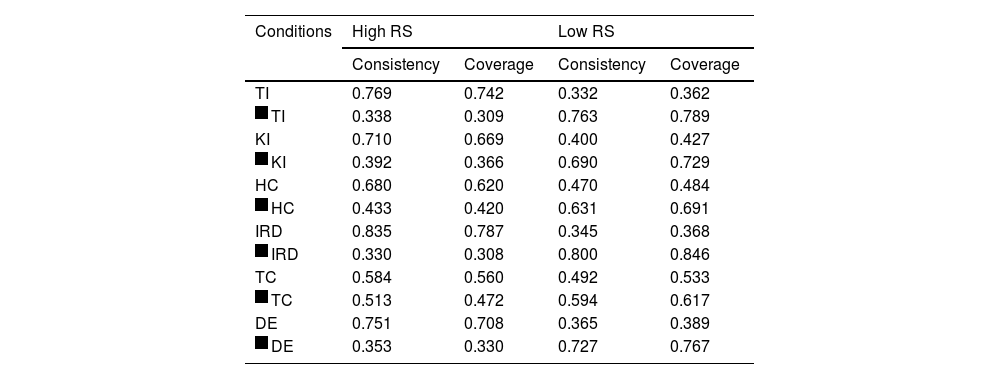
Necessary condition identification was further performed using fsQCA software, with findings detailed in Table A.4. In accordance with Amara et al. (2019), a consistency threshold of 0.9 was adopted for the necessity analysis. The analysis revealed that the necessary consistency of each individual antecedent condition with respect to high or low RS was below the 0.9 threshold, thereby indicating that no single conditional variable constitutes a necessary condition. Consequently, the explanatory capacity of any single conditional variable for high RS was deemed insufficient, necessitating further investigation into the joint effects of antecedent conditions.
Sufficiency analysis of conditional pathwayAfter identifying no individual necessary condition for generating high RS, we analyzed the conditional combination of the six conditional variables to identify configurational pathways leading to high RS. This study adopted a consistency threshold of 0.75−0.85, as established by Ragin (2006)). Following existing studies, the case frequency and original consistency thresholds were set to 1 and 0.85, respectively (Ragin, 2006). The analysis identified four configurations (detailed in Table A.5) sufficient for producing high RS: A1, A2, and A3. Due to the shared core conditions (“TI*IRD*DE”) between A1a and A1b, the two configurations are considered equivalent at a higher level and are collectively referred to as A1. Additionally, the overall solution coverage was 0.530, suggesting that the solution covered more than half of the cases with high RS. Configuration A1a suggests that technological innovation, robust R&D investment, a well-developed digital economy and human capital can compensate for the absence of technological cooperation to achieve high RS, as posited by hypotheses 1, 3, 4, and 6. This configuration demonstrated a consistency of 0.971, raw coverage of 0.213, and unique coverage of 0.072. Conversely, configuration A1b shows that knowledge innovation can substitute for human capital, while technological cooperation may emerge as a non-core condition, also leading to high RS and validating hypotheses 1, 2, 4, 5, and 6. Configuration A2 highlights that in the absence of traditional supportive factors, such as human capital, R&D investment, and technological cooperation, technological innovation and a favorable digital economy are critical drivers of regional sustainability. Knowledge innovation supports sustainability by generating and disseminating new knowledge, fostering the intellectual atmosphere necessary for innovation, and validating hypotheses 1, 2, and 6. This configuration achieved a consistency of 0.983, raw coverage of 0.086, and unique coverage of 0.006. Configuration A3 posits that even without traditional innovation and human capital, concentrated R&D investment, effective technological cooperation and a robust digital economy can enhance regional sustainability, validating hypotheses 4, 5 and 6. This configuration demonstrated a consistency of 0.901, raw coverage of 0.084, and unique coverage of 0.023.
Robustness analysisFollowing established practices in prior research (Alonso-Dos-Santos & Llanos-Contreras, 2019), which employed adjusted consistency thresholds for robustness checks, the study reprocessed the data by raising the PRI consistency threshold from 0.8 to 0.9. The resulting high RS pathways remained as a subset of the original findings, and the configuration remained consistent, thereby confirming the stability and robustness of the conclusions.
DiscussionGrounded in innovation ecosystem theory, which emphasizes the complex interdependencies, complementarities, and synergistic effects among elements (Granstrand & Holgersson, 2020), this study adopts a configurational perspective (Fiss, 2011) to develop a theoretical framework for the innovation ecosystem-regional sustainability (IE-RS) relationship. Utilizing NCA and fsQCA, we have identified four distinct pathways leading to high RS and proposed a hierarchical “core-periphery” model. In addressing RQ1, our findings reveal that technological innovation (present in 3 of 4 pathways), R&D investment (3 of 4), and the digital economy (4 of 4) constitute the core conditions for high RS. This challenges the notion of “flattening” or “equal elements,” which posits that elements such as human capital or knowledge innovation (Schiuma & Lerro, 2008) play equivalent roles. Our research demonstrates that not all innovation elements are equally influential. In a well-functioning and sustainable innovation ecosystem, there exists a hierarchy of functional priorities and dependencies among its elements. Moreover, fsQCA addresses the limitations of traditional linear models that rely on net-effect analysis (Kumar et al., 2022), revealing how the synergy between soft and hard power elements generates high RS, thus significantly enriching the existing research framework. The configurational pathways exhibit three main characteristics, substitutability (where the digital economy compensates for weak traditional technological infrastructure), complementarity (where human capital enhances the effectiveness of technological cooperation), and non-linearity (where a single element is insufficient to achieve high regional sustainability). Finally, drawing on Zhao’s (2024) research on the allocation of innovation factors and high-quality development, the identification of these key elements also provides a necessary prerequisite and supplement for subsequent analysis and policy recommendations.
Regarding RQ2, the result of configuration A1 align with the existing research. For instance, human capital accumulation plays a significant role in promoting economic growth (Aman-Ullah et al., 2022), particularly under resource and environmental constraints. Technological innovation, including technological investment, output capacity, and diffusion ability, enhances economic efficiency (Ceipek et al., 2021; Cannavacciuolo et al., 2023). Furthermore, the digital economy provides new opportunities and support for regional sustainability by improving information flow and resource allocation efficiency (Li et al., 2022), underscoring its critical role. R&D investment provides essential financial support and material foundations for talent cultivation, technological innovation, and environmental optimization (Boeing et al., 2022). For example, Zhao (2023) used Huawei’s implementation of open innovation as a case study and demonstrated that innovation networks improve resource utilization efficiency through knowledge sharing and technological cooperation. Innovation networks can also address deficiencies in technology and resources within individual regions, thus bolstering regional sustainable development capacity. Specifically, Guangdong province exemplifies configuration A1b (see Appendix B). Guangdong has continually advanced its economic structural optimization through technological innovation. Technology parks and enterprises, represented by Shenzhen (e.g., Huawei and Tencent), have achieved global technological breakthroughs through sustained increases in R&D investment, establishing Guangdong as a national and global innovation hub. Knowledge innovation drives industrial upgrading. The Guangdong-Hong Kong-Macao Greater Bay Area (centered on Guangzhou and Shenzhen) serves as an international hub for scientific and technological innovation, attracting leading universities, research institutions, and technology companies worldwide and forming a knowledge-intensive innovation ecosystem. Guangdong also capitalizes on its geographic advantages, complementing Hong Kong and Macao in areas, such as scientific research and financial services, thereby creating a cross-border knowledge cooperation network.
In the research on high RS development, configurations A2 and A3 revealed two intriguing pathways. Specifically, although both pathways included the digital economy as a core condition, A2 and A3 exhibited symmetrical differences in their configurations, reflecting the differentiated roles of technological innovation and R&D investment in the respective pathways. Importantly, both pathways effectively promoted high RS. A2 emphasized technological innovation as the driving force, leveraging the complementary role of knowledge innovation in enhancing regional sustainability. This partially supports Shi et al. (2022), who found significant differences in the efficiency of knowledge innovation (led by Chinese universities) and technological innovation (led by enterprises) across regions. Specifically, innovation efficiency in the eastern regions (Guangdong, Jiangsu, Hubei, Shanghai, and Shanxi) outperformed that of the central (Beijing) and western regions (see Appendix B). Sichuan province exemplifies configuration A2, with its sustainability reflected in economic growth, environmental protection, and social development. Sichuan province promotes green financial innovation to provide financial support for the green transformation of traditional industries and innovation in emerging industries. The Sichuan Green Financial Innovation Development Plan (2024–2026) outlines initiatives, such as loans linked to carbon footprints and environmental benefits, fostering green finance while ensuring funding for regional sustainability. Additionally, Sichuan boasts high-caliber research institutions, such as Sichuan University, which act as vital drivers of knowledge innovation and technological research and development. In contrast, A3 highlighted the central role of R&D investment, supported by non-core technological cooperation, in enhancing the systematic and open nature of regional technology development. Sánchez-Sellero and Bataineh (2021) noted the positive effects of necessary R&D expenditures and external R&D cooperation on firms’ green innovation. Additionally,Hervás-Oliver et al. (2021) underscored the significant roles of cooperative mechanisms and regional characteristics in SME innovation. This further supports the notion that regional resource endowments and environments profoundly influence innovation pathway choices, as evidenced by the geographic differences in Europe. Liaoning province represents configuration A3. As China’s northeast industrial core, Liaoning’s economic development reflects its resource-dependent industrial structure and traditional manufacturing characteristics. The government provides dedicated funds to support industrial upgrades, smart equipment, and new energy sectors, thereby addressing the lack of enterprise-level innovation funding. Liaoning province also enhances collaboration with economically advanced regions, such as the Pearl River Delta and the Yangtze River Delta, leveraging imported advanced technologies and management expertise to address local technological resource deficiencies. Additionally, the province integrates technologies, such as digital twins and the Internet of Things into traditional industries, transitioning them into intelligent production models, thereby improving efficiency and resource utilization.
Finally, traditional factors remain important but may play more supportive or synergistic roles, whereas the digital economy emerges as a key driver of regional sustainability. These four pathways confirm that knowledge innovation, human capital, and technological cooperation are not core conditions for achieving high RS. This contrasts with the literature that emphasizes the critical roles of human capital and innovation activities in regional sustainability (Feng et al., 2025), suggesting that these factors might have context-dependent effects. Liu et al. (2025) explored regional disparities in green innovation, highlighting how significant inequalities in R&D expenditures (Sánchez-Sellero & Bataineh, 2021), human capital levels, and other innovation factors hinder the ability of underdeveloped regions to enhance green technological innovation effectively. In comparison, the digital economy is consistently a core condition across all pathways, emphasizing its critical role in enhancing sustainability (Wen et al., 2025). This finding disrupts the traditional regional disparity framework and provides a common foundation for diverse developmental pathways. This supports recent research on digital transformation and sustainability (Song et al., 2024), particularly those focusing on digital infrastructure and data-driven innovation. The digital economy may optimize resource allocation, enhance system resilience, and promote the efficient operation of collaborative networks, thus providing fundamental support for regional sustainability.
Theoretical contributionThis research makes three primary theoretical contributions to the extant discourse on how innovation ecosystems drive regional sustainability. While the positive link between IE and RS is generally acknowledged in the literature (Torrent‐Sellens et al., 2025), there remains insufficient discussion on (1) the development of a comprehensive IE-RS theoretical framework integrating diverse elements, (2) the identification of specific combinations of IE elements driving high RS, and (3) the empirical validation of these relationships using a configurational perspective. Our contributions follow a logical progression: advancing an overall configurational understanding - refining the roles of specific elements - providing empirical evidence through rigorous methods.
First, the study’s core theoretical contribution lies in advancing a configurational understanding of the IE-RS relationship. Employing a combined NCA and fsQCA approach, we empirically demonstrate that achieving high levels of RS is not contingent upon optimizing isolated elements but rather emerges from specific configurations of multiple IE elements (TI, KI, HC, IRD, TC, DE). This provides robust empirical evidence, within the specific outcome domain of RS, for the core IE tenets of complexity, synergy, complementarity, and substitutability. The identification of multiple equifinal pathways leading to high RS challenges theoretical inclinations seeking a single best-practice IE model, and underscores the diversity and context-dependency inherent in regional sustainable development trajectories.
Second, this research offers more nuanced theoretical insights into the roles of internal IE elements. While existing studies address IE development, they often lack detailed specifications of the internal structure and the differential roles of its components (Su et al., 2018; Dias Sant´Ana et al., 2020). We categorize IE components into hard power elements reflecting foundational capabilities (TI, IRD, DE) and soft power elements embodying network interactions and the knowledge base (HC, KI, TC). Our analysis reveals that across the four identified pathways leading to high RS, the hard power elements consistently function as core conditions. This finding suggests that fostering RS through IE development necessitates prioritizing the cultivation of these foundational capabilities. Notably, the digital economy emerges not merely as infrastructure but as a potential amplifier, enhancing the contributions of other elements (like TI and IRD) to RS and facilitating efficient knowledge and resource flows within the ecosystem. This amplifying mechanism warrants further exploration in future IE-RS theoretical models.
Finally, the integration of NCA and fsQCA provides essential methodological grounding and empirical validation for the IE-RS theoretical framework. This combined approach confirms the complex causal mechanisms driving high RS, thereby empirically reflecting the inherent complexity, synergy, complementarity, and substitution characteristic of IEs. Furthermore, the analysis empirically substantiates the principles of equifinality and element substitutability within the IE-RS model. For instance, configuration A2 demonstrates that even with relatively weaker HC, IRD, and TC, a potent combination of TI, KI, and DE can effectively drive high RS. This challenges theoretical perspectives that might assume the indispensability of certain elements and advocates for adopting a more holistic, systemic, and flexible theoretical lens when analyzing the IE-RS relationship.
Managerial implicationsThis study provides important practical insights for policymakers and practitioners. Governments and enterprises should invest in technological innovations and digital transformations to enhance regional sustainability and competitiveness. This includes supporting the R&D of new technologies, promoting digital tools and platforms, and optimizing digital infrastructure. It is critical to increase regional R&D investments to support ongoing innovation activities. Public and private sectors should collaborate to provide funding and resources to support R&D activities in research institutions and enterprises. Establishing and maintaining innovation networks to facilitate collaboration and knowledge sharing among diverse innovation entities is vital. Platforms should be created to foster dialogue and cooperation among academia, businesses, and governments. Education and training are essential for enhancing workforce skills and innovation capacity. Regions should invest in educational resources to improve the overall quality of their workforce. When traditional supportive factors are insufficient, regions can compensate for these deficiencies by strengthening technological and knowledge innovations, thereby improving sustainability, which requires regions to flexibly adjust their innovation strategies and optimize the utilization of their existing resources and conditions.
Limitations and future researchWhile insightful, this study acknowledges certain limitations. Firstly, it focused solely on factors influencing the sustainability of provinces in China without addressing factors in other countries. Thus, future research should broaden the sample geographically. Secondly, the static nature of the fsQCA methodology employed prevented a full exploration of the temporal dynamics inherent in regional sustainability. Subsequent studies could benefit from employing temporal QCA to capture the dynamic interactions among regional sustainability factors over time.
ConclusionIn summary, employing an innovation ecosystem perspective and analyzing empirical data from 30 provinces in China, this study investigates the mechanisms driving high regional sustainability. Departing from the traditional linear assumptions, we adopt configurational thinking, integrating fsQCA and NCA to unravel the complex causal patterns linking IE elements to RS. Through this analysis, we identify four distinct configurational pathways to high RS. These pathways comprise varying combinations of critical hard power elements (technological innovation, R&D investment, digital economy) and soft power elements (knowledge innovation, human capital, technological cooperation). This finding underscores the principle of equifinality in achieving regional sustainability, demonstrating that different combinations of resources and capabilities can lead to the same desired outcome. Theoretically, this study integrates hard power and soft power elements into the innovation ecosystem, and expands the boundary of IE theory by constructing IE-RS theoretical model. Unlike traditional research often focusing on single elements, our integrated IE-RS model reveals the complex interactions and synergistic effects among system components. Furthermore, the application of fsQCA and NCA provides novel insights into the causal complexity underlying regional sustainable development, emphasizing the importance of complementarity and systemicity among contributing factors. At the practical policy level, the findings, highlighting TI, IRD, and DE as core conditions across multiple pathways, suggest several priorities. Policymakers should focus on fostering deeply integrated industry-university-research ecosystems (e.g., establishing interdisciplinary research centers, strengthening intellectual property rights protection, developing technology transfer platforms), increasing R&D investment and optimizing its allocation, and consolidating digital infrastructure and capabilities (e.g., implementing digital skills training programs, promoting the digital transformation of traditional industries). Additionally, given the supportive yet non-core role of other elements in specific configurations, comprehensive and flexible policy frameworks are essential. These should focus on enhancing cross-departmental coordination, designing multi-dimensional innovation incentives, and building platforms for multi-stakeholder collaboration. Crucially, the existence of four equifinal pathways to high RS underscores that policy formulation should avoid a standardized one-size-fits-all model. Instead, regions should leverage their existing strengths and resource endowments to select and cultivate the development trajectory most suited to their specific context, thereby fostering differentiated competitive advantages. Although grounded in Chinese regional data, the IE-RS model with fsQCA/NCA offers significant value for studying RS in diverse global contexts. For instance, in developed economies (e.g., EU, North America), the model might highlight the roles of KI and TC within sophisticated institutional environments. In emerging economies (e.g., Southeast Asia, Latin America), the focus might shift towards foundational investments in DE and HC, alongside strategies to overcome institutional hurdles. In less developed regions, policy derived from this framework might prioritize basic infrastructure development and mechanisms for external knowledge absorption and adaptation. Therefore, employing a configurational perspective, this study elucidates how diverse combinations of IE elements generate multiple pathways toward regional sustainability. Moving beyond simplistic variable-centric analyses, it advances the theoretical integration of innovation ecosystem and regional sustainability. Importantly, it provides an empirical foundation for crafting more effective, context-sensitive, and strategically configured policies, offering novel insights and approaches relevant to achieving sustainable development goals globally.
FundingThis work was funded by the Ministry of Education's Major Project for Research in Philosophy and Social Sciences on "Research on Comprehensively Improving the Quality of Talent Cultivation under New Circumstances" [grant number 23JZD045]."
CRediT authorship contribution statementYangjie Huang: Writing – review & editing, Writing – original draft, Project administration, Methodology, Investigation, Funding acquisition, Conceptualization. Yue Yuan: Writing – original draft. Jiali Zhang: Data curation. Ping Li: Supervision, Formal analysis.
The authors declare that the research was conducted in the absence of any commercial or financial relationships that could be construed as a potential conflict of interest.
Fig. A.1, Fig. A.2, Table A.1, Table A.2, Table A.3, Table A.4, Table A.5.
Provinces’ Data Source.
Note: RS=Regional Sustainability; TI=Technological Innovation; KI=Knowledge Innovation; HCHuman Capital; IRD=R&D Investment; TC=Technological Cooperation; DE=Digital Economy.


Definition of variables.
Necessary condition analysis (NCA) result tables.
Note: 0 < d < 0.1: Low level; 0.1 ≤ d < 0.3: Middle level; 0.3 ≤ d < 0.5: High level; CR: ceiling region; CE: ceiling envelope. P < 0.01: Significant.
Necessity test for a single condition.
Configurations for High RS.
Notes:●=core causal condition(present); ◎=contributing causal condition (present); △= contributing causal condition (absent); Blank spaces indicate a “don’t care” condition (Fiss, 2011).
TI: Technological Innovation; KI: Knowledge Innovation; HC: Human Capital; IRD: Research and Development Investment; TC: Technological Cooperation; DE: Digital Economy.
