



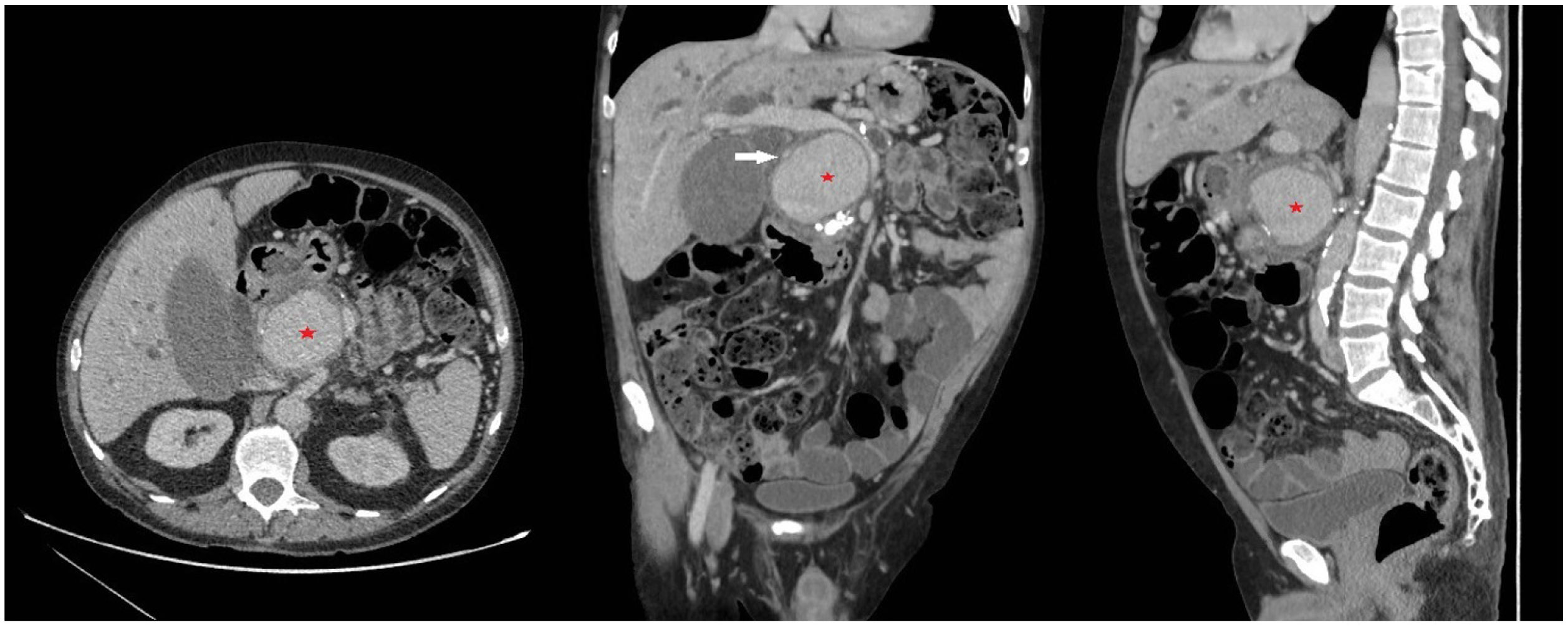
This was a 42-year-old male with a history of chronic pancreatitis and portal hypertension with collateral circulation. He was admitted with a two-week history of abdominal pain in the right hypochondrium and obstructive jaundice with total bilirubin of 21.4 mg/dl. CT scan of abdomen and pelvis with IVC revealed a large pseudoaneurysm on the hepatic artery located at the head of pancreas, causing extrinsic compression of the common bile duct with major dilation of the intra- and extrahepatic biliary tract (Fig. 1).

CT scan of abdomen and pelvis with intravenous contrast administration (axial, coronal and sagittal view): marked dilation of the intra- and extrahepatic bile duct due to extrinsic compression of the common bile duct secondary to an 8 × 5 cm mass located at the head of pancreas, with IVC inside and well-defined walls compatible with a pseudoaneurysm (*) originating from the hepatic artery (arrow).
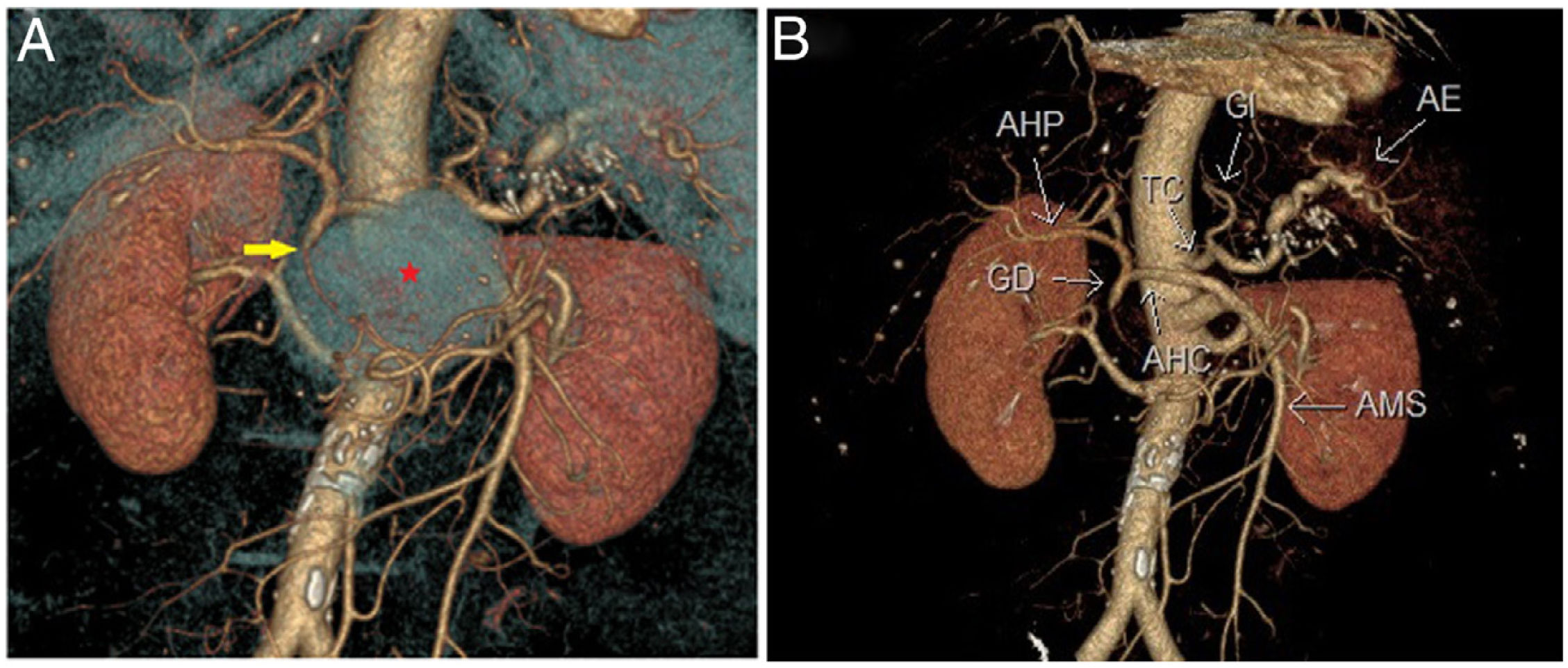
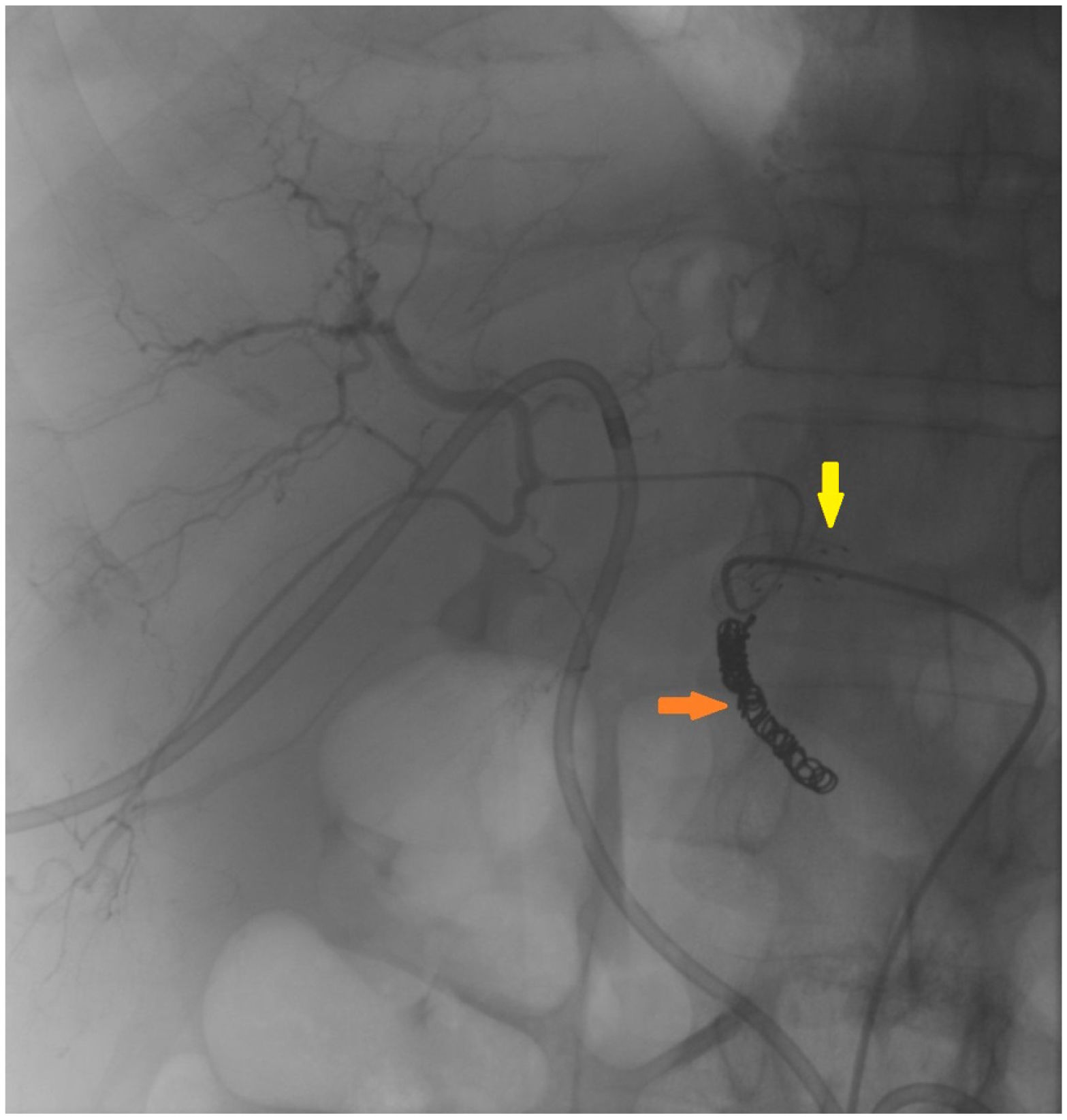
CT angiography showed the origin of the common hepatic artery in the superior mesenteric artery as an anatomical variant, with an outflow of the gastroduodenal artery and the hepatic artery itself, and contrast extravasation filling the pseudoaneurysm from the confluence between the common hepatic artery and the gastroduodenal artery outflow (Fig. 2 A and B). The patient underwent embolisation of the gastroduodenal artery with coils and placement of a covered stent in the hepatic artery covering the orifice from which the pseudoaneurysm originates, subsequently verifying that the stent and the intrahepatic arteries are fully patent and confirming the exclusion of the pseudoaneurysmal lesion (Fig. 3). An internal-external percutaneous biliary drain was then positioned. Subsequent monitoring has shown a decrease in the volume of the arterial pseudoaneurysm and in the dilation of the bile duct.1–4

3D reconstruction of the arterial phase. A: poor filling of the pseudoaneurysm (*) due to its large size, causing a change in lumen between the hepatic artery and the outflow of the gastroduodenal artery from which it originates (yellow arrow). B: anatomical variant of the common hepatic artery (CHA) originating from the superior mesenteric artery (SMA), passing to the gastroduodenal artery (GD) and the hepatic artery proper (HAP). Coeliac trunk (CT) with outflow of the left gastric artery (LG) and splenic artery (SA).

Protection of people and animals. The authors declare that no experiments were performed on humans or animals for this study.
Data confidentiality. The authors declare that they have followed their workplace protocols on the publication of patient data.
Right to privacy and informed consent. The authors have obtained the informed consent of the patients and/or subjects referred to in the article. This document is in the possession of the corresponding author.
FundingThe authors declare that this study received no specific funding from public, private or non-profit organisations.
Conflicts of interestThe authors declare that they have no conflicts of interest.

