



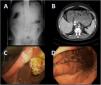
We present the case of a 54-year-old male patient with atrial fibrillation (AF), on treatment with rivaroxaban, flecainide and bisoprolol, who underwent pulmonary vein isolation cryoablation as his AF was refractory to drug management, and was discharged after 24 h without incident. Five days later, he came into the accident and emergency department with vomiting, epigastric pain and abdominal distension. Abdominal X-ray showed dilation of the gastric chamber (Fig. 1A). A nasogastric tube was inserted and intravenous analgesia administered. Abdominal CT scan showed marked gastric distension with no apparent obstructive cause (Fig. 1B). The patient remained under observation and tests were completed with a gastroscopy, where large gastric dilation was identified with only partial assessment of the gastric body due to food debris, but reaching the second duodenal portion without evidence of obstructive cause (Fig. 1C). Twenty-four hours after arriving at the accident and emergency department, the patient was discharged with a low-fat diet and double-dose omeprazole. He was referred to Gastroenterology and levosulpiride was added to his treatment. Repeat gastroscopy showed no evidence of lesions (Fig. 1D). After seven months, the patient is asymptomatic and the treatment has been discontinued.

Gastroparesis is a motor disorder of the stomach in which gastric emptying is slowed in the absence of mechanical obstruction. Although idiopathic in up to 60% of cases, the most common causes are: type 1 and 2 diabetes mellitus; surgery on the proximal part of the vagus nerve branches (for example, on the oesophagogastric junction, fundoplication and other anti-reflux techniques) or the distal part on the gastric antrum (for example, subtotal gastrectomy and cephalic pancreaticoduodenectomy); and pharmacological interventions (for example, opioids, tricyclic antidepressants and calcium antagonists).1,2 Diagnosis requires an imaging test (X-ray or CT scan) and usually a gastroscopy to rule out an obstructive cause. The gold standard is gastric emptying scintigraphy.1
Catheter ablation of the pulmonary veins is a technique increasingly used in the management of AF. Depending on the energy source used, the term radiofrequency ablation (RFA) is applied if a heat source is used to produce tissue damage, and cryoablation if a cold source is used.3 Cryoablation seems to be as effective as RFA, with lower rates of complications such as cardiac perforation, thromboembolism or pulmonary vein stenosis, although it does appear to have a higher risk of phrenic nerve and peri-oesophageal vagus nerve palsy.3 Injury to the vagus nerve can cause gastroparesis due to compromise of the innervation of the antrum and pylorus, leading to abdominal pain, vomiting, distension and early satiety. However, this complication tends to be asymptomatic and its incidence in the literature varies from one series to another (0.2–48%).4 Risk factors include the use of low temperatures in the inferior pulmonary veins and a small left atrium (shortening the distance between the ostium of the right inferior pulmonary vein and the oesophagus).5
Management is usually conservative and in most cases it resolves in about six months.4 It is advisable to avoid factors that might distend the stomach, by eating smaller amounts at a time and avoiding carbonated beverages and drinking liquids while ingesting solids. A low-fat, high-fibre diet and the use of prokinetics are recommended. If there is no response, patients may benefit from endoscopic treatment such as botulinum toxin injection, pyloric dilation or peroral pyloromyotomy.5 Surgical options would be subtotal or total gastrectomy or gastroenteroanastomosis as a palliative intervention, reserved for the most refractory cases.4
With the development and increased implementation of new ablative procedures, it is important to be aware of this complication in order to avoid it as far as possible; and to recognise it as a cause of gastroparesis to ensure its early detection and treatment.

