


metricas
covid
Gastroenterología y Hepatología (English Edition) A rare case of hemangioma complicated with hepatic hemangiomatosis
Journal Information
Vol. 46. Issue 6.
Pages 472-473 (June - July 2023)
Image of the month
Full text access
A rare case of hemangioma complicated with hepatic hemangiomatosis
Un caso raro de hemangioma complicado con hemangiomatosis hepática
Visits
541
María del Mar Díaz Alcázar
Corresponding author
mmardiazalcazar@gmail.com

Corresponding author.
, Francisca Luisa Sousa Domínguez
UGC Aparato Digestivo, Hospital Universitario Clínico San Cecilio, Granada, Spain
This item has received
Article information
Full Text
Bibliography
Download PDF
Statistics
Figures (2)
Full Text

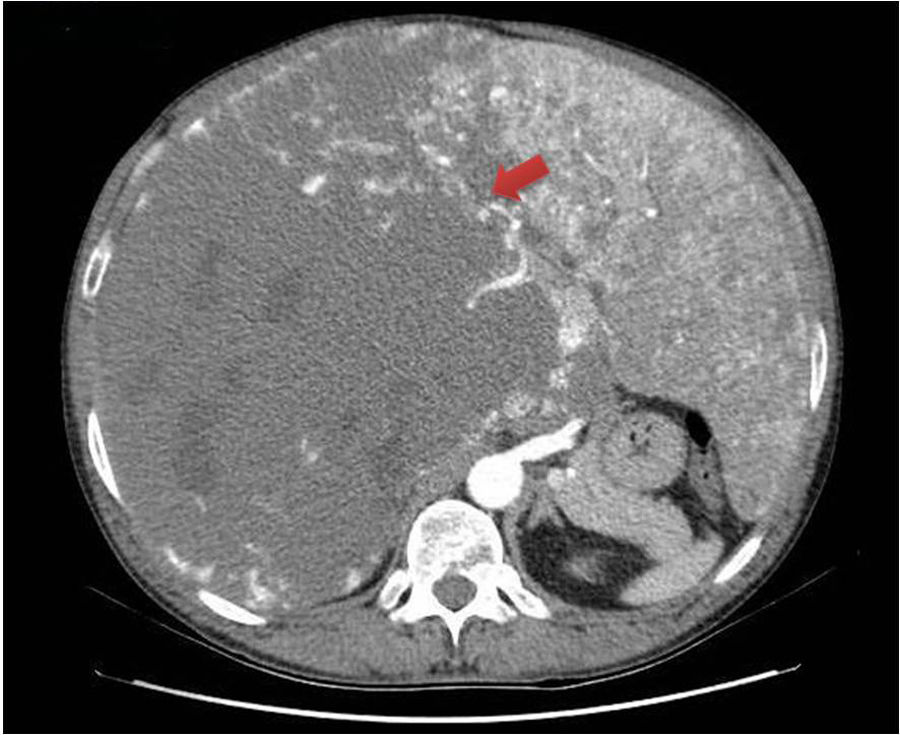
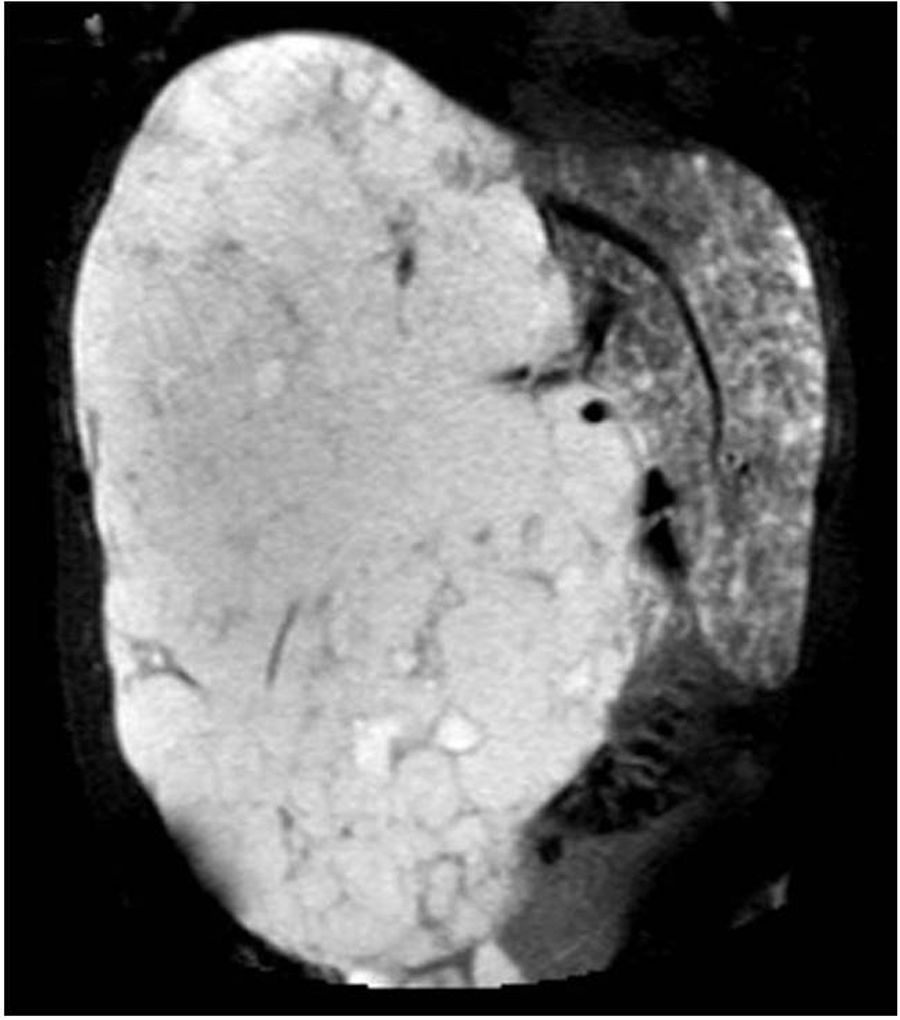
This was a 47-year-old man, with no previous medical history, who consulted for sudden onset of abdominal pain. Stony hepatomegaly was palpable occupying both hypochondriac regions and reaching the iliac crests, for which an abdominal ultrasound was performed, followed by a computed tomography scan (Fig. 1), which showed hepatomegaly measuring 37 × 29 × 23 cm due to a space-occupying lesion in the right lobe of the liver compatible with giant cavernous haemangioma. This was confirmed by contrast magnetic resonance imaging (Fig. 2), which showed that the rest of the liver parenchyma was occupied by countless lesions, suggestive of hepatic haemangiomatosis with absence of normal liver parenchyma.

Figure 1.

Cross-section of contrast-enhanced abdominal computed tomography showing hepatomegaly occupying both hypochondriac regions with giant cavernous haemangioma in the right liver lobe.

Figure 2.

Coronal slice of contrast-enhanced MRI of the liver, T2-weighted sequence, showing hepatomegaly occupying both hypochondriac regions and reaching the iliac crest. The liver parenchyma is completely occupied by lesions compatible with haemangiomas.

Haemangiomas are the most common type of benign liver tumour.1,2 They are often isolated incidentalomas, but they can also cause abdominal pain, bleeding, jaundice due to biliary compression and disseminated intravascular coagulation (Kasabach-Merritt syndrome).1,2

Diffuse hepatic haemangiomatosis is the replacement of the liver parenchyma by haemangiomas, and often has associated systemic involvement.2 The typical profile is a neonate with an abdominal mass and congestive heart failure.3 Diagnosis in adults without involvement of other organs, as in our case, is very unusual.3

In patients with symptomatic haemangiomas, surgical treatment should be considered,1 and transplantation in patients with unresectable lesions, or multiple haemangiomas in both lobes of the liver or those affecting the hilum.1 In our case, liver transplant was decided on after histological confirmation of the lesion.


References
[1]
P.A. Vagefi, I. Klein, B. Gelb, B. Hameed, S.L. Moff, J.P. Simko, et al.
Emergent orthotopic liver transplantation for hemorrhage from a giant cavernous hepatic hemangioma: case report and review.
J Gastrointest Surg., 15 (2011), pp. 209-214
[2]
T. Ota, T. Kamiyama, T. Kato, T. Hanamoto, K. Hirose, N. Otsuka, et al.
A rare case of cavernous hemangioma accompanied with diffuse hepatic hemangiomatosis.
Surg Case Rep., 6 (2020), pp. 251
[3]
A. Toro, A.E. Mahfouz, A. Ardiri, M. Malaguarnera, G. Malaguarnera, F. Loria, et al.
What is changing in indications and treatment of hepatic hemangiomas. A review.
Ann Hepatol., 13 (2014), pp. 327-339
Copyright © 2022. Elsevier España, S.L.U.. All rights reserved
Download PDF
Article options
Tools