


metricas
covid
European Journal of Psychiatry Study of social cognition as a risk factor for self-injurious behavior in border...
Journal Information
Vol. 39. Issue 4.
(October - December 2025)
Share
Download PDF
More article options
Vol. 39. Issue 4.
(October - December 2025)
Original article
Study of social cognition as a risk factor for self-injurious behavior in borderline personality disorder: an exploratory analysis with machine learning
Alejandra Galvez-Merlina,b, Ivan Perez-Diezc,d, Jose Manuel Lopez-Villatoroa,b, Alejandro de la Torre-Luqueb,d, Sandra Díaz-Gonzáleza,b, Marina Diaz-Marsaa,b,d, Jose Luis Carrascoa,b,d,
Corresponding author
jolope09@ucm.es

Corresponding author at: Department of Legal Medicine, Psychiatry and Pathology, Faculty of Medicine, Universidad Complutense de Madrid, 28046. Madrid, Spain.
a Health Research Institute of the Hospital Clínico San Carlos (IdISSC), Madrid, Spain
b Department of Legal Medicine, Psychiatry and Pathology, Universidad Complutense de Madrid (UCM), Spain
c Department of Psychiatry, Universidad Autónoma de Madrid (UAM), Madrid, Spain
d Centre for Biomedical Research in Mental Health (CIBERSAM), Madrid, Spain
Article information
Abstract
Full Text
Bibliography
Download PDF
Statistics
Figures (3)
Show moreShow less
Tables (1)
Table 1. Sociodemographic and clinical variables of patients with and without self-injurious behavior.
Tables
Additional material (1)
Abstract
Background and objectives

Self-injurious behavior (SIB) is a severe and frequent problem in patients with a borderline personality disorder (BPD). Previous studies have shown difficulties in social cognition (SC) related to SIB, and different deficits in SC have also been observed in BPD patients. However, the role of SC in SIB has not yet been studied in people with BPD. Therefore, the aim of this work was to study the relationship between SC impairments and self-injurious behavior in patients with BPD, using machine learning methods.

Methods

The SC of 77 patients with a BPD (71.5 % with suicide attempts and 60 % with nonsuicidal self-injury (NSSI)) was assessed using the Movie for the Assessment of Social Cognition (MASC). Other relevant clinical and sociodemographic features were also explored. Participants were classified according to the SIB presence and considering sociodemographic, SC and clinical factors, using supervised learning techniques adapted to small samples under different algorithms.

Results

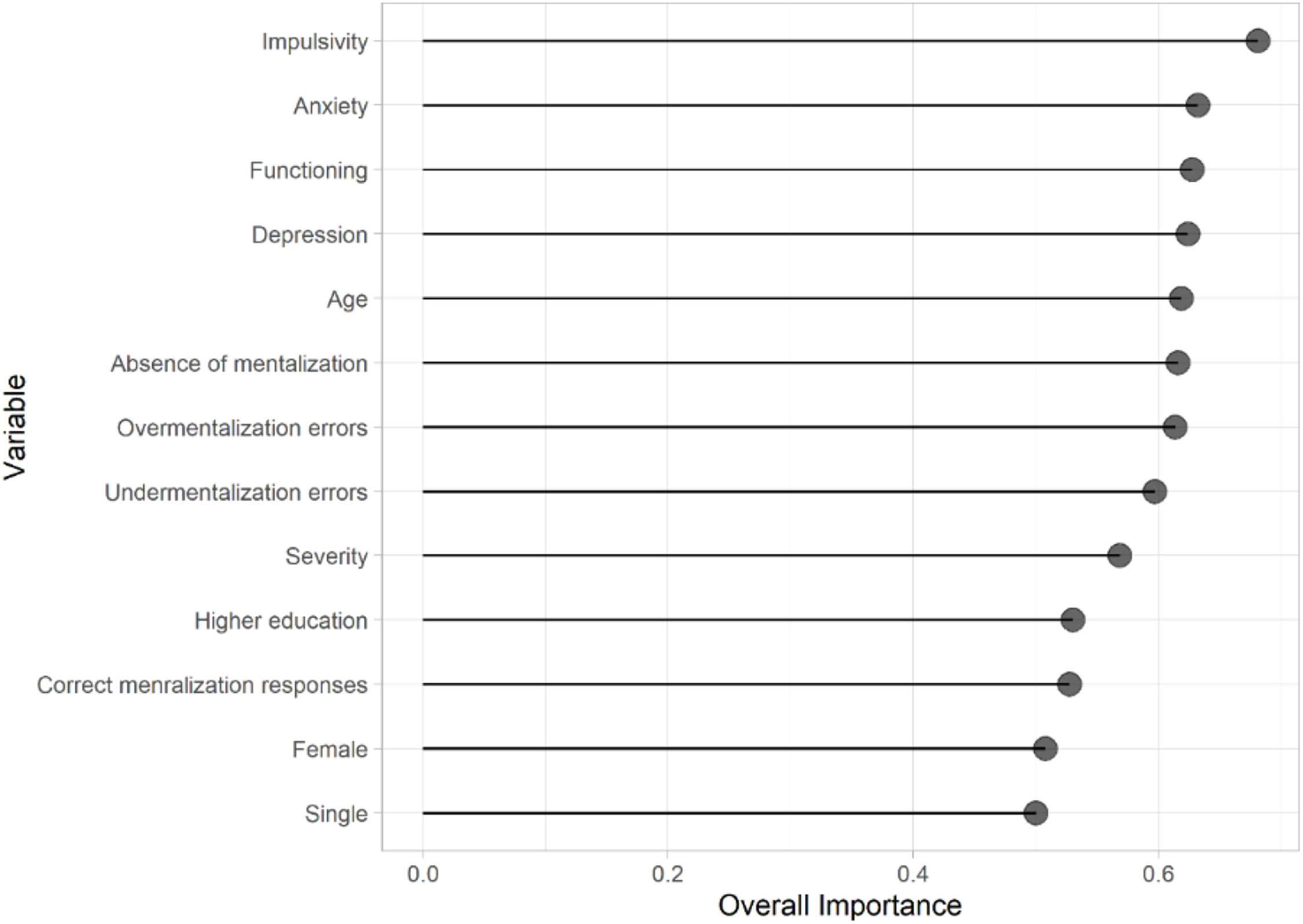
Theory of Mind (ToM) errors had a moderate predictive value on the presence of NSSI. Other variables with a relevant influence for NSSI classification were: high levels of impulsivity, anxiety, impairment in functioning, depressive symptomatology, age and theory of mind errors (AUC: 0.66). In addition, significant differences in impulsivity were found between patients with NSSI compared to those without NSSI.

Conclusion

The results of this study show that although impairments in social cognition have a moderate influence on the presence of NSSI in patients with a BPD, their impact is smaller than that of other variables such as impulsivity, functioning and emotional dysregulation.

Keywords:
Borderline personality disorder
Social cognition
Theory of mind
Self-injurious behavior
Suicide
Non-suicidal injuries
Impulsivity

Article

These are the options to access the full texts of the publication European Journal of Psychiatry
Subscriber
Subscriber

If you already have your login data, please click here .

If you have forgotten your password you can you can recover it by clicking here and selecting the option “I have forgotten my password”
Purchase
Purchase article

Purchasing article the PDF version will be downloaded

Purchase now
Contact
Phone for subscriptions and reporting of errors
From Monday to Friday from 9 a.m. to 6 p.m. (GMT + 1) except for the months of July and August which will be from 9 a.m. to 3 p.m.
Calls from Spain
932 415 960
Calls from outside Spain
+34 932 415 960
E-mail
Article options
Tools
Supplemental materials