




Intimate partner violence (IPV) against pregnant women during pregnancy is a major concern to healthcare practitioners globally due to the negative impact on the health of the woman and her unborn child. This study determined the level of intimate partner violence experienced among pregnant women and the factors influencing the occurrence.
MethodA cross-sectional descriptive research design was employed, and data were collected from 394 pregnant women attending two selected public healthcare facilities in Lagos State, Nigeria. The World Health Organization Multi-Country Study on Women’s Health and Domestic Violence Against Women questionnaire was used to collect the information. Frequency and percentage were used to determine the experience of IPV and Binomial regression was used to predict the associated factors on the experience of IPV at significance set at P < .05.
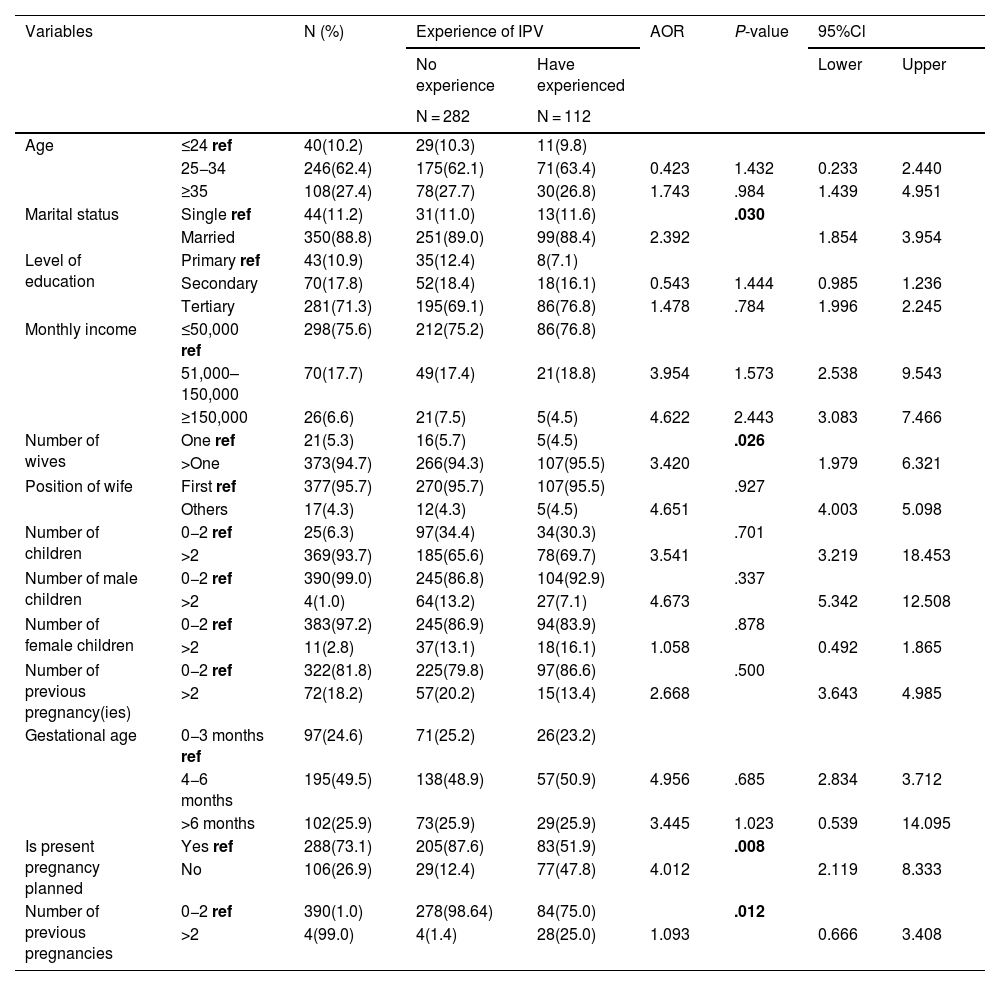
ResultsThe results revealed that 28.45 of pregnant women had experienced IPV. The Pregnant women who are married were 2.4 times more likely to experience IPV compared to those who are pregnant but not married (adjusted OR = 2.392, 95% CI 1.854–3.954; P = .030). Pregnant women who did not planned for the pregnancy were 4 times more likely to experience IPV (adjusted OR = 4.012, 95% CI 2.119–8.333; P = .008). Also, pregnant women from polygamous settings were more likely to experience IPV compared with those in monogamous family (adjusted OR = 3.420, 95% CI 1.979–6.321; P = .026).
ConclusionThis study concluded that about one quarter of the pregnant women had experienced IPV. Some of the factors contributing to the experience are the low monthly income of the pregnant women, polygamous settings and unplanned pregnancy. Therefore, there is a need for more enlightenment on the factors responsible for intimate partner violence among pregnant women.
La violencia de pareja (VP) contra las mujeres embarazadas durante el embarazo es una preocupación importante para los profesionales de la salud en todo el mundo, debido al impacto negativo en la salud de la mujer y su hijo no nacido. Este estudio determinó el nivel de VP experimentado entre las mujeres embarazadas y los factores que influyen en su incidencia.
MétodoSe empleó un diseño de investigación descriptivo transversal, y se recogieron datos de 394 mujeres embarazadas que asistían a dos centros de salud pública seleccionados en el estado de Lagos, Nigeria. Para recopilar la información se utilizó el cuestionario del Estudio Multinacional de la Organización Mundial de la Salud sobre la Salud de la Mujer y la Violencia Doméstica contra la Mujer. Se utilizaron frecuencias y porcentajes para determinar la experiencia de VP y una regresión binomial para predecir los factores asociados a la experiencia de VP con una significación establecida en P < ,05.
ResultadosLos resultados revelaron que el 28,45 de las mujeres embarazadas habían experimentado VP. Las mujeres embarazadas casadas tenían 2,4 veces más probabilidades de experimentar VP en comparación con las embarazadas no casadas (OR ajustado = 2,392, IC 95% 1,854–3,954; P = ,030). Las mujeres embarazadas que no planificaron el embarazo tenían 4 veces más probabilidades de experimentar VP (OR ajustado = 4,012, IC 95% 2,119–8,333; P = ,008). Además, las mujeres embarazadas de entornos polígamos tenían más probabilidades de experimentar VP en comparación con las de una familia monógama (OR ajustado = 3,420, IC 95% 1,979–6,321; P = ,026).
ConclusiónEste estudio concluyó que alrededor de una cuarta parte de las mujeres embarazadas habían experimentado VP. Algunos de los factores que contribuyen a la experiencia son los bajos ingresos mensuales de las mujeres embarazadas, los entornos polígamos y los embarazos no planificados. Por lo tanto, es necesario esclarecer en mayor medida los factores responsables de la VP entre las mujeres embarazadas.

