


metricas
covid
Enfermería Clínica (English Edition) Impact of a motor-cognitive intervention on Health-Related Quality of Life in pa...
Journal Information
Vol. 35. Issue 6.
(November - December 2025)
Visits
31
Vol. 35. Issue 6.
(November - December 2025)
Brief Original Articles
Impact of a motor-cognitive intervention on Health-Related Quality of Life in patients with type 2 diabetes
Impacto de una intervención motora-cognitiva en la calidad de vida relacionada con la salud en pacientes con diabetes tipo 2
Visits
31
Nilton João Chantre Leitea,b,
Corresponding author
niltonchleite@gmail.com

Corresponding author.
, Armando Manuel Mendonça Raimundoa,b, Romeu Duarte Carneiro Mendesc,d,e, Soraia Daniela Pires Ferreiraa,b, José Francisco Filipe Marmeleiraa,b
a Departamento de Desporto e Saúde, Escola de Saúde e Desenvolvimento Humano, Universidade de Évora, Largo dos Colegiais, 7000-727 Évora, Portugal
b Comprehensive Health Research Centre (CHRC), University of Évora, 7004-516 Evora, Portugal
c EPIUnit - Instituto de Saúde Pública, Universidade do Porto, Porto, Portugal
d Unidade Local de Saúde de Trás-os-Montes e Alto Douro, Vila Real, Portugal
e Laboratório Para a Investigação Integrativa e Translacional em Saúde Populacional (ITR), Porto, Portugal
This item has received
Article information
Abstract
Full Text
Bibliography
Download PDF
Statistics
Figures (2)
Tables (4)
Table 1. Descriptive characteristics of the participants who completed the exercise programme.
Tables
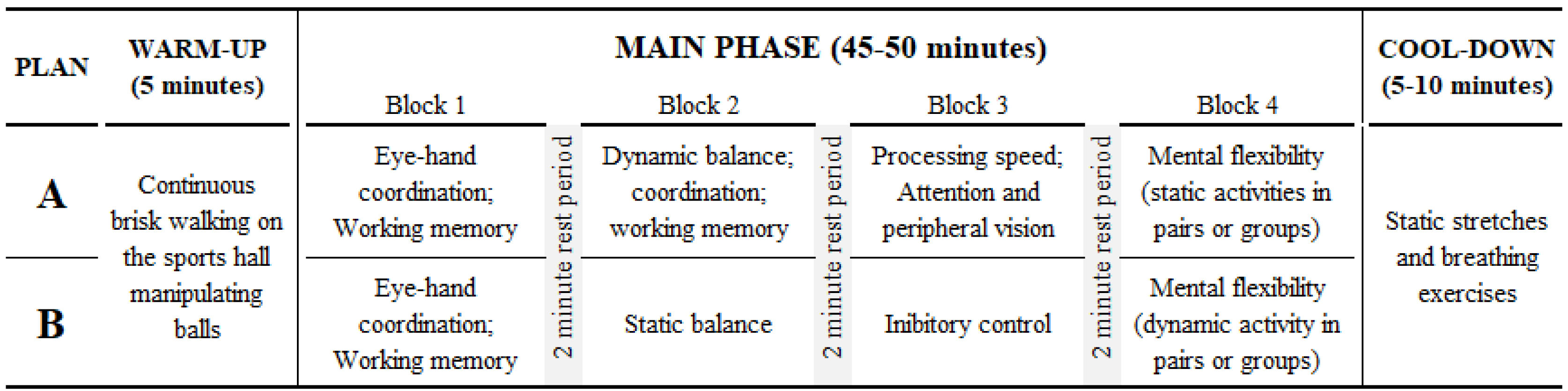
Table 2. Examples of exercises include in the main phase targeting specific abilities.
Tables
Table 3. Percentage frequency distributions of EQ-5D-3 L dimensions at all time points.
Tables
Table 4. Results for the HRQoL. Data are means ± SD.
Tables
Show moreShow less
Abstract
Aim

This study aimed to investigate the impact of a multimodal exercise programme on the Health-Related Quality of Life (HRQoL) in patients with type 2 diabetes mellitus (T2DM).

Methods

A quasi-experimental study with a single-group design and repeated measures was used. Twenty-six patients with T2DM (aged 68.58 ± 6.15 years, with a diabetes duration of 14.81 ± 8.35 years) participated in a motor-cognitive exercise programme that consisted of 60-minute sessions, three times per week for eight weeks. Data were collected at two baseline measurements (pretest 1 and pretest 2) and the final measurement (post-test). Health-related quality of life was assessed using the EuroQol five-dimensions-3-level questionnaire.

Results

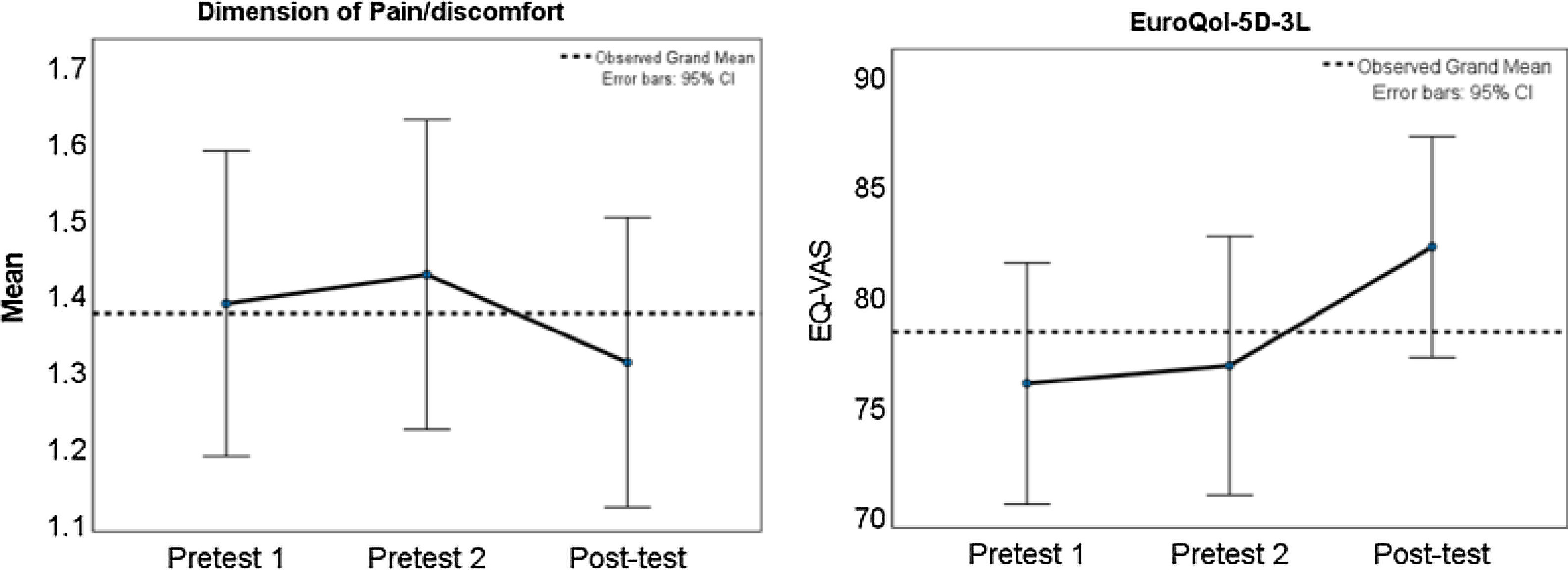
Although the repeated measure analysis showed no significant differences between measures at all time points, a small positive effect was found on the pain/discomfort domain and EuroQol visual analogue scale eight weeks after participating in the exercise programme.

Conclusions

These results show promising effects of the motor-cognitive intervention on health-related quality of life in patients with T2DM. However, given the study's limitations, such as the small sample size and lack of a control group, further research is needed to investigate the intervention's efficacy.

Keywords:
Type 2 diabetes mellitus
Physical exercise
Multimodal exercise
Dual-task
Health-Related quality of life
Resumen
Objetivo

Este estudio tuvo como objetivo investigar el impacto de un programa de ejercicio multimodal en la calidad de vida relacionada con la salud en pacientes con diabetes mellitus tipo 2 (DMT2).

Métodos

Se utilizó un estudio cuasi-experimental con un diseño de un solo grupo y medidas repetidas. Veintiséis pacientes con DM2 (edad 68.58 ± 6.15 años, con una duración de la diabetes de 14.81 ± 8.35 años) participaron en un programa de ejercicios motor-cognitivos que consistió en sesiones de 60 minutos, tres veces por semana durante ocho semanas. Se recopilaron datos en dos mediciones iniciales (pretest 1 y pretest 2) y la medición final (post-test). La calidad de vida relacionada con la salud se evaluó utilizando el cuestionario EuroQol cinco dimensiones-3 niveles.

Resultados

Aunque el análisis de medidas repetidas no mostró diferencias significativas entre las mediciones, se encontró un pequeño efecto positivo en el dominio de dolor/malestar y en la escala visual analógica del EuroQol ocho semanas después de participar en el programa de ejercicio.

Conclusiones

Estos resultados muestran efectos prometedores de la intervención motor-cognitiva en la calidad de vida relacionada con la salud en pacientes con DMT2. Sin embargo, dadas las limitaciones del estudio, como el tamaño reducido de la muestra y la falta de un grupo de control, se necesita más investigación para estudiar la eficacia de la intervención.

Palabras clave:
Diabetes mellitus tipo 2
Ejercicio físico
Ejercicio multimodal
Doble-tarea
Calidad de vida

Article

These are the options to access the full texts of the publication Enfermería Clínica (English Edition)
Subscriber
Subscriber

If you already have your login data, please click here .

If you have forgotten your password you can you can recover it by clicking here and selecting the option “I have forgotten my password”
Subscribe
Subscribe to

Enfermería Clínica (English Edition)

Purchase
Purchase article

Purchasing article the PDF version will be downloaded

Purchase now
Contact
Phone for subscriptions and reporting of errors
From Monday to Friday from 9 a.m. to 6 p.m. (GMT + 1) except for the months of July and August which will be from 9 a.m. to 3 p.m.
Calls from Spain
932 415 960
Calls from outside Spain
+34 932 415 960
E-mail
Article options
Tools