




A 35-year-old male presented with complaints of a 15-day history of a painful swelling under his right armpit and fatigue. His physician prescribed amoxicillin/clavulanic acid and ciprofloxacin for a possible bacterial infection but no regression was observed. Physical examination revealed a tender, erythematous mass in the right axillary region, measuring approximately 3cm×4cm in diameter, without fluctuation. In his medical history, he had a cat at home but no bite and scratch were noted. The same antibiotics were continued. The patient's laboratory results were as follows: leukocyte count 4720/mm3; hemoglobin: 14.7mg/dL; hematocrit 43%; C-reactive protein: 23mg/L; sedimentation rate 8mm/h. Ultrasonography (USG) revealed a reactive appearance of lymph node with a distinct cortex and diffuse thickening of the cortex in the right axillary region measuring 33mm×22mm. Other examinations were normal. Urinalysis, basic chemistry, and hepatic function testing results were within normal limits. Serologies for syphilis, human immunodeficiency virus, Epstein-Barr virus, toxoplasmosis, cytomegalovirus and brucellosis were unremarkable.
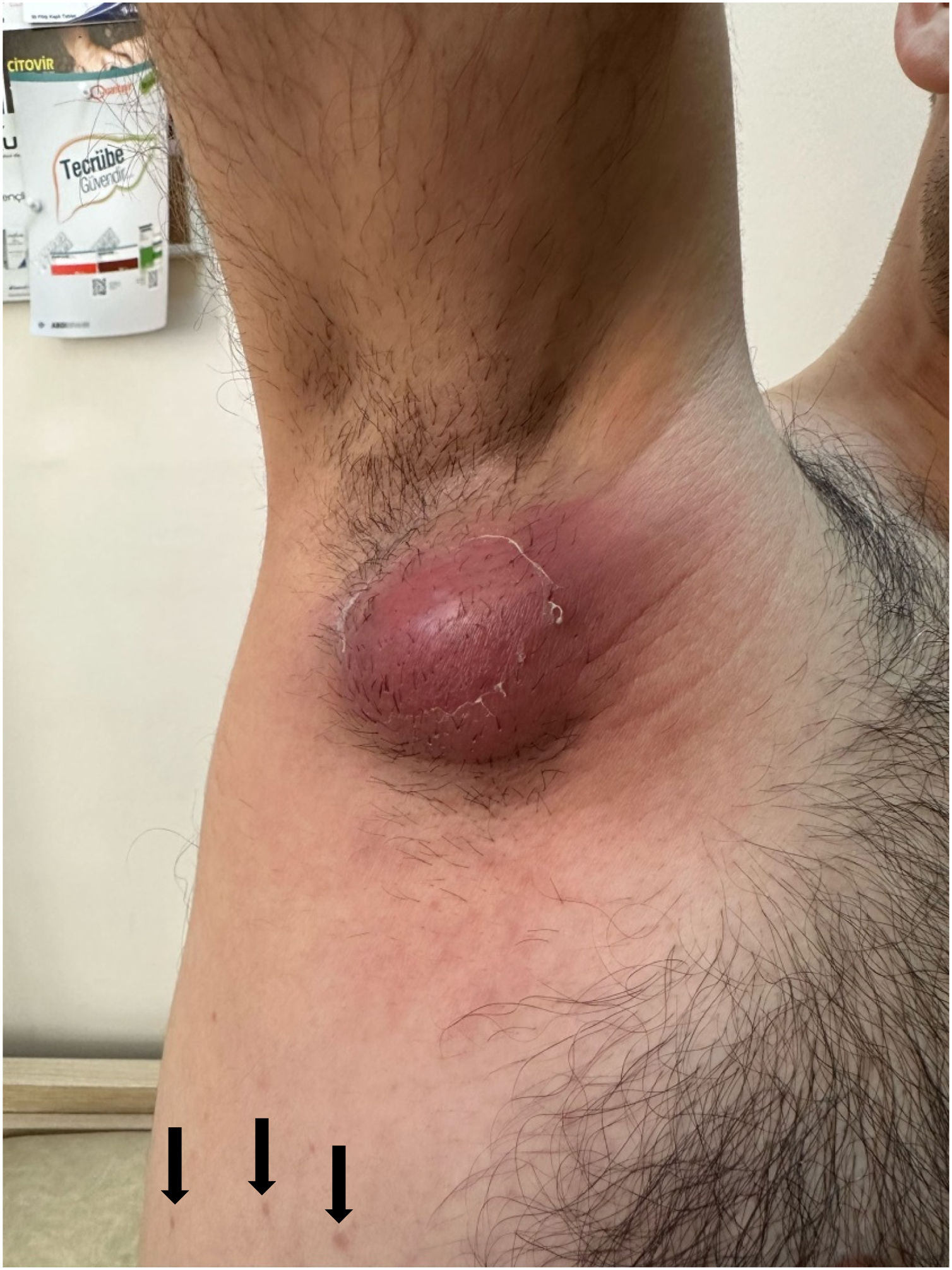
Diagnosis and evolutionDespite the administration of 2 weeks of antibiotics, the patient reported further enlargement of the swelling in the right axillary region, increased erythema, and fluctuation of the mass (Fig. 1). USG showed a dense, echogenic fluid collection measuring 53mm×47mm in the subcutaneous superficial region of the right axilla, consistent with an abscess. Fine needle aspiration was performed from the abscess and the material was sent for analysis for cat scratch disease (CSD), tuberculosis and other infections (Fig. 2). The sample revealed predominantly mononuclear leukocytes with no bacteria observed on Gram staining. Cultures of the material from the abscess in solid and liquid media were sterile. Chest X-ray was normal and the tuberculin skin test was negative. The Ehrlich–Ziehl–Neelsen, culture and PCR of the sample for tuberculosis were negative. The antibiotics were continued after drainage. However, 5 days later, the swelling reappeared. The mass was re-drained and the aspirate was re-analyzed but no specific etiology was reached. The sample was tested for Bartonella spp. by PCR and the result was positive. After the administration of azithromycin, the mass decreased in size and the pain gradually resolved within ten days. The patient has been doing well without recurrence for 3 months.


CSD is a rare bacterial infection that is usually transmitted from a scratch or bite from a cat infected with Bartonella henselae, as well as from exposure to cat-fleas infected with the bacteria.1,2 In our patient, upon re-evaluation of the patient's history, it was revealed that he worked in an area surrounded by numerous fleas-infested cats. He admitted to be bitten several times from fleas and there were some bite marks near the abscess (Fig. 1, arrows). CSD often begins with a skin lesion at the site of inoculation and then involves the lymph nodes. It typically persists for one to three weeks. However, this lesion is not seen in flea-borne infection as in our case.1 Enlarged lymph nodes appear proximal to the inoculation site and are almost always tender, often have erythema of the overlying skin, and occasionally suppurate.3 Most CSD are self-limited and do not require medical therapy. In some cases, azithromycin is an effective choice and shorten the duration of symptoms.
The differential diagnosis of axillary lymphadenopathy (LAP) includes pyogenic lymphadenitis, cat scratch disease, tularemia, tuberculosis, toxoplasmosis, HIV, lymphoma and metastatic cancer. The first four conditions can lead to abscess formation over time. Acute suppurative lymphadenitis is often caused by Staphylococcus aureus or group A Streptococcus. Both bacteria are easily seen on Gram stain and grow on culture media. They also respond well to the antibiotics mentioned above and to drainage. On the other hand, a diagnosis of lymphoma is unlikely because the erythrocyte sedimentation rate was normal, there were no B symptoms, and the lesion was completely healed. Tularemia can also cause similar symptoms/findings and is associated with recent exposure to the outdoors, animals or insects. However, there were no index cases in the surrounding area. Additionally, tularemia does not respond to azithromycin. In countries where tuberculosis is endemic, it is considered the primary etiology of fluctuating LAP. In our case, all tests were negative for tuberculosis. In addition, tuberculosis LAPs are frequently localized in the cervical region. In our patient, serological tests for CSD could not be performed and the biopsy was not taken, nor was the sample stained with Warthin-Starry stain. In CSD, axillary LAP is a common feature, and these clinical symptoms and the development of suppuration are typical. This case was considered as CSD based on patient history, the positive PCR result, despite a 10–20% of false positive rate, and the exclusion of alternative diseases. Its response to azithromycin further supported the diagnosis.
In conclusion, CSD can present as a lymphadenopathy without a history of cat scratch and bite. If treatment is delayed, suppuration develops in the lesion, thereby becoming abscess formation. In such situation, multiple drainages may be also required in addition to the administration of antibiotic.
Conflict of interestThere is no conflict of interest.

