

The BD Phoenix™ Emerge panel incorporates the CPO detect test (CPO-T), which enables both detection and classification of carbapenemases. Integrating reliable carbapenemase detection – particularly group D enzymes – into routine antimicrobial susceptibility testing (AST), along with rapid susceptibility results, supports early optimization of antimicrobial therapy and implementation of infection control measures. These actions are essential for improving clinical outcomes and limiting the spread of resistance. This study evaluated the performance of CPO-T in detecting carbapenemase activity in a well-characterized collection of Escherichia coli isolates producing only OXA-48, without co-production of ESBL or pAmpC (OXA48-NoE-NoA-E. coli). Additionally, we assessed the BD Phoenix™ system ability to provide rapid antimicrobial susceptibility results.
MethodsFifty-one OXA48-NoE-NoA-E. coli isolates were included. Ten carbapenem-resistant, non-carbapenemase-producing isolates served as negative controls (NC). All isolates underwent whole-genome sequencing using Illumina technology, and carbapenem MICs were determined by reference broth microdilution.
ResultsCPO-T detected carbapenemase activity in 100% of the OXA48-NoE-NoA-E. coli isolates, with 82.4% correctly assigned to Ambler class D. Three NC isolates were misclassified as carbapenemase producers. The BD Phoenix™ system provided definitive susceptibility results in under 8h for 64.6% of the antibiotics tested.
ConclusionsCPO-T is a reliable tool for detecting OXA48-NoE-NoA-E. coli, even in phenotypically complex cases. To ensure rapid and accurate classification, a confirmatory test – such as immunochromatography – should be performed. The BD Phoenix™ system also enables timely AST, supporting early and informed therapeutic decisions.
El panel BD Phoenix™ Emerge incluye el CPO Detect Test (CPO-T), que permite la detección y caracterización de carbapenemasas. Una detección y clasificación fiable de la producción de carbapenemasas del grupo D en las pruebas rutinarias de sensibilidad, junto con resultados rápidos del antibiograma, permite el ajuste temprano del tratamiento específico y de las medidas de aislamiento, lo que tiene un impacto clínico y epidemiológico significativo. Evaluamos la precisión de la prueba CPO-T frente a una colección caracterizada de aislados de Escherichia coli productores de OXA-48 que no coproducen ESBL/pAmpC (OXA48-NoE-NoA-E. coli), y del BD PhoenixTM como sistema rápido de sensibilidad a los antimicrobianos.
MétodosSe incluyeron 51 OXA48-NoE-NoA-E. coli. También se incluyeron 10 aislados resistentes a carbapenémicos no productores de carbapenemasas como controles negativos (NC). Todos los aislados se secuenciaron con Illumina y también se realizó microdilución de caldo de referencia para determinar la concentración mínima inhibitoria (CMI) de los carbapenémicos.
ResultadosCPO-T detectó actividad carbapenemasa en el 100% de los aislados de OXA48-NoE-NoA-E. coli y 42 (82,4%) fueron asignadas correctamente a la clase D de Ambler. Tres NC fueron clasificados como productores de carbapenemasas. BD Phoenix™ proporcionó resultados de sensibilidad definitivos en menos de 8 horas en el 64,6% de todos los antibióticos.
ConclusionesCPO-T es una herramienta fiable para la detección de OXA48-NoE-NoA-E. coli. Para garantizar una clasificación rápida y precisa, debería realizarse una prueba de confirmación, como la inmunocromatografía. BD Phoenix™ proporciona resultados rápidos para los antibióticos comúnmente utilizados en el tratamiento empírico.
OXA-48-type β-lactamases are increasingly reported among Enterobacterales. In a recent multicenter study conducted in Spain,1blaOXA-48 was predominant (73.1%) in carbapenemase-producing Escherichia coli. These enzymes hydrolyze penicillins, but not broad-spectrum cephalosporins, and show weak activity against carbapenems, often resulting in low MIC values for carbapenems. Therefore, reliable detection of OXA-48-like enzymes typically requires additional immunochromatographic or molecular tests, as biochemical assays like Carba-NP are less reliable than for metallobetalactamases or KPC enzymes.2
This characteristic weak-hydrolytic activity of OXA-48-type β-lactamases3 can hinder their detection in routine antimicrobial susceptibility testing, particularly when the isolate does not co-produce other β-lactamases. Recent studies have demonstrated the ability of the BD Phoenix™ CPO detect test (CPO-T) to detect carbapenemases, using phenotypic or molecular detection assays as reference methods.4–9 These studies reported high overall sensitivity rates ranging from 89.4% to 100% for detecting carbapenemase activity in different collections of clinical Enterobacterales isolates. Specifically, CPO-T sensitivity for detecting OXA-48-like enzyme ranged from 97.1% to 100%, although most tested isolates co-produced additional enzymes such as ESBL or pAmpC.
Recently, several promising automated antimicrobial susceptibility testing (AST) systems have been developed to provide rapid results (RAST), within 8h or less. However, these new technologies often require further optimizations and are usually costly (an average of ten times the cost of routinely panels).10 Some established automated systems, such as BD Phoenix™, can also deliver rapid susceptibility results for certain antibiotics, as they combine oxidation-reduction indicators with turbidity-based growth detection.
In this study, we evaluated the accuracy of CPO-T for the detection and classification of carbapenemase production in a well-characterized set of OXA-48 producing E. coli isolates that do not co-produce ESBL/pAmpC. Additionally, we assessed the time to result for each antibiotic tested by BD Phoenix™ system.
Material and methodsCollection of isolatesA total of 51 OXA-48-producing and ESBL/pAmpC-negative E. coli isolates were submitted to the Andalucía Reference Laboratory during the period 2018–2022. Andalusian microbiology laboratories included in the PIRASOA program voluntarily submitted carbapenemase-producing Gram negative bacteria, detected according to EUCAST guidelines for the detection of resistance mechanisms, which include a screening cut-off of ertapenem >0.125mg/l for Enterobacteriaceae (https://www.eucast.org/fileadmin/src/media/PDFs/EUCAST_files/Resistance_mechanisms/EUCAST_detection_of_resistance_mechanisms_170711.pdf).
The isolates were detected from 40 (78.4%) surveillance cultures and 11 (21. 6%) clinical samples (5 blood, 4 exudate, 1 respiratory and 1 urine samples). They were collected from 10 hospitals located in 5 Andalusian provinces.
Ten isolates (8 Klebsiella pneumoniae and 2 E. coli), with ertapenem MICs ≥0.5μg/ml, that do not co-produce carbapenemases, were also included as negative controls.
Initial bacterial identification was confirmed using the MALDI-TOF Biotyper (Bruker Daltonics). Antimicrobial susceptibility testing was performed using the commercial MDRM1 panel (Microscan; Beckman Coulter), which includes ertapenem concentrations of 0.12, 0.5 and 1mg/l, and susceptibility disk diffusion on Mueller-Hinton agar (Becton Dickinson) for ertapenem, imipenem, meropenem, ceftazidime and cefotaxime (Oxoid), following EUCAST guidelines. Phenotypic carbapenemase characterization was performed with the imipenem hydrolysis test (β-CARBA test, Bio-Rad), immunochromatography with the NG-test CARBA 5 (NG Biotech) and study of inhibitors with disk diffusion (dipicolinic acid, phenyl-boronic acid, and cloxacillin, Rosco Diagnostica). In addition, all the isolates were sequenced by using Nextera Flex DNA library preparation, libraries were loaded onto an Illumina sequence Miseq 2000, sequencing was performed using paired-end 2×250bp. Raw reads were quality-checked, trimmed, and assembled de novo by submitting to Enterobase11 and assembled de novo with EToKi (Enterobase Tool Kit). Quality parameters are included in Table A1. Assemblies were annotated by using Resfinder12 with the default configuration (60–90% threshold) for acquired resistance determinants, PointFinder13 and CARD14 for SNPs variants within gyrA/parC topoisomerases genes, ompC and ompF porins deletions and regulatory network of AcrAB efflux pump (acrR, marAR and soxS/R), MLSTfinder15 for typing and Clermont Phylotyper to assign phylotype.
BD Phoenix™ CPO detect testThe test was performed using the BD Phoenix™ NMIC-502 panel (BD Diagnostic Systems, Sparks, MD) following to the manufacturer's recommendations. E. coli ATCC 25922 was included as the quality control strain. Briefly, the panels were manually inoculated with isolates prepared from samples stored at −80°C storage, after an overnight growth onto BD Columbia Agar with 5% Sheep Blood. The BD Phoenix™ NMIC-502 routine panel includes a confirmatory test that uses meropenem, doripenem, temocillin and cloxacillin, alone and in combination with various chelators and beta-lactamase inhibitors in concentrations required for the detection and classification of carbapenemase-producing organisms (CPO-T). In addition, the panel contains 136 wells with antimicrobial agents for susceptibility testing. AST results were interpreted according to EUCAST guidelines, using the BD Epicenter software (BD Diagnostic Systems, Sparks, MD), which allows real-time reporting of individual antibiotic results as soon as they are finalized.
Statistical methodsSensitivity (true positive rate), specificity (true negative rate), positive predictive value (PPV) and negative predictive value (NPV) were calculated for CPO-T (detection of carbapenemase production) as follows: Sensitivity: (True Positives/(True Positives+False Negatives))×100; Specificity: (True Negatives/(False Positives+True Negatives))×100; PPV: (True Positives/(True Positives+False Positives))×100 and NPV: (True Negatives/(True Negatives+False Negatives))×100. A result was considered a true positive if CPO-T was positive for an isolate producing OXA-48, and a false negative if CPO-T was negative for such an isolate. A true negative was defined as a negative CPO-T result in an isolate not producing OXA-48, while a false positive was defined as a positive CPO-T result in an isolate that does not produce carbapenemases.
Reference broth microdilution assayMinimum inhibitory concentrations (MICs) of ertapenem, imipenem and meropenem were determined for all 51 OXA-48-producing and ESBL/pAmpC-negative E. coli isolates using three biological replicates by reference broth microdilution assays. MICs were determined using cation-adjusted Mueller-Hinton (MH) broth. EUCAST-v14.0 clinical breakpoints and guidelines (https://www.eucast.org/clinical_breakpoints) were used for reference purposes. The reference strains E. coli ATCC 25922 and K. pneumoniae ATCC BAA-2814 were used as quality control strains.
Categorical agreement (CA), minor errors (mE), major errors (ME), and very major errors (VME) were defined according to the US Food and Drug Administration (FDA) criteria for carbapenems.16 As recommended by the FDA, acceptable performance thresholds are CA >90%, VME <1.5%, and ME <3%. Essential agreement (EA) and bias were also calculated according ISO 20776.2:2021.17 For ertapenem, sensitivity and specificity were additionally assessed, as only three concentrations are included in the panel. An overall EA ≥90% and bias within ±30% compared to the reference method were considered acceptable performance criteria.
ResultsForty-eight isolates (94.2%) carried blaOXA-48, two isolates (3.9%) carried blaOXA-244 and one isolate (1.9%), blaOXA-181. Additionally, sixteen isolates co-carried blaTEM-1, one co-carried blaSHV-1 and another one, blaOXA-1. Twenty-four isolates (47%) carried genes encoding aminoglycoside-modifying enzymes, 21 (41.2%) isolates had genes linked to trimethoprim and/or sulfonamides resistance and 19 (37.2%) isolates had genes linked to tetracyclines resistance (Fig. A1). Quinolone resistance-determining regions (QRDR) mutations and/or plasmid-mediated quinolones resistance were detected in 16 (31.4%) isolates. Several isolates showed mutations: 14 (27.5%) isolates showed at least one mutation in topoisomerases genes (Fig. A1), 6 (11.8%) isolates had a variant in the uhpT gene (E350Q), 7(13.7%) isolates a variant in the cyaA gene (S352T) and 46 (86.3%) had the same SNPs variant in the marR gene (Y137H, G103S). Phylogroup B1 (39%) predominated, followed by phylogroup A (21.6%) (Fig. A1). The collection was polyclonal and isolates belonged to 36 different MLSTs and 19 (37%) isolates were a member of 3 clonal complexes (10, 23 and 155).
Evaluation of the CPO-T to detect the presence of a carbapenemaseThe CPO-T successfully detected carbapenemase production in 100% of the isolates within 7h of incubation. Following detection, classification results were as follows: 42 (82.4%) isolates were assigned to class D Ambler, 5 (9.8%) isolates to class B Ambler, and in 4 (7.8%) were detected as carbapenemase producers without specific assignment. The 9 isolates not classified as class D (Table A2) showed notable resistance to ertapenem and piperacillin–tazobactam, while retaining susceptibility to aztreonam, ceftazidime–avibactam, and meropenem. Among the negative controls, three isolates (30%) were classified as carbapenemase producers (those with ertapenem MICs >1μg/ml), with one assigned to class A and two remaining unassigned. The values for sensitivity, specificity, positive predictive value and negative predictive value for the detection of carbapenemases were 100%, 70%, 94.5% and 100%, respectively.
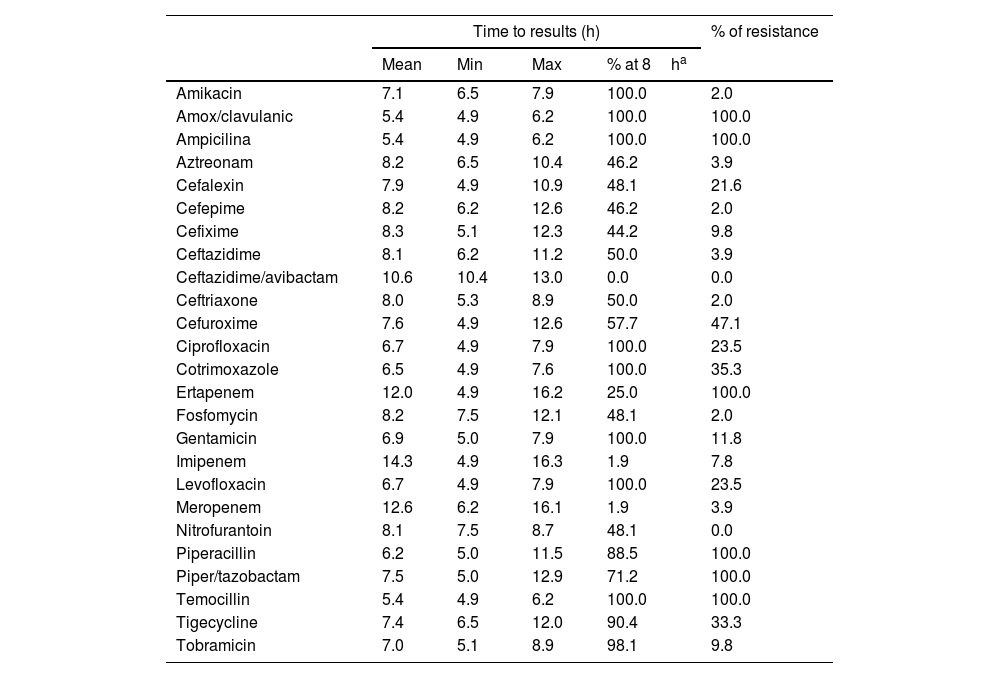
Antimicrobial susceptibility results using BD Phoenix™Antimicrobial susceptibility results for all the isolates using BD Phoenix™ are presented in Table 1.
Performance of Phoenix panel on 51 OXA-48-producing E. coli isolates.
| Time to results (h) | % of resistance | ||||
|---|---|---|---|---|---|
| Mean | Min | Max | % at 8ha | ||
| Amikacin | 7.1 | 6.5 | 7.9 | 100.0 | 2.0 |
| Amox/clavulanic | 5.4 | 4.9 | 6.2 | 100.0 | 100.0 |
| Ampicilina | 5.4 | 4.9 | 6.2 | 100.0 | 100.0 |
| Aztreonam | 8.2 | 6.5 | 10.4 | 46.2 | 3.9 |
| Cefalexin | 7.9 | 4.9 | 10.9 | 48.1 | 21.6 |
| Cefepime | 8.2 | 6.2 | 12.6 | 46.2 | 2.0 |
| Cefixime | 8.3 | 5.1 | 12.3 | 44.2 | 9.8 |
| Ceftazidime | 8.1 | 6.2 | 11.2 | 50.0 | 3.9 |
| Ceftazidime/avibactam | 10.6 | 10.4 | 13.0 | 0.0 | 0.0 |
| Ceftriaxone | 8.0 | 5.3 | 8.9 | 50.0 | 2.0 |
| Cefuroxime | 7.6 | 4.9 | 12.6 | 57.7 | 47.1 |
| Ciprofloxacin | 6.7 | 4.9 | 7.9 | 100.0 | 23.5 |
| Cotrimoxazole | 6.5 | 4.9 | 7.6 | 100.0 | 35.3 |
| Ertapenem | 12.0 | 4.9 | 16.2 | 25.0 | 100.0 |
| Fosfomycin | 8.2 | 7.5 | 12.1 | 48.1 | 2.0 |
| Gentamicin | 6.9 | 5.0 | 7.9 | 100.0 | 11.8 |
| Imipenem | 14.3 | 4.9 | 16.3 | 1.9 | 7.8 |
| Levofloxacin | 6.7 | 4.9 | 7.9 | 100.0 | 23.5 |
| Meropenem | 12.6 | 6.2 | 16.1 | 1.9 | 3.9 |
| Nitrofurantoin | 8.1 | 7.5 | 8.7 | 48.1 | 0.0 |
| Piperacillin | 6.2 | 5.0 | 11.5 | 88.5 | 100.0 |
| Piper/tazobactam | 7.5 | 5.0 | 12.9 | 71.2 | 100.0 |
| Temocillin | 5.4 | 4.9 | 6.2 | 100.0 | 100.0 |
| Tigecycline | 7.4 | 6.5 | 12.0 | 90.4 | 33.3 |
| Tobramicin | 7.0 | 5.1 | 8.9 | 98.1 | 9.8 |
Cumulative and average time to result for each antibiotic in the BD Phoenix™ NMIC-502 panel are presented in Table 1. The BD Phoenix™ system provided definitive susceptibility results in less than 8h in 64.6% of all the tested antibiotics (95% CI 51.1–78.1%). The mean time to results ranged from 8.0 to 8.3h for aztreonam, cefepime, cefixime, ceftazidime and ceftriaxone. Tigecycline results were obtained in an average of 7.4h, while levofloxacin showed the shortest mean time at 6.7h, all of them antibiotics widely used in empirical treatments. The median time to result for ceftazidime/avibactam was 10.6h.
Comparison between BD Phoenix™ and reference broth microdilution for carbapenems.The categorical agreement between BD Phoenix™ and reference broth microdilution method was 96% for ertapenem, 56.8% for imipenem and 100% for meropenem. For ertapenem, two ME were observed (3.9%). In the case of imipenem, 18 minor errors were recorded (35.3%, “S” by reference broth microdilution but “I” by BD Phoenix™), along with 2 ME (3.9%) and 2 VME (3.9%). For this carbapenem, considering “S” and “I” the same category (susceptible), the categorical agreement is 92.1%
Essential agreement for imipenem and meropenem were 70.6% and 98%, respectively. For ertapenem, sensitivity was 100% and specificity could not be determined due to the absence of isolates at the lowest concentration tested. Bias values were 45.1% for imipenem and 62.7% for meropenem (Fig. A2).
DiscussionAlthough nearly 10% of the isolates were categorized as metallo-beta-lactamase producers, our study demonstrated that CPO-T reliably detected carbapenemase production in all E. coli isolates which only produce OXA-48. Nevertheless, a confirmatory test for rapid classification (e.g. immunochromatography) remains advisable. While a slightly lower proportion of correct carbapenemase assignment was found than in previous studies, it is important to highlight that the isolates tested in our study exclusively produced a single carbapenemase type, characterized by low-level hydrolysis of meropenem and ertapenem.3 Including a phenotypic confirmatory test for carbapenemase production within the routine AST panel is highly valuable, as it facilitates the detection of complex phenotypes that might otherwise go unnoticed in the absence of a clear clinical suspicion. This integrated approach enhances early identification, even though an additional confirmatory test is typically required before reporting results to clinicians. As an extra component of the panel, the CPO test demonstrates excellent sensitivity and contributes meaningfully to routine diagnostic workflows.
No specific explanation was found for the misidentification of class D as class B in five of the isolates included in our study. In previous studies4–9 focusing solely on OXA-48-like producing Enterobacterales, 215 isolates were evaluated and 90.3% were correctly classified as producers of class D carbapenemase, and misclassification was found to be lower than our data (8.4% were unclassified, 0.4% were classified as class B-producing and 0.9% were considered negative). Incorporating susceptibility to ceftazidime–avibactam into the classification algorithm, as suggested in the French novel disc diffusion-based algorithm,18 may help prevent misclassification of OXA-48 as class B. Regarding specificity of the CPO-T, 3 of 10 negative controls were classified as carbapenemase producers. These findings underscore the importance of confirmatory testing to avoid unnecessary isolation or escalation of therapy, although in clinical settings, this is generally less critical than failing to detect a true carbapenemase producer.
Based on the time to results, RAST has been defined as a technology that yields results in less than 8h, thus providing clinicians with the final report within the same working shift or, at least, the same day.19 This may have a direct impact on patient management.20 This goal can also be achieved with routinely used traditional methods, such as disk diffusion.21 In our study, the BD Phoenix™ system provided definitive results in less than 8h for several antibiotics widely used in the empirical treatments of serious infections. Nevertheless, some key agents (e.g. ertapenem and imipenem) exhibited longer time to results. We hypothesize two possible explanations: differences in “in vitro” action kinetics (carbapenems may require more time to achieve a clear metabolic inhibition than other beta-lactams) and the number of tested concentrations, as Phoenix panels typically include more dilutions for carbapenems than for other beta-lactams, This implies that the system must monitor a greater number of wells for a longer period, thereby extending the time to results.
Slightly higher proportion of VME and ME for ertapenem and imipenem than those recommended by FDA were observed when comparing BD Phoenix™ with reference broth microdilution. Categorical agreement for ertapenem exceed 90% and for imipenem, this level was also achieved when interpreting results using only two clinical categories (susceptible and resistant). Notably, for meropenem, categorical agreement was 100%. The EA for imipenem was lower than recommended. This finding aligns with previous observations, as clinical microbiology laboratories have frequently encountered challenges in achieving accurate susceptibility testing results for carbapenem agents.22 Several studies have reported instances of false resistance and false susceptibility with various automated systems particularly when testing β-lactam antimicrobial agents against selected Gram negative bacteria.23 Substantial variability in carbapenem MICs for OXA-48-like carbapenemase-producing Enterobacterales isolates by commercial microdilution methods has also been demonstrated.24 For example, marked discrepancies in meropenem MICs have been observed between Sensititre/Vitek and Etest was marked, with some isolates showing susceptible results by E-test while exhibiting MICs of 8mg/mL and 16mg/mL by Sensititre and Vitek, respectively; similar inconsistencies were also observed for imipenem. Haldorsen et al.25 reported that 25% of meropenem MICs for OXA-48-like isolates obtained by Vitek 2 were 4-fold higher than those determined by broth microdilution. Furthermore, comparative studies using sequencing data to predict resistance phenotype had shown limited concordance, partly because a proportion of the isolates might possess uncharacterized antimicrobial resistance genes.26
The main limitation of this study is the number of isolates included. However, it is worth noting that very few studies have evaluated such a substantial number of OXA-48-producing E. coli isolates, although very few studies include such numbers of OXA-48-producing E. coli isolates that do not co-produce ESBL/AmpC production. Moreover, the isolate collection is multicentric, highly polyclonal, and has been thoroughly characterized by sequencing, which adds robustness to the findings. Another limitation is that some OXA-48 variants, like OXA-244 and OXA-181, were included in the study but underrepresented.
As conclusions, our results demonstrate that CPO-T is a reliable tool for simultaneous detection and classification of OXA-48 in E. coli isolates that do not co-produce ESBL/pAmpC where carbapenemase production is difficult to detect. However, a confirmatory test for rapid classification (e.g. immunochromatography) is recommended. BD Phoenix™ also provides definitive results in less than 8h for at least nine antibiotics in these isolates, including some of those most frequently used in empirical treatment. The ability to rapidly detect carbapenemases in routine susceptibility testing together with rapid results of antibiotic susceptibility, lies in an early adjustment of the targeted treatment and isolation measures, which meaningful clinical and epidemiological benefits.
CRediT authorship contribution statementFátima Galán-Sánchez: Conceptualization, Data curation, Formal analysis, Investigation, Methodology, Validation, Writing – original draft, Writing – review and editing; Inés Portillo-Calderón: Investigation, Methodology; Manuel Rodriguez-Iglesias: Funding acquisition, Resources, Validation, Writing – review and editing; Álvaro Pascual: Funding acquisition, Resources, Validation, Writing – review and editing; Lorena López-Cerero: Conceptualization, Data curation, Formal analysis, Investigation, Methodology, Supervision, Software, Validation, Writing – review and editing.
Ethics approvalBacterial isolates obtained from anonymised sources arising from routine diagnostic samples were used. As no patient identifying information was available to the investigators, this project represents an evaluation of a diagnostic tools; therefore, no ethical approval was required.
FundingThe authors declare that no funding was received to assist with the preparation of this manuscript.
Conflict of interestNo conflict of interest declared.
Data availabilityData are contained within this article and supplementary materials. WGS data are available in the ENA database (Reviewer link: https://dataview.ncbi.nlm.nih.gov/object/PRJNA1104240?reviewer=m1jkbifa4hjlbvbkasb7t7rqm7).
The following are the supplementary data to this article: