



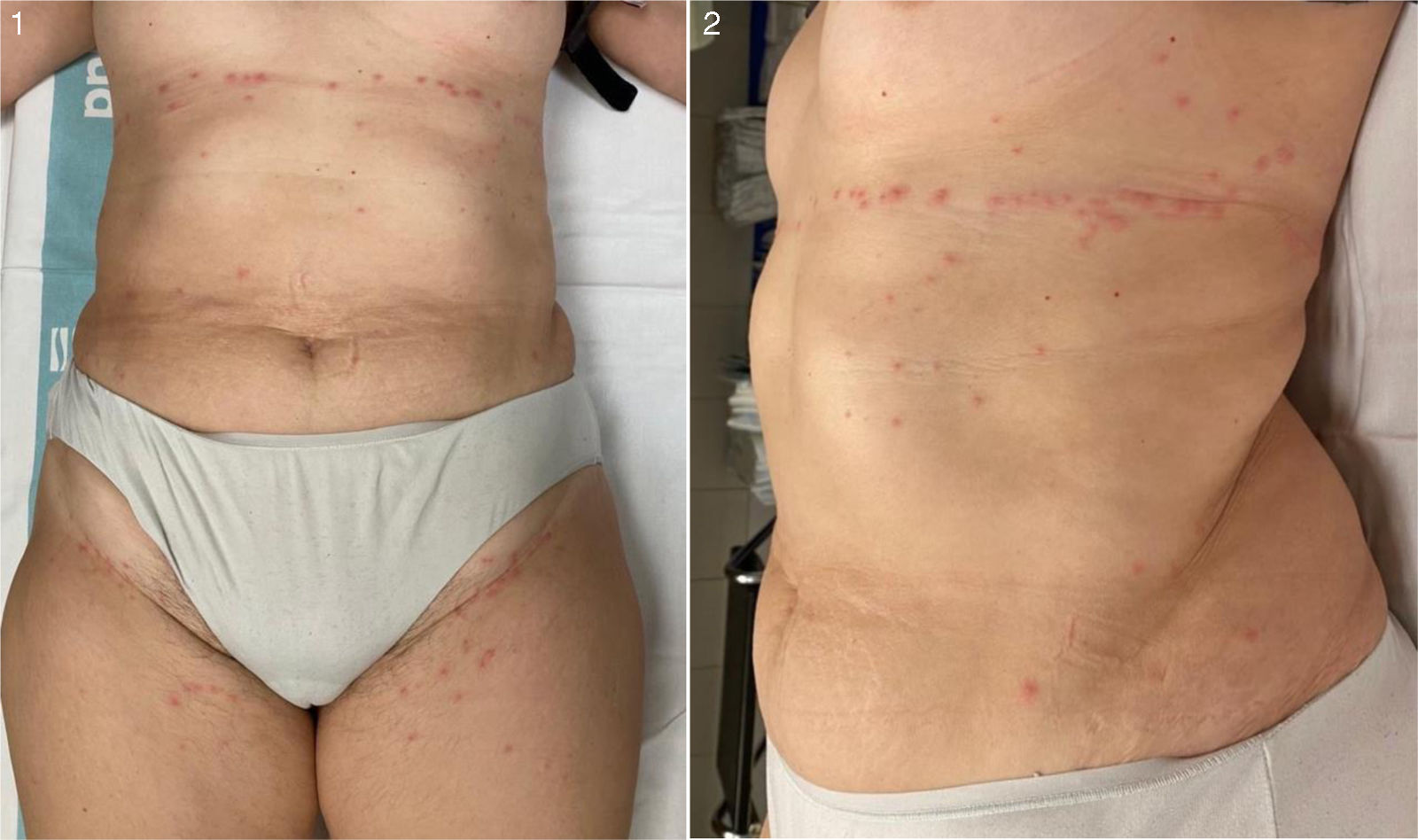

A 41-year-old woman attended due to the sudden appearance 24 h earlier of an intensely itchy skin rash. As the only relevant history, she reported having been in a forest in the Soria region of Spain approximately six hours before the onset of her symptoms.
On examination, erythematous papules were identified on her trunk and extremities, some of which were excoriated. These papules were located mainly in the sub-mammary, axillary and inguinal folds, although they are also seen in a scattered manner at the top of the limbs (Fig. 1).

Dermoscopy revealed the presence of 4–5 shiny orange larvae measuring 0.2 mm with six legs, strongly attached to the tegument (Fig. 2).
Clinical course
After microbiological confirmation, trombiculiasis was diagnosed. Treatment was started with topical permethrin 5% and oral antihistamines every 12 h with complete resolution of the lesions within a week.
Closing remarksTrombiculiasis, also known as trombiculosis, is a dermatitis caused by the bites of larvae from mites belonging to the Trombiculidae family (class Arachnida, order Trombidiformes). These larvae are usually found at the apex of plants or dry branches on forest floors.1
The life cycle of mites belonging to the Trombiculidae family consists of the following stages: a) egg; b) larva; c) nymph; and d) adult. The larval phase is the only one in which these organisms act as parasites. Adult females lay eggs on the ground or nearby vegetation, and these hatch in six to 10 days, giving rise to pre-larvae, which mature in six days to form larvae. These bright red-orange parasitic larvae can reach a size of up to 0.3 mm and have six legs.2 During the larval stage, mites inhabit warm, humid environments, normally on the edges of leaves and grasses, where they wait for a host to attach themselves to.2,3 Once they reach the host, they migrate along the skin2 and adhere by means of the chelicerae, forming the stylostome, a tubular cavity that penetrates the subcutaneous cellular tissue to feed on lymphatic fluid. The production of saliva and the secretion of enzymes cause the skin symptoms.3
Between six and 72 h after exposure, intense itching develops associated with skin inflammation, caused by enzymatic cell destruction and the host’s immune response.4 Lesions (papules and vesicles) usually appear in groups, around areas of constriction or sites where clothing is thinner (armpits, ankles).3,4
The larvae usually remain in the host for about 3–5 days and then detach, fall to the ground and continue their life cycle. The outcome is generally good, as the itching goes away in 72 h and the lesions within a couple of weeks.
The post-larval stages (nymph and adult) develop their life on the ground, where they feed on other arthropods. Unlike larvae, adults have four pairs of legs, and their sexual dimorphism is not clearly identified.3
In children, especially boys 6 to 11 years of age, summer penile syndrome or “lion’s mane penis”, a type of localised hypersensitivity reaction, is common. It consists of a classic triad of itching, dysuria and oedema, which appears after contact with outdoor plants in the spring and summer months.2,3
In Spain, 18 species of trombiculids have been identified. However, there are few documented cases of trombiculiasis, and all of them were located in a specific area in the north of the country. These cases have been recorded in the Sierra de Cebollera Natural Park, located between the autonomous regions of La Rioja and Castille-Leon.3
Recommendations to prevent trombiculiasis include avoiding areas infested by the arthropod and wearing appropriate clothing for the outdoors. In cases of parasitism, treatment includes topical corticosteroids and antihistamines, and in some cases acaricides have been used, with rapid resolution of the condition.
Mites of the Trombiculidae family are capable of parasitising humans, so it is important to know how to identify them, in order to avoid unnecessary treatments and promote prevention mechanisms.

