


metricas
covid
Enfermedades Infecciosas y Microbiología Clínica (English Edition) Characterization of new HIV diagnoses made in hospital emergency departments thr...

Journal Information
Vol. 43. Issue 8.
Pages 496-503 (October 2025)
Visits
7
Vol. 43. Issue 8.
Pages 496-503 (October 2025)
Original article
Characterization of new HIV diagnoses made in hospital emergency departments through the “Leave Your Mark” program
Caracterización de los nuevos diagnósticos de VIH realizados en los servicios de urgencias hospitalarios a partir del programa “Deja tu huella”
Visits
7
Phillipe Calpe Delgadoa, Patricia Muñozb, Alberto Pizarro Portilloc, Virginia Álvarez Rodríguezd, Ángel Iván Díaz Saladoe, Isabel Arenas Berenguerf, Marta Álvarez Alonsog, Esther Gargallo Garcíah, Fátima Fernández Salgadoi, Alma Elena Real Martínj, Irene Cabrera Rodrigok, Anaura Carrasquel Regaladel, María Ángeles Moreno Planellesm, Margarita Jurado Oteron, Rodrigo Sanz Lorenteo, Luis Pérez Ordoñop, Ana Carrero Fernándezq, Juan González del Castillor,
Corresponding author
jgonzalezcast@gmail.com

Corresponding author.
, representing the Madrid HIV network
a Servicio de Urgencias, Hospital Universitario Puerta de Hierro, Madrid, Spain
b Servicio de Microbiología Clínica, Hospital Universitario Gregorio Marañón, Madrid, Spain
c Servicio de Urgencias, Hospital Universitario La Princesa, Madrid, Spain
d Servicio de Urgencias, Hospital Universitario de Getafe, Getafe, Spain
e Servicio de Urgencias, Hospital Universitario Infanta Cristina, Parla, Spain
f Servicio de Urgencias, Hospital Universitario La Paz, Madrid, Spain
g Servicio de Urgencias, Hospital Universitario de Fuenlabrada, Fuenlabrada, Spain
h Servicio de Urgencias, Hospital Universitario Gregorio Marañón, Madrid, Spain
i Servicio de Urgencias, Hospital Universitario de Móstoles, Móstoles, Spain
j Servicio de Urgencias, Hospital Universitario Fundación Alcorcón, Alcorcón, Spain
k Servicio de Urgencias, Hospital Universitario Severo Ochoa, Leganés, Spain
l Servicio de Urgencias, Hospital Universitario Ramón y Cajal, Madrid, Spain
m Servicio de Urgencias, Hospital Universitario Infanta Sofía, Madrid, Spain
n Servicio de Urgencias, Hospital Universitario Infanta Leonor, Madrid, Spain
o Servicio de Urgencias, Hospital Fundación Jiménez Díaz, Madrid, Spain
p Servicio de Urgencias, Hospital Universitario 12 de Octubre, Madrid, Spain
q Servicio de Urgencias, Hospital Universitario Príncipe de Asturias, Alcalá de Henares, Spain
r Servicio de Urgencias, IdISSC, Universidad Complutense, Madrid, Spain
Ver más
This item has received
Article information
Abstract
Full Text
Bibliography
Download PDF
Statistics
Figures (1)
Tables (4)
Table 1. Geographical area of birth of new diagnoses.
Tables
Table 2. Emergency department diagnosis of new diagnoses.
Tables
Table 3. Patient characteristics according to birth country.
Tables
Table 4. Patient characteristics based on CD4 count at diagnosis.
Tables
Show moreShow less
Additional material (1)
Abstract
Introduction

The Leave Your Mark (DTH) program launched recommendations for HIV screening in emergency departments (ED) when patients presented with certain conditions. It is unknown whether the profile of patients diagnosed in the ED is similar to those reported for general population in epidemiological reports.

Methods

Retrospective study evaluating the characteristics of patients with new HIV diagnosed in 17 ED over a one-year period was developed. Demographic data (sex at birth, age, country of birth), sexual and risk behaviour, diagnosis in ED, number of emergency visits in previous five years, time from the ED to the specific HIV consultation, and from ED to start antiretroviral treatment were recorded. Information on the first CD4 and viral load was also collected.

Results

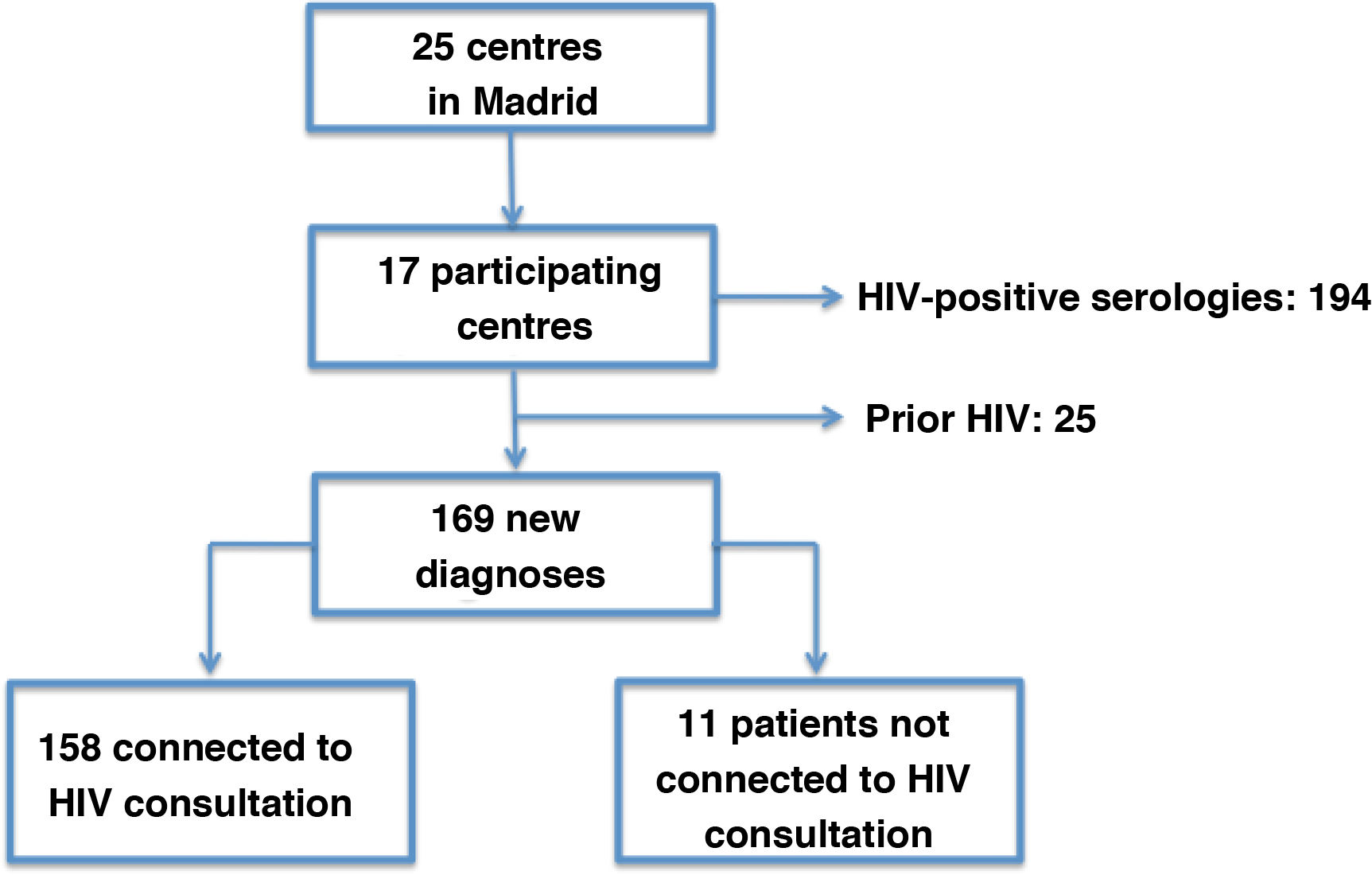
A total of 169 patients were included. There were 122 (72.2%) migrants, 57 (32.5%) heterosexual, and injection drug use was the transmission route in 14 (8.3%) cases. Data reported for the general population were 49.8%, 25.7%, and 1.7%, respectively. Late diagnosis was found in 80 (47.3%) patients (reported figures by the Ministry, 48.7%). Compared to Spanish, migrant were more frequently women (13.1% vs. 6.4%), heterosexual (38.5% vs. 21.3%), and had worse immunological status [median CD4 count of 310 (IQR 132–457) vs. 444 (IQR 215−607)].

Conclusion

ED can play a key role in diagnosing a different patient profile that may not seek care at other healthcare levels.

Keywords:
Human immunodeficiency virus (HIV)
Emergency department
Early diagnosis
HIV infection
Resumen
Introducción

El programa Deja Tu Huella (DTH) publicó unas recomendaciones para el cribado de VIH en los servicios de urgencias hospitalario (SUH) cuando los pacientes presentaban ciertas condiciones. Se desconoce si el perfil de los pacientes diagnosticados en los SUH es similar a no a los generales comunicados por las autoridades sanitarias.

Método

Estudio retrospectivo que evalúa las características de pacientes diagnosticados de VIH en 17 SUH durante un período de un año. Se registraron datos demográficos (sexo al nacer, edad, país de nacimiento), conducta sexual y de riesgo, el diagnóstico en el SUH, el número de asistencia en urgencias en los 5 años anteriores, el tiempo desde la asistencia hasta la consulta específica de VIH y desde la atención hasta el inicio del tratamiento antirretroviral. Se recopiló información sobre el recuento de CD4 y carga viral.

Resultados

Se incluyeron 169 pacientes. Hubo 122(72,2%) pacientes migrantes, 57(32,5%) eran heterosexuales y la vía de trasmisión fue la inyección de drogas en 14(8,3%). Los datos para población general eran de 49,8%,25,7% y 1,7%, respectivamente. Presentaron un diagnóstico tardío 80(47,3%) pacientes, similar a lo comunicado previamente por el Ministerio (48,7%). Los pacientes migrantes, respecto a los nacidos en España, son con más frecuencia mujeres (13,1% vs 6,4%), heterosexuales (38,5% vs 21,3%) y tienen una peor situación inmunológica al diagnóstico [mediana de CD4 de 310 (RIC 132–457) vs 444 (RIC 215−607)].

Conclusión

Los SUH pueden ser claves para el diagnostico de un perfil distinto de paciente que puede no acudir a otro nivel asistencial.

Palabras clave:
Virus de la inmunodeficiencia humana (VIH)
Servicios de urgencias
Diagnóstico precoz
Infección por VIH

Article

These are the options to access the full texts of the publication Enfermedades Infecciosas y Microbiología Clínica (English Edition)
Member

Socio de la Sociedad Española de Enfermedades Infecciosas y Microbiología Clínica

Para acceder a la revista

Es necesario que lo haga desde la zona privada de la web de la SEIMC, clique aquí

Para realizar los cursos formativos

La actividad estará abierta para socios de la SEIMC. IMPORTANTE, recuerde que requiere registro previo gratuito. Empezar aquí


Subscriber
Subscriber

If you already have your login data, please click here .

If you have forgotten your password you can you can recover it by clicking here and selecting the option “I have forgotten my password”
Subscribe
Subscribe to

Enfermedades Infecciosas y Microbiología Clínica (English Edition)

Purchase
Purchase article

Purchasing article the PDF version will be downloaded

Purchase now
Contact
Phone for subscriptions and reporting of errors
From Monday to Friday from 9 a.m. to 6 p.m. (GMT + 1) except for the months of July and August which will be from 9 a.m. to 3 p.m.
Calls from Spain
932 415 960
Calls from outside Spain
+34 932 415 960
E-mail
Article options
Tools
Supplemental materials