




Classical surgery, also called analog surgery, is transmitted to us by our mentors, whose knowledge has been delegated from generation to generation throughout the history of surgery. Its main limitations are limited surgical precision and dependence on the surgeon’s skill to achieve surgical goals. So-called digital surgery incorporates the most advanced technology, with the aim of improving the results of all phases of the surgical process. Robotic platforms are currently considered to be one of the main drivers of the digital transformation of surgery. They bring considerable advances to the digitalization of surgery, including: higher quality visualization, more controlled and stable movements with elimination of tremor, minimized risk of errors, data integration throughout the patient’s surgical process, use of various systems for better surgical planning, application of virtual and augmented reality, telementoring, and artificial intelligence.
La cirugía clásica, llamada Cirugía Analógica, es aquella transmitida por nuestros mentores, cuyo conocimiento es delegado de generación en generación durante toda la historia de la cirugía. Sus principales limitaciones son una precisión quirúrgica limitada y la dependencia de la destreza del cirujano para la consecución de los objetivos quirúrgicos.
La llamada Cirugía Digital incorpora toda la tecnología más avanzada, con el objetivo de mejorar los resultados de todas las fases del proceso quirúrgico. Las plataformas robóticas se consideran actualmente como unos de los principales impulsores de la transformación digital de la cirugía. Aporta considerables avances en la digitalización de la cirugía, Visualización de mayor calidad, Movimientos más controlados y estables con eliminación de temblor, minimizando el riesgo de errores, Integración de todos los datos dentro del proceso quirúrgico del paciente, Uso de diferentes sistemas para una mejor planificación quirúrgica, Aplicación de la realidad virtual y aumentada, Telementoring o Inteligencia Artificial.
We are witnessing the dawn of one of the greatest revolutions in the history of surgery. Thanks to the advances in technology and implementation of robotic surgery, the so-called digital transformation of surgery has begun.
The digitalization of surgery will provide intraoperative navigation aided by imaging tests, assistance in the decision-making process, and even the automation of part or all of a surgical procedure. This digital transformation will not only impact patient care but also the teaching of our profession and the future development of our science.
Surgeons cannot remain on the sidelines of this revolution. We have the obligation to familiarize ourselves with artificial intelligence as well as data management and usage to be prepared to participate in future technological advances in surgery.
Digitalization of surgery can be defined as the process that includes the incorporation of digital technologies (eg: virtual, augmented or mixed reality; surgical simulation; telesurgery; or artificial intelligence) in the field of surgery to improve the precision, efficiency and results of surgical procedures.
Robotic surgery deserves special mention, as it has played a significant role in the digitalization of surgery in recent years. To understand the reasons why robotic surgery is currently a basic pillar in the digital transformation of surgery, we first need to understand what changes have led traditional analog surgery to become the current digital surgery.
Analog surgeryThis type of surgery is based on 2 fundamental concepts:
- •
Experience acquired during years of surgical practice. Classic surgical knowledge is based on the transmission of information from our mentors and on the experience acquired with the repetition of surgical procedures, at first as surgeons-in-training under supervision, and later independently.
- •
Skill of the surgeon. Surgeons depend largely on our manual skills; therefore, there is a great difference between one surgeon and another based on the skill that each possesses to perform certain manual procedures.
This type of surgery has different limitations:
- 1
Visualization: Visualization in classical analog surgery is mainly performed through magnifying lenses or surgical cameras, which offer limited, low-quality vision.
- 2
Human error: Due to its dependence on the manual skill of the surgeon, analog surgery presents a greater risk of human error, the probability of which increases in long and complex procedures.
- 3
Precision: Precision in analog surgery largely depends on the skill and coordination of the surgeon. The natural limitations of human hands associated with surgeon fatigue in long and complex procedures lead to decreased precision of movements.
- 4
Data integration: The acquisition, management and integration of data from medical records and medical images are not included in the analog surgical process, which greatly limits pre-, intra-, and post-operative decision making.
Digital surgery uses more advanced technology, such as surgical robots, which incorporate high-definition 3D visualization systems and other intraoperative surgical navigation tools, offering considerable advantages over analog surgery.
Robotic surgery is becoming the driving force for the expansion of digital surgery. The reasons why robotic platforms are a fundamental part of surgical digitalization are explained below:
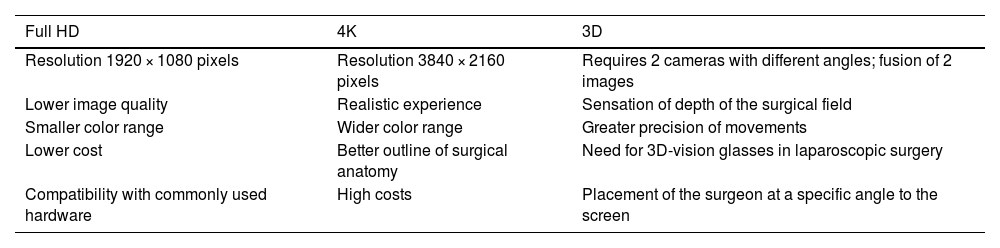
Improved visualizationDigital surgery provides a considerable improvement in surgical visualization, as the use of 4K and 3D images improves the surgeon’s ability to detect structures during surgical procedures, facilitating the performance of complex surgical techniques with more safety and better control1 (Table 1).
Characteristics of Full-HD, 4 K and 3D images.
| Full HD | 4K | 3D |
|---|---|---|
| Resolution 1920 × 1080 pixels | Resolution 3840 × 2160 pixels | Requires 2 cameras with different angles; fusion of 2 images |
| Lower image quality | Realistic experience | Sensation of depth of the surgical field |
| Smaller color range | Wider color range | Greater precision of movements |
| Lower cost | Better outline of surgical anatomy | Need for 3D-vision glasses in laparoscopic surgery |
| Compatibility with commonly used hardware | High costs | Placement of the surgeon at a specific angle to the screen |
Likewise, it is possible to enlarge and focus the image in real time without affecting image definition. All these improvements help surgeons identify and treat complex surgical situations with greater precision. This is a crucial aspect that has transformed the way surgeons perceive and perform surgical procedures.
In addition, the image stability provided by surgical robots makes it possible to eliminate unwanted movements of the surgeon’s hand, guaranteeing a clearer and more stable visualization during surgery.
Furthermore, the illumination in robotic systems can be flexibly adjusted to provide optimal illumination in the surgical field, which is critical for precise surgery.1
Fewer human errorsDigital surgery reduces reliance on the surgeon’s manual skill, lowering the risk of human error. The main reasons why digital surgery manages to reduce the probability of errors through robotic platforms are:
Control of movements and precision:2 Robotic surgery systems allow surgeons to perform extremely precise and controlled movements. This surgical precision is achieved in several ways:
Elimination of tremor: Robotic systems are designed to eliminate the natural tremor of human hands. Even the most skilled surgeon can have microtremors of the hands that affect precision in delicate procedures.
Controlled movements: Robotic arms are highly controllable and can move with millimeter precision. This is especially valuable in surgeries involving delicate or small anatomical structures, such as nerves or blood vessels.
Stability of repetitive movements: Robots can repeat movements with consistent precision, which is particularly beneficial in procedures that require the performance of repetitive tasks or precise suturing.
Reduction of fatigue: An important factor that directly affects the possibility of human error is surgeon fatigue during long procedures, a fact that is reduced significantly with robotic surgery. The surgeon is seated comfortably at the console during the procedure. This fact significantly improves the probability of errors during the different surgical steps.
Data integrationAll medical data is digitized within the same platform, so electronic health records and medical images are directly integrated into the surgical process in digital surgery, providing the surgeon access to said information at any time during the process, and from anywhere.3
The first step towards digitalization in surgery involves adopting the use of electronic medical records (EMR). This entails transferring health information from paper records to an electronic format, making it easier to access, search and share medical data relevant to the patient and the surgical procedure.
Electronic storage and management of all medical health data provides considerable advantages3:
- •
Faster and more efficient access: EMR allow healthcare professionals to access patients’ medical records quickly and efficiently.
- •
Fewer documentation errors: The digitization of medical information significantly reduces documentation errors. Unlike paper records, digital data is more readable and less prone to transcription errors.
- •
Interoperability: EMR systems allow data to be shared between different systems and health professionals. This is crucial for the coordination of care between surgeons, anesthesiologists, nurses, and other members of the surgical team.
- •
Complete medical history: EMR store the complete medical history of each patient, including information about previous visits, procedures performed, medications prescribed, and test results. This provides a comprehensive view of the patient’s health, which is valuable for making informed medical decisions. The availability of accurate medical data updated in real time facilitates clinical decision making during surgery. Surgeons can access relevant patient information and subsequently adapt their approach based on that information.
- •
Information security: EMR are designed with robust security measures to protect patient health information. This includes data encryption, controlled access and authentication, all of which ensure confidentiality of the information.
- •
Integration with surgical planning and navigation systems: EMR data can be integrated with surgical planning and navigation systems, helping surgeons plan and execute procedures more accurately.
- •
Auditing and monitoring: EMR facilitate the auditing and monitoring of healthcare. This is important to evaluate the quality of surgical procedures and ensure that best medical practices are followed.
During a surgical procedure, various types of data and records are generated to ensure accurate monitoring of surgery and patient care. These data are essential to document the procedure, evaluate patient safety, and optimize outcomes. Data are recorded and classified for patient-related variables, surgical variables (type of surgery performed, date and time of start and end of surgery, name of the primary surgeon, detailed description of the surgical procedure, etc), vital sign monitoring, anesthesia records, specific surgical data (quantity and type of tissue removed or repaired, specific medical devices or instruments used, record of unusual events or complications during surgery), with the aim to guarantee safe and high-quality surgical care.4
Surgical planningDigitalization in surgery also includes the use of surgical planning systems. Surgical planning systems are digital tools that allow surgeons to accurately plan surgical procedures before or during surgery. These systems use digital medical images, 3D models and specialized software tools to assist in surgical planning, navigation and execution.
Surgical planning systems enable critical anatomical structures to be identified through the analysis of medical images and the subsequent evaluation of the best surgical strategy. These systems allow surgeons to perform simulations of surgical procedures before actual surgery. This includes the simulation of movements and approaches to better plan the steps required to conduct the subsequent surgery. This is especially valuable in minimally invasive surgeries that must be navigated with precision.
In addition, with surgical planning, specific instruments and devices can be selected for use during surgery, allowing for meticulous preparation and ensuring that the appropriate resources are on hand.
Detailed 3D models of the patient’s anatomy can also be created, showing anatomical structures, organs, blood vessels, or tumors from computed tomography (CT) scans or magnetic resonance imaging (MRI). With these 3D models and specific software, it is possible to simulate the surgery to be performed by planning the sequence of surgical steps in a virtual environment prior to surgery.5 By enabling detailed planning and visualization of potential complications before surgery, these systems can help reduce risks during the actual procedure.5
Digitalized surgical planning also facilitates communication between members of the surgical team, who all have access to the surgical approach and planned steps during surgery, which improves interconnection between the members of the team.
After surgery, planning systems can be used to evaluate the accuracy and results of the procedure. This is useful for continuous improvement and to monitor quality.
Virtual, augmented and mixed realityAccording to the Royal Spanish Academy of Language, virtual reality (VR) is defined as: a representation of scenes or images of objects produced by a computer system, which gives the sensation of their real existence.
It is therefore an environment of real-looking scenes or objects, which results in a sensation of immersion for the user. It is a digital, simulated reality, created in such a way that VR applications immerse the user in an artificial environment, generated by a computer, that simulates reality using interactive devices, which send and receive information through the use of sensors and actuators. These interactive devices are usually called virtual reality glasses or helmets (HMD, Head-Mounted Display), although there may be others, such as headphones, gloves, or special suits, which foster the perception of different visual, auditory, or tactile sensory stimuli.6
There are 2 types of VR: immersive and non-immersive. The non-immersive version also uses a computer, but without the need for additional interactive devices. Much less expensive than the immersive variant, this approach is similar to navigation in 3D environments using a computer, manipulating the environment only with a keyboard and mouse or non-immersive peripherals. Non-immersive VR therefore allows for interaction with a virtual world, but without feeling inside it.
VR can be implemented according to different methods:7
- •
Use of simulators
- •
Use of avatars (characters in the digital sphere)
- •
Projection of real images (computer graphic design)
- •
3D computer modeling
- •
Immersion in virtual environments (brain-machine interfaces)
- •
VR does not modify reality, but instead creates a completely new reality. Through computer programming, virtual worlds and environments (simulations) are generated to create an alternative representation of reality with which one can interact.8
Augmented reality (AR) is based on a representation of reality displayed through a device that adds digital information. Tangible physical elements are thus combined with virtual elements, thereby creating an augmented reality in real time. It therefore complements the perception of the real world with overlays of digital information (still images, sound, video, data, 3D models, etc.), which are superimposed on reality (the perception of the physical world) in real time.9
In robotic surgery, AR has been used to improve the precision and efficiency of procedures by superimposing MRI or CT images over the real-time image of the surgical field, allowing for better visualization and orientation of the anatomical structures. Additionally, through the use of AR, anatomical landmarks or surgical markers can be highlighted in the surgeon’s field of vision to facilitate the identification of specific structures and ensure precise surgery.9
AR can display vital patient data during surgery, such as heart rate, blood pressure or blood oxygen levels, in the surgeon’s field of vision during surgery. This provides continuous monitoring without having to take your eyes off the surgical field.
In summary, AR during laparoscopic or robotic procedures improves the precision, safety and efficiency of these procedures, thereby reducing the risk of errors and complications (Table 2).
Difference between virtual and augmented reality.
| Virtual reality | Augmented reality | |
|---|---|---|
| Interaction between surgeon and real world | Low | High |
| Immersion of surgeon in the digital experience | HighTotal immersion of the surgeon in a parallel reality | ModerateDepends on the intensity of digital aspects in the real world |
| Cost | High | Depends on the level of digitalization in the real world |
| Ease of use | ComplexA completely new reality is created; more complicated to handle | Simple |
Mixed reality (MR), also called hybrid reality, is a combination of VR and AR, creating new spaces in which both real and virtual objects and/or people can interact. Through MR, the real world is transferred to the virtual world, generating a 3D model of reality with an overlay of virtual information, linking the 2 realities. In MR, the insertion of real-world elements in a virtual environment is achieved by registering the real object or person in real time, through a computerized interface.9
Surgical simulationThe digitalization of surgery involves the use of surgical simulation platforms, making it possible to simulate the process to be carried out before surgery. Some platforms even use CT or MRI images as a basis to simulate the steps of surgery in the patient’s own anatomy.
Telesurgery and telementoringRobotic surgery, as part of digital surgery, provides the possibility for so-called telesurgery, through which a surgeon located at a specific point can perform a surgical intervention remotely using robotic platforms that utilize said system.10
Through telesurgery, patients have access to highly specialized surgeons, without having to be physically present in their geographic area. This is especially valuable in cases of complex or unusual procedures, where the experience of a specialist is required.10
Telesurgery has been used in emergency situations, such as natural disasters or remote areas where advanced medical care is scarce.11 Surgical robots and communication technology allow surgeons to perform critical procedures remotely, in special emergency situations.
Telementoring, or remote guidance, involves establishing a relationship in which an expert (mentor) provides guidance to a less expert surgeon (mentee) from a remote location, allowing for real-time collaboration between surgeons who are in different locations.12
Telementoring is therefore used in the training process of surgeons and residents, making it possible to supervise and guide surgeons-in-training in real time, which improves the quality of medical education.
It is important to highlight that telesurgery also has various drawbacks that must be corrected, such as communication delays, data security, ethics, and legal considerations.
Artificial intelligence (AI) and machine learning in surgeryThe incorporation of artificial intelligence (AI) and machine learning in surgery has transformed the way surgical procedures are planned and executed. These technologies allow for real-time data collection and analysis, more accurate decision making, and improved patient safety.13,14
AI and machine learning provide real-time data analysis during surgery. AI algorithms can detect abnormal changes in data during surgery, which may indicate potential complications. For example, AI can alert the surgeon to unexpected bleeding or a drop in oxygen saturation.
In robotic surgery, AI algorithms can optimize the robot’s movements to ensure maximum precision and minimize patient recovery time.
AI can help reduce human errors by providing real-time alerts and reminders, improving patient safety during surgery, and potentially minimizing the risk of intra- and post-operative complications.
AI can personalize surgical treatment for each patient based on their medical history, current condition, and individual characteristics. This enables us to provide more precise care adapted to individual patient needs.13,14
Machine learning (ML) is a discipline within AI that, through algorithms, provides the robotic platform with the ability to identify patterns in massive amounts of data and make predictions. It plays a fundamental role in robotic surgery, resulting in significant improvements in the precision, efficiency and safety of surgical procedures.15
Applications of ML in robotic surgery16:
- •
Identify specific patterns in medical images that indicate the presence of lesions or tumors, facilitating their early diagnosis and treatment.
- •
Develop algorithms to more accurately detect intra-abdominal lesions and divide anatomical structures to locate tumors in solid organs based on CT or MRI images, which is very useful for surgical planning and intraoperative navigation.
- •
Analyze patient medical data (images, health records, etc), for optimal surgical planning that is personalized for each patient.
- •
Analyze movements of robotic instruments and tissue response in real time. This allows surgeons to adjust their movements and minimize the risk of injury.
- •
Eliminate involuntary tremor during surgical movements through algorithms, which improves surgical precision.
- •
Monitor the surgeon’s biometric signals, such as heart rate and eye movement, to detect signs of fatigue and stress. This can help prevent errors due to burnout.
- •
Develop ML-based haptic feedback systems that allow surgeons to feel the resistance and texture of tissues through robotic instruments.
- •
Evaluate postoperative data to help identify areas of pre- and intra-operative improvement.
Given the above, ML plays an integral role in robotic surgery by improving the precision, efficiency and safety of surgical procedures. The combination of artificial intelligence and robotics allows surgeons to perform more precise and personalized interventions that benefit both patients and healthcare professionals.
To summarize, robotic surgery is presented as the main driver of surgical digitalization with great potential for evolution, but currently we are at the beginning of the path towards achieving the total integration of the data of the entire pre-, intra- and post-operative process.
In open or laparoscopic surgery, the experience and skill of the surgeon are fundamental pillars for achieving set objectives. However, with the advent of robotic digital transformation, surgeons will become scientists who will be supported by the technology that the robotic digital platform provides, integrating all the information from each phase of the surgical procedure in order to minimize risks and complications during said process, without requiring extensive surgical experience or high manual dexterity.
In short, the robot will be the control center in which the patient’s ‘big’ data will be integrated (both data and images), and whose information can be analyzed automatically to help the surgeon make decisions at each stage of the surgical process.

