






To summarize the key findings of occupational exposures during aluminum production in cohort studies on bladder cancer published between 1979 and 2023.
Materials and methodsThis systematic review was conducted in accordance with PRISMA guidelines and registered in PROSPERO. Study quality was evaluated using the Newcastle–Ottawa scale.
ResultsThe literature search identified 24 cohort studies examining the standardized incidence (SIR) and mortality ratios (SMR) of bladder cancer among aluminum production workers. Five of the 13 studies examined SIR (95% CI) and three of the 16 studies that examined SMR (95% CI) reported a statistically significant increased risk of bladder cancer among aluminum production workers. The highest SIR was recorded in the secondary aluminum smelter (2.85; 95% CI: 1.23–5.62), suggesting a significantly elevated risk. In aluminum reduction plants, the SIR was 1.82 (95% CI: 1.59–2.07), while in Söderberg plants, it was 1.69 (95% CI: 1.06–2.57) and 1.4 (95% CI: 1.0–1.9), respectively. For aluminum plants overall, the SIR was 1.30 (95% CI: 1.10–1.50). The results indicate an increased risk, with the highest SMR of 5.90 (95% CI: 1.58–15.1), suggesting a significantly elevated hazard in the secondary aluminum smelter. The other values—3.47 (95% CI: 1.25–9.62) for the aluminum smelter and 2.24 (95% CI: 1.77–2.79) for the aluminum reduction plant—also indicate an increased risk, albeit with varying degrees of statistical certainty.
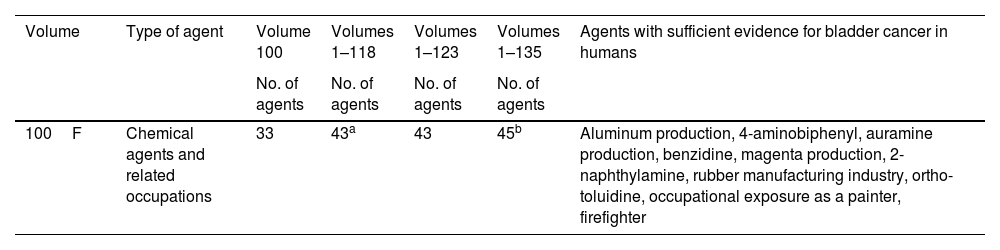
ConclusionThe International Agency for Research on Cancer has classified aluminum production as a Group 1 carcinogenic activity, providing strong evidence of its association with bladder cancer. The studies primarily included workers from Prebake, Söderberg, and aluminum reduction plants. Some findings indicate a significant yet variable risk across different segments of aluminum production. However, the review did not clearly confirm an increased risk of bladder cancer in specific aluminum-related occupations. Aluminum exposure may influence the lifetime risk of bladder cancer among these workers.
Resumir los principales hallazgos sobre la exposición ocupacional durante la producción de aluminio en estudios de cohortes sobre cáncer de vejiga publicados entre 1979 y 2023.
Materiales y métodosEsta revisión sistemática se realizó de acuerdo con las directrices PRISMA y se registró en PROSPERO. La calidad de los estudios se evaluó mediante la escala de Newcastle-Ottawa.
ResultadosLa búsqueda bibliográfica identificó 24 estudios de cohortes que analizaron la razón de incidencia estandarizada (RIE) y la razón de mortalidad estandarizada (RME) del cáncer de vejiga en trabajadores de la industria del aluminio. De los 13 estudios que evaluaron la RIE (IC del 95%), cinco informaron un aumento estadísticamente significativo del riesgo de cáncer de vejiga. Asimismo, tres de los 16 estudios que analizaron la RME (IC del 95%) reportaron un incremento significativo del riesgo. La RIE más elevada se observó en la fundición secundaria de aluminio, con un valor de 2,85 (IC del 95%: 1,23-5,62), lo que indica un riesgo significativamente incrementado. En las plantas de reducción de aluminio, la RIE fue de 1,82 (IC del 95%: 1,59-2,07); en las plantas de Söderberg, los valores fueron de 1,69 (IC del 95%: 1,06-2,57) y 1,4 (IC del 95%: 1,0-1,9), respectivamente. Considerando el conjunto de las plantas de aluminio, la RIE global fue de 1,30 (IC del 95%: 1,10-1,50). Estos hallazgos reflejan un aumento del riesgo, siendo la RME más elevada de 5,90 (IC del 95%: 1,58-15,1) en la fundición secundaria de aluminio, lo que sugiere una peligrosidad considerablemente elevada. Otros valores destacados fueron una RME de 3,47 (IC del 95%: 1,25-9,62) para la fundición de aluminio y de 2,24 (IC del 95%: 1,77-2,79) para la planta de reducción de aluminio, lo que también indica un mayor riesgo, aunque con distintos niveles de certeza estadística.
ConclusionesLa Agencia Internacional para la Investigación sobre el Cáncer ha clasificado la producción de aluminio como actividad cancerígena del Grupo 1, lo que aporta pruebas sólidas de su asociación con el cáncer de vejiga. Los estudios incluyeron principalmente a trabajadores de prehorneado, Söderberg y plantas de reducción de aluminio. Algunos hallazgos indican un riesgo significativo aunque variable en los distintos segmentos de la producción de aluminio. Sin embargo, la revisión no confirmó claramente un mayor riesgo de cáncer de vejiga en ocupaciones específicas relacionadas con el aluminio. La exposición al aluminio puede influir en el riesgo de cáncer de vejiga a lo largo de la vida entre estos trabajadores.

